wayground logo

Free Printable Worksheets

Font size

S
M
L
XL
Worksheets

Final physics revision. For final exam

Total questions: 175

Worksheet time: 10hrs 5mins

Name
Class
Date
1.

A textbook is dropped from a second floor window and falls to the ground. What happens to the velocity as the book falls to the ground

a)

the velocity increases

b)

the velocity decreases

c)

the velocity remain constant

2.

A textbook is dropped from a second floor window and falls to the ground. What happens to the acceleration as the book falls to the ground

a)

the acceleration increases

b)

the acceleration decreases

c)

the acceleration remains constant

3.

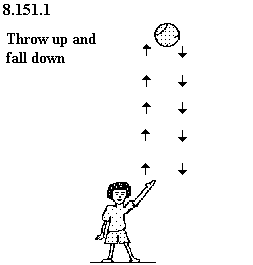
A baseball is thrown up into the air. What happens to the velocity as the ball rises in the air?

a)

the velocity increases

b)

the velocity decreases

c)

the velocity remains constant

4.

A baseball is thrown up into the air. What happens to the acceleration as the ball rises in the air?

a)

the acceleration increases

b)

the acceleration decreases

c)

the acceleration remains constant

5.

A baseball is thrown up into the air. What direction is the velocity of the ball?

a)

upward

b)

downward

6.

A baseball is thrown up into the air. What direction is the acceleration of the ball?

a)

upward

b)

downward

7.

A ball is thrown upward with an initial speed of 30m/s. At what location will the ball be moving upward with a speed of 20m/s

a)

A

b)

B

c)

E

d)

F

8.

What is the acceleration of a ball that is dropped off the side of a cliff after 1,2,3,4,5 seconds? (assume g is rounded to 10 m/s2)

a)

5,10,15, 20, 25 m/s2

b)

10, 20, 30, 40, 50 m/s2

c)

5, 20, 45, 80, 125 m/s2

d)

10,10,10,10,10 m/s2

9.

In the free fall equation d=12at2d=\frac{1}{2}at^2  , the d represents __________ with units __________.

a)

dollar, $

b)

distance (height), inches (in)

c)

density, g/ml

d)

distance, meters (m)

10.

If given the following problem: A package is dropped from the height of 122.5 m and falls freely. How long will it take to reach the ground? 

Which formula will help you answer the question?

a)

s=dts=\frac{d}{t}  

b)

v=atv=at  

c)

t=2dat=\sqrt{\frac{2d}{a}}  

d)

d=12at2d=\frac{1}{2}at^2  

11.

A pumpkin is dropped from a 35 m building. What is its initial velocity?

a)

9.8 m/s2

b)

35 m

c)

0 m/s

d)

9.8 m/s

12.

A ball is thrown upward in the air with an initial velocity of 40 m/s. How long does it take to reach the top of its path?

a)

~4 seconds

b)

~2 seconds

c)

~6 seconds

d)

~8 seconds

13.

A freely falling object starts from rest. After falling for 6 seconds, it will have a speed of about

a)

6 m/s

b)

30 m/s

c)

60 m/s

d)

300 m/s

14.
A ball is thrown upwards and caught when it comes back down. In the absence of air resistance, the speed of the ball when caught would be 
a)
less than the speed it had when thrown upwards.
b)
more than the speed it had when thrown upwards.
c)
the same as the speed it had when thrown upwards.
15.

What is terminal velocity?

a)

The speed an object dies at.

b)

The highest velocity an object reaches because air resistance equals (offsets) the force of weight.

c)

When an object reaches its final velocity of zero

d)

The velocity of an object after falling 10 seconds.

16.

What is the acceleration of an object traveling upward during "free fall"?

a)

+9.8 m/s2

b)

-9.8 m/s2

c)

9.8 m/s

d)

-9.8 m/s

17.

How far does an object fall in 3 seconds when dropped?

a)

44 m

b)

10 m

c)

3 m

d)

29 m

18.

How high does a ball travel when thrown upwards at 40 m/s?

a)

40 m

b)

82 m

c)

4 m

d)

1600 m

19.
Given the magnitude & direction of the resultant, find the horizontal & vertical components.
a)
Horizontal 63.9
 Vertical 44.7
b)
Horizontal 7.3
 Vertical 34.2
c)
Horizontal -63.9
 Vertical 44.7
d)
Horizontal -7.3
 Vertical 34.2
20.
Force
a)
Vector
b)
Scalar
21.
A quantity that has both magnitude and direction is called a scalar quantity.
a)
True
b)
False
22.

17 m/s, East

a)

Vector

b)

Scalar

23.

10 mph

a)

scalar

b)

vector

24.
If a car moves 12 km North, 19 km East, and 12 km South, what is its displacement?
a)
12 km
b)
19 km, East
c)
31 km
d)
43 km, East
25.
Which of the following quantities are vectors?
a)
speed, velocity, acceleration
b)
velocity, acceleration, force
c)
force, acceleration, mass
d)
length, mass, time
26.

You slowly walked 10 km West and then quickly ran 10 km North. During each part of the journey, the ______________ was the same.

a)

displacement

b)

distance

c)

time

d)

velocity

27.
What is the total displacement of the object represented in this motion graph?
a)
0 meters
b)
20 meters
c)
30 meters
d)
60 meters
28.
If vectors X and Y are added, then the resultant would be best represented by vector _____. 
a)
A
b)
B
c)
C
d)
D
29.
How do you combine vectors if they are in opposite directions?
a)
Add
b)
Subtract
c)
Pythagorean Theorem
d)
Use trigonometry
30.

The change in velocity in a given time period is?

a)

initial velocity

b)

final velocity

c)

acceleration

d)

displacement

31.
When an object falls in physics world, what happens?
a)
It accelerates at a constant rate until it hits the ground
b)
It accelerates at a non-constant rate until it hits the ground
c)
It accelerates at a constant rate until it reaches terminal velocity
d)
It accelerates at a non-constant rate until it reaches terminal velocity
32.

Which would hit the ground first if dropped from the same height in a vacuum—a feather or a metal bolt?

a)

the feather

b)

the metal bolt

c)

They would hit the ground at the same time.

d)

They would be suspended (floating) in a vacuum.

33.
If a freely falling object were somehow equipped with a speedometer, its speed reading would increase each second by 
a)
about 5 m/s.
b)
about 10 m/s.
c)
about 15 m/s.
d)
a rate that depends on its initial speed.
34.
Which statement describes a vector?
a)
It has magnitude but no direction
b)
It has direction but no magnitude
c)
It has both direction and magnitude
d)
It has constant magnitude but no
 direction
35.
A car travels 90 meters due north in 15 seconds. Then the car turns around and travels 40 meters due south.  What is the magnitude and direction  of the car's resultant displacement?  
a)
40 metres, South
b)
50 metres, South
c)
50 metres, North
d)
40 metres, North 
36.
If a boomerang is thrown 20 m in a straight line and returns exactly to the spot it was thrown what is its displacement?
a)
20m
b)
40m
c)
0m
d)
-20m
37.

A ball rolls off a table and strikes the floor, as shown. If the time the ball spent in the air was 0.58 s, how fast did the ball leave the table?

a)

3.6 m/s

b)

1.2 m/s

c)

2.9 m/s

d)

0.99 m/s

38.

A ball rolls off a table top and strikes the floor as shown. Given the measurements made, the time the projectile spent in the air is ---.

a)

17 s

b)

0.34 s

c)

0.58 s

d)

0.49 s

39.
What two measurements are necessary for calculating speed?
a)
Mass and time
b)
Temperature and mass
c)
Mass and distance
d)
Distance and time
40.
What is the speed of an object that travels 60 meters in 4 seconds?
a)
240 m/s
b)
15 m/s
c)
0.067 m/s
d)
15 mph
41.
A measurement of how fast an object is moving
a)
Velocity
b)
Speed
c)
Vector
d)
Acceleration
42.
Can be measured in seconds (s)
a)
Distance
b)
Time
c)
Speed
d)
Acceleration
43.

Total distance divided by total time, for an object shows:

a)

acceleration

b)

the size of one's toupee

c)

absolute speed

d)

average speed

44.
You walk 10 meters to math class in 20 seconds. Your average speed is
a)
2 m/s
b)
0.5 m/s
c)
200 m/s
d)
5 m/s
45.

How long will it take to go 150,000 m traveling at 50 km/hr?

a)

3000 hours

b)

3000 sec

c)

3 hours

d)

3 sec

46.
Acceleration of an object happens when things ________
a)
slow down
b)
go faster
c)
change direction (turn)
d)
All of the above
47.
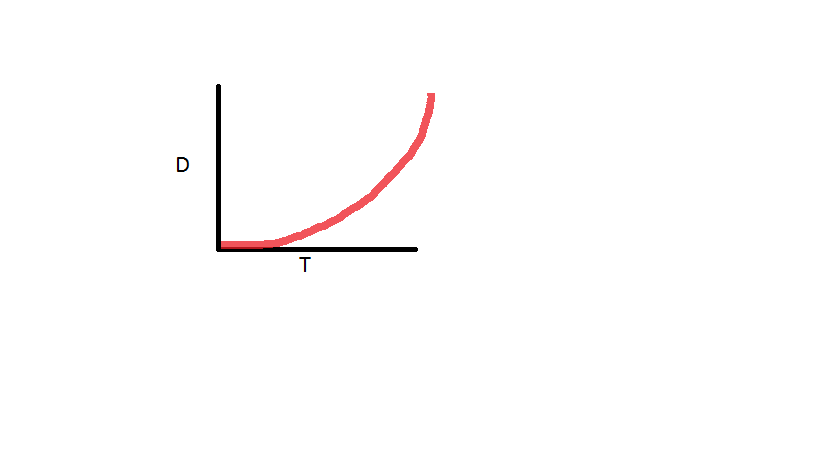
In the distance vs. time graph, what type of motion does the line represent? 
a)
Speed
b)
Velocity
c)
Acceleration
d)
Deceleration
48.
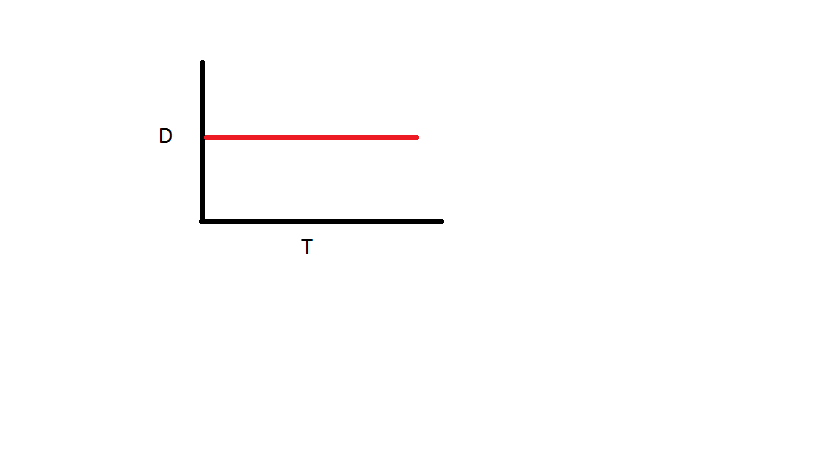
In the distance vs. time graph, what type of motion does the line represent?
a)
No motion
b)
Constant velocity
c)
Acceleration
d)
Deceleration
49.
What is the object doing from 10-12.5 seconds?
a)
Slowing down 
b)
Returning to the starting position
c)
Speeding up
d)
Not moving
50.
Which time section is the object moving the fastest?
a)
0-10 seconds
b)
10-20 seconds
c)
20-30 seconds
d)
30-40 seconds
51.
What kind of acceleration is shown here?
a)
positive
b)
negative
c)
none
d)
varies
52.
A golf ball accelerates off a tee at 15m/s2, changing its velocity from 0m/s to 50 m/s down the fairway. How long did it take the golf ball to accelerate?
a)
750 seconds
b)
35 seconds
c)
0.3 seconds
d)
3.3 seconds
53.
A box sliding down an inclined plane attains a velocity of 27 m/s in 3 seconds from rest.  Find the acceleration.
a)
30 m/s
b)
24 m/s2
c)
9 m/s2
d)
81 km/hr
54.
A dog runs with an initial speed of 7.5 m/s on a waxed floor.  It slides to a stop in 15 seconds.  What is the acceleration?
a)
-7.5 m/s
b)
-7.5 m/s2
c)
-0.5 m/s2
d)
7.5 mi//hr
55.
A car starts from rest at a stop light and reaches 20 m/s in 3.5 s. Determine the acceleration of the car.
a)
2.2m/s2
b)
7.0m/s2
c)
5.7m/s2
d)
70m/s2
56.

Work is done ___________

a)

only when force is applied

on an object

cause the object to move

into the opposite direction

as applied force.

b)

only when force is applied

on an object

cause the object to move

into the same direction

as applied force.
57.
What is the formula to calculate speed?
a)
Speed = time/distance
b)
Speed = distance/time
c)
Speed = distance x time
d)
Speed = time x distance
58.
Which of the following is a unit for acceleration?
a)
km/s
b)
m/s2
c)
mi/hr
d)
ft
59.
Can be measured in meters per second (m/s)
a)
Distance
b)
Time
c)
Speed
d)
Acceleration
60.
What is velocity?
a)
the quickness of an object
b)
the location of an object
c)
acceleration
d)
speed in a specific direction
61.
When a car goes around a corner at 20 mph, why do we say it  accelerates?
a)
The car is accelerating because of the velocity is constant
b)
The car accelerates because it's going 20 mph
c)
Cars always accelerate when they are in motion
d)
The car is accelerating because it's changing direction
62.
A value that only has magnitude (a number)
a)
Scalar
b)
Vector
c)
Speed
d)
Velocity
63.
A dog runs with an initial speed of 7.5 m/s on a waxed floor.  It slides to a stop in 15 seconds.  What is the acceleration?
a)
-7.5 m/s
b)
-7.5 m/s2
c)
-0.5 m/s2
d)
7.5 mi//hr
64.
A car starts from rest at a stop light and reaches 20 m/s in 3.5 s. Determine the acceleration of the car.
a)
2.2m/s2
b)
7.0m/s2
c)
5.7m/s2
d)
70m/s2
65.
Acceleration is defined as the CHANGE in 
a)
time it takes for one place to move to another place. 
b)
velocity of an object.
c)
distance divided by the time interval 
d)
velocity divided by the time interval 
66.
Why does a car accelerate as it round a corner at a constant speed?
a)
Its direction changes
b)
It doesn't
c)
It slows down
d)
Its speeds up  
67.
Acceleration only takes place when things speed up. 
a)
True
b)
False
68.
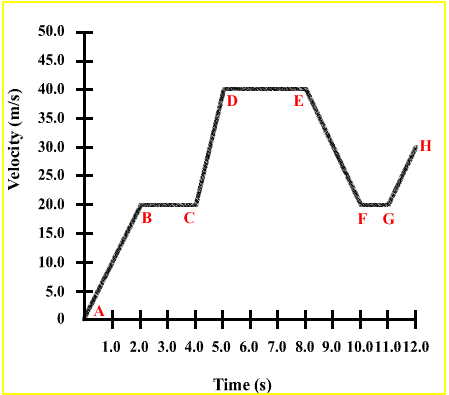
Which section of the graph shows acceleration?
a)
AB
b)
BC
c)
EF
d)
FG
69.
What happened during C to D point?
a)
not moving
b)
increasing speed at a constant rate
c)
moving at a constant speed
d)
moving at 0 m/sacceleration
70.
When are you undergoing an acceleration in a car? 
a)
speed up
b)
slow down
c)
make turns
d)
All of the above 
71.
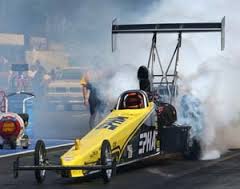
A drag racer accelerated from 0 m/s to 200 m/s in 5 s.  What was the acceleration?
a)
0 m/s
b)
40 m/s2
c)
-40 m/s2
d)
40 m/s
72.
Voltage is measured in __.
a)
volts.
b)
watts.
c)
coulombs. 
73.

what is heat ?

a)

A form of energy

b)

A form of light

c)

A measure of how old or cold something is

74.

What is temperature ?

a)

A form of heat

b)

Something to measure how hot or cold something is

c)

A measure of how old or cold something is

75.

Which is NOT a source of heat ?

a)

The sun

b)

Iron

c)

oven

d)

pot

76.

what happens during heat gain?

a)

The object will expand

b)

The object will contract

77.

What happens during heat loss?

a)

The object will Expand

b)

The object will contract

78.

A cold spoon is placed inside a cup of hot milk . which of the following is true?

a)

Heat flows from spoon to the tea

b)

temperature flows from flows from the spoon to the tea

c)

Heat flows flows from the tea to the spoon

79.

What is temperature scales that is used to measure temperature?

a)

Grams

b)

meter

c)

celsius

80.

Which of the following materials is a poor conductor of heat ?

a)

metal

b)

rubber

c)

glass

d)

rubber

81.

What is conductor ?

a)

A tool for measuring temperature

b)

A material that turns cold when heated

c)

A material that allows heat flow through it easily

82.

An example of scalar magnitude is _____.

a)

velocity

b)

mass

c)

acceleration

d)

force

83.

Which statement describes a scalar?

a)
It has magnitude but no direction
b)
It has direction but no magnitude
c)
It has both direction and magnitude
d)
It has constant magnitude but no
 direction
84.
Find the distance Sara walks from A to B,  B to C then C to D?
a)
11m
b)
3m
c)
5m
d)

8m

85.

Distance and direction of an object's change in position from a starting point is called _____.

a)
displacement
b)
distance
c)
motion
d)
reference point
86.

Speed in a specific direction is called _____.

a)

velocity

b)

motion

c)

position

d)

displacement

87.

Is this a scalar quantity or a vector quantity?

A deer running 15 meters per second due west.

a)
Scalar
b)
Vector
88.

Is this a scalar quantity or a vector quantity?

Wind blowing at 20 m/s.

a)
Scalar
b)
Vector
89.
The _______ of two or more vectors is the sum of the vectors.
a)
components
b)
scalar
c)
resultant
d)
magnitude
90.
Which of the following quantities are vectors?
a)
speed, velocity, acceleration
b)
velocity, acceleration, force
c)
force, acceleration, mass
d)
length, mass, time
91.
Which of these is not a vector quantity? 
a)
displacement 
b)
time
c)
velocity 
d)
acceleration
92.
Which statement describes a vector?
a)
It has magnitude but no direction
b)
It has direction but no magnitude
c)
It has both direction and magnitude
d)
It has constant magnitude but no
 direction
93.
Which of the following could never be negative?
a)
a distance
b)
a velocity
c)
a displacement
d)
a vector
94.

The students are arguing over the differences between speed and velocity. One student says, “Speed is a vector because it describes how fast an object traveling. Velocity is a scalar because it tells how fast and what direction an object is traveling.” Which of the following statements is correct?

a)

The students' understanding of all four terms (speed, velocity, scalar, and vector) is correct.

b)

The students' understanding of all four terms (speed, velocity, scalar, and vector) is incorrect.

c)

The students' understanding of speed and velocity is incorrect but their

understanding of scalar and vector is correct.

d)

The students’ understanding of speed and velocity is correct but their understanding of scalar and vector is incorrect.

95.

How do scalars and vectors differ?

a)

scalers have units

b)

scalers have direction

c)

vectors have units

d)

vectors have direction

96.

7. For winter, a duck flies 10 m/s due to south against a gust of wind with a speed 2.5 m/s. What is the resultant velocity of the duck?

a)

7.5 m/s, north

b)

12.5 m/s, south

c)

7.5 m/s, south

d)

12.5 m/s, north

97.

What is the resultant force?

a)

40 N left

b)

0 N Balalnced

c)

400 N right

d)

40 N right

98.
How will this object move? 
a)
It won't move. 
b)
It will move to the right. 
c)
It will move to the left. 
d)
It will move in both directions. 
99.

What is the resultant/ net force?

a)

400 N Up

b)

400 N Down

c)

- 400 N Down

d)

800 N Down

100.

What is the resultant force?

a)

17 N, Left

b)

6N, Right

c)

None of the above

d)

11N, Left

101.
What is the net force?
a)
5.5 N left
b)
5.5 N right
c)
2.5 N left
d)
2.5 N right
102.

___ refers to how fast an object is moving.

a)

Speed

b)

Velocity

c)

Acceleration

d)

Motion

103.

Which two factors does speed depend on?

a)

distance and direction

b)

direction and time

c)

distance and time

d)

distance, time and direction

104.

Which is an example of speed?

a)

A car driving 55 miles per hour south.

b)

A bicyclist traveling 10 meters per hour toward the next town.

c)

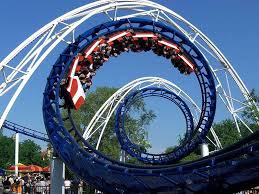
A roller coaster is traveling 10 meters per second.

d)

A rocket blasting off at 2,500 meters per second toward space.

105.

Which is an example of velocity?

a)

A car driving 55 miles per hour south.

b)

A bicyclist traveling 10 meters per hour.

c)

A roller coaster is traveling 10 meters per second.

d)

A rocket blasting off at 2,500 meters per second.

106.

Which is NOT an example of Acceleration?

a)

An object speeds up

b)

An object slows down

c)

An object changes direction

d)

An object is in constant motion.

107.

Speed or Velocity?:

A turtle is crawling 34 cm/min.

a)

Speed

b)

Velocity

c)

Neither

d)

Both

108.

Speed or Velocity?:

A train is travelling North 220 km/hr

a)

Speed

b)

Velocity

c)

Neither

d)

Both

109.

Acceleration is a speeding up, slowing down or a change in direction. Is the following acceleration and if so, which one?


A swimmer has 10 meters left in the race and he is neck-in-neck with his competitor. He has a surge of adrenaline and pulls ahead to win.

a)

Yes, this is acceleration since the swimmer starts to speed up to pull ahead.

b)

Yes, this is acceleration since the swimmer uses the wall to change directions.

c)

No, this is not acceleration since there is no speeding up, slowing down, or change in direction.

110.

Acceleration is a speeding up, slowing down or a change in direction. Is the following acceleration and if so, which one?


A dancer is warming up. She turns on music with a good beat and does 10 pirouettes in a row perfectly on the beat. (pirouette is a body spin in ballet)

a)

Yes, this is acceleration since the dancers is going a certain speed.

b)

Yes, this is acceleration since the dancer is changing direction when she spins.

c)

No, this is not acceleration since there is no speeding up, slowing down, or change in direction.

111.

True or False: You are standing at the bus stop and not moving at all. Since you are not moving, your acceleration would be 0 (zero). Support with how you know.

a)

True since you are not speeding up, slowing down or changing directions.

b)

True since you are traveling no distance in a certain amount of time.

c)

False since you are speeding up, slowing down and/or changing directions.

d)

False since you were going to get on a moving bus.
112.
Acceleration of an object happens when things ________
a)
slow down
b)
go faster
c)
change direction (turn)
d)
All of the above
113.
Velocity is both ____ and _____. 
a)
speed , direction 
b)
direction, mass
c)
volume, density 
d)
direction, magnitude 
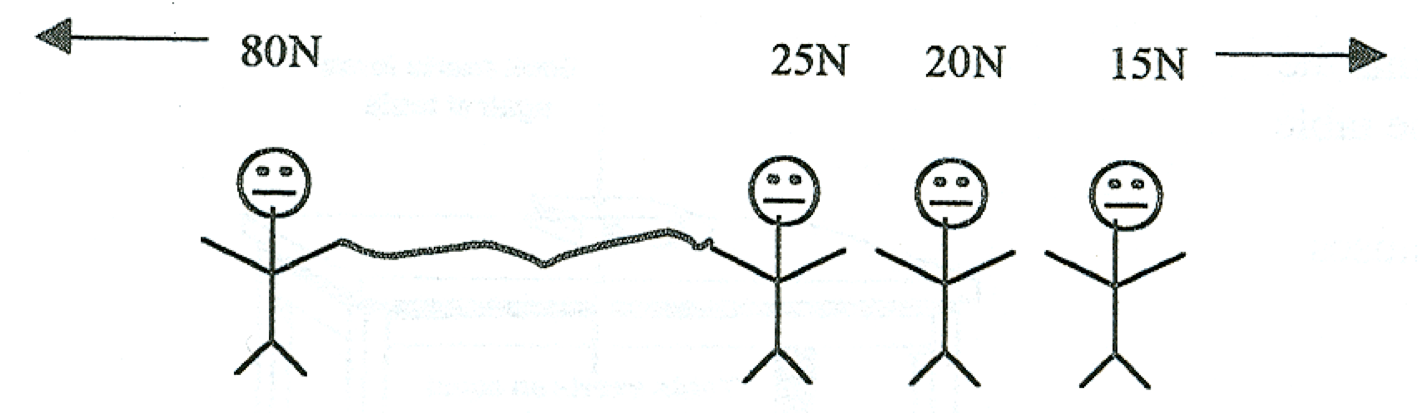
114.
Who wins the tug of war with what net force?
a)
The person on the left with 20 N
b)
The person on the left with 80 N
c)
The people on the right with 20 N
d)
The people on the right with 100 N
115.

What is the unit to MEASURE force?

a)

Kilogram

b)

Meter

c)

Pounds

d)

Newton

116.

A ____________ is a push or a pull on an object.

a)

friction

b)

force

c)

magnet

d)

gravity

117.
The sum of all forces acting on an object.
a)
Contact Force
b)
Balanced Force
c)
Unbalanced Force
d)
Net Force
118.
65 miles per hour North is an example of an objects what?
a)
Speed
b)
Velocity
c)
Average Speed
d)
Constant Speed
119.
An elevator traveled 15 floors (150 ft) at a speed of 4.5 m/s. What additional information is needed to determine the velocity of the elevator?
a)
the direction the elevator traveled
b)
how long the elevator was stationary
c)
how many times the elevator stopped
d)
the total distance the elevator traveled
120.

The subway car begins to slow down as it makes its way to the train station.

a)

Speed

b)

Velocity

c)

Acceleration

121.

Olympic runner, Usain Bolt is able to increase his speed faster than any runner in his heat.

a)

Speed

b)

Velocity

c)

Acceleration

122.
If a freely falling object were somehow equipped with a speedometer, its speed reading would increase each second by 
a)
about 5 m/s.
b)

about 9.8 m/s.

c)
about 15 m/s.
d)
a rate that depends on its initial speed.
123.
What is the velocity of a ball that has been dropped off a cliff after 1 , 2, 3, 4, and 5 seconds? (assume g is rounded to 10 m/s2)?. 
a)
10, 20, 30, 40, 50 m/s
b)
5, 10, 15, 20, 25 m/s
c)
5, 20, 45, 80,125 m
d)
10,10,10,10,10 m/s
124.

Free fall is any motion of a body where ____ is the only force acting upon it.

a)

body attraction

b)

tension

c)

gravity

d)

velocity

125.

Two rocks with different size and mass are dropped from the same height. Which of the rock will reach the ground first?

a)

greater rock

b)

smaller rock

c)

both reach the ground at the same time

126.

If an object is in free fall for three seconds, how fast will it be falling at the end of its motion?

vf= gt

a)

9.8 m/s

b)

19.6 m/s

c)

29.4 m/s

d)

39.2 m/s

127.
A pumpkin is dropped from a 35 m building. What is its initial velocity (vi)?
a)
9.8 m/s2
b)
35 m
c)
0 m/s
d)
9.8 m/s
128.
Dave runs a 400 m race with a speed of 4 m/s. What time will it take him to finish the race?
a)
400 minutes
b)
100 minutes
c)
100 seconds 
d)
.25 seconds 
129.

A unicyclist pedals 40 hours at 5 miles per hour without making any stops. How far does she get?

a)

200 miles

b)

8 miles

c)

35 miles

d)

45 miles

130.

An object falls from a high building. Ignoring air resistance, what will its velocity be after 6 seconds of falling?

vf=gt

a)

9.8 m/s

b)

58.8 m/s

c)

6 m/s

d)

8 m/s

131.

You drop your cell phone while in the bathroom in front of the mirror while the water is running in the sink below. If you are 0.45 meters above the sink, how long do you have before your cell phone is a gonner.

t=2dgt=\sqrt[]{\frac{2d}{g}}  

a)

0.09 s

b)

0.03 s

c)

0.3 s

d)

0.9 s

132.
A runner races in the 100 meter dash.  It takes her 10 seconds to finish.  What is her average speed?
a)
10 m/s
b)
1000 m/s
c)
100 seconds
d)
10 seconds
133.
Shona cycles at an average speed of 8km/h. How far has she travelled if she cycles for 4 hours?
a)
55km
b)
32km
c)
43km
d)
32miles
134.
Dave runs a 400 m race with a speed of 4 m/s. What time will it take him to finish the race?
a)
400 minutes
b)
100 minutes
c)
100 seconds 
d)
.25 seconds 
135.
Scott travels north 5 miles and then goes west 3 miles before coming straight back south 2 miles. What is his distance?
a)
10
b)
7
c)
8
d)
6
136.
David walks 3 km north, and then turns east and walks 4 km. What is the distance?
a)
7 km
b)
3 km
c)
4 km
d)
1 km
137.

An dog runs 35 m right then 45 m left in a total time of 20s. What was its velocity?

a)

+0.5 m/s

b)

-0.5 m/s

c)

+4 m/s

d)

-4 m/s

138.

An bug flies runs 3.5 m left then 4.5 m left in a total time of 20s. What was its speed?

a)

0.05 m/s

b)

+8 m/s

c)

15.75 m/s

d)

0.4 m/s

139.

Orande rides his bike 130 m North then 240 m South and finally 90 m North in a total time of 80 s. What was his velocity?

a)

-0.25 m/s

b)

-20 m/s

c)

23 m/s

d)

-46 m/s

140.
Which of the following is a unit for acceleration?
a)
km/s
b)
m/s2
c)
mi/hr
d)
ft
141.
When a car goes around a corner at 20 mph, why do we say it  accelerates?
a)
The car is accelerating because of the velocity is constant
b)
The car accelerates because it's going 20 mph
c)
Cars always accelerate when they are in motion
d)
The car is accelerating because it's changing direction
142.
A roller coasters accelerates from an initial velocity of 6.0 m/s to a final velocity of 70 m/s over 4 seconds.  What's the acceleration?
a)
24 m/s2
b)
18 m/s2
c)
16 m/s2
d)
16 m/s
143.
A drag racer accelerated from 0 m/s to 200 m/s in 5 s.  What was the acceleration?
a)
0 m/s
b)
40 m/s2
c)
-40 m/s2
d)
40 m/s
144.
A dog runs with an initial speed of 7.5 m/s on a waxed floor.  It slides to a stop in 15 seconds.  What is the acceleration?
a)
-7.5 m/s
b)
-7.5 m/s2
c)
-0.5 m/s2
d)
7.5 mi//hr
145.
Calculate the speed of a runner that ran 14 meters in 7 seconds.
a)
2 seconds
b)
2 m/s
c)
2 m/s2
d)
2 m
146.
What is the acceleration of a soccer ball that is kicked and in 2 seconds its velocity has changed from 8 m/s to 10 m/s.
a)
1  m/s
b)
1 m/s2
c)
2 m/s
d)
2 m/s2
147.
An airplane flies a speed of 680 km/h. How long will it take to travel a distance of 2040 km?
a)
2 hours
b)
1 hour
c)
5 hours
d)
3 hours
148.
Cindy drives a car at 108 km/h. How far can she drive in 3.5 hours?
a)
375 km
b)
385 km
c)
378 km
d)
400 km
149.
A minibus drives a constant speed of 40 km/h. How far can it travel in 3 hours?
a)
50 km
b)
100 km
c)
75 km
d)
120 km
150.
A car accelerates at a rate of 3.0 m/s2. If its original speed is 8.0 m/s, how many seconds will it take the car to reach a final speed of 25.0 m/s?
a)
7.5 s
b)
5.7 s
c)
6.0 s
d)
3.2 s
151.
What is the x component of the vector in the diagram?
a)
104N
b)
60N
c)
-104N
d)
95N
152.
What is the y component of the vector in the diagram?
a)
104N
b)
60N
c)
-104N
d)
95N
153.
In practice A of the figure, What is  the magnitude of the  resultant displacement?
a)
5 km 
b)
8 km
c)
11 km
d)
15 km
154.
Find the length of the missing side. 
a)
17 cm
b)
22 cm
c)
15 cm
d)
13 cm
155.

The sum of two or more vectors (450 N in this picture)

a)

Zero vector

b)

Parallel vectors

c)

Equivalent vectors

d)

Resultant

156.
Which side is adjacent to the 400 angle?
a)
AB
b)
AC
c)
BC
157.
Which side is adjacent to the 400 angle?
a)
AB
b)
AC
c)
BC
158.
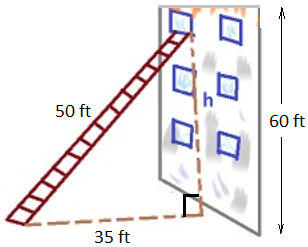
Find h
a)
35.60
b)
35.00
c)
35.71
d)
61.03
159.
solve for the value of y
a)
13
b)
5
c)
23
d)
10
160.
What is the height of the tree? Round the the nearest foot. 
a)
38 ft
b)
63 ft
c)
20 ft
d)
98 ft
161.
What is the value of d? Round to the nearest tenth of a meter. 
a)
18.9 m
b)
19.5 m
c)
47 m
d)
27.5 m
162.
Find the measure of the missing angle. Round to the nearest degree. 
a)
49o
b)
50o
c)
41o
d)
33o
163.
Find the length of side y. Round to the nearest hundredth. 
a)
22.32 cm
b)
36.5 cm
c)
76.34 cm
d)
87.76 cm
164.
What is the y component of the vector in the diagram?
a)
104N
b)
-60N
c)
60N
d)
95N
165.
What is the x component of the vector in the diagram?
a)
104N
b)
-60N
c)
60N
d)
95N
166.

A resultant vector is

a)

equal to the sum of one vector.

b)

equal to the sum of two or more vectors.

c)

equal to the difference of one vector.

167.

If two vectors to be added are at right angles, you will need to

a)

just add them together.

b)

use the Pythagorean theorem.

c)

use the Law of Cosines.

d)

subtract the smaller for the larger.

168.

Bob walks 2 miles north and turns west and walks 2 miles. What is Bob's displacement?

a)

4 miles northeast

b)

4 miles northeast

c)

3 miles northwest

d)

3 miles southeast

169.

What are the vector components?

a)

(2, 2)

b)

(3, 3)

c)

(3, 2)

d)

(2, 3)

170.

What are the vector components?

a)

(2, 2)

b)

(3, 3)

c)

(3, 2)

d)

(2, 3)

171.

Which vector has these components?

(2, 3)

a)
b)
c)
d)
172.

Which vector has these components?

(3, 2)

a)
b)
c)
d)
173.

Which vector has these components?

(3, 3)

a)
b)
c)
d)
174.

What are the vector components?

a)

(-2, -2)

b)

(-3, -3)

c)

(-3, -2)

d)

(-2, -3)

175.

Has magnitude and direction

a)

Scalar

b)

Vector

c)

Initial Point

d)

Terminal Point