
 Worksheets
AP Chemistry Full Unit 3 Review
Total questions: 181
Worksheet time: 5hrs 32mins
Which of the following substances contains both ionic and
covalent bonds?
NH3
CH4
NaOH
C2H5OH
What type of bonding is found within a water molecule?
ionic bonding
polar covalent bonding
nonpolar covalent bonding
hydrogen bonding
How many of the following molecules have a measurable dipole moment?
S03 CCl4 PF3 BH3
1
2
3
4
Which best describes the bonding in the cyanide ion (CN-)?
3 (sigma) bonds
2 (sigma) bonds and I (pi) bond
1 (sigma) bond and 2 (pi) bonds
3 (pi) bonds
Which bond is the most polar?
F-O
H-O
Na -O
Sn-O
Which of the following compounds would have the highest lattice energy?
LiF
MgCl2
CaBr2
C2H6
List ALL the Intermolecular forces that exist in PCl3
hydrogen bonding, london dispersion
london dispersion, hydrogen bonding, dipole dipole
london dispersion, dipole dipole
london dispersion
“More polarizable” refers to which Intermolecular Force?
hydrogen bonding
london dispersion
dipole dipole
What is an example of a covalent network solid?
Salt
Diamond
Sugar
Water
Name a property that decreases as Intermolecular Forces increase.
Vapor pressure
Conductivity
Melting point
Solubility
P and V are ___________________ related?
inversely
directly
The more molar mass a gas has, the_________________ it moves
faster
slower
Average Kinetic Energy is another term for _____________.
Heat
Temperature
Pressure
Activation energy
Real gases behave most like an ideal gas at what conditions of temperature and pressure?
High T, Low P
High P, Low T
High V, Low T
Name a property that increases as Intermolecular Forces increase.
Vapor pressure
Conductivity
Melting point
Solubility
When a molecular solid melts or boils, which bonds break?
Intermolecular
Intramolecular

What type of alloy is this?
Interstitial
Substitutional
What type of alloy is made when the radii of one element are similar in size with the other element making up the alloy?
interstitial
substitutional

The dashed line is a representation of a hydrogen bond.
True
False

The dotted line is a representation of a hydrogen bond.
True
False
Distillation separates mixtures based on differences in what property?
Solubility
Boiling Point
Particle Size
State of Matter
Chromatography separates mixtures based on what property?
particle size
intermolecular forces
boiling points
state of matter
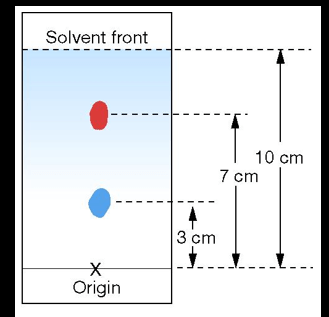
In paper chromatography, if water is the mobile phase, what kind of substance will move up the farthest?
polar substance
non polar substance
List the 4 Intermolecular forces from weakest to strongest
hydrogen bonding, ion-dipole, london dispersion, dipole dipole
london dispersion, hydrogen bonding, ion-dipole, dipole dipole
london dispersion, dipole dipole, hydrogen bonding, ion-dipole
dipole dipole, hydrogen bonding, ion-dipole, london dispersion
What type of solid will not conduct electricity until it is liquid or aqueous?
Ionic Solid
Covalent Network Solid
Molecular Solid
Metallic Solid
What type of solid always conducts electricity?
Ionic Solid
Metallic Solid
Covalent Network Solid
Molecular Solid
What causes gas pressure?
large space between the molecules
random motion of particles
collisions with the walls of the container
Gases generally have
low density
high density
closely packed particles
no increase in volume when temperature is increased
no decrease in volume when pressure is increased
Pressure is
defined as the mass that an object exerts when at rest
measured in Newtons
defined as the number of moles of substance divided by the mass of the substance
defined as the force per unit area
measured in grams
A gas sample is held at constant pressure. The gas occupies 3.62 L of volume when the temperature is 21.6°C. Determine the temperature at which the volume of the gas is 3.42 L.
312K
278K
20.4K
295K
552K
A balloon has a volume of 2.32 liters at 24.0°C. The balloon is heated to 48.0°C. Calculate the new volume of the balloon.
2.32L
2.51L
2.15L
4.64L
1.16L
You are holding four identical balloons each containing 10.0 g of a different gas. The balloon containing which gas is the largest balloon?
H2
He
Ne
O2
All have the same volume.
According to kinetic molecular theory, in which of the following gases will the root mean square speed of the molecules be the highest at 200ºC?
SF6
H2O
HCl
Cl2
None, the molecules of all gases have the same root mean square speed at any given temperature.
A sample of a gas (5.0 mol) at 1.0 atm is expanded at constant temperature from 10.0 L to 15.0 L. The final pressure is ___ atm.
1.5 atm
15 atm
0.67 atm
3.3 atm
7.5 atm
A sample of He gas (2.35 mol) occupies 57.9 L at 300.0 K and 1.00 atm. The volume of this sample is ___L at 423 K and 1.00 atm.
0.709 L
57.9 L
41.1 L
81.6 L
1.41 L
The density of N2O at 1.52 atm and 45.2ºC is ____ g/L.
0.388 g/L
2.58 g/L
9.99 g/L
1.76 g/L
18.2 g/L
The volume of a sample of gas (2.49 g) is 752 mL at 1.98 atm and 62ºC. What is the gas?
NO2
SO3
SO2
Ne
NH3
The pressure in a 12.2 L vessel that contains 2.34 g of carbon dioxide, 1.73 g of sulfur dioxide and 3.33 g of argon; all at 42ºC is ____ mmHg.
116 mmHg
395 mmHg
134 mmHg
263 mmHg
0.347 mmHg
According to kinetic molecular theory, in which of the following gases will the root mean square speed of the molecules be the highest at 200ºC?
SF6
H2O
HCl
Cl2
None, the molecules of all gases have the same root mean square speed at any given temperature.


Which substance has the weakest intermolecular forces?
Substance A, boiling point of 75 °C
Substance B, boiling point of 105 °C
Substance C, boiling point of 25 °C
Substance d, boiling point of 45 °C
Which substance would have the weakest intermolecular forces of attraction?
CH4
NaCl
H2O
MgF2

Which type of spectrum is this?
Emission Spectrum
Absorption Spectrum
Continuous Spectrum
Gases generally have
low density
high density
closely packed particles
no increase in volume when temperature is increased
no decrease in volume when pressure is increased
According to kinetic molecular theory, in which of the following gases will the root mean square speed of the molecules be the highest at 200ºC?
SF6
H2O
HCl
Cl2
None, the molecules of all gases have the same root mean square speed at any given temperature.
A sample of a gas (5.0 mol) at 1.0 atm is expanded at constant temperature from 10.0 L to 15.0 L. The final pressure is ___ atm.
1.5 atm
15 atm
0.67 atm
3.3 atm
7.5 atm
A sample of He gas (2.35 mol) occupies 57.9 L at 300.0 K and 1.00 atm. The volume of this sample is ___L at 423 K and 1.00 atm.
0.709 L
57.9 L
41.1 L
81.6 L
1.41 L
The volume of a sample of gas (2.49 g) is 752 mL at 1.98 atm and 62ºC. What is the gas?
NO2
SO3
SO2
Ne
NH3
How are pressure and temperature related?
Directly
Indirectly
They aren't related
A dissolved solute that does not form ions is
a nonelectroyte
a weak electrolyte
a strong electrolyte
insoluble
Which does not affect the rate at which a solid solute dissolves?
the vapor pressure of the solvent
the temperature of the solvent
the surface area of the solid
the speed at which the solution is stirred
Which of the following occurs as temperature increases?
solubility decreases
solubility increases
solubility remains the same
molarity doubles
At 333 K, which of the pairs of gases below would have the most nearly identical rates of effusion?
CO and CO2
CO and N2
NO2 and N2O4
N2O and NO2
N2 and O2
What is the pressure in a container that has 3 atm H2, 2 atm of N2 and 5 atm of F2?
2 atm
3 atm
5 atm
10 atm
The shape of a liquid's meniscus is determined by ____.
the viscosity of the liquid
the type of material the container is made of
the relative magnitudes of cohesive forces in the liquid and adhesive forces between the liquid and its container
the amount of hydrogen bonding in the liquid
Which type of solid typically has the lowest melting point of the four types of crystals?
Ionic
Molecular
Metallic
Covalent Network
Chromatography separates solutions on the basis of _____ while distillation separates solutions on the basis of ______.
IMFs; solubility
solubility; conductivity
IMFs; boiling point
boiling point; solubility
Which of the following will be the least soluble in water?
CH3CH2CH2OH
CH3OH
CH3CH2OH
None of them are soluble in water.
They are all equally soluble in water.
How can you increase the solubility of a gas in a liquid?
Decrease the IMFs between the gas the and the liquid.
Increase the temperature of the solution.
Increase the pressure of the solution.
All of these would work.
In general, how could you increase the solubility of a solid in a liquid?
Increase the pressure.
Decrease the pressure.
Increase the temperature.
Decrease the temperature.
A photon is a (a) of light
If the frequency of electromagnetic radiation is high, then the wavelength will be (a)
Which of the following is an assumption of the kinetic-molecular theory of gases?
Collisions between gas particles are inelastic.
Gases consist of closely spaced particles.
Gas particles move around in an orderly manner.
The temperature of a gas depends on the average kinetic energy of the gas particles.
A balloon has a volume of 2.32 liters at 24.0°C. The balloon is heated to 48.0°C. Calculate the new volume of the balloon.
2.32L
2.51L
2.15L
4.64L
1.16L
A sample of a gas (5.0 mol) at 1.0 atm is expanded at constant temperature from 10.0 L to 15.0 L. The final pressure is ___ atm.
1.5 atm
15 atm
0.67 atm
3.3 atm
7.5 atm
The pressure in a 12.2 L vessel that contains 2.34 g of carbon dioxide, 1.73 g of sulfur dioxide and 3.33 g of argon; all at 42ºC is ____ mmHg.
116 mmHg
395 mmHg
134 mmHg
263 mmHg
0.347 mmHg
Carbon dioxide, CO2, has the following bonding:
lattice of positive and negative ions held together by electrostatic forces
closely packed lattice with delocalized electrons throughout
strong single covalent bonds with weak intermolecular forces
strong multiple covalent bonds with weak intermolecular forces
Of the following molecules, which is the most polar?
CO
CO2
O2
HF
F2
Which of the following has the lowest melting point?
Zn
SiO2
CaCl2
C2H6
Which of the following probably has the highest solubility in hexane, C6H14?
Metals
Polar covalent molecules
Ionic compounds
Nonpolar covalent molecules
Copper (II) nitride, Cu3N2, has the following bonding:
ionic
metallic
nonpolar covalent
polar covalent
Ethane, C2H6, has the following bonding:
ionic
metallic
nonpolar covalent
polar covalent
Which of the following is most likely to be soluble in water?
NaF
C12H22O
Mn
Cl2
A dissolved solute that does not form ions is
a nonelectroyte
a weak electrolyte
a strong electrolyte
insoluble
List ALL the Intermolecular forces that exist in PCl3
hydrogen bonding, london dispersion
london dispersion, hydrogen bonding, dipole dipole
london dispersion, dipole dipole
london dispersion
“More polarizable” refers to which Intermolecular Force?
hydrogen bonding
london dispersion
dipole dipole
What is an example of a covalent network solid?
Salt
Diamond
Sugar
Water
P and V are ___________________ related?
inversely
directly
The more molar mass a gas has, the_________________ it moves
faster
slower
Real gases behave most like an ideal gas at what conditions of temperature and pressure?
High T, Low P
High P, Low T
High V, Low T
Name a property that increases as Intermolecular Forces increase.
Vapor pressure
Conductivity
Melting point
Solubility
The dashed line is a representation of a hydrogen bond.
True
False
Distillation separates mixtures based on differences in what property?
Solubility
Boiling Point
Particle Size
State of Matter
Chromatography separates mixtures based on what property?
particle size
intermolecular forces
boiling points
state of matter
In paper chromatography, if water is the mobile phase, what kind of substance will move up the farthest?
polar substance
non polar substance
List the 4 Intermolecular forces from weakest to strongest
hydrogen bonding, ion-dipole, london dispersion, dipole dipole
london dispersion, hydrogen bonding, ion-dipole, dipole dipole
london dispersion, dipole dipole, hydrogen bonding, ion-dipole
dipole dipole, hydrogen bonding, ion-dipole, london dispersion
What type of solid will not conduct electricity until it is liquid or aqueous?
Ionic Solid
Covalent Network Solid
Molecular Solid
Metallic Solid
Copper (II) nitride, Cu3N2, has the following bonding:
ionic
metallic
nonpolar covalent
polar covalent
Ethane, C2H6, has the following bonding:
ionic
metallic
nonpolar covalent
polar covalent
A gaseous mixture containing 7.0 moles of nitrogen, 2.5 moles of oxygen, and 0.5 moles of helium exerts a total pressure of 0.90 atmosphere. What is the partial pressure of the nitrogen?
0.13 atm
0.27 atm
0.63 atm
0.90 atm
Which of the following typically has the lowest melting point?
Metals
Covalent network solids
Ionic compounds
Molecular solids
Sodium chloride (NaCl) can dissolve in polar solvents such as H2O due to what intermolecular forces?
Ionic
Ion-Dipole
Hydrogen Bonding
Dipole-dipole
What types of intermolecular force present in hydrogen chloride (HCl)?
dipole dipole
london dispersion
hydrogen bonding
ion-dipole
What type of intermolecular force present in I2, Br2, and Cl2.
dipole dipole
hydrogen bonding
london dispersion
dipole induced dipole
Which of these typically increases when intermolecular forces increase?
Surface Tension
Melting Point
Viscosity
All of these
Which of the following has the highest melting point?
H2
NH3
CO2
MgCl2
Under which conditions does a real gas behave very much like an ideal gas?
high temperature and low pressure
high temperature and high pressure
low temperature and high pressure
low temperature and low pressure
According to kinetic molecular theory, in which of the following gases will the speed of the molecules be the highest at 200ºC?
SF6
H2O
HCl
Cl2
None, the molecules of all gases have the speed at any given temperature.
What best explains the difference in melting points between Cl2 (-101.5) and F2 (-219)?
Increased # of electrons and polarizability of chlorine
Increased electronegativity of fluorine
Increased molar mass in chlorine
Decrease metallic character of fluorine
Which of the following has the highest solubility in hexane, C6H14?
Metals
Polar covalent molecules
Ionic compounds
Nonpolar covalent molecules
A chromatography experiment uses water as a mobile phase. Which of the following would have the greatest affinity for the mobile phase?
C2H5OH
C2H6

A mixture of butane (C4H12) and octane (C8H18) is separated using distillation. Which will be collected first?
butane (C4H12)
octane (C8H18)

Which ionic compound (NaCl or MgS) will have a lower melting point and why?
MgS will have lower melting point because the strength of the attraction between its 2+ ions and 2− ions are stronger than those between the ions in NaCl.
NaCl will have a lower melting point because NaCl is a polar covalent compound whereas MgS is an ionic compound which has stronger attractive forces.
NaCl will a lower melting point because the strength of the attraction between its +1 ion and -1 ion are weaker than those between the +2/-2 ions in MgS.
Which statement best helps to explain the observation that NH3 boils at −28°C, whereas PH3 boils at −126°C?
The dispersion forces in NH3 are weaker than the dispersion forces in PH3.
The dispersion forces in NH3 are stronger than the dipole-dipole forces in PH3.
NH3 has hydrogen bonding which is stronger than the dipole-dipole forces in PH3.
A real gas has observable IMF at low temperatures. What will happen to the observed pressure compared to the ideal/predicted pressure?
The real pressure will be less than the ideal pressure
The real pressure will be more than the ideal pressure
The real pressure will be the same as the ideal pressure
Which of the following is an assumption of the kinetic-molecular theory of gases?
Collisions between gas particles are inelastic.
Gases consist of closely spaced particles.
Gas particles move around in an orderly manner.
The average kinetic energy of the gas particles depends on the kelvin temperature of the gas.
A sample of gas with a volume of 30.0 mL at 25.0oC is heated to 50.0oC. What is the new volume of the gas?
60.0 mL
15.0 mL
27.5 mL
32.5 mL

Which of the following explains how the dispersion-force model of intermolecular attraction does not account for the unusually high boiling point of HF?
F2 is soluble in water, whereas HF is insoluble in water.
The F2 molecule has a greater mass than the HF
HF molecule has.
Liquid F2 has weak dispersion force attractions between its molecules, whereas liquid has strong ionic interactions between H+ and F ions.
Liquid F2 has weak dispersion force attractions between its molecules, whereas liquid HF has both weak dispersion force attractions and hydrogen bonding interactions between its molecules.

Intermolecular forces between the gas molecules will cause them to condense into the liquid phase if the temperature is lowered. Which of the following best describes how the model is limited in its depiction of the phenomenon?
It does not show how hydrogen bonds are constantly forming, breaking, and reforming, which results in a net force of attraction between the molecules.
It does not show how the interactions between ions and the induced molecular dipoles result in a net force of attraction between the molecules.
It does not show how the interacting permanent dipoles of the molecules result in a net force of attraction between the molecules.
It does not show how the temporary fluctuating dipoles of the molecular electron clouds result in a net force of attraction between the molecules.

This form of boron nitride is one of the hardest substances known. Which of the following best helps explain why boron nitride is so hard?
Boron ions and nitrogen ions are held together by ionic bonds.
Boron nitride is a network solid of atoms connected by covalent bonds with fixed bond angles.
Boron nitride is an alloy, and alloys are typically harder than the elements used to make them.
Boron nitride is a polymer made of long chains of boron atoms and nitrogen atoms held together by dispersion forces.
Compounds NaCl MgS, which statement correctly identifies diagram 1 and identifies the compound with the lower melting point.
Diagram 1 represents MgS; it has a lower melting point than NaCl because the coulombic attractions between its doubly charged Mg 2+ ions and the S 2− ions are stronger than those between the ions in NaCl.
Diagram 1 represents NaCl ; it has a lower melting point than MgS has because the coulombic attractions between the singly charged Na+ ions and the Cl− ions in NaCl
NaCl are stronger than those between the ions in MgS.
Diagram 1 represents NaCl; it has a lower melting point than MgS because the coulombic attractions between its singly charged Na+ ions and the Cl− ions are weaker than those between the ions in MgS.
Which statement best helps to explain the observation that NH3(l) boils at −28°C, whereas PH3(l) boils at −126°C?
The dispersion forces in NH3 are weaker than the dispersion forces in PH3.
The dispersion forces in NH3 are stronger than the dipole-dipole forces in PH3.
NH3 has hydrogen bonding that is stronger than the dipole-dipole forces in PH3.
Of the following, the best explanation for the fact that most gases are easily compressed is that the molecules in a gas
are in constant motion
are relatively far apart
have relatively small masses
have a real, nonzero volume
A gas mixture at 0°C and 1.0atm contains 0.010mol
0.010mol of H2, 0.015mol of O2, and 0.025mol
0.025mol of N2. Assuming ideal behavior, what is the partial pressure of hydrogen gas (H2) in the mixture?
About 0.20atm 0.20atm, because H2 comprises 20%
20% of the total number of moles of gas.
About 0.050atm, because there is 0.050mol of gases at 0°C and 1.0atm.
About 0.010atm, because there is 0.010mol
0.010mol of H2 in the sample.
A 2 L container will hold about 4 g of which of the following gases at 0°C and 1 atm?
SO2
N2
CO2
C4H8
A sample of an ideal gas is cooled from 50.0oC to 25.0oC in a sealed container of constant volume. Which of the following values for the gas will decrease?
I. The average molecular mass of the gas
II. The average distance between the molecules
III. The average speed of the molecules
only I
only II
only III
I and III
A student uses visible spectrophotometry to determine the concentration of CoCl2(aq) in a sample solution. First the student prepares a set of CoCl2(aq) solutions of known concentration. Then the student uses a spectrophotometer to determine the absorbance of each of the standard solutions at a wavelength of 510nm and constructs a standard curve. Finally, the student determines the absorbance of the sample of unknown concentration.
The original solution used to make the solutions for the standard curve was prepared by dissolving 2.60g of
CoCl2 (molar mass 130.g/mol) in enough water to make 100.mL of solution. What is the molar concentration of the solution?
.200 M
.500 M
1.00 M
5.00 M

covalent bond
London forces
hydrogen bond
dipole-dipole attraction
Which of the following is an assumption of the kinetic-molecular theory of gases?
Collisions between gas particles are inelastic.
Gases consist of closely spaced particles.
Gas particles move around in an orderly manner.
The temperature of a gas depends on the average kinetic energy of the gas particles.
1. Under which conditions does a real gas behave very much like an ideal gas?
high temperature and low pressure
high temperature and high pressure
low temperature and high pressure
low temperature and low pressure
According to kinetic molecular theory, in which of the following gases will the root mean square speed of the molecules be the highest at 200ºC?
SF6
H2O
HCl
Cl2
None, the molecules of all gases have the same root mean square speed at any given temperature.
Which of the following has the lowest melting point?
Zn
SiO2
CaCl2
C2H6
Which of the following probably has the highest solubility in water?
Metals
Covalent network solids
Ionic compounds
Covalent molecules
Which of the following probably has the highest solubility in hexane, C6H14?
Metals
Polar covalent molecules
Ionic compounds
Nonpolar covalent molecules
The density of an unknown gas is 2.00 grams per Liter at 3.00 atmosphere pressure and 127oC. What is the molar mass of this gas?
(254/3) R
188 R
(800/3) R
600 R
A gaseous mixture containing 7.0 moles of nitrogen, 2.5 moles of oxygen, and 0.5 moles of helium exerts a total pressure of 0.90 atmosphere. What is the partial pressure of the nitrogen?
0.13 atm
0.27 atm
0.63 atm
0.90 atm
Chromatography separates solutions on the basis of _____ while distillation separates solutions on the basis of ______.
IMFs; solubility
solubility; conductivity
IMFs; boiling point
boiling point; solubility
Which of the following is an assumption of the kinetic-molecular theory of gases?
Collisions between gas particles are inelastic.
Gases consist of closely spaced particles.
Gas particles move around in an orderly manner.
The temperature of a gas depends on the average kinetic energy of the gas particles.
1. Under which conditions does a real gas behave very much like an ideal gas?
high temperature and low pressure
high temperature and high pressure
low temperature and high pressure
low temperature and low pressure
Which of the following has the lowest melting point?
Zn
SiO2
CaCl2
C2H6
Which of the following typically has the lowest melting point?
Metals
Covalent network solids
Ionic compounds
Covalent molecules
Which of the following probably has the highest solubility in water?
Metals
Covalent network solids
Ionic compounds
Covalent molecules
Ethane, C2H6, has the following bonding:
ionic
metallic
nonpolar covalent
polar covalent
Which of the following is most likely to be soluble in water?
NaF
C12H22O
Mn
Cl2
The density of an unknown gas is 2.00 grams per Liter at 3.00 atmosphere pressure and 127oC. What is the molar mass of this gas?
(254/3) R
188 R
(800/3) R
600 R
A gaseous mixture containing 7.0 moles of nitrogen, 2.5 moles of oxygen, and 0.5 moles of helium exerts a total pressure of 0.90 atmosphere. What is the partial pressure of the nitrogen?
0.13 atm
0.27 atm
0.63 atm
0.90 atm
Chromatography separates solutions on the basis of _____ while distillation separates solutions on the basis of ______.
IMFs; solubility
solubility; conductivity
IMFs; boiling point
boiling point; solubility

