wayground logo

Free Printable Worksheets

Font size

S
M
L
XL
Worksheets

system of particles

Total questions: 99

Worksheet time: 3hrs 37mins

Name
Class
Date
1.

Moment of inertia of a rod about an axis through the center is 600 gcm2. its mass is 30 g. The moment of inertia about another parallel axis at a distance of 5cm from its centre is

a)

1350 gcm2

b)

1150 gcm2

c)

1250 gcm2

d)

1475 gcm2

2.

The separation between carbon and oxygen atoms in CO is 1.2 A0A^0  . The distance of centre of mass from carbon atom is

a)

0.21 A0

b)

0.69 A0

c)

0.91 A0

d)

0.43 A0

3.

Four point masses of values as shown are connected by a thin massless rod as shown in the figure. The radius of gyration of the system about AB is

a)

2a\sqrt[]{2}a  

b)

3a\sqrt[]{3}a  

c)

2a

d)

5a\sqrt[]{5}a  

4.

A ring and a disc of the same radius have the same moment of inertia about an axis of rotation passing through their centers and perpendicular to their planes. The mass of the ring and disc are in the ratio

a)

0.5

b)

2

c)

12\sqrt[]{\frac{1}{2}}  

d)

2\sqrt[]{2}  

5.

Moment of inertia of a rod of length L, mass M about an axis perpendicular to its length and passing through its center is ML212\frac{ML^2}{12}  . The moment of inertia about a parallel axis through one end is

a)

ML24\frac{ML^2}{4}  

b)

ML22\frac{ML^2}{2}  

c)

2ML22ML^2  

d)

ML23\frac{ML^2}{3}  

6.

Dimensional formula of angular momentum is

a)

ML2T2ML^2T^2  

b)

ML2T2ML^2T^{-2}  

c)

ML2T1ML^2T^{-1}  

d)

ML1T2ML^{-1}T^2  

7.

The power required to maintain a rotor at a uniform speed is 300 rad s-1 to transmit a torque of 150Nm is

a)

50 kW

b)

60 kW

c)

45 kW

d)

2 kW

8.

A uniform disc of radius R rotates about an axis through its centre and perpendicular to its plane with angular velocity ω\omega  . A stationary disc of the same material and thickness but half the radius is placed on its axially. The final angular velocity of the system is

a)

4ω5\frac{4\omega}{5}  

b)

16ω17\frac{16\omega}{17}  

c)

ω2\frac{\omega}{2}  

d)

2ω3\frac{2\omega}{3}  

9.

A rigid massless rod is suspended horizontally by two wires A and B. The force in wire B is

a)

50N

b)

37.5N

c)

35N

d)

30N

10.

The ratio of rotational kinetic energy to total kinetic energy of a uniform rolling body of radius R and radius of gyration K is

a)

K2K2+R2\frac{K^2}{K^2+R^2}  

b)

K2(K2+R2)K^2\left(K^2+R^2\right)  

c)

K2+R2K2\frac{K^2+R^2}{K^2}  

d)

K2+R2K2K^2+\frac{R^2}{K^2}  

11.

A solid sphere of mass m and radius R is kept on smooth surface. A force F is applied on the sphere at a distance h from the ground, for maximum acceleration what is the value of h?

a)

h must be equal to R

b)

h must be equal to 2R

c)

h must be equal to 2R/5

d)

acceleration will be same for all value of h

12.


What is necessarily required for pure rolling? note:- this question may have multiple answers.

a)

Friction Surface

b)

Torque

c)

force or component of force parallel to surface

d)

all of the above

13.

two solid sphere A and B both of mass m and radius R are on plane surface, sphere A is rolling with translation velocity V and angular velocity ω and sphere B is at rest. Now sphere A collide with sphere B ( head on elastic collision),after collision translation and angular velocity of sphere A respectively are ( note:- all surface are smooth)

a)

V and ω

b)

V/2,ω/2

c)

0,0

d)

0,ω

14.
a)

1

b)

2

c)

3

d)

4

15.

note:- radius of the sphere is 12 m.

a)

4 m/s2

b)

5 m/s2

c)

160\sqrt[]{160}  m/s2

d)

16 m/s2

16.
a)

a

b)

b

c)

c

d)

d

17.
a)

1

b)

2

c)

3

d)

4

18.
a)

1

b)

2

c)

3

d)

4

19.

Where will be the centre of mass of a uniform rod lies ?

a)

At its end

b)

At its middle point

c)

At its centre of its cross sectional area

d)

Depends upon its material

20.

Where the center of mass of a circle lies?

a)

At its centre

b)

Anywhere on its radius

c)

Anywhere on its circumference

d)

Anywhere on its diameter

21.

The relation between linear velocity and angular velocity

a)

r = v⍵

b)

⍵ = vr

c)

v = r⍵

d)

a = v⍵

22.

The unit of angular velocity is

a)

m/s

b)

m/s²

c)

rad/s

d)

rad/s²

23.

A grindstone spinning at the rate of 8.3 rev/s has what approximate angular speed?

a)

3.2 rad/s

b)

26 rad/s

c)

52 rad/s

d)

81 rad/s

24.
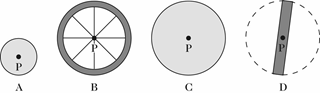
The figure shows scale drawings of four objects, each of the same mass and uniform thickness, with the mass distributed uniformly. Which one has the greatest moment of inertia when rotated about an axis perpendicular to the plane of the drawing at point P?
a)
A
b)
B
c)
C
d)
D
25.
Two uniform solid balls, one of radius R and mass M, the other of radius 2R and mass 8M, roll down a high incline. They start together from rest at the top of the incline. Which one will reach the bottom of the incline first?
a)
The small sphere arrives first.
b)
The large sphere arrives first.
c)
Both reach the bottom at the same time.
26.
When an object is experiencing a net torque
a)
it is in dynamic equilibrium.
b)
it is in static equilibrium.
c)
it is rotating.
d)
it is translating.
27.

Calculate the torque produced by 75- N perpendicular force at the end of a 0.20 m long wrench.

a)

15 Nm

b)

1.5 Nm

c)

15.0 Nm

d)

16 Nm

28.
What would happen to the length of one day if Earth's moment of inertia were to increase?
a)
The day would be longer.
b)
The day would be shorter.
c)
The day would stay the same.
29.
The easiest way to open a heavy door  is by applying the force
a)
Near the hinges
b)
In the middle of the door
c)
At the edge of the door far from the hinges
d)
At the top of the door
30.
A person sits on a freely spinning lab stool that has no friction in its axle. When this person extends her arms,
a)
her moment of inertia increases and her angular speed decreases.
b)
her moment of inertia decreases and her angular speed increases.
c)
her moment of inertia increases and her angular speed increases.
d)
her moment of inertia increases and her angular speed remains the same.
31.

A uniform solid cylinder with a radius of 10 cm and a mass of 3.0 kg is rotating about its center with an angular speed of 33.4 rpm. What is its kinetic energy? (Hint: I=1/2 MR2)

a)

0.092 J

b)

17 J

c)

1.1 J

d)

0.18 J

32.
Which of these gives rotational kinetic energy?
a)
a
b)
b
33.
What does this formula measure?
a)
moment of inertia
b)
impulse
c)
electric current
d)
angular momentum
34.
A 15-kg child is sitting on a playground teeter-totter, 1.5 m from the pivot. What is the magnitude of the minimum force, applied 0.30 m on the other side of the pivot, that is needed to make the child lift off the ground?
a)
66 N
b)
740 N
c)
23 N
d)
44 N
35.
Which represents the acceleration of the ball?
a)
A
b)
B
c)
C
d)
D
36.
A ball on a string is travelling in circular motion. Which vector represents the centripetal force?
a)
The green vector because it points towards the center of the circular path
b)
The blue vector because it shows the direction of the object's inertia
c)
The green vector because it shows the path of the ball
d)
The blue vector because this is the way the ball will move when it is released.
37.
Centripetal acceleration is ...
a)
Acceleration toward the center of a curved or circular path
b)
Acceleration toward the outside of a circle
c)
Vertical motion instead of horizontal motion
38.
Which of the following is the unit for centripetal force?
a)
J
b)
m/s2
c)
kg⋅m/s
d)
N
39.

The unit of angular velocity is

a)

m/s

b)

m/s²

c)

rad/s

d)

rad/s²

40.

The force that keeps the tennis ball going in a circle is called?

a)

torque

b)

centripetal force

c)

centrifugal force

d)

gyroscopic progression

41.

What's the centripetal acceleration of an object traveling 2.3 m/s around a circle of diameter 0.6 m?

a)

5 m/s2

b)

17.63 m/s2

c)

10 m/s2

d)

8.81 m/s2

42.

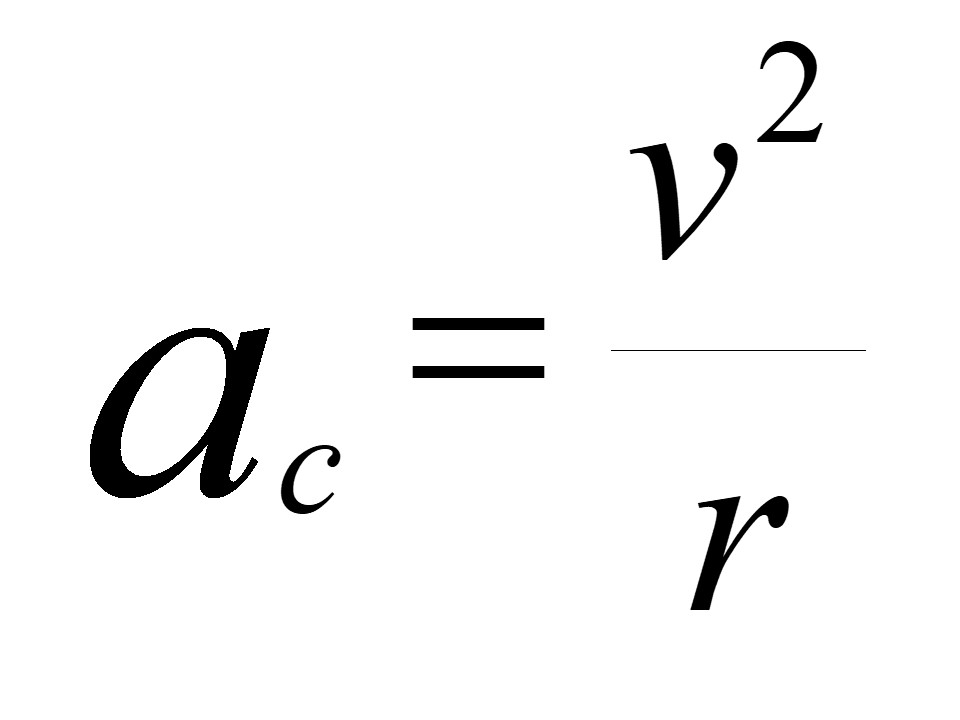
what is the centripetal acceleration formula?

a)
b)
c)
d)
43.
The velocity is always _____ to the line of a circle. 
a)
outwards
b)
towards the center
c)
tangent
d)
faster
44.
You swing a bucket of water attached to a string in a circle above your head. What keeps the water in the bucket?
a)
Friction
b)
Centripetal Force
c)
Gravity
d)
Inertia
45.
 2600 rev/min is equivalent to which of the following?
a)
2600 rad/s 
b)
43.3 rad/s 
c)
273 rad/s
d)
60 rad/s
46.
A grindstone spinning at the rate of 8.3 rev/s has what approximate angular speed?
a)
3.2 rad/s
b)
26 rad/s
c)
52 rad/s
d)
81 rad/s
47.
A 0.12-m-radius grinding wheel takes 5.5 s to speed up from 2.0 rad/s to 11.0 rad/s. What is the wheel's average angular acceleration?
a)
9.6 rad/s/s
b)
4.8 rad/s/s
c)
3.1 rad/s/s
d)
1.6 rad/s/s
48.
What is the angular speed about the rotational axis of the Earth for a person standing on the surface?
a)
7.3 x 10-5 rad/s
b)
3.6 x 10-5 rad/s
c)
6.28 x 10-5 rad/s
d)
3.14 x 10-5 rad/s
49.
A spool of thread has an average radius of 1.00 cm. If the spool contains 62.8 m of thread, how many turns of thread are on the spool? "Average radius" allows us to not need to treat the layering of threads on lower layers.
a)
100
b)
1000
c)
3140
d)
62800
50.
A 0.30m radius automobile tire rotates how many rad after starting from rest and accelerating at a constant 2.0 rad/s2 over a 5.0 s interval?
a)
25 rad
b)
12.5 rad
c)
2 rad
d)
0.5 rad
51.
A fan blade, initially at rest, rotates with a constant acceleration of 0.025 rad/s2. What is its angular speed at the instant it goes through an angular displacement of 4.2 rad?
a)
0.025 rad/s
b)
0.11 rad/s
c)
0.46 rad/s
d)
1.2 rad/s
52.
A fan blade, initially at rest, rotates with a constant acceleration of 0.025 rad/s2. What is the time interval required for it to reach a 4.2 rad displacement after starting from rest   
a)
1.8 s
b)
2.0 s
c)
16 s
d)
18 s
53.
A Ferris wheel starts at rest and builds up to a final angular speed of 0.70 rad/s while rotating through an angular displacement of 4.9 rad. What is its average angular acceleration?
a)
0.01 rad/s/s
b)
0.05 rad/s/s
c)
1.8 rad/s/s
d)
2.6 rad/s/s
54.
A Ferris wheel, rotating initially at an angular speed of 0.50 rad/s, accelerates over a 7.0-s interval at a rate of 0.040 rad/s2. What is its angular speed after this 7-s interval?
a)
0.2 rad/s
b)
0.3 rad/s
c)
0.46 rad/s
d)
0.78 rad/s
55.
You are making a circular turn in your car on a horizontal road when you hit a big patch of ice, causing the force of friction between the tires and the road to become zero. While the car is on the ice, it
a)
continues to follow a circular path, but with a radius larger than the original radius.
b)
moves along a straight-line path toward the center of the circle.
c)
moves along a straight-line path away from the center of the circle
d)
moves along a straight-line path in its original direction.
56.
When a car goes around a circular curve on a horizontal road at constant speed, what force causes it to follow the circular path?
a)
the normal force from the road
b)
gravity
c)
the friction force from the road
d)
No force causes the car to do this because the car is traveling at constant speed and therefore has no acceleration.
57.
If a coin is rotating clockwise in a circular path on a turntable, which of the following is true?
a)
when the coin is at the top of the turntable, the acceleration is pointing to the left
b)
when the coin is at the bottom of the turntable the velocity points towards the center.
c)
the force keeping the coin in place is the weight of the coin pointing towards the center
d)
the acceleration of the coin is caused by a frictional force pointing towards the center 
58.
A car goes around a circular curve on a horizontal road at constant speed. What is the direction of the friction force on the car due to the road?
a)
tangent to the curve in the forward direction
b)
perpendicular to the curve outward
c)
perpendicular to the curve inward
d)
tangent to the curve opposite to the direction of the car's motion
59.
When an object moves in uniform circular motion, the direction of its acceleration is
a)
in the same direction as its velocity vector.
b)
is directed toward the center of its circular path.
c)
in the opposite direction of its velocity vector.
d)
depends on the speed of the object.
60.
A 1000-kg car is moving at 30 m/s around a horizontal unbanked curve whose diameter is 0.20 km. What is the magnitude of the friction force required to keep the car from sliding?
a)
9000 N
b)
300 N
c)
9800 N
d)
900 N
61.
A 0.50-kg toy is attached to the end of a 1.0-m very light string.  The toy is whirled in a horizontal circular path on a frictionless tabletop.  If the maximum tension that the string can withstand without breaking is 350 N.  What is the maximum speed the mass can have without breaking the string?
a)
700 m/s
b)
26 m/s
c)
13 m/s
d)
19 m/s
62.
Jack and Rose are holding hands and spinning in a circle as fast as they can. If rose lets go on accident, what can you say about Jack's motion.
a)
it will be in a straight line opposite of Rose
b)
it will be in a straight line in the direction of the instantaneous velocity
c)
it will be in a curved path in the direction that he was originally going
d)
Rose said she would never let go... she lied
63.
A jet plane flying 600 m/s experiences an acceleration of 4.0g (4 times that of gravity) when pulling out of a circular dive.  What is the radius of curvature of the circular part of the path in which the plane is flying?
a)
7100 m 
b)
640 m 
c)
1200 m
d)
9200 m 
64.
Which of the following is not a centripetal force?
a)
tension
b)
rotational
c)
normal force
d)
friction
65.
A 2.0-kg ball is moving with a constant speed of 5.0 m/s in a horizontal circle whose diameter is 1.0 m. What is the magnitude of the net force on the ball?
a)
50 N
b)
20 N
c)
0 N
d)
100 N
66.
A small 175-g ball on the end of a light string is revolving uniformly on a frictionless surface in a horizontal circle of diameter 1.0 m.  The ball makes 2.0 revolutions every 1.0 s. What are the magnitude and direction of the acceleration of the ball?
a)
79.0 m/s2
b)
35.0 m/s2
c)
13.8 m/s2
d)
87.5 m/s2
67.
What type of velocity do we use to calculate the centripetal acceleration of an object. 
a)
rotational velocity
b)
centripetal velocity
c)
angular velocity
d)
instantaneous velocity
68.
A future use of space stations may be to provide hospitals for severely burned persons. It is very painful for a badly burned person on Earth to lie in bed. In a space station, the effect of gravity can be reduced or even eliminated. How long should each rotation take for a doughnut-shaped hospital of 200-m radius so that persons on the outer perimeter would experience 1/10 the normal gravity of Earth?
a)
91 min
b)
0.011 min
c)
1.5 min
d)
8.7 min
69.
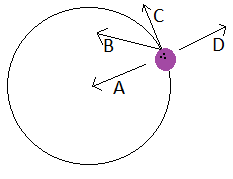
A car travels counterclockwise with constant speed around the track shown to the right. Which of the vectors depicts the direction of the net force acting on the car at the point shown.
a)
A
b)
B
c)
C
d)
D
70.

Bola A bermassa = 60 gram dan bola B = 40 gram dihubungkan batang AB (massanya diabaikan).

Jika kedua bola diputar dengan sumbu putar di P maka momen inersia sistem adalah....

a)

12,25 x 10⁻⁴ kg m2

b)

13,50 x 10⁻⁴ kg m2

c)

14,50 x 10⁻⁴ kg m2

d)

15,00 x 10⁻⁴ kg m2

e)

16,50 x 10⁻⁴ kg m2

71.

Momen inersia suatu benda tegar tergantung pada:

(1) Massa benda

(2) Jari-jari benda

(3) Letak sumbu putar

(4) Bentuk benda

Pernyataan yang benar adalah:

a)

1 dan 2

b)

1 dan 2

c)

1 dan 4

d)

1,2 dan 3

e)

semua benar

72.

Enam buah partikel tersusun seperti gambar berikut.

Tentukan besar momen inersia sistem jika diputar pada sumbu Y!

a)

18 mr218\ mr^2

b)

27 mr227\ mr^2

c)

36 mr236\ mr^2

d)

54 mr254\ mr^2

e)

60 mr260\ mr^2

73.

6 buah partikel seperti ditunjukkan gambar, massa m1 = 4 kg, m2 = m4 = 1 kg dan m3 = m5 = m6 = 2 kg, panjang a = 1 meter dan b = 2 meter serta massa batang penghubung diabaikan, besar momen inersia sistem partikel jika diputar melalui sumbu putar O adalah....

a)

11 kgm2

b)

28 kgm2

c)

39 kgm2

d)

40 kgm2

e)

50 kgm2

74.

Perhatikan gambar di atas, jika partikel m bermassa 1 kg dan jaraknya dari sumbu putar 0,2 m, maka besarnya momen inersia partikel adalah....

a)

4 kgm2

b)

20 kgm2

c)

0,04 kgm2

d)

0,2 kgm2

75.

Sebuah batang silinder homogen dengan panjang 60 cm dan bermassa 4 kg diputar dengan poros di pusat massa. berapakah memen inersia batang tersebut...

a)

1200 kg.cm2

b)

2400 kg.cm2

c)

3600 kg.cm2

d)

4000 kg.cm2

e)

5000 kg.cm2

76.

Susunan 3 buah massa titik seperti gambar berikut! 
Jika m1 = 1 kg, m2 = 2 kg dan m3 = 3 kg, tentukan momen inersia sistem tersebut jika diputar  pada poros P

a)

11 kg m2

b)

 12 kg m2

c)

13 kg m2

d)

14 kg m2

e)

15 kg m2

77.

Jika disajikan gambar batang AB massa 2 kg diputar melalui titik A ternyata momen inersianya 8 kg.m2. Bila diputar melalui titik pusat O (AO = OB), Berapa momen inersianya

....

a)

2 kg m2

b)

3 kg m2

c)

4 kg m2

d)

5 kg m2

e)

6 kg m2

78.

Batang pejal (padat) bermassa 2 kg dan panjang batang pejal adalah 2 meter. Tentukan momen inersia batang jika sumbu rotasi terletak di tengah batang!

a)

I = 2/7 kg m2

b)

I =2/6 kg m2

c)

I= 2/5 kg m2

d)

I = 2/4 kg m2

e)

I = 2/3 kg m2

79.

Tentukan momen inersia bola pejal (padat) bermassa 20 kg dan berjari-jari 0,1 meter, jika sumbu rotasi berada di pusat bola, sebagaimana ditunjukkan gambar.

a)

I = 0,07 kg m2

b)

I = 0,08 kg m2

c)

I = 0,09 kg m2

d)

I = 0,10 kg m2

e)

I = 0,11 kg m2

80.

Berikut ini pernyataan tentang faktor-faktor gerak rotasi

(1) Kecepatan sudut

(2) Letak sumbu rotasi

(3) Bentuk benda

(4) Massa benda

Faktor-faktor yang mempengaruhi besarnya momen inersia adalah …

a)

(1), (2), (3) dan (4)

b)

(1), (2) dan (3)

c)

(1), (3) dan (4)

d)

(2), (3) dan (4)

e)

(2) dan (4) saja

81.

Tentukan nilai mmomen inersia bola pejal bermassa 15 kg dan berjari-jari 0,1 meter, jika sumbu rotasi berada di pusat bola, sebagaimana ditunjukkan gambar!

a)

0,002 kg.m2

b)

0,008 kg.m2

c)

0,04 kg.m2

d)

0,06 kg.m2

82.

Sebuah bola pejal memiliki massa 4 kg berputar dengan sumbu putar tepat melalui tengahnya. Jika diameter bola tersebut 60 cm hitunglah momen inersia bola tersebut!

a)

0,144 kg.m2

b)

0,256 kg.m2

c)

0,384 kg.m2

d)

0,642 kg.m2

83.

Tiga bola identik terpasang pada tali ringan kemudian terhubung pada batang yang sama dan berputar, seperti tampak pada gambar. Urutan inersia bola dari yang terbesar ke terkecil adalah...

a)

123

b)

231

c)

321

d)

132

84.

Sebuah batang besi homogen bermassa 4 kg dan panjangnya 0,25 m. Jika sumbu pusatnya terletak pada titik tengah dan tegak lurus batang, momen inersia besi adalah ....

a)

112kg.m2\frac{1}{12}kg.m^2  

b)

124kg.m2\frac{1}{24}kg.m^2  

c)

136kg.m2\frac{1}{36}kg.m^2  

d)

148kg.m2\frac{1}{48}kg.m^2  

85.

Batang pejal (padat) bermassa 6 kg dan panjang batang pejal adalah 2 meter. Tentukan momen inersia batang jika sumbu rotasi terletak di tengah batang!

a)

2 kg.m2

b)

4 kg.m2

c)

8 kg.m2

d)

16 kg.m2

86.

Lima titik massa tersusun seperti pada gambar!

m1 = 1 kg, m2 = 2 kg, m3 = 3 kg, m4 = 4 kg, m5 = 5 kg. Tentukan momen inersianya jika poros putar sumbu X.

a)

6 kg.m2

b)

10 kg.m2

c)

14 kg.m2

d)

18 kg.m2

87.

Sebuah bola pejal dengan massa 10 kg dan jari-jari 0,2 m berotasi dengan sumbu putar melalui pusat lingkaran. Besar momen inersia dari bola pejal tersebut adalah ....

a)

0,4 kg.m20,4\ kg.m^2  

b)

0,2 kg.m20,2\ kg.m^2

c)

0,16 kg.m20,16\ kg.m^2  

d)

0,18 kg.m20,18\ kg.m^2  

e)

0,1 kg.m20,1\ kg.m^2  

88.

Sebuah batang pejal homogen memiliki massa 3 kg dan panjang 2 m. Berapakah momen inersia batang jika diputar dengan sumbu putar yang berjarak 0,5 m dari pusat massa batang?

a)

1 kgm21\ kg\cdot m^2

b)

4 kgm24\ kg\cdot m^2

c)

1,75 kgm21,75\ kg\cdot m^2

d)

4,75 kgm24,75\ kg\cdot m^2

e)

3,25 kgm23,25\ kg\cdot m^2

89.

Sebuah silinder/cakram pejal dengan massa 5 kg, jari-jari 10 cm, dan panjang 50 cm berotasi dengan sumbu putar melalui pusatnya seperti ditunjukkan pada gambar berikut.


besar momen inersia silinder pejal tersebut adalah ....

a)

2,5 ×102  kg m22,5\ \times10^{-2}\ \ kg\ m^2

b)

1,25 ×104  kg m21,25\ \times10^{-4}\ \ kg\ m^2

c)

5 ×102  kg m25\ \times10^{-2}\ \ kg\ m^2

d)

1,25 ×103  kg m21,25\ \times10^{-3}\ \ kg\ m^2

e)

5 ×104  kg m25\ \times10^{-4}\ \ kg\ m^2

90.

Calculate the torque produced by 75- N perpendicular force at the end of a 0.20 m long wrench.

a)

15 Nm

b)

1.5 Nm

c)

15.0 Nm

d)

16 Nm

91.

Multiplying any angular measurement by the radius will change the measurement to:

a)

torque

b)

tangential

c)

projectile

d)

inertia

92.
In the diagram above, two masses, one with mass m, the other with mass M = 2m are resting on a uniform plank of length L that pivots at its midpoint. If the mass m is at the far end of the plank, how far away from the pivot should the mass M be to balance the plank in a horizontal position shown?
a)
L/2
b)
L/3
c)
L/4
d)
L/6
93.
When an object is experiencing a net torque
a)
it is in dynamic equilibrium.
b)
it is in static equilibrium.
c)
it is rotating.
d)
it is translating.
94.
What is the distance the masses on the right of the fulcrum need to be to balance with the two masses on the left?
a)
.65 m
b)
.56 m
c)
.79 m
d)
.39 m
95.

What direction is the torque acting with respect to post A?

a)

clockwise

b)

Counter clockwise

c)

It's in equilibrium

d)

It's parallel so there is no torque

96.
A 15-kg child is sitting on a playground teeter-totter, 1.5 m from the pivot. What is the magnitude of the minimum force, applied 0.30 m on the other side of the pivot, that is needed to make the child lift off the ground?
a)
66 N
b)
740 N
c)
23 N
d)
44 N
97.
Which has greater angular speed, a horse near the outside rail of a merry-go-round or a horse near the inside rail?
a)
The inside horse
b)
The outside horse
c)
Neither - they both have the same angular speed
98.
A person sits on a freely spinning lab stool that has no friction in its axle. When this person extends her arms,
a)
her moment of inertia increases and her angular speed decreases.
b)
her moment of inertia decreases and her angular speed increases.
c)
her moment of inertia increases and her angular speed increases.
d)
her moment of inertia increases and her angular speed remains the same.
99.
The figure shows scale drawings of four objects, each of the same mass and uniform thickness, with the mass distributed uniformly. Which one has the greatest moment of inertia when rotated about an axis perpendicular to the plane of the drawing at point P?
a)
A
b)
B
c)
C
d)
D