wayground logo

Free Printable Worksheets

Font size

S
M
L
XL
Worksheets

Gr 6 Cumulative 2022-23 Adaptive HW

Total questions: 161

Worksheet time: 2hrs 28mins

Name
Class
Date
1.

The water cycle takes place in which layer of Earth's atmosphere? (a)  

Choose from the below words
Thermosphere
Exosphere
Mesosphere
Troposphere
2.

Dew forms when the surface temperature of a windshield is ____ than the temperature of the ____ near it, which results in condensation.

a)

lower, air

b)

lower, water

c)

higher, air

d)

higher, water

3.

Salt lowers the freezing point of ______.

a)

water

b)

ice

c)

freezing point

d)

air

4.
Which air mass forms over a cool land region?
a)
continental tropical
b)
continental polar
c)
maritime polar
d)
maritime tropical
5.
Which air mass forms over a warm water region?
a)
continental tropical
b)
continental polar
c)
maritime polar
d)
maritime tropical
6.

Kinetic energy is the energy

a)

an object has due to its size.

b)

an object has due to its position.

c)

an object has due to its motion.

d)

an object has due to its shape.

7.

Potential energy is the energy

a)

an object has due to its size.

b)

an object has due to its position.

c)

an object has due to its motion.

d)

an object has due to its shape.

8.

The faster an object is moving, the _____ kinetic energy it has.

a)

more

b)

less

9.

The ______ an object is, the more potential energy it has.

a)

lower

b)

higher

c)

wider

d)

smaller

10.

______ is the change from a gas to a liquid.

a)

vaporization

b)

condensation

c)

precipitation

d)

sublimation

11.
________ are large regions of air that have properties similar to the part of the Earth over which they develop.
a)
Air sections
b)
Air masses
c)
Air matresses
d)
Air pockets
12.
Which air mass forms over a cool water region?
a)
continental tropical
b)
continental polar
c)
maritime polar
d)
maritime tropical
13.

True or False: New energy can be created.

a)

True

b)

False

14.

What makes an energy source renewable?

a)

Humans can make more of it

b)

We will run out of it

c)

You can buy it

d)

It is naturally replenished

15.

What is the correct order of kinetic energy from least to greatest?

a)

dog walking, car driving, lightning striking, bee flying

b)

bee flying, car driving, lightning striking, dog walking

c)

dog walking, bee flying, car driving, lightning striking

d)

car driving, lightning striking, bee flying, dog walking

16.

_____ forms on the windshield when water vapor condenses into solid form.

a)

Frost

b)

Dew

c)

Water

17.

_____ forms on the windshield when water vapor condenses into liquid form.

a)

Frost

b)

Ice

c)

Dew

18.

As a balloon is carried up a mountain, it expands since the atmospheric pressure around the balloon ________.

a)

increases

b)

decreases

19.

Which is not an example of a renewable energy?

a)

Solar Power

b)

Wind Power

c)

Hydropower

d)

Fossil Fuels

20.

Wood burning is an example of ....

a)

electrical energy.

b)

chemical energy.

c)

mechanical energy

21.
Kinetic energy is
a)
Energy of moving objects
b)
Energy stored in an object
c)
Energy within plants
d)
Energy from heat
22.

Which layer of Earth's atmosphere do we live in and is also known as the weather layer?

a)

Troposphere

b)

Mesosphere

c)

Thermosphere

d)

Stratosphere

23.

Frost forms when the surface temperature of the windshield is ...

a)

below the freezing point of ice.

b)

above the freezing point of water.

c)

below the freezing point of water.

d)

above the boiling point of water

24.

How does salt affect ice?

a)

The molecules in salt melt the ice.

b)

The molecules in salt help the molecules in ice and allow them from linking together.

c)

The molecules in salt disrupt the molecules in water and prevent them from linking together.

d)

The molecules in salt disrupt the molecules in ice and prevent them from linking together.

25.

At what position does the rock have the greatest potential energy?

a)

A

b)

B

c)

D

d)

C

26.

Which is a renewable source of energy?

a)

coal

b)

nuclear

c)

ocean tides

d)

natural gas

27.

Which is a nonrenewable source of energy?

a)

solar

b)

wind

c)

coal

d)

geothermal

28.
A flat sloping surface that connects lower and higher elevations. It makes raising objects easier.  
a)
wedge
b)
screw
c)
lever
d)
inclined plane 
29.
An axe is an example of a
a)
pulley
b)
inclined plane
c)
screw
d)
wedge 
30.
Stairs
a)
wedge
b)
pulley
c)
inclined plane
d)
wheel and axle
31.
Which is an example of someone using a simple machine to do work?
a)
a boy runs across a football field
b)
a banker counts money
c)
a mother pushes a stroller up a ramp
d)
a girl eats a sandwich
32.

What are two types of pulleys?

a)

wings, fries

b)

load. weight

c)

fixed, movable

d)

effort, force

33.

Identify the type of pulley

a)

fixed

b)

moveable

c)

block and tackle or pulley system

34.

Identify the type of pulley

a)

Fixed

b)

Moveable

c)

Block and Tackle or pulley system

35.
The ozone layer is made of ____ and shields us from damaging ______ radiation from the Sun.
a)
carbon dioxide, ultraviolet
b)
oxygen, violet
c)
oxygen, ultraviolet
d)
ozone, radio
36.
Salt lowers the freezing point of ______.  
a)
water.
b)
ice.
c)
freezing point.
d)
air.
37.
Which air mass forms over a warm land region?
a)
continental tropical
b)
continental polar
c)
maritime polar
d)
maritime tropical
38.
Which air mass forms over a warm water region?
a)
continental tropical
b)
continental polar
c)
maritime polar
d)
maritime tropical
39.

Match the following

a)

stratosphere

1.

commercial jets fly here

b)

mesosphere

2.

meteors burn up

c)

troposhere

3.

water cycle occurs

d)

exosphere

4.

gas escape into space

e)

thermosphere

5.

International Space Station

40.

Salt lowers the freezing point of ...

(a)  

41.

Place in order from closest to Earth's surface to closest to space

a)

troposphere

b)

stratosphere

c)

mesosphere

d)

thermosphere

e)

exosphere

1)
2)
3)
4)
5)
42.
Rotation is the ...
a)
spinning of Earth on the North Pole.
b)
spinning of Earth on its axis.
c)
revolution of Earth on its top.
d)
pausing of Earth on its axis.
43.
Revolution is the movement of ...
a)
one object spinning on its axis.
b)
one object in between another object.
c)
one object around another object.
d)
one object moving another object.
44.
What did ancient Egyptians notice about the bright star Sirius? 
a)
It would first become visible in the sky four times every year.
b)
It would first become visible in the sky every year shortly before the flooding of the Amazon River.
c)
It would first become visible in the sky every year shortly before the flooding of the Nile River.
d)
It was red in color.
45.
A system of organizing time that defines the beginning of a year, the length of a year, and how the year is portioned or divided is called a _________.
a)
folder
b)
file cabinet
c)
clock
d)
calendar
46.
How did the ancient Egyptians figured out about how long a month is? 
a)
By counting the days in between each full moon.
b)
By counting the days in between each bright Sun.
c)
By counting the days in between each sighting of the star Sirius.
d)
By counting the days in between each flood.
47.
The law of universal gravitation states that ...
a)
every object in the universe repels every other object.
b)
every object in the universe attracts every other object.
c)
magnetic objects in the universe attracts every other object.
d)
every object on Earth attracts every object on the moon.
48.
Why does the moon orbit the Earth instead of the Sun? 
a)
The distance between the Sun and the moon is much greater than the distance between the Earth and the moon. 
b)
The distance between the Sun and the moon is much less than the distance between the Earth and the moon. 
c)
The moon is larger than the Sun.
d)
The Sun is smaller than the Earth.
49.
The force of gravity on an object is called _____.
a)
mass
b)
weight
c)
gravity
d)
pressure
50.
True or False?  A person would weigh less on the moon than they do on Earth.
a)
True
b)
False
51.
How many interior layers does the Sun have?
a)
1
b)
2
c)
3
d)
4
52.
How many exterior layers does the Sun have?
a)
1
b)
2
c)
3
d)
4
53.
Name the interior (inner) layers of the Sun.
a)
Core, Conduction Zone, Radiation Zone
b)
Core, Convection Zone, Radiation Zone
c)
Core, Convection Zone, Magma Zone
d)
Crust, Convection Zone, Radiation Zone
54.
Name the exterior (outer) layers of the Sun.
a)
Photosphere, Chromosphere, Coronita
b)
Photosphere, Chromosone, Corona
c)
Photosphere, Chromosphere, Corona
d)
Photograph, Chromosphere, Corona
55.
Which layer of the Sun is most dense?
a)
Core 
b)
Chromosphere
c)
Convection Zone
d)
Corona
56.
In which layer of the Sun does nuclear fusion take place?
a)
Core 
b)
Chromosphere
c)
Convection Zone
d)
Corona
57.
This layer of the Sun is so dense that it can take energy more than 100,000 years to move through it.
a)
Core 
b)
Chromosphere
c)
Radiation Zone
d)
Corona
58.

This layer of the Sun where hot gases rise and cool gases sink to create loops of energy 

a)

Core 

b)

Chromosphere

c)

Radiation Zone

d)

Convection Zone

59.
This layer of the Sun is the visible light layer made up of thick gases. 
a)
Photosphere
b)
Chromosphere
c)
Radiation Zone
d)
Convection Zone
60.
This layer of the Sun is the faint light that can be seen around the chromosphere.
a)
Photosphere
b)
Chromosphere
c)
Radiation Zone
d)
Corona
61.

Mars was once like Earth, but the sun evaporated the oceans into space. What is protecting the Earth from becoming like Mars?

a)

Earth has a force shield made of clouds for protection.

b)

The spinning inner core made of iron and nickel.

c)

The Earth is farther away from the sun.

d)

Earth has a large moon to protect it from the sun.

62.

What is the beauty of Aurora Borealis (Northen lights)

a)

Evidence of alien life.

b)

The power of Hogwarts.

c)

Evidence of the spinning iron and nickel core.

d)

Reflection of Christmas lights off the atmosphere.

63.

Without ozone layer, what would happen?

a)

Cancer would decrease.

b)

The temperature of the Earth’s core would increase.

c)

Sunscreen companies will have better business.

d)

Life on Earth would only be possible underwater.

64.

Small plants in the oceans use sunlight to change water into energy and also makes ...

a)

The oceans green color.

b)

Food for great white sharks.

c)

Oxygen to create an ozone layer.

d)

The ocean taste salty.

65.

Volcanoes produce CO2. CO2 traps heat, making the Earth warmer. What keep us from becoming like Venus?

a)

Rain trapping the CO2 and storing it under the oceans.

b)

Polar ice sheets would melt cooling down the planet.

c)

Strong winds acting like a fan.

d)

The Earth is too big to get that hot.

66.

What do the churning metals in the core create?

a)

Earth’s North and South poles

b)

Earth’s continents

c)

Earth’s magnetic field

d)

Earth’s seasons

67.

How does the magnetic field protect life from the sun?

a)

Deflects the sun’s radiation.

b)

Deflects the sun’s flare-ups.

c)

Deflects the sun’s melting abilities.

d)

Deflects the sun’s comets.

68.

What is the name of the thin layer of molecules protecting us from UV light?

a)

Troposphere

b)

Ozone

c)

Mesosphere

d)

Exosphere

69.

How did the hole in the ozone form?

a)

Magnetic asteroids

b)

Sun bursts

c)

Greenhouse gases

d)

Man-made chemicals

70.

Why is using a glider necessary for ozone sampling?

a)

They are the only aircraft that reaches that altitude.

b)

Because it has to be done in a small aircraft.

c)

Gliders can fly for longer times.

d)

No engine to cause chemical contamination.

71.

What happens to oxygen as it rises high into the atmosphere?

a)

Turns into rain

b)

Goes into space

c)

Forms as ozone

d)

Disappears

72.

What molecule makes up the majority of the gas released by the volcano?

a)

Nitrogen

b)

Hydrogen

c)

Oxygen

d)

Carbon dioxide

73.

Which planet is the hottest?

a)

Mars

b)

Venus

c)

Jupiter

d)

Earth

74.

How did man stop the deterioration of the ozone?

a)

Banning harmful chemicals

b)

Shooting ozone particles into the atmosphere

c)

Creating better technology

d)

Stopping climate change

75.
What are asteroids?
a)
Asteroids are small rocky objects that orbit the moon.
b)
Asteroids are small rocky objects that orbit the Sun.
c)
Asteroids are small gassy objects that orbit the Sun.
d)
Asteroids are small rocky objects that fly into the Sun.
76.
Most asteroids are found in the main asteroid belt, which is a region between the orbits of ____ and ____.
a)
Mars and Saturn
b)
Mars and Jupiter
c)
Jupiter and Venus
d)
Earth and Mars
77.
What is a meteor?
a)
Meteors are smaller broken pieces of asteroids. 
b)
Meteors are smaller broken pieces of the Sun. 
c)
Meteors are streaks of light in the sky.
d)
Meteors are pieces of asteroids that end up on Earth's surface.
78.
What is a space probe?
a)
A space probe is a robotic submarine that is sent out to space to do research.
b)
A space probe is a robotic spacecraft that is sent out to the ocean to do research.
c)
A space probe is a manned spacecraft that is sent out to space to do research.
d)
A space probe is a robotic spacecraft that is sent out to space to do research.
79.
A space probe may contain scientific instruments and tools that allow it to take _____, collect _____, or take ______.
a)
photographs, money, measurements
b)
photographs, samples, measurements
c)
drawings, samples, measurements
d)
photographs, samples, images
80.
The TAGSAM will collect a sample of the asteroid's surface.  What do the letters "T" and "G" stand for?
a)
Trap and Get
b)
Touch and Go
c)
Touch and Get
d)
Trap and Go
81.
The law of universal gravitation states that ...
a)
every object in the universe repels every other object.
b)
every object in the universe attracts every other object.
c)
magnetic objects in the universe attracts every other object.
d)
every object on Earth attracts every object on the moon.
82.
A cloud of ___ and ___ in outer space is called a nebula.
a)
gas and dust
b)
gas and water
c)
ice and steam
d)
oxygen and snow
83.
_______ brings gas and dust particles of a nebula closer together.
a)
Magnetism
b)
Gravity
c)
Wind
d)
Tides
84.
The hottest stars are ____ in color.
a)
red
b)
yellow
c)
blue
d)
white
85.
The coolest stars are ____ in color.
a)
red
b)
yellow
c)
blue
d)
white
86.
The Space Race was a competition between which two counties?
a)
U.S. and Soviet Union
b)
Germany and Soviet Union
c)
U.S. and Germany
d)
U.S. and Japan
87.
Which was the first country to successfully launch a satellite into orbit?
a)
U.S.
b)
Soviet Union
88.
Which was the first country to successfully land a space probe on the moon?
a)
U.S.
b)
Soviet Union
89.
Which was the first country to  have a human orbit Earth?
a)
U.S.
b)
Soviet Union
90.
Which was the first country to have humans land on the moon?
a)
U.S.
b)
Soviet Union
91.
Which achievement did SpaceX accomplish recently that allows rockets to be reusable?
a)
Rockets can be crushed and recycled.
b)
Rocket pieces can be reused to make new ones.
c)
Rockets can be reused by landing them vertically.
d)
The ISS can collect used rockets and send them back to Earth.
92.
A major reason why the International Space Station is in space is to experiment on how a ...
a)
human can live without air.
b)
human can survive in space.
c)
human can die in space.
d)
human can survive in water.
93.
A rocket is a device that ____ gas in one direction to move in the opposite direction.
a)
absorbs
b)
expels
c)
cools
d)
attracts
94.
As each stage of the rocket uses up its fuel, the empty containers _________.
a)
fall away
b)
disintegrate
c)
explode
d)
stay attached
95.
How does a multistage rocket function?
a)
Smaller rockets are placed one on top of the other and then fired in succession.
b)
Smaller rockets are placed one next to each other and then fired in succession.
c)
Smaller rockets are placed one on top of the other and then fired in recession.
d)
Larger rockets are placed one on top of the other and then fired in succession.
96.
Fuel and oxygen that are in separate compartments until combined and ignited are an example of
a)
Solid Fuels
b)
Liquid Fuels
c)
Gas Ions
d)
Fire
97.
Dry explosive chemicals like those found in fireworks are which type of rocket fuel?
a)
Solid Fuels
b)
Liquid Fuels
c)
Gas Ions
d)
Fire
98.
Escape velocity is the velocity a rocket needs to fly ...
a)
beyond the moon’s gravitational pull.
b)
beyond the Earth’s gravitational push.
c)
beyond the Earth’s magnetic pull.
d)
beyond the Earth’s gravitational pull.
99.
Thrust is the same as which type of force?
a)
Action Force
b)
Reaction Force
c)
Gravity Force
d)
Magnetic Force
100.

The amount of mass in a given volume. How close the particles in a substance are.

a)

Density

b)

Solubility

c)

Diffusion

d)

Dissolving

101.

When heat is applied to matter ...

a)

particles get closer and speed up.

b)

particles get closer and slow down.

c)

particles spread out and speed up.

d)

particles spread out and slow down.

102.

When water molecules stick to other water molecules, beads form. This is because of...

a)

cohesion

b)

adhesion

c)

solution

d)

nonpolarity

103.

Surface tension is the property of water in which...

a)

water molecules at the surface tend to stick together.

b)

water spills easily.

c)

water tends to be see-through.

104.

What type of energy transfer happens when a person places their hands in front of the fire to warm them up?

a)

Convection

b)

Conduction

c)

Radiation

105.

The transfer of energy through molecules in direct contact is ...

a)

Heat

b)

Conduction

c)

Convection

d)

Radiation

106.
The flow of energy that occurs when a warm liquid or gas rises ..
a)
Heat
b)
Conduction
c)
Convection
d)
Radiation
107.
The transfer of energy by electromagnetic waves.
a)
Heat
b)
Conduction
c)
Convection
d)
Radiation
108.

As you touch a hot stove the heat transfers -

a)

from your hand to the stove by conduction.

b)

from the stove to your hand by conduction.

c)

from your hand to the stove by radiation.

d)

from the stove to your hand by radiation.

109.

Which sentence explains why a cold metal spoon placed in a pot of boiling water becomes hot?

a)

Thermal energy is transferred from the spoon to the water by conduction

b)

Thermal energy is transferred from the water to the spoon by conduction.

c)

Thermal energy in the water is transformed into kinetic energy in the spoon by convection.

d)

Thermal energy in the spoon is transformed into kinetic energy in the water by convection.

110.
In a lava lamp, the warm part rises and the cool part sinks.  This is an example of 
a)
heat computation
b)
convection
c)
conduction
d)
radiation
111.

Warm air rises and the cool air sinks demonstrates this type of heat transfer.

a)

Conduction

b)

Convection

c)

Radiation

112.

Walking on hot sand with your bare feet shows this type of heat transfer.

a)

conduction

b)

convection

c)

radiation

113.

Ironing a shirt is an example of:

a)

condensation

b)

evaporation

c)

conduction

d)

convection

114.

You and your friends are gathered around a campfire to keep warm. How is heat being transferred to you?

a)

conduction

b)

convection

c)

radiation

115.

What kind of heat transfer is occurring when the sun warms the sand?

a)

Conduction

b)

Convection

c)

Radiation

d)

All of them

116.
Heat transfer in boiling water.
a)
Conduction
b)
Convection
c)
Radiation
117.
What is viscosity?
a)
A liquid's resistance to flow.
b)
a liquids flow.
c)
a liquid
d)
gas to solid.
118.

Low viscosity can be described as...

a)

liquids that flow quickly

b)

liquids that flow slowly

119.

High viscosity can be described as...

a)

a liquid that flows quickly

b)

a liquid that flows slowly

120.

The best example of a substance with low viscosity is?

a)

Honey

b)

Dish soap

c)

Ketchup

d)

Water

121.
As the temperature of lava increases, ________
a)
its viscosity decrease
b)
it begins to harden
c)
its viscosity increases
d)
it can flow a much short distance
122.

The best example of high viscosity would be?

a)

Honey

b)

Soap

c)

Marbles

d)

Water

123.

Why does the ketchup packet sink when you squeeze the bottle?

a)

The pressure causes the water to push down on the packet.

b)

The pressure causes the air in the packet to compress and become more dense.

c)

The pressure causes the air in the packet to expand and become less dense.

d)

The pressure causes the ketchup in the packet to compress and become more dense.

124.

Which is the formula to calculate pressure?

a)

Force x Area

b)

Force / Area

125.

Pascal's Law states that when a force is applied to a(n) _______ fluid, the increase in pressure is transmitted equally to all parts of the fluid.

a)

confined

b)

open

c)

delicate

d)

odorless

126.

As a balloon is carried up a mountain, it expands since the atmospheric pressure around the balloon ____________.

a)

increases

b)

decreases

127.
If the horse reared up on 2 legs what effect would it have on the pressure?
a)
it will exert half the pressure it did before
b)
it will exert the same pressure it did before
c)
it will exert twice the pressure it did before
d)
it will exert four times the pressure it did before
128.
Pressure is equal to force divided by what
a)
area
b)
mass
c)
time
d)
distance
129.
As you climb up a mountain what happens to the air pressure?
a)
decreases
b)
increases
c)
stays the same
130.
What types of charges repel?
a)
Positive and Positive
b)
Positive and Neutral
c)
Negative and Neutral
d)
Neutral and Neutral
131.
If a substance has a higher number of electrons than protons on its surface, what type of charge does it have?
a)
A positive charge.
b)
A negative charge.
c)
A neutral charge
d)
No charge at all
132.

How will these charges interact?

a)

Repel

b)

Attract

c)

No interaction

133.

How will these charges interact?

a)

Repel

b)

Attract

c)

No interaction

134.

Repel means

a)

To pull toward each other.

b)

To push away from each other.

c)

Neither positive nor negative.

d)

Either a negative (-) or positive (+) charge.

135.

Attract means

a)

To pull toward each other.

b)

Either a negative (-) or positive (+) charge.

c)

To push away from each other.

d)

Neither positive nor negative.

136.
Which type of charges do these balloons have?
a)
like charges
b)
opposite charges
137.
What charge does a proton have?
a)
negative (-)
b)
positive (+)
c)
neutral or no charge (0)
138.

Which diagram correctly shows the field lines between two like charges?

a)

A

b)

B

c)

Both

d)

Neither

139.
Protons and Electrons balance the charge of an atom.
a)
True
b)
False
140.

Repelling or attracting magnets?

a)

repelling

b)

attracting

141.

Repelling or attracting?

a)

attracting

b)

repelling

142.
Batteries convert what type of energy into electricity?
a)
Chemical energy
b)
Mechanical energy
c)
Both
d)
Kinetic energy
143.

What do all waves transfer?

a)

Matter

b)

Heat

c)

Electricity

d)

Energy

144.

What are the two types of waves?

a)

longitudinal and transverse

b)

sound and light

145.
The matter (solid, liquid, or gas) through which waves can travel
a)
Medium
b)
Object
c)
Transverse Wave
d)
Wavelength
146.

The highest point on a transverse wave is the

a)

compression

b)

crest

c)

rest position

d)

trough

147.

The lowest point on a transverse wave is the

a)

compression

b)

crest

c)

rest position

d)

trough

148.

A wave that can travel through matter and empty space is a:

a)

electromagnetic wave

b)

longitudinal wavy

c)

transverse wave

d)

mechanical

149.

What type of wave is this?

a)

Longitudinal

b)

Transverse

c)

Electromagnetic

d)

x ray

150.
Which of the following is NOT a mechanical wave?
a)
sound
b)
light
c)
ocean
d)
seismic
151.

You can't hear sounds in outer space because there is no

a)

medium

b)

light

c)

energy

d)

heat

152.
Longitudinal waves are ______.
a)
Parallel
b)
Perpendicular
c)
Crazy
153.
Transverse waves are ___.
a)
Parallel
b)
Perpendicular
c)
Weird
154.
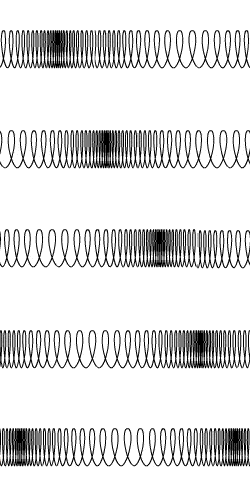
What kind of wave is pictured below?
a)
compressional wave
b)
transverse wave
c)
sound wave
d)
mechanical wave
155.
In a longitudinal wave, the parts where the coils are close together are called what?
a)
longitudes
b)
rarefactions
c)
compressions
d)
contractions
156.

Which EM waves have the longest wavelength?

a)

radio

b)

x-rays

c)

ultraviolet

d)

gamma rays

157.

Which EM waves have the shortest wavelength?

a)

radio

b)

x-rays

c)

ultraviolet

d)

gamma rays

158.
These waves make water molecules vibrate and warm up.
a)
Gamma
b)
Microwaves
c)
Radio
d)
Ultraviolet
159.
These high-energy waves are given off by radioactive materials.
a)
Gamma
b)
Microwaves
c)
Radio
d)
Ultraviolet
160.
These waves are used to send signals, including WiFi and text messages.
a)
Gamma
b)
Microwaves
c)
Radio
d)
Ultraviolet
161.
These waves from the sun cause sunburn.
a)
Gamma
b)
Microwaves
c)
Radio
d)
Ultraviolet