
Font size
 Worksheets
14 Steering Systems
Total questions: 24
Worksheet time: 6hrs 46mins

Identify the steering system component in the image.
Steering box
Steering rack gaitor
Steering column
Track rod end (TRE)
Identify which of these functions are performed by the steering system.
Provide a degree of 'feel' of the road to the driver.
Change direction of the vehicle.
Not transmit road shocks back to the driver.
Not cause excessive tyre wear.

Identify the steering system component in the image.
Steering box
Steering rack gaitor
Steering column
Track rod end (TRE)
This component joins the track rod to steering knuckle, allowing for suspension, steering movement and adjustment.
Steering column
Steering box
Steering rack
Track rod end (TRE)

Identify the steering system component in the image.
Steering column
Steering box
Steering rack
Track rod end (TRE)
After replacing a steering or suspension component, it is vital that the steering alignment is checked and adjusted to meet manufacturer's requirements.
False
True

Identify the steering system component in the image.
Steering box
Steering rack gaitor
Steering column
Track rod end (TRE)
On a steering box type system, what is the name of the first linkage out of the box giving the angular movement.
Steering Wheel
Steering rack gaitor
Pitman arm
Track rod end

Identify the steering system component in the image.
Steering Wheel
Steering rack gaitor
Steering column
Track rod end

The Ackerman Principle refers to steering geometry, it was designed to avoid the need for tyres to slip sideways when following the path around a curve.
False
True

The higher the caster, the less stability a vehicle will have at higher speeds. Higher caster equals more responsive handling.
True
False
A driver complains of steering wheel 'shimmy' that gets worse as the vehicle's speed increases. This most likely indicates:
the tyre pressures are too high
the front wheels need balancing
the wheel alignment needs adjusting
the shock absorbers need replacing
In relation to steering, 'oversteer' is produced during cornering when the:
rear wheels of a car are carrying much less load than the front wheels
slip angles of the rear tyres are larger than the slip angles of the front tyres
slip angles of the rear tyres are smaller than the slip angles of the front tyres
slip angles of the front tyres are the same as the slip angles of the rear tyres

Identify the steering system component in the image.
Steering Wheel
Steering rack gaitor
Steering knuckle/Hub Assembly
Track rod end
In relation to steering geometry, the purpose of the 'castor angle' is to:
provide centre point steering layout
provide toe-out on turns when cornering
allow for the deflection of the wheels
provide self centering of the steering
In relation to steering geometry 'camber angle' is defined as:
the outward or inward tilt of the road wheel
the backward tilt of the kingpin or swivel pin
the inward tilt of the kingpin or swivel pin
the angle between the kingpin and the wheel

When the toe is at the correct angle, there’s less friction on the tires as they roll. When they are facing away from each other (toe-out) or toward each other (toe-in), they’re essentially scrubbing on the road ever so slightly with every passing mile.
False
True
Which of the following is a type of steering mechanism?
Peg and Ball
Ackermann steering
Crown wheel and pinion
Rack and pinion
In relation to checking and adjusting the front wheel alignment which of the following is NOT true?
Adjustments must be made equally to both track rods
You should remove any very heavy loads from the boot
You should check the tyre pressures are correct
Buckled wheels will not affect the wheel alignment
The Ackermann steering layout produces:
understeer of the front wheels during cornering
oversteer of the front wheels during cornering
toe-out of the front wheels during cornering
centre point steering on the front wheels

The 'camber' of a vehicle's wheels play a key-role in cornering performance. If the camber is out of the manufacturer’s range, it can cause handling issues and excessive tire wear, which costs you money. If a vehicle has rear-camber adjustments, adjusting the rear camber plays a big role in straight-line stability and cornering.
True
False
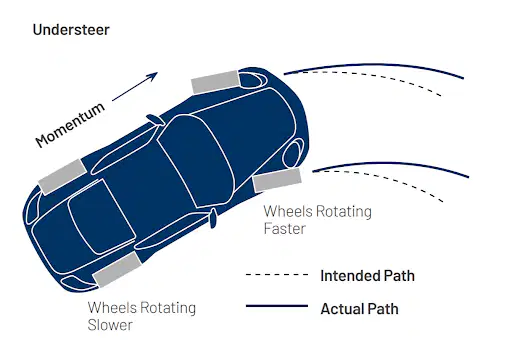
In relation to vehicle behaviour during cornering ‘understeer’ is when the:
slip angles of the front tyres are larger than the slip angles of the rear tyres
slip angles of the rear tyres are smaller than the slip angles of the front tyres
slip angles of the front tyres are the same as the slip angles of the rear tyres
rear wheels of a vehicle are carrying much less load than the front wheels
A ball joint splitter is used for what reason?
To disconnect the ball joint from the hub carrier/steering knuckle
To unfasten the locknut on a rack and pinion type track rod.
To turn the adjuster sleeve on a linkage type track rod.
To remove worn suspension bushes.
In a hydraulic Power Assisted Steering system (PAS), what are the fluid pipes from the power steering pump connected to?
The power steering rack's control valve.
The steering wheel.
The steering column.
The hydraulic actuator.

