
 Worksheets
Force and Motion Review
Total questions: 52
Worksheet time: 26mins
What is a force?
energy of movement
something that pushes or pulls
increasing speed
outside
What is speed?
The distance that an object travels in a given unit of time
the amount of matter in an object
quickness of motion
a push or a pull on an object
What is a force that causes an object to start moving, stop moving, or change direction
Acceleration
Unbalanced Force
Balanced Force
Inertia
What is a force that equals the forces acting on an object in the OPPOSITE direction
Acceleration
Unbalanced Force
Balanced Force
Inertia
What is the tendency of an object to resist changes in motion
Acceleration
Unbalanced Force
Balanced Force
Inertia
What is friction?
the force of gravity on a person or object at the surface of a planet
the amount of matter in an object
anything that has mass and takes up space
force that two surfaces exert on each other when they rub against each other
Newton's 2nd Law: Acceleration depends on an object's _____ and the _____ ________ acting on the object.
inertia
gross
force
inertia
net
force
mass
net
force
mass
gross
force
What is the strength or force that something has because it is moving
weight
momentum
acceleration
air resistance

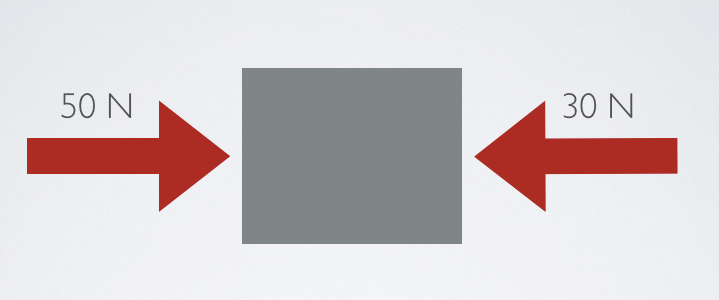
The forces are ___
balanced
unbalanced
The net force is
1000 N TO THE RIGHT
1000 N TO THE LEFT
ZERO

What is Motion?
A change in position relative to a point of reference, a change in speed, or a change in distance
An increase or decrease in the speed of an object
The rate of change in an object’s position
a force that acts on an object through direct touching
An object in motion tends to stay in motion and an object at rest tends to stay at rest unless acted on by an outside force is Newton's what law?
2nd Law of Motion
3rd Law of Motion
1st Law Of Motion
An object in motion tends to stay in motion and an object at rest tends to stay at rest unless acted on by an outside force is Newton's what law?
2nd Law of Motion
3rd Law of Motion
1st Law Of Motion

How can you describe the bird’s motion?
The bird flew toward the house.
The bird flew from the left of the tree to the right of the tree.
The bird flew away from the tree.
All of the above are correct
The greater the mass of an object....
The less the force needed to change the object
Nothing will happen to the object
The greater the force needed to change the object


According to Newton's first law of motion, a moving object that is not acted on by an unbalanced force will
change its momentum
eventually come to a stop
accelerate
remain in motion

What law is best described
1st
2nd
3rd
law of motion
What is Newton's 2nd Law?
F=ma
Every action has an equal and opposite reaction
An object at rest stays at rest, an object in motion stays in motion.
Friction

What law is best described
A person not paying attention while skateboarding hits a rock. The skateboard stops...they don't.
The Law of Inertia (1st law)
The Law of Acceleration (2nd law)
The Law of Conservation of Momentum
Action Reaction Law (3rd law)
Velocity is both speed and _________.
mass
direction
distance
motion
Which of the following is NOT TRUE about friction:
Friction is a force that acts in the opposite direction of motion.
Friction slows objects down.
There is no friction on earth.
Friction on carpet is greater than friction on a bare floor.

According to Newton's Third Law of Motion, if Mike pushes down on the springboard to being his dive, what is the reaction force?
Mike splashing into the water
The springboard pushing Mike into the air
The height of the water when Mike enters the water
The sound the board makes as he pushes into the air
Ana pushed on a big rock in her back yard. She was unable to get it to move because she did not -
apply enough force
have a good grip on the rock
have enough mass
weigh enough
Billy pushes his little brother on a sled through the snow. He then tries to push his father on the the same sled. He noticed that it was much harder to push his father. Which law is this an example of?
1st Law (Law of Inertia)
2nd Law (Law of Acceleration)
3rd Law (Law of Action-Reaction)

A girl jumps forward off a boat. According to Newton's 3rd law of motion, what happens to the boat?
the boat also moves forward
the boat remains motionless
the boat moves backward
the boat moves backward and then forward
What is a force?
energy of movement
something that pushes or pulls
increasing speed
outside
The FIRST part of Newton's 1st law states:
An object at rest will stay at rest
An object in motion will stay in motion
An object at rest will stay in motion
An object in motion will stay at rest
The SECOND part of Newton's 1st law states:
An object at rest will stay at rest
An object in motion will stay in motion
An object at rest will stay in motion
An object in motion will stay at rest
The THIRD part of Newton's 1st law states things will move the way they are moving right now...:
UNLESS acted upon by an inside force
UNLESS unchanged by an outside force
UNLESS acted upon by a balanced force
UNLESS acted upon by an outside force
When objects remain in the same place, it is called...
gravity
friction
balanced forces
unbalanced forces
When an object is getting faster, it is called...
potential energy
kinetic energy
acceleration
deceleration
Inertia is...
for every action, there is an equal and opposite reaction
larger objects take more force to move
an object in motion tends to stay in motion unless acted on by an opposite force
a push that acts in the opposite direction and it slows down

Examine the image of the forces acting on a cart. Which additional force can be applied to make the cart move in the opposite direction? (Think carefully about each option!!!)
60 N towards the west
40 N towards the west
40 N towards the east
60 N towards the east

John and Alex play tug-of-war with a rope.
If John wins the game, what would likely be the combination of forces applied?
Both John and Alex applied a force of 50 N each.
Both John and Alex applied a force of 50 N each.
John applied a force of 50 N, and Alex applied a force of 80 N.
John applied a force of 100 N, and Alex applied a force of 40 N.

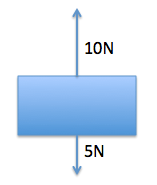
A student investigates how unbalanced forces affect the motion of an object. The student applies a force of 2 N to a toy car in the direction shown.
The student wants to slow the motion of the car without causing it to stop or reverse direction. What force should the student apply to the toy car to achieve the desired result?
1 N towards the left
1 N towards the right
2 N towards the right
2 N towards the left
What relationship exists between mass and inertia?
As mass increases, inertia decreases.
As mass increases, inertia increases.
Mass cancels the property of inertia.
Mass cancels the property of inertia.

The table shows the details of three moving objects.
A student claims that it is easier to stop Object 2 than to stop Objects 1 and 3. What justifies the student’s claim?
Object 2 has the least mass, so it has the least inertia.
Object 2 has the least speed, so it requires the most force to stop.
Object 2 is the slowest, so it experiences the least friction.
Object 2 is the lightest, so it experiences the smallest gravitational force.
Newton's Third Law of Motion is also known as?
The Law of Inertia
The Law of Acceleration
The Law of Interaction
None of the Above
Newton's Third Law States that..?
Objects in motion stay in motion and objects at rest stay at rest.
Force is equal to mass times acceleration.
For each action, there is an equal and opposite reaction.
A baseball player bats a ball with a force of 1,000N. The ball exerts a reaction force against the bat of...
1,000N
Less than 1,000N
More than 1,000N
500N
In which of the following shows the Law of Interaction being used in our everyday lives?
Person walking on earth.
Animal swimming in water.
Person hitting a tree.
All of the above.
For every action, there is...
an equal and opposite reaction.
mass times acceleration.
food and water.
none of the above.

