Wayground logo

Free Printable Worksheets

Font size

S
M
L
XL
Worksheets

PMA 2 Review... Part 2

Total questions: 50

Worksheet time: 1hrs 5mins
Name
Class
Date
1.
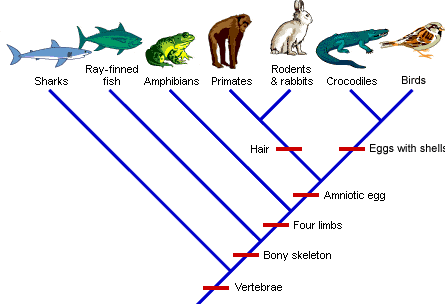
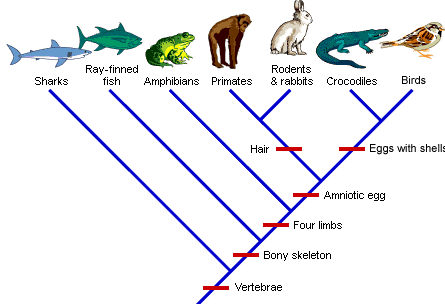
According to this cladogram, primates are most closely related to -
a)
Amphibians
b)
Rodents and rabbits
c)
Crocodiles
d)
Birds
2.
According to this cladogram, birds are LEAST related to -
a)
Amphibians
b)
Sharks
c)
Ray Finned Fish
d)
Crocodiles
3.
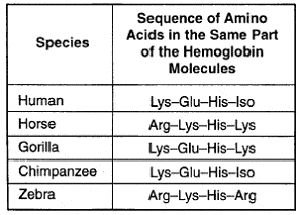
You look at two species and see very similar amino acid sequences. What does this likely tell you?
a)
These are the same animal.
b)
These animals have a common ancestor.
c)
These animals are not likely related.
d)
These animals are likely becoming one species.
4.
According to this cladogram, sharks are MOST closely related to which organism? 
a)
Amphibians
b)
Ray finned fish
c)
Crocodiles
d)
Birds
5.
Which terms best describe heterotrophs?
a)
Plants; producers
b)
Animals; producers
c)
Plants; consumers
d)
Animals; consumers
6.
Which terms best describe autotrophs?
a)
Plants; producers
b)
Animals; producers
c)
Plants; consumers
d)
Animals; consumers
7.
Fungi, Plants, and Animals
a)
Unicellular organisms 
b)
Multicellular organisms
8.
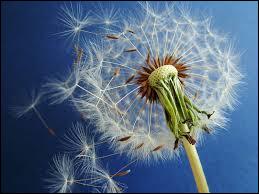
Dandelion, What kingdom does it belongs to?
a)
Plant Kingdom
b)
Animal Kingdom
c)
Fungi Kingdom
d)
Protista Kingdom
9.
The 8 levels of classification, most broad to most specific.
a)
Domain, Genus, Family, Order, Class, Phylum, Kingdom, Species
b)
Domain, Species, Kingdom, Genus, Phylum, Family, Class, Order
c)
Domain, Kingdom, Phylum, Class, Order, Family, Genus, Species
d)
Order, Kingdom, Species, Domain, Phylum, Family, Class, Genus
10.
The most general in the order of classification is?
a)
Kingdom 
b)
Phylum 
c)
Class 
d)
Order
11.
The most specific of the classifications is?
a)
class 
b)
order 
c)
genus 
d)
species
12.
The 2 kingdoms that make up Prokaryotes are?
a)
Animals and Plants 
b)
Protists and Fungi
c)
Archea and Bacteria
13.

type of consumer eats secondary consumers

a)

primary consumer

b)

plants

c)

tertiary consumer

d)

sunlight

14.

This type of consumer

eats a producer. (herbivores)

a)

Primary Consumer

b)

Secondary Consumer

c)

Tertiary Consumer

d)

Vegan Consumers

15.

This is an example of a producer because it makes its own food.

a)

venus fly trap

b)

bacteria

c)

algae

d)

toadstools

16.

The original source of energy in any food chain.

a)

Decomposers

b)

Sun

c)

Plants

d)

Animals

17.

A field mouse eats seeds,

a snake eats the field mouse, & a hawk eats

a snake

a)

food web

b)

food link

c)

energy chains

d)

food chain

18.

when food chains overlap they create this

a)

food web

b)

food link

c)

energy chains

d)

food chain

19.

meat eaters

a)

herbivores

b)

omnivores

c)

Carnivores

d)

Producers

20.

What are the 3 consumers we have discussed?

a)

herbivores

b)

carnivores

c)

omnivores

d)

grass

21.
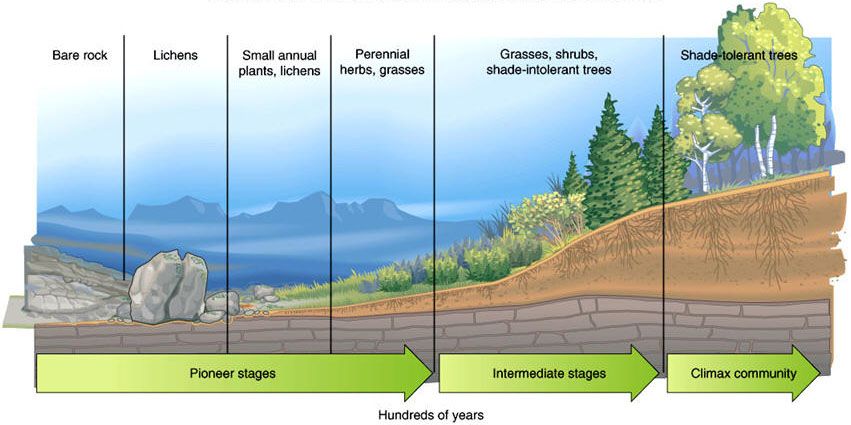
What is formed during primary succession that doesn't need to be formed during secondary succession?
a)
pioneer species
b)
soil
c)
climax community
d)
lichens
22.
What type of succession is shown going from figure A to figure B?
a)
primary succession
b)
eutrophication
c)
secondary succession
d)
intermediate
23.
After a forest fire, an ecosystem would start regrowth through -
a)
primary succession
b)
secondary succession
c)
climax community
d)
limiting factors
24.
Which catastrophic event will most likely have the effect of returning an ecosystem to primary succession?
a)
A tornado
b)
A volcanic eruption
c)
A flood
d)
A drought
25.
succession that occurs in an area with no soil
a)
ecological succession 
b)
primary succession 
c)
secondary succession
d)
pioneer speciles
26.
How do lichens contribute to primary succession?
a)
Lichens decompose organic matter from animals and plants
b)
Lichens begin to break down rock to form soil
c)
Lichens are nitrogen fixing bacteria
d)
Lichens convert carbohydrates into fossil fuels.
27.

The picture shows what type of succession?

a)

primary

b)

secondary

c)

tertiary

d)

quadanary

28.
TRUE or FALSE?
All of the carbon in existence is continually recycled in the carbon cycle.
a)
True
b)
False
29.

How do animals get carbon?

a)

By eating plants and or other animals.

b)

They absorb it from the atmosphere.

c)

From the ground

d)

They do not get carbon from anywhere.

30.

What are fossil fuels made from?

a)

Plants and animals that are buried underground for millions of years.

b)

They absorb it from the atmosphere.

c)

Water

d)

Wind

31.
When humans burn fossil fuels, most of the carbon quickly enters the                       as carbon dioxide.
a)
Water
b)
Atmosphere
c)
Sun
d)
Air
32.
What word describes when water is attracted to other substances?
a)
cohesion
b)
adhesion
c)
capillary action
d)
surface tension
33.
Why does ice float?
a)
As water freezes, it expands and its density decreases.
b)
As water freezes, it takes up more hydrogen from the atmosphere, causing it to have a greater buoyancy.
c)
As water freezes, air becomes trapped between the hydrogen bonds of water molecules.
d)
As water freezes, it takes up more oxygen from the atmosphere, causing it to have a greater buoyancy.
34.
Water is a universal solvent because it...
a)
It can be found anywhere
b)
It freezes when it gets cold
c)
floats when frozen
d)
Dissolves most substances
35.
Large bodies of water, such as lakes and oceans, do not quickly fluctuate in temperature. What is the reason for this phenomenon?
a)
Water is an acid.
b)
Water is a versatile solvent.
c)
Water has a high heat capacity.
d)
 Water acts as a buffer.
36.
When a molecule has an opposite electrical charge on each end, it is known as what?
a)
cohesion
b)
polar molecule
c)
hydrogen bond
d)
solution
37.

Sunlight is capable of reaching the deepest parts of the ocean.

a)

True

b)

False

38.

What are some factors affecting Aquatic Ecosystems?

a)

Depth

b)

Temperature

c)

Water level

d)

Chemistry

39.

Which of the following is an abiotic factor?

a)

Water

b)

Plants

c)

grass

d)

bacteria

40.

What effect does the sun have on surface water?

a)

It causes it to boil

b)

It causes it to rain

c)

It causes it to sink

d)

It causes it to evaporate

41.

When water vapor is cooled and forms droplets of liquid water

a)

Condensation

b)

Evaporation

c)

Transpiration

d)

Runoff

42.
When water turns into a gas
a)
condensation 
b)
evaporation
c)
precipitation
43.
What is water that flows in rivers and streams into the oceans and lakes?
a)
evaporating
b)
condensing
c)
precipitating
d)
runoff
44.

What is precipitation?

a)

Sweat from our bodies on hot days

b)

Warm rain but not cold snow or sleet

c)

Gas that we use in furnaces or ovens

d)

Any form of water that falls from the sky

45.

The process when plants release water vapor from their leaves is called _____________.

a)

precipitation

b)

evaporation

c)

transpiration

d)

condensation

46.
In the energy pyramid here, how much of the energy in each level gets lost as heat or used by the organism for survival?
a)
80%
b)
90%
c)
10%
d)
20%
47.

Which organism in the food web shown to the right would

contain the lowest concentration of chemical pollutants?

a)

producers

b)

primary consumers

c)

secondary consumers

d)

tertiary consumers

48.

The phenomenon by which toxins concentrate in the organisms at higher trophic levels within an ecosystem is known as...

a)

Biotoxicity

b)

Biomagnification

c)

Eutrophication

d)

Predation

49.

In what year were the most toxins present in smallmouth bass?

a)

2000

b)

2002

c)

2004

d)

2005

50.

Toxin concentrations _____________ as you go up the food chain.

a)

do not change

b)

increase

c)

decrease