
Font size
 Worksheets
Laura
Total questions: 119
Worksheet time: 3hrs 47mins
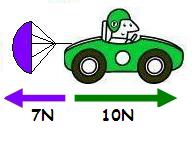
What will happen?
The car will slow down
The car will speed up
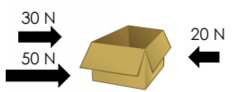
Which direction will the box move?
To the left
To the right
Magnetic Force is an example of ____________ force.
contact
non-contact
balanced
unbalanced
Which is an example of a non-contact force?
elastic force
normal force
applied force
electric force
Applied force is an example of a _________________ force.
contact
non-contact
balanced
unbalanced

A cat shoving a glass off a table
Unbalanced force
Balanced force

A ____________ is a push or a pull on an object.
Friction
Force
Magnet
Gravity
What is the unit to MEASURE force?
Kilogram
Meter
Pounds
Newton
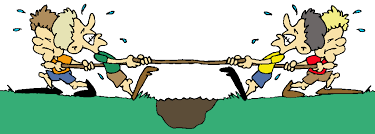
If both of these teams are pulling with the same amount of force what will happen?
The boys in green and orange will win.
Neither side will move at all.
The boys in red and yellow will win.
Both sides will fall down.

What does the head of each arrow indicate?
The magnitude of the force
The area of the force
The strength of the force
The direction of the force

You ate steak and salad for dinner last night.
What does that make you?
a herbivore
a carnivore
an omnivore
a producer
Which of the following is an example of a predator & prey relationship?
a frog eats a housefly
a person eats an orange
a frog eats a deer
a rabbit eats grass
Prey is an animal that __________.
is killed and eaten by other animals
kills other animals
only eats plants
is not in a food chain

Which animal in this food chain is an herbivore and eats only plants?
wolf
hedgehog
fox
grasshopper

An animal that hunts other animals for food is a ___________
herbivore
predator
prey
energy

Which of the following is NOT a consumer
grass
dog
shark
fish

An animal that eats other animals is a __________.
Living things that can make their own food are called ________.
consumers
herbivores
producers
carnivore

What is the original source of all energy in a food chain?
plants
sun
producers
decomposers

The arrows in a food chain show the flow of __________.
eating
sunlight
energy
time
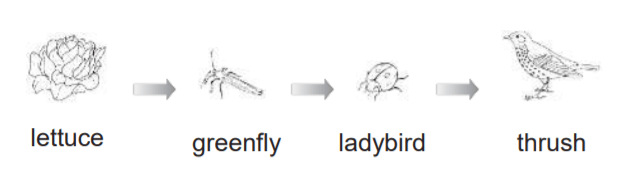
Which one is the producer?
lettuce
greenfly
ladybird
thrush

An organism that gets energy from eating other organisms is a ______________
producer
consumer
decomposer


Which of these organisms would RECEIVE energy from the snake?

When green plants make food using energy from the sun it is called...
oxigen
photosynthesis
sunlight

predator
prey
predator and prey

What is the best definition of animal adaptation?
Changes to an animal's diet.
Characteristics that help animals survive.
Characteristics of an animal's habitat.
Skills learned in order to hunt.
True or false: All animals have adaptations that help them survive in their habitat.
True
False
Partially true: Not all animals have adaptations
Partially true: adaptations are not for surviving
Animals who travel to warmer habitats in the winter to escape the cold are using which behavioral adaptation?
Mimicry
Camouflage
Hibernation
Migration
What is the best definition of animal adaptation?
Changes to an animal's diet.
Characteristics that help animals survive.
Characteristics of an animal's habitat.
Skills learned in order to hunt.
True or false: All animals have adaptations that help them survive in their habitat.
True
False
Partially true: Not all animals have adaptations
Partially true: adaptations are not for surviving
Animals who travel to warmer habitats in the winter to escape the cold are using which behavioral adaptation?
Mimicry
Camouflage
Hibernation
Migration
True or false: Humans have studied adaptations in order to create technology to survive.
True
False
When animals go into a deep sleep during the winter, they are using which behavioral adaptation?
Hibernation
Mimicry
Migration
Camouflage
Fill in the blanks: A _________ adaptation is the way an animal acts in order to help them survive.
Physical
Behavioral
Simple
Memory
The black bear’s primary diet is fruit, nuts, honey, and berries. However, they also like to eat fish and small mammals. Their long, sharp claws make it possible to climb trees in order to reach some of their food sources. Black bears also have an extremely good sense of smell. Their long nose allows them to smell up to 20 miles away. This is 100 times better than humans can smell. The black bear’s tongue is sticky allowing them to easily eat ants, berries, and nuts. Black bears also have extremely strong legs, allowing them to move rocks and other obstacles out of their way to get to their food. SELECT ONE EXAMPLE OF THE PHYSICAL ADAPTATIONS LISTED ABOVE.
Eating nuts
Sticky tongue
Eating fish and small mammals
Moving rocks
Fill in the blank: A ______________ adaptation is the way an animal looks in order to help them survive.
simple
behavioral
physical
extreme
Some animals are able to copy other animals in order to look more dangerous to get away from predators. What is this called?
Hibernation
Camouflage
Mimicry
Migration
I am a polar bear who lives in the arctic. My fur is a beautiful white, just like the snow I live in. What adaptation is this adaptation called?
camouflage
mimicry
migration
hibernation
I am a grey goose who loves to fly. Every fall when it starts to get cold, I fly south for the warmth. Once my home warms up, I know it is safe to go back home. What adaptation is this?
hibernation
mimicry
camouflage
migration
It is a not learned behavior that allows organisms to survive.
innate behavior
nate behavior
learned behavior
It is an example of an innate adaptation
hibernating
building a nest
hunting
It is an example of an learned adaptation.
finding shelter
breathing
web spinning

Study the diagram and choose the correct answer.
1
2
3
4
1. A group of students were discussing about habitats. Each of them made a statement.
Bert: Habitats can be man-made.
Clyde: Habitats can only be found on land.
Sonya: Habitats are the non-living parts of an ecosystem.
Raphael: Bees can be found in both a field as well as a garden habitat.
Whose statement/s above is/are not true about habitats?
(A) Clyde only
(B) Clyde and Sonya
(C) Bert, Sonya and Raphael
(D) Bert, Clyde, Sonya and Raphael
What is the main source of all energy on Earth?
Humans
Plants
Water
The sun
Which is a primary consumer?
Panda bear
Cricket
Mouse
Chameleon
What is a HABITAT?
The place where an organism lives.
A living thing
A garden

Which of the following organism gets energy directly from the Sun?
bird
plant
caterpillar

Which organism in this food chain is a predator?
plant
caterpillar
bird

Which of the following factors was the most likely cause of why all the frogs died a few days later?
There was not enough water.
There was not enough food.
There was not enough air.

What will happen to the population of grass if there is a decrease in the number of tigers?
increase
decrease
remain the same

Which of the following could have caused the tiger's population to decrease?
Tigers were killed by hunters.
An increase in the population of zebras.
Deers moved into the grassland.

Which organism is a plant?
Organism W
Organism X
Organism Y
Which organism is an animal-eater?
Organism Z
Organism X
Organism Y

As the temperature of the surrounding increases, the population of plant A ______________.
increases
decreases
remains the same
As the temperature of the surrounding increases, the population of plant A ______________.
increases
decreases
remains the same
Which plant will grow the best in the place where the temperature of the surrounding is at about 20oC?
Plant A
Plant B
Plant C

Which of the following is the most likely reason why the number of guppies decreased from part C to part E?
There was an increase in the amount of food for the guppies.
There was an increase in the number of predators of the guppies.
There was an decrease in the number of predators of the guppies.
Having the tendency to pull other objects toward
itself
Force
Gravity
Attractive
Mass
Which is needed to determine the amount of gravitational force between two objects?
distance and mass
weight and time
area and weight
Thick fur and fat help a polar bear
find a mate.
eat less.
stay warm.
drink less.
What is something that animals need, but plants do not?
water
protection from the environment
a mate
a source of food
How quickly do animals develop adaptations?
throughout their lifetime
over generations
in a year
in a week
Traits that help organisms meet their basic needs and survive are (a) .
Protective coloration that helps an organism's body match the color or pattern of its background is called _____.
mimicry
behavioral adaptation
camouflage
The remains or trace of an organism that lived long ago is a _____.
fossil
cast
mold
Animals moving to a warmer place each year in order to survive is called _____.
camouflage
migration
hibernation
Name ONE organism that has adaptations.
An adaptation of an organisms body parts or coloring is _____.
behavioral
structural
An adaptation of an organism's actions or behaviors is _____.
behavioral
structural
All animals require ____ to live.
water
food
oxygen
all of the above
A bee's "dancing" is an example of a ____.
defense against enemies
learned response
structural adaptation
behavioral adaptation
Which of the following is an example of a lizard's INTERNAL structure?
skin
eyes
lungs
claws
Give an example of a BEHAVIORAL adaptation.
Give an example of a STRUCTURAL adaptation.
What animal has the adaptation of "playing dead"?
bee
opossum
rabbit
fish
What behavioral adaptation of a rabbit helps it protect itself from predators?
camouflage
playing dead
burrowing underground
making itself look bigger
Name one adaptation of a giraffe.
What kind fo environment would an animal with thick fur likely live in?
cold
warm
dry
wet
What is one thing you have learned in Science so far this year that you did not know before?

Which of these is a possible Food Chain for this Ecosystem?
grass → fly → frog
frog → fly → grass
grass ← fly ← frog
fly → frog → snake
_______ are organisms that eat plants.
plant
rabbit
mouse
hawk
Which best describes what a Food Chain shows you?
A food chain shows the energy flow through an ecosystem
A food chain shows food flowing through an ecosystem
A food chain shows consumers fighting other consumers
A food chain shows who eats who
What does a Food Chain always begin with?
Producers
Primary Consumers
Heterotrophs
Grass

What are some of the primary consumers in this Food Web?
Owl
Grasshopper
Mouse
Bird
Rabbit
What some of the Secondary Consumers in this Food Web?
Owl
Fox
Mouse
Bird
Rabbit
Primary Consumers can be ...
Herbivores
herbivores and omnivores
carnivores
producers
The primary consumers belongs to
1st Trophic Level
2nd Trophic Level
3rd Trophic Level
A strawberry plant is
Producer
Primary Consumer
3rd Trophic Level

Which organism is the apex predator?

Why is a shark a carnivore ...
How do birds perch on trees ?
Using beaks
Using feathers
Using feet and claws
Using eyes
Look at the picture and identify the bird that can swim in water.


This bird has _____________
strong, short and hard beak
strong, sharp and hooked beak
Broad and flat beak
Long and pointed beak
Perching birds have which of the following type of feet?


This type of feet is used to _____________
Climb up the tree
swim forward by pushing the water
to pick up small worms
to perch on thin branches

Based on its beak, what is the food source of this bird?
Seeds or Nuts
Carrion (dead meat)
Insects
Fish or Water plants
Small rodents / live prey

Based on its beak, what is the food source of this bird?
Seeds or Nuts
Carrion (dead meat)
Insects
Fish or Water plants
Small rodents / live prey

Based on its beak, what is the food source of this bird?
Seeds or Nuts
Carrion (dead meat)
Insects
Fish or Water plants
Small rodents / live prey

Based on its beak, what is the food source of this bird?
Seeds or Nuts
Carrion (dead meat)
Insects
Fish
Small rodents / live prey

Based on its beak, what is the food source of this bird?
Seeds or Nuts
Carrion (dead meat)
Insects
Water plants
Live prey

Based on its beak, what is the food source of this bird?
Seeds or Nuts
Carrion (dead meat)
Insects
Fish or Water plants
Small rodents / live prey

Based on its beak, what is the food source of this bird?
Seeds or Nuts
Carrion (dead meat)
Insects
Fish or Water plants
Small rodents / live prey

Based on its beak, what is the food source of this bird?
Seeds or Nuts
Carrion (dead meat)
Insects
Fish
Small rodents / live prey

Based on the bird's feet, it has adaptations for:
Climbing or Scratching/Digging
Swimming across open water
Perching on branches or rock
Grasping prey
Wading in shallows

Based on the bird's feet, it has adaptations for:
Climbing or Scratching/Digging
Swimming across open water
Perching on branches or rock
Grasping prey
Wading in shallows

Based on the bird's feet, it has adaptations for:
Climbing or Scratching/Digging
Swimming across open water
Perching on branches or rock
Grasping prey
Wading in shallows

Based on the bird's feet, it has adaptations for:
Climbing or Scratching/Digging
Swimming across open water
Perching on branches or rock
Grasping prey
Wading in shallows

Based on the bird's feet, it has adaptations for:
Climbing or Scratching/Digging
Swimming across open water
Perching on branches or rock
Grasping prey
Wading in shallows

Based on the bird's feet, it has adaptations for:
Climbing or Scratching/Digging
Swimming across open water
Perching on branches or rock
Grasping prey
Wading in shallows

Based on the bird's feet, it has adaptations for:
Climbing or Scratching/Digging
Swimming across open water
Perching on branches or rock
Grasping prey
Wading in shallows

