
 Worksheets
Limits
Total questions: 50
Worksheet time: 2hrs 37mins
Evaluate
x→0+lim(x41)+∞
−∞
undefined
0
Evaluate
x→0−lim(2x71)+∞
−∞
undefined
0
Evaluate
x→5+lim(x−54)+∞
−∞
undefined
0
Evaluate
x→2−lim(x2−42x)+∞
−∞
undefined
0
Use the theorems to evaluate the limit x→−2lim 4−x2
31
−31
1
-1
Use the theorems to evaluate the limit x→−3lim 4x2 −36(2x +6)
0
does not exist
−121
-1

Hint: Find the horizontal asymptote
-2/9
0
∞
-∞

Find the coordinates of the hole.
(-3, -3)
(-3, 3)
(3, -3)
(3, 3)

What technique would you use to find this limit?
Direct Substitution only
Factor & Cancel
Conjugate Multiplication
Rewrite with a Trig Identity

Find x→2+ limf(x)
-1
5
0
DNE
Let x→8limf(x)=3 and x→8limg(x)=10. Find x→8limg(x)f(x).
8
10/3
-7
3/10
Find x→2limx+4x+2x−2 .
4
-4
41
−41

x→4lim xx2−7
211
9/4
3/2
no limit
x→∞lim x3+2x2+13x2+x+2 = ...
0
1,5
2
3
∞

Determine the value of the limit
4
-1
1
DNE

Determine the value of the limit
∞
-∞
DNE
0

Determine the value of the limit
∞
-∞
DNE
0

Use the given function to determine the limit
-4
4
-9
DNE

Use the given function to determine the value of the limit
49
-6
-28
DNE

Use the given function to determine the value of the limit
DNE
-12
10
0

The x→0limf(x) fails to exist because...
As the function approaches zero, left and right of zero do not match
As the function approaches zero, the graph oscillates.
As the function approaches zero, the graph increases without bound.

The x→0limf(x) fails to exist because...
As the function approaches zero, left and right of zero do not match
As the function approaches zero, the graph oscillates.
As the function approaches zero, the graph increases without bound.
The function only approaches zero from one side.

The x→2limf(x) fails to exist because...
As the function approaches two, left and right of two do not match
As the function approaches two, the graph oscillates.
As the function approaches two, the graph increases or decreases without bound.

7
1/4
infinty
-8


2 only
2 and 4
0 and 2 only
0, 1 and 2
0, 1, 2, and 4.

Find the limit as x approaches 7 from the right
1
0
infinity
DNE
Find f(4)
1
5
0
DNE

-1/4
-3/10
-9/5
DNE

x→3−limf(x)=
0
6
6
DNE

The graph of f is shown in the figure. Which of the following statements is false?
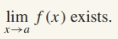
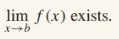
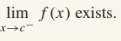

The graph of f is shown in the figure. If f is defined at k, but the limit of f(x) as x approaches k DNE, then k =
a
b
c
0

Select all statements that are TRUE.


Find the limit. Hint: Where is the horizontal asymptote?
3/7
0
∞
−∞
Find the limit. Hint: Where is the horizontal asymptote?
-2/9
0
∞
−∞
x→∞lim 4x +12x−3
0
DNE
1/2
2
x→∞lim(2x3+3x−1)=
Hint: Think of the end behavior
∞
−∞
2
2/3
x→−∞lim(x2+3x−1)=
Hint: Think of the end behavior of an even and positive polynomial.
∞
−∞
2
3
x→∞limex=
Hint: Think of the end behavior
∞
−∞
0
DNE
Determine the limit at infinity by finding the slant asymptote using long division and then looking at the end behavior of the slant asymptote.
x→∞lim(x+3x2−x−12)
∞
−∞
-3
4
x→∞lim xsin x+4
1
0
DNE
4
x→−∞lim xcos x
DNE
1
0
−∞

Find the limit
6/5
0
∞
−∞
x→∞lim 5−3x−x4x3−x2+1=...
0
-1
-5
∞
−∞
x→∞lim x3+x+11−2x+2x3= ...
- 4
- 2
1
2
∞
x→∞lim 4x2+3xx+7=...
−∞
∞
21
0
−21
The x→0limf(x) fails to exist because...
As the function approaches zero, left and right of zero do not match
As the function approaches zero, the graph oscillates.
As the function approaches zero, the graph increases without bound.
The function only approaches zero from one side.

