Wayground logo

Free Printable Worksheets

Font size

S
M
L
XL
Worksheets

Unit 4 Review

Total questions: 83

Worksheet time: 1hrs 8mins

Name
Class
Date
1.

The gas produced by photosynthesis

a)

Carbon Dioxide

b)

Oxygen

c)

Water

d)

Glucose

2.

 The process by which autotrophs use energy from sunlight to produce glucose

a)

Cellular Respiration

b)

Light Reaction

c)

Photosynthesis

d)

Calvin Cycle

3.

Pigment primarily responsible for photosynthesis

a)

Carotene

b)

Chloroplast

c)

Photosynthesis

d)

Chlorophyll

4.

Membranous sacs inside the chloroplast where the light reactions take place

a)

Thylakoid

b)

Stroma

c)

Chloroplast

d)

Mitochondria

5.

Where the Calvin Cycle takes place

a)

Thylakoid

b)

Stroma

c)

Mitochondria

6.

The photosynthetic reaction that turns light and water into oxygen and energy

a)

Calvin Cycle

b)

Photosynthesis

c)

Light Reaction

d)

Cellular Respiration

7.

The photosynthetic reaction that ends with the production of glucose

a)

Calvin Cycle

b)

Photosynthesis

c)

Light Reaction

d)

Cellular Respiration

8.

The glucose created during photosynthesis comes from the ________ molecules.

a)

Carbon Dioxide

b)

Oxygen

c)

Water

d)

Glucose

9.

Most of the energy used by life on Earth comes from the…

a)

Sun

b)

Moon

c)

Oxygen

d)

Glucose

10.

Chlorophyll is green because

a)

It reflects green wavelengths of light

b)

Of an optical illusion caused by transmitted light

c)

It absorbs blue and yellow, which make green

d)

It absorbs green wavelengths of light

11.

Which of the following environmental factors does not affect the rate of photosynthesis?

a)

Light intensity

b)

Carbon dioxide concentration

c)

Temperature

d)

Oxygen concentration

12.

Refer to the illustration below. Graph A demonstrates that the rate of photosynthesis

a)

Increases indefinitely in response to increasing light intensity

b)

Increases in response to increasing light intensity, but only to a certain point

c)

Decreases in response to increasing light intensity

d)

Is unaffected by changes in light intensity

13.
This is referred to as the energy currency of the cell
a)
ADP
b)
ATP
c)
Mitochondria
d)
Nucleus
14.
This process releases chemical energy from sugars and other carbon-based molecules to make ATP when oxygen is present.
a)
photosynthesis
b)
light-independent reaction
c)
cellular respiration
d)
light-dependent reaction
15.

Glucose is broken down into pyruvic acid during which process

a)
Krebs cycle
b)
Calvin cycle
c)
Glycolysis
d)
Photosynthesis
16.
Aerobic respiration is different from anaerobic respiration in that aerobic respiration needs...
a)
chlorophyll
b)
carbon dioxide
c)
glucose
d)
oxygen
17.
What is the correct equation for cellular respiration?
a)
6O2 + C6H12O6 -> 6CO2 + 6H2O + Energy
b)
6O2 + C6H12O6 + Energy -> 6CO2 + 6H2O
c)
6CO2 + 6H2O -> 6O2 + C6H12O6 + Energy
d)
6CO2 + 6H2O + Energy -> 6O2 + C6H12O6
18.
Where does the Krebs Cycle take place?
a)
mitochondria
b)
chloroplast
c)
cytoplasm
d)
nucleus
19.

Which molecule isn't a high energy hydrogen carrier?

a)
FADH2
b)
NADH
c)
oxygen
20.

what are the outputs of glycolysis?

a)

CO2

b)

Pyruvic acid x 2

c)

H2O

d)

ATP

21.
The energy in ATP is stored 
a)
in the bond between the second and third phosphate
b)
in the bond between the first and second phosphate
c)
in the bond between the adenosine and the first phosphate
d)
I like turtles
22.
What is the energy molecule?
a)
DNA
b)
ATP
c)
RNA
d)
AAA
23.
The splitting of the glucose molecule is called?
a)
synthesis
b)
denaturalization
c)
glycolysis
d)
dissolving
24.

Which of the following is a product of cellular respiration?

a)

Radiant Energy

b)

Oxygen

c)

Glucose

d)

Water

25.

What are the reactants (taken into) of cellular respiration? (Mark all of them!)

a)

oxygen

b)

glucose

c)

carbon dioxide

d)

water

e)

energy

26.

Each glucose (6C) produces how many pyruvic acid (3C) molecules?

a)

5

b)

2

c)

3

d)

4

27.
Where does glycolysis take place?
a)
Cytoplasm
b)
Stroma
c)
Thylakoid
d)
Mitochondria
28.

Which of the following do at least one stage of cellular respiration

a)

plants

b)

animals

c)

bacteria

d)

fungi

29.

What happens to the carbon atoms in glucose during cellular respiration?

a)

They are exhaled as CO2CO_2  

b)

They disappear

c)

They are broken down and dissolve

d)

They stay in the mitochondria forever

30.

Why does the third phosphate in ATP have so much energy stored in the bond?

a)

it is highly unstable

b)

it isn't

c)

it is highly stable

d)

it is moving very fast

31.

What role do NADH and FADH2 (produced during Glycolysis and Kreb's Cycle) play in cellular respiration

a)

they are energy carriers (hydrogen)that use that energy to produce massive amounts of ATP

b)

They are waste products and are pushed out of the cell

c)

They are necessary for long-term energy storage

d)

They don't play any role in cellular respiration

32.

What are the outputs of the kreb's cycle

a)

CO2

b)

H2O

c)

ATP

d)

NADH and FADH2

33.

What happens in the electron transport chain?

a)

NADH and FADH2 drop off hydrogens to form massive amounts of ATP

b)

pyruvic acid is formed from breaking down glucose

c)

CO2 is released and H2O and ATP

d)

glucose is broken down and ATP is formed

34.

Which is a product of glycolysis?

a)

2 molecules of pyruvic acid

b)

1 molecule of glucose

c)

NAD+

d)

oxygen

35.

Where does the pyruvic acid produced by glycolysis go next?

a)

the Calvin Cycle

b)

the electron transport chain

c)

the Krebs Cycle

d)

back through the glycolysis process

36.

Glycolysis requires oxygen

a)

True

b)

False

37.

Which of these is broken down into pyruvic acid?

a)

glucose

b)

oxygen

c)

water

38.

After the NAD+ receives electrons, what does it change to?

a)

ATP

b)

NADH

c)

ADP

39.

Glycolysis has a net gain of how many ATP molecules?

a)

2

b)

4

c)

6

40.

Glycolysis DOES NOT need ATP to occur.

a)

True

b)

False

41.
Where does glycolysis take place in cells?
a)
Cytoplasm
b)
Mitochondrion
c)
Endoplasmic Reticulum
d)
Ribosomes
42.
Which is not part of the net products of Glycolysis?
a)
2 ATP
b)
2 NADH
c)
2 Pyruvate
d)
2 CO2
43.
Which of the following is not a requirement for glycolysis?
a)
Oxygen
b)
ATP
c)
NAD+
d)
Glucose
44.
Which of the following is not a product of glycolysis?
a)
FADH2
b)
NADH
c)
ATP
d)
Pyruvate
45.

Where does the pyruvic acid produced by glycolysis go next?

a)

the Calvin Cycle

b)

the electron transport chain

c)

the Krebs Cycle

d)

back through the glycolysis process

46.
Glycolysis literally translates to:
a)
sugar-taking
b)
Glucose-making
c)
sugar-baking
d)
Glucose-breaking
47.

What are the end products of Glycolysis?

a)

2 ATP, 2 NADH, 2 Pyruvate

b)

4 ATP, 2 NADH, 1 Pyruvate

c)

2 ATP, 1 NADH, 2 Pyruvate

d)

4 ATP, 2 FADH2, 2 Pyruvate

48.
How many H+ are pumped out of the matrix from 1 FADH2?
a)
1
b)
2
c)
3
d)
4
49.
How many H+ are pumped out of the matrix from 1 NADH?
a)
1
b)
2
c)
3
d)
4
50.
If a hole was created in the inner mitochondrial membrane the result would be _________ ATP created from the ETC.
a)
Less
b)
More
51.
The "Final Electron Acceptor" of the ETC is
a)
Oxygen
b)
Nitrogen
c)
CO2
d)
H2O
52.
ATP molecules are made by this process during the ETC.
a)
Tinkerbell
b)
Substrate Level Phosphorylation
c)
Oxidative Phosphorylation
d)
Photo-phosphorylation
53.
The process of using electrons to pump H+ to create an electrochemical gradient that must flow through a protein is called:
a)
Chemiosmosis
b)
Fantasia
c)
Induced Fit
d)
Electrolysis
54.
All cells have a:
a)
Nucleus
b)
Plasma membrane
c)
Cell wall
d)
Buddy
55.
The function of the plasma membrane is....
a)
to regulate what enters and leaves the cell.
b)
fight bacteria and viruses that enter the cell.
c)
provide rigid support and protection to the cell.
d)
make sure each cell can move
56.
What is NOT TRUE about the cell membrane
a)
It controls what enters and leaves the cell
b)
Semipermeable
c)
Phospholipid bilayer
d)
Contains digestive enzymes
57.
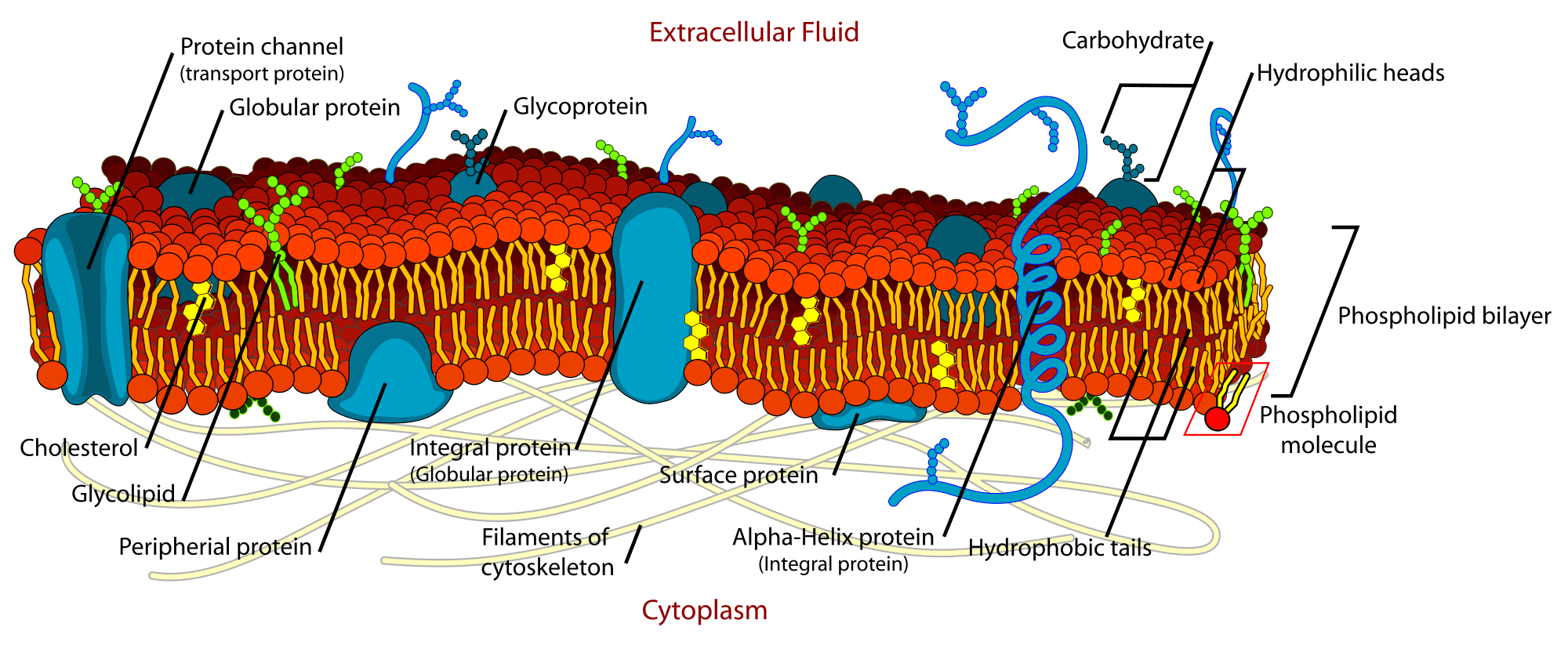
What do the brown structures represent?
a)
Phospholipids
b)
Glycoproteins
c)
Channel Proteins 
d)
Cyctoskeleton Filaments
58.
What is another term for "selectively permeable"?
a)
porous
b)
completely permeable
c)
permanent
d)
semipermeable
59.
Maintaining a constant internal state in a changing environment.
a)
Homeostasis
b)
Active Transport
c)
Mitosis
d)
Photosynthesis
60.
A type of passive transport that moves particles from high concentration to low concentration; like the iodine into the cornstarch bag
a)
Exocytosis
b)
Osmosis
c)
Diffusion
d)
Endoyctosis
61.
A type of active transport that brings particles into a cell when the cell membrane encloses a particle to make a vesicle
a)
Diffusion
b)
Passive Transport
c)
Active Transport
d)
Endocytosis
62.
A type of active transport that releases particles that were enclosed from a cell when the membrane of the vesicle fuses with that of the cell membrane
a)
Exocytosis
b)
Osmosis
c)
Mitosis
d)
Endoyctosis
63.
A type of passive transport that occurs when water crosses a cell membrane; like water entering raisin cells
a)
Osmosis
b)
Diffusion
c)
Mitosis
d)
Endocytosis
64.

Diffusion & Facilitated Diffusion are both __________ transport.

a)

Passive

b)

Active

c)

Easy

d)

Free

65.

Passive Transport is the movement of particles across the membrane from an area of [ ___ ] to an area of [ ___ ]

a)

high to low

b)

low to high

c)

low to low

d)

high to high

66.

Passive Transport uses ____ energy

a)

no

b)

a lot of

c)

a little bit of

d)

some

67.

The type of transport that requires the use of transport proteins

a)

Passive Transport

b)

Facilitated Diffusion

c)

Active Transport

d)

Vesicular Transport

68.

The passage of a substance from an area of high concentration to an area of low concentration

a)

Active Transport

b)

Diffusion

c)

Vesicular Transport

d)

Exocytosis

69.

The energy molecule that powers some modes of transport

a)

ADP

b)

ATP

c)

AGP

d)

ABP

70.
What is this image?
a)
cell membrane
b)
proteins
c)
carbohydrates
d)
lipids
71.
What does "bilayer" mean?
a)
one layer
b)
two layers
c)
laminated
d)
bilateral
72.
Hydrophilic means...
a)
water-loving
b)
water-fearing
c)
nonpolar
d)
lipid soluble
73.
Hydrophobic region of the cell membrane?
a)
E
b)
B
c)
C
d)
A 
74.
A ______________ is composed of a phosphate and glycerol head and 2 fatty acid chain tails. 
a)
phospholipid 
b)
Carbohydrate
c)
Cholesterol 
d)
Protein 
75.
___________ allow cells to recognize each other and act like ID tags. 
a)
Carbohydrates 
b)
Proteins
c)
Phospholipids 
d)
Cholesterol
76.
___________ strengthens and stabilizes the cell membrane.
a)
Carbohydrates 
b)
Proteins 
c)
Phospholipids 
d)
Cholesterol
77.

The _______________ of the phospholipids in a cell membrane face inward towards each other.

a)

heads

b)

tails

c)

stems

d)

sticks

78.

The solution surrounding the cell in Diagram B, would be defined as:

a)

hypertonic

b)

hypotonic

c)

isotonic

79.

The solution surrounding the cell in Diagram C, would be defined as

a)

hypertonic

b)

isotonic

c)

hypotonic

80.
The cell below is in a _________ solution.
a)
Hypotonic
b)
Hypertonic
c)
Isotonic
81.
What type of solution is this cell in?
a)
Isotonic
b)
Hypertonic
c)
Hypotonic
d)
diffused
82.
What type of solution allows water to enter the plant cell?
a)
hypotonic solution
b)
hypertonic solution
c)
isotonic solution
d)
active transport
83.
What type of solution is this cell in?
a)
Isotonic
b)
Hypertonic
c)
Hypotonic
d)
diffused