
Font size
 Worksheets
BASPHYS practice finals
Total questions: 115
Worksheet time: 2hrs 52mins
Which one of the following statements is true concerning scalar quantities?
Scalar quantities must be represented by base units.
Scalar quantities have both magnitude and direction.
Scalar quantities can be added to vector quantities using rules of trigonometry.
Scalar quantities can be added to other scalar quantities using rules of trigonometry.
Scalar quantities can be added to other scalar quantities using rules of ordinary addition.
What is the x component of a vector A = 34 units, 30o S of W?
-29.44 units
29.44 units
17
-17
In getting the proper angle in component method, by how much angle should be added to the given angle if the direction is East of South?
90 degrees
180 degrees
270 degrees
360 degrees
Which of the following should be used to get the magnitude of the resultant vector?
pythagorean theorem
law of cosine
tangent identity
sine identity
Which of the following is considered the opposite side in computing for the angle of the resultant vector?
x component
y component
depending on the situation
none of the 2 components
Calculate for the angle theta if the sum of all x components is 7.2 units and sum of all y components is 8.3 units. Round off your answer to one decimal place only.
(a)
What is the value of vector if you are asked to get the -B, where B = 24 units, W?
24 units, E
-24 units
24 units, S
24 units, N
What is the polar coordinate equivalent of C = 4.5 units, 60o W of N?
60o
150o
30o
240o
Which of the following methods should be used when you are asked to find for the sum of 3 or more vectors? Check all that applies.
tail-tip method
component method
polygon method
parallelogram method


What is the average velocity of the object between 0 and 10 seconds?
6.0 m/s
1.5 m/s
-4 m/s
0 m/s

What is the average velocity of the object between 10 and 15 seconds?
6 m/s
1.5 m/s
-4 m/s
0 m/s

What is the rate of acceleration of the object between 0 and 4 seconds?
1 m/s
0 m/s2
-1 m/s2
1 m/s2
What does 'inertia' mean?
Two unequal oppositely exerted forces
A property of matter where it continues in its existing state of rest or uniform motion.
an instance of one moving object or person striking another
A body continues to be in its state of rest or of uniform motion unless acted upon by an unbalanced external force.
Newton's First Law of Motion
Newton's Second Law of Motion
Newton's Third Law of Motion
The law of Inertia
What are the types of inertial?
inertia of direction
inertia of motion
inertia of curve
inertia of rest
At one instant an object in free fall is moving downward at 50 m/s. One second later its speed is
100 m/s
50 m/s.
55 m/s.
60 m/s.
Jogging Jake runs at 4 m/s along a train flatcar that moves at 10 m/s in the same direction. Jake's speed relative to the ground is
6 m/s
10 m/s
14 m/s
Need more information
A car's speed 3 seconds after accelerating from rest at 2 m/s2 is
2 m/s
3 m/s
4 m/s
6 m/s
While an iron block near the Earth's surface is in free fall, it undergoes an increase in
speed
acceleration
both of these
neither of these
If an object falling freely were somehow equipped with an odometer to measure the distance it travels, then the amount of distance it travels each succeeding second would be
constant
less and less each second
greater than the second before
doubled
A ball is thrown upwards and returns to the same location. Compared with its initial speed its speed when it returns is about
half as much
twice as much
the same as before
four times as much
Action and reaction forces are equal in magnitude, but opposite in (a) .

A basketball that is thrown to the ring follows a path that is ______________.
hyperbolic
parabolic
linear
circular
What happens to the horizontal velocity of a projectile as it travels along the curved path?
increases
decreases
stays the same
none of these
What happens to the vertical velocity of a projectile as it goes up?
increases
decreases
stays the same
none of these
What happens to the vertical velocity of a projectile as it goes down?
increases
decreases
stays the same
none of these

What is the vertical acceleration of a projectile due to gravity?
-9.0 m/s
-9.8 m/s
-9.8 m/s2
-9.08 m/s2

In the diagram, which letter represents the vertical displacement dy ?
A
B
C
D
In the diagram, which letter represents the horizontal displacement dx ?
A
B
C
D

What is the horizontal acceleration of a projectile?
0 s2m
-9.8 s2m
What force acts in the y direction that causes an object to follow a parabolic path?
tension
friction
gravity
no force
Which vector pair (arrow pair) correctly represents the acceleration and velocity at point P?


When is work done on an object?
When an object has a net force applied to it.
When an object moves while a net force is being applied to it
When an object doesn't move while a net force is applied to it
When an object is moving without a net force being applied to it

When the weightlifter holds the weight above his head he may get incredibly tired, ...
He is getting tired because he is doing work on the barbell of weights
He is getting tired because his muscles are stretching and squeezing to do work on the barbell of weights
He is now the equivalent of a table with weights on it.
He is getting tired because his muscles are stretching and squeezing, but he is not doing work on the barbell of weights

What just happened in this picture?
The weight lifter did work by lifting the barbells from the floor to above his head.
The weight lifter did not do work when lifting the barbells above his head.
The weight lifter did no work because he is just a table for weights.
The barbells did work on the weight lifter when lifted from the ground to above the weight lifters head.
Which of the following examples has NO work being done? (Choose all that apply)
An archer stretches her bowstring.
An ant carries a leaf cutting from a tree to his colony
An athlete does push-ups on the ground
A book sits on the shelf
An asteroid speeds across the solar system
Which of the following examples has work being done? (Choose all that apply)
An archer stretches her bowstring.
An ant carries a leaf cutting from a tree to his colony
An athlete does push-ups on the ground
A book sits on the shelf
An asteroid speeds across the solar system
The units of measurement for work are?
Newton
Newton*meter
Joule
Watt
Joule per second
A kilojoule is how many joules?
1
100
10,000
100,000
1,000
A megajoule is how many joules?
1
100,000
1,000
1,000,000
100
Suppose that you apply a 100 Newton horizontal force to a box on the floor, which pushes the box 10 meters. How much work do you do on the box?
100 J
1 J
1000J
10000J
1 kJ
How do you calculate power?
Amount of work done divided by the time interval during which the work is done.
Amount of net force applied to an object multiplied by the distance the object moves
Mass multiplied by acceleration
Amount of momentum gained multiplied by the time interval in which the momentum was gained
If a newer better engine has twice the power of an older engine, this means that the newer engine can do what? (Choose all that apply)
The engine can do half the work in twice the time.
The engine can do twice the work in the same amount of time.
The engine can do the same amount of work in half the time.
The engine can do twice the work in twice the time.
The engine can do twice the work in half the time.
What are the units of power?
Watts
Joules per second
Joules multiplied by seconds
Newtons multiplied by meters divided by seconds
Horsepower
One kilowatt is equal to how many watts?
1
10
1,000
10,000
100,000
What are the two forms of mechanical energy?
elastic
kinetic
potential
chemical
gravitational
To find gravitational potential energy on Earth we use which of the following equations?
PE = m*g*h
PE = m*v*d
PE = m*g*s
PE = m*g/h
PE = m*v/g
The work required to bring an object up to a final speed from rest is called what?
gravitational potential energy
chemical energy
thermal energy
potential energy
kinetic energy
The work required to slow down an object down to rest from some initial speed is called what?
gravitational potential energy
chemical energy
thermal energy
potential energy
kinetic energy

The kinetic energy of an object increases by what factor if the velocity is doubled?
a factor of one half
a factor of double
a factor of triple
a factor of quadruple
The kinetic energy of an object increases by what factor if the mass is doubled?
a factor of one half
a factor of double
a factor of triple
a factor of quadruple
The units of measurement for potential energy are?
Newton
Newton*meter
Joule
Watt
Joule per second
The units of measurement for kinetic energy are?
Newton
Newton*meter
Joule
Watt
Joule per second
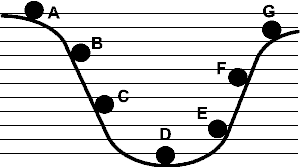
At which point does the ball has the greatest gravitational potential energy (GPE)?
A
G
D
C
G

You throw a ball into the air as shown in the diagram. At what point does the ball have the most gravitational potential energy?
W
X
Y
Z

At which point in the picture must the cart have the most MECHANICAL energy?
Point 1
Point 2
Point 3
They would all be the same
A rubber band that is pulled back waiting to "fly" has what type of energy?
chemical potential
electrical potential
gravitational potential
elastic potential
When you turn on a lamp, electrical energy is converted to
radiant energy
sound energy
chemical energy
nuclear energy
What is a force that opposes motion when two objects are in contact with each other called?
applied force
frictional force
potential force
thermal force
The law of Conservation of energy states that energy can be transformed from one form to another, but it cannot be _______ or ________
transformed, or created
divided or multiplied
radiated or conducted
created or destroyed

Which letter shows the ball when it has NO potential energy?
B
C
D
E
F
Which letter shows the ball when it has THE MOST kinetic energy?
B
C
D
E
F
Which letter shows the ball when it has THE MOST kinetic energy?
B
C
D
E
F
Which letter shows the ball when it has THE LEAST kinetic energy?
A
B
C
F
G
Which letter shows the ball when it is moving the fastest?
B
C
D
E
F

What happens when the ball goes from the highest position to the lowest position
PE and KE increases and decreases together
Impossible to know without knowing the mass of the object
the PE decreases while KE increases
According to the law of conservation of energy, energy can be created or destroyed.
True
False



A constant force of 4.5 N acts on a 7.2-kg object for 10.0 s. What is the change in the object's momentum?
45 kg m/s
72 kg m/s
32.4 kg m/s
0.45 kg m/s
Impulse is equal to:
FΔx
mv − mvo
21mv2− 21mvo2
ΔtΔp
What is a term to indicate an elastic collision?
Couple
Stick
Rebound
Motion
What is a term to indicate an inelastic collision?
Bounce Off
Rebound
Motion
Couple
When two objects are both moving in a system, when summing the momentums it is important to pay attention to the
direction of the velocity
direction of the mass
magnitude of the velocity
magnitude of the mass
Wearing a safety helmet is an effective way to protect your head from injury. In order for the force to ___________ on impact, the time to bring your head to a stop must ____________. This is done through adding padding in the helmet.
decrease; increase
increase; decrease
increase; increase
decrease; decrease
The conservation of momentum states that the initial momentum into a system is ____________ to the final momentum out of a system.
Greater than
Less than
Equal
Momentum conservation applies to ________ systems.
All
Some
No
A golfer swings his golf club to strike a golf ball on a tee. If the golfer wants to apply the greatest force on the golf ball:
Increase the time of contact with the golf ball
Decrease the time of contact with the golf ball
Increase the energy of the swing
Decrease the energy of the swing
What determines the direction of the impulse applied to an object?
The magnitude of the force
The magnitude of the velocity
The direction of the force
The time it takes to apply the force
Which of the following has the greatest amount of momentum if all objects are moving the same velocity?
A car
A big rig truck
A train
A bicycle
Impulse is equal to the
Change in work of a system
Change of energy of a system
Change of momentum
Change of time
What type of relationship do force and time have in the impulse equation?
Direct relationship
Inverse relationship
Indirect relationship
Different relationship
A soccer ball with a mass of 0.43 kg is kicked with a velocity of 15 m/s. If a basketball thrown with a mass of 0.62 kg has the same momentum as the soccer ball being kicked, how fast would it need to be thrown?
6.45 m/s
10.4 m/s
9.3 m/s
21.6 m/s
A train car with a mass of 12,000 kg travels toward another train car at a speed of 0.60 m/s. The second train car has a mass of 13,500 kg and is at rest when it collides and couples with the first train car. At what final speed will the two train cars travel off together after the collision?
0.28 m/s
0.53 m/s
0.60 m/s
0.32 m/s
A bowling ball with a mass of 6 kg is thrown down a lane with a velocity of 4.70 m/s toward a bowling pin with a mass of 1.6 kg at rest. If the bowling pin is struck and rebound off the bowling ball with a speed of 3.4 m/s in the same direction as the bowling ball was initially moving, what is the final speed of the bowling ball after the collision?
3.8 m/s
-8.1 m/s
5.6 m/s
0.91 m/s

