
 Worksheets
PS Modules 6&7 Electricity and Magnetism
Total questions: 79
Worksheet time: 1hrs 21mins
The rate of electron flow in a circuit
Voltage
Resistance
Current
Power
Energy used or gained across two points in a circuit
Current
Voltage
Resistance
Power
Opposition to the flow of electrons
Current
Voltage
Resistance
Power
Which of the following charge pairs would repel each other? (Choose all that apply)
positive and negative
negative and negative
positive and positive
negative and positive
Determine how the following factor would affect the amount of resistance: thick wire
increase resistance
decrease resistance
would not affect resistance
Determine how the following factor would affect the amount of resistance: insulating material
increase resistance
decrease resistance
would not affect resistance
Determine how the following factor would affect the amount of resistance: longer wire
increase resistance
decrease resistance
would not affect resistance

What type of circuit is this?
Series
Parallel
Simple
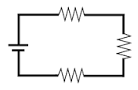
In a series circuit, how is the brightness of a light bulb affected when another bulb is connected?
It gets brighter
It stays the same
It gets dimmer
It goes out
Which of the following materials that is not a good electrical conductor?


Two unlike charges_________
Attract each other
Neutralize each other
Repel each other
Have no effect on each other
What energy changes take place to make a fan spin?
Electrical energy changes to heat energy.
Electrical energy changes to mechanical energy.
Wind energy changes to electrical energy.
Heat energy changes to mechanical energy.
What produces an electrical current when a turbine is used to rotate an iron core wrapped with a coil of wire near a magnet.
fan
generator
motor
radiator
Which of these DOES NOT affect the strength of an electromagnet?
voltage of the battery
amount of material in the core
number of times the wire is looped around the core
size of the object being attracted by the core
What types of energy are made when a there is a light bulb in a complete circuit?
thermal and light
magnetism and sound
sound and thermal
light and magnetism
If a student wanted to make a generator, what would be the next step?
1. wrapping wire around a cardboard tube
2. attaching the ends of the wire to a current detector 3. ???
Surround the cardboard tube with magnets
Set a magnet next to the cardboard tube
Hold a magnet stationary in a cardboard tube
Push and pull a magnet through the cardboard tube
When the switch is closed on an electromagnet, what will most likely happen?
The battery's charge will be depleted
Rusting will be immediately observed
The iron in the nail will break down
A magnetic field will be produced.
Which of the following will always produce a magnetic force?
a long piece of copper wire
an electric field
a large static electric current
an electric current
What is the energy conversion provided by a generator?
thermal to electrical energy
mechanical to electrical energy
nuclear energy to mechanical
thermal energy to mechanical energy
When an iron nail wrapped in a copper wire is attached to a circuit it forms
a battery
an engine
an insulator
an electromagnet
What energy conversions take place in a kitchen toaster?
heat to mechanical
electrical to heat
heat to chemical
electrical to chemical
An object becomes positively charged when which of the following occurs?
loses electrons
gains electrons
loses protons
gains neutrons
Electric current moves from areas of positive charge to areas of _____________.
positive charge
negative charge
They are materials that do NOT allow electrons to flow through them easily. Example: rubber, dry wood, glass, ceramic, fabric, plastic, and paper, among others.
conductors
insulators
drivers

In an open circuit the switch is _____.
on
off
In an closed circuit the switch is _____.
on
off
What is one problem with using a series circuit?
If one device goes down, they all go down!
It doesn't work properly.
It has a lot of series.
There are no problems.
What is one benefits of using a parallel circuit?
It gets confusing.
There are no problems.
If one goes down, it does not affect theothers.
It has no benefits

This is the symbol for a(n) ..................?
single cell
bulb
battery
AC current source
Which does electric current flow naturally?
insulators to conductors
high-voltage areas to low-voltage areas
low-voltage areas to high-voltage areas
low-resistance areas to high-resistance areas
Which of the following transforms electrical energy into thermal energy?
battery
series circuit
parallel circuit
resistor
What is the stanadard voltage difference of electrical energy entering homes in the US?
220 V
1200 V
120 V
12 V
In order to work, a circuit must be:
Open
Closed
A current of 2A flows through a resistor with a resistance of 10Ω. What is the potential difference across the resistor?
5V
5J
20V
20J
A light bulb has a resistance of 7Ω with a potential difference of 21V across it. What is the current flowing through the light bulb?
147 A
28 A
3A
30A
A resistor has a potential difference of 10V across it and a current of 2A flowing through it. What is the resistance of the resistor?
20Ω
5Ω
200Ω
0.2Ω
A current of 5A passes through a resistor of 1kΩ. What is the potential difference across the resistor?
5 V
5x10⁻³ V
5x10³ V
0.2 V
A current of 2A flows through a resistor with a resistance of 10Ω. What is the potential difference across the resistor?
5V
5J
20V
20J
A light bulb has a resistance of 7Ω with a potential difference of 21V across it. What is the current flowing through the light bulb?
147 A
28 A
3A
30A
Which equation can be used to calculate the resistance R of a resistor?
V = I / R
I = V x R
R = V x I
V = I x R
What is the equation to calculate electric power?
P = V÷I
P = V x I
P = I ÷ V
P = V x R

A fridge has a potential difference across it of 155V and a current of 5A through it. Calculate the power.
21W
160W
31W
150W
The primary function of a fuse is to
Open the circuit
Protect the appliance
Protect the line
Prevent excessive currents from flow through the circuit
A circuit breaker is
power factor correcting device
a device to neutralize the effect of transients
a waveform correcting device
a current interrupting device.
A thermal protection switch provides protection against what?
Overload
Temperature.
Short circuit.
Overvoltage
To prevent overload and overheating of wires
fuses are used
circuit breakers are used
fuses and circuit breakers are used
fuses and resistor are used
The function of the circuit breaker is
To safeguard the circuit
On and off the circuit
To save human life
None of these

when 2 magnets are put close to each other from the same poles they .................each other
attract
repel

when 2 magnet are put from different poles they.................each other.
attract
repel
which of the following is magnetic?
Iron
Copper
Plastic
Wood
Where is the force of a magnet the strongest?
at the magnet's poles
in the middle of the magnet
far away from the magnet
When all of the magnetic fields of magnetic domains align in the ______ direction, a material becomes magnetic.
opposite
same
If two magnets have their North Poles facing each other then what will happen?
They will attract.
They will drift.
They will explode.
They will repel.
Which metal is NOT magnetic?
copper
iron
cobalt
nickel

Which of the following shows the magnetic field correctly around a bar magnet?
Diagram A
Diagram B
Diagram C
Diagram D

We know the substance in the image is magnetized because ___.
All the domains are at right angles to each other.
All the domains are aligned.
All the arrows are drawn in red.
All the domains are not aligned.
How do magnetic field lines move?
always from the south pole towards the
north pole
always from the north pole towards the
south pole
always from the pole to the middle
depends of the type of magnet
Earth is like a giant magnet due to....
its iron and nickel from the Earth's core
the wind patterns of Coriolis Effect
the alignment of the continents
solar particles moving through the atmosphere
If you cut a bar magnet into 4 pieces, each piece will
be either a North or South Pole
no longer be magnetic
still be a complete magnet
In unmagnetized objects, the magnetic domains
Are in random directions
In one straight direction
Two different directions
None of the above
If you break a magnet in half you will have created.
1 north and 1 south magnet
2 new magnets
2 demagnetized magnets
1 giant magnet

