
 Worksheets
Science Interim Review
Total questions: 83
Worksheet time: 1hrs 8mins

An object that is thrown into water and floats has...
Less density than water
more density than water
Delicious flavor
less gravity
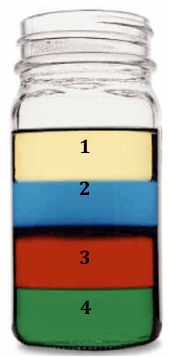
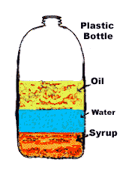
4, 3, 2, 1
1, 2, 3, 4
3, 4, 2, 1,
4, 3, 1, 2

A type of cold pack has two separate sections inside. One section contains a liquid and the other section contains a powder. When the cold pack is squeezed, the section that holds the liquid breaks. When the liquid combines with the powder, the pack becomes very cold.
Which is the BEST explanation why the temperature of the pack decreases when the liquid and powder combine?
a mixture forms
a solution forms
a chemical change occurs
thermal energy is used
Students completed four investigations where they combined two different substances.
Which investigation shows evidence that the chemical properties of the substances changed?
Sand sinks in water when water and sand are combined.
Bubbles form when baking soda and vinegar are combined.
Salt dissolves in water when salt and water are combined.
Vegetable oil coats the surface of lettuce when oil and lettuce are combined.

Cherise mixed 30 grams of sugar into 100 grams of water. The sugar dissolved. Cherise recorded the data in the table.
Based on the data in the table, find the mass of the sugar solution.
100 grams
108 grams
130 grams
200 grams

Chris fit the pieces of a shuttle model together.
Which statement BEST describes how the pieces compare to the complete model?
Each piece is stronger than the completed model.
The mass of the completed model equals the mass of all the pieces.
Each piece is made from a different material than the completed model.
The mass of the completed model is more than the mas of all the pieces.
Which picture BEST shows what change occurs when heat is added to ice?


Which of the following models best shows this process?


The picture shows butter and water in solid states. The melting point is shown. Which statement describes the most likely state of each substance after 2 hours?
The butter and water will both remain solids.
The butter and water will both become liquids.
The butter will remain a solid and the water will become a liquid.
The butter will become a liquid and the water will remain a solid.
Choose 3 examples of a chemical reaction. Click all that apply.
burning paper
melting ice
rotting food
cooking cake
In the periodic table, elements in the same column have...
similar properties
same number of protons
same number of neutrons
nothing in common
How can a scientist, using the periodic table, find an element with properties similar to another element?
By comparing density
By finding its group on the periodic table
By comparing malleability
By comparing atomic weight
What are size, shape, color, texture, and hardness?
states of matter
properties of matter
measures of matter
changes in matter
How does heat transfer?
Hot to cold
Cold to hot
What type of heat transfer is occurring between a hot cup of coffee in your hands?
Conduction
Convection
Radiation
What type of heat transfer is occurring when a fireplace heats the air in a room?
Conduction
Convection
Radiation

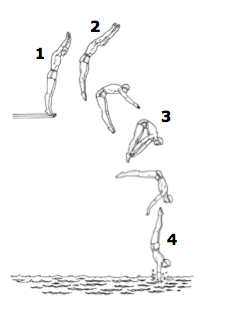
At which point is potential energy greatest?
W
X
Y
Z
Which of the following properties are chemical properties?
a tee shirt is extra large
100 pennies weighs 90 g
vinegar produces carbon dioxide bubbles when combined with baking soda.
the density of copper is 8.96 g/cm3
______________________ can only be recognized when substances react or do not react chemically with one another.
Physical properties
Chemical properties
Flammable properties
Colorful properties

Nanaki is investigating some of the properties of eggs through a series of experiments. She records her results in a table, but she is not sure which changes are physical and which are chemical.
Based on the information in the table, which experiment(s) caused chemical changes and how do you know?
All of the experiments caused chemical changes, because they were all irreversible and changed the appearance of the eggs.
Experiments 2, 3, and 4 caused chemical changes, because they changed the basic properties of the eggs; Experiment 1 did not, because it only created a mixture.
Experiments 3 and 4 caused chemical changes, because they involved heat and resulted in new substances; Experiments 1 and 2 did not, because they only created mixtures.
Experiment 4 caused a chemical change, because it created a new, crusty brown substance; the others did not, because they only caused changes in phase and color without changing the chemical makeup of the eggs
On a hot summer day, you make a glass of refreshing sweet iced tea by combining boiling water, tea, sugar, and ice. What type of change occurs and how do you know?
Physical change; sugar dissolves in the tea and water, but the chemical composition remains the same.
Physical change; sugar dissolves in the tea and water which breaks the bonds of the molecules.
Chemical change; sugar dissolves in the tea and water due to heat being added to the water.
Chemical change; sugar dissolves in the tea and water which breaks the bonds of the molecules.

Is this an example of a physical or chemical change?
physical
chemical

Is this an example of a physical or chemical change?
physical
chemical

What does the picture represent ?
physical change
chemical change
One cup of water is left outside for two days when it was checked there was only half a cup left. What happened?
evaporation; chemical change
condensation; physical change
evaporation; physical change
condensation; chemical change
How many nitrogen atoms does NH3 have?
1
2
3
4
Which are the reactants in the following reaction?
2Mg + O2 ---> 2MgO
Mg and O
MgO
Mg and MgO
O and MgO
What will weigh more when a chemical change is complete? The reactants before the chemical reaction, or the product after the reaction is complete?
They both will weigh the same
The product always weighs more than the reactant
The reactant will weigh more than the product
They both will loose mass after the reaction

Directions: Read the passage about mass in a combustion reaction.
The combustion of methane is a reaction in which methane gas burns in oxygen to produce carbon dioxide and water vapor. It is represented by the equation:
CH4 (g) + 2O2 (g) → CO2 (g) + 2H2O (g)
In the equation, one molecule of methane gas requires two molecules of oxygen gas to produce one molecule of carbon dioxide gas and two molecules of water in vapor form. The molecules in the equation can be modeled with circles to represent atoms and straight lines to represent the bonds between them, as shown in the picture.
A student observes the model and claims that the total mass of the reaction is conserved. Is the student's claim correct? Why or why not?
No, because the arrangement of atoms is different in the reactants and products.
Yes, because the reactants and products are made of atoms of the same elements.
Yes, because the number of atoms of each element is the same on both sides of the equation.
No, because the total number of atoms in products is greater than the total number of atoms in reactants.

Consider the following chemical equation.
What explanation from the evidence within the chemical equation BEST supports the idea that matter is conserved in a chemical reaction?
There are the same number of atoms of oxygen and hydrogen in the reactants as there are in the products.
There are the same number of elements in the reactants as there are in the products.
More reactants, hydrogen and oxygen, were added to make the product, water.
Two reactants, hydrogen and oxygen, combined to make one product, water.
In a chemical reaction, table sugar (sucrose) is mixed with sulfuric acid. The result of the reaction is a towering black structure of elemental carbon, water vapor, carbon dioxide, and sulfur dioxide gases. How can conservation of matter be proved using this reaction?
The masses of the sugar, sulfuric acid, and glassware should be recorded before the experiment, then the resulting reactant masses should be compared with the original masses.
The masses of the resultant gases and structure should be weighed to show that the resultants are heavier than the products.
The masses of the resultant gases and structure should be weighed to show that the resultants are lighter than the products.
The masses of the sugar, sulfuric acid, and glassware should be recorded before the experiment, then the energy lost can be added to the resultants and compared to the original masses.

Which point has the most potential energy?
G
F
B
A
The faster an object moves, the ________ kinetic energy it has.
more
less

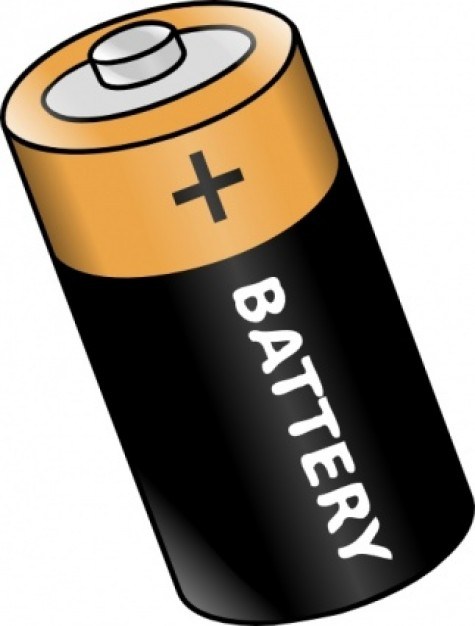
What form of energy is stored in a battery?
Chemical energy
Light energy
Mechanical energy
Heat energy
Which of the observations indicates that a chemical change has occurred?
A tray of water evaporates while sitting on a window sill.
A flashlight feels warm after it has been on for a long time
A gas is generated when two liquids are mixed together.
Paint dries after it is applied to a wall.

How many protons are in Gold
79
197
118
276

How many neutrons does Sodium (Na) have?
11
23
34
12
How could you increase the gravitational potential energy of an object without changing its mass and gravity?
Make the object larger
Lower the object towards the ground
Raise the object farther off the ground
Allow the object to roll on the ground
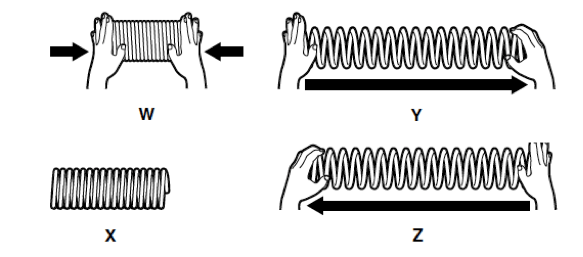
Elastic potential energy is energy stored in an object, such as a spring, due to the object being stretched or compressed. In which position is it most likely that the spring has lost its elastic potential energy?
W
Y
X
Z

Which pie chart represents the energy balance of the rollercoaster in this diagram?
Choice A
Choice B
Choice C
Choice D

A 15,000-kilogram truck and a 3,000-kilogram van are moving alongside one another on a road. The vehicles are moving at the same speed, and the speed of both vehicles is constant.
Which of the following statements is true about the vehicles?
The truck has more kinetic energy than the van.
The van has more kinetic energy than the truck.
Neither vehicle has any kinetic energy.
The vehicles have the same kinetic energy.

Daniel and Robert went rowing. While Robert was rowing at a speed of 8 km/h, Daniel was rowing at a speed of 10 km/h in the opposite direction.
If the masses of the boats and their rowers are equal, which of the following is a true statement about their kinetic energies?
Only Robert has kinetic energy because he is rowing in the forward direction.
Robert has more kinetic energy than Daniel.
Daniel has more kinetic energy than Robert.
Only Daniel has kinetic energy because his energy cancels out Robert’s.

Juniper and her cousins are racing model cars they have built. Based on the table below, whose car has the most kinetic energy as it rolls down the road?
Kylie
Craig
Sheldon
Juniper


Potential energy depends on ______ and _______.
height, mass
weight, mass
speed, mass
height, speed

Which picture is NOT an example of Chemical PE?
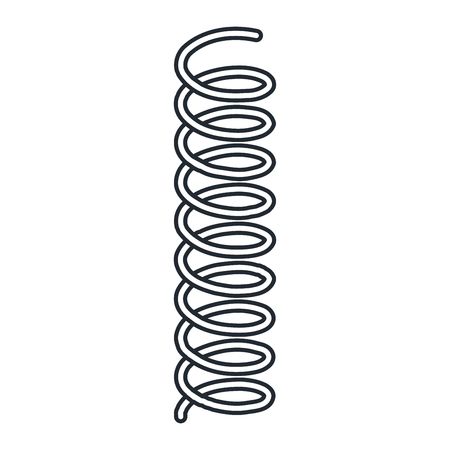


Consider the following samples.
Which model accurately classifies the samples?


Pure Substance
MIxture

What is it?
Pure Substance
Mixture

What is it?
Pure Substance
Mixture

What is it?
Pure Substance
Mixture

What is it?
Pure Substance
Mixture

What is this?
Element
Compound
Homogeneous Mixture
Heterogeneous Mixture

What is this?
Element
Compound
Homogeneous Mixture
Heterogeneous MIxture
Which is a mixture of compounds?


A phase change diagram is used to show the relationship between temperature, pressure and state of matter. Explain what is happening on the horizontal lines and why the lines are horizontal.

What line segment represents only the solid state? (Diagram F)
A-B
B-C
C-D
D-E
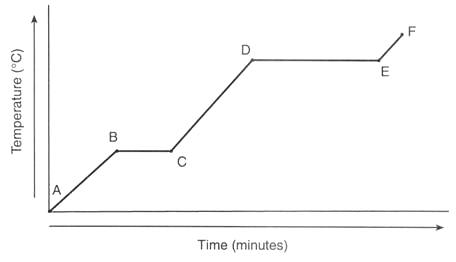
Between which points is the temperature of the substance remaining constant? (Diagram F)
A-B only.
A-B, C-D, E-F
B-C only.
B-C, D-E

Which line segment demonstrates vaporization occurring? (Diagram E)
B-C
C-D
D-E
E-F

Which state of matter is much like a gas, but with particles that are charged?
Solid
Liquid
Gas
Plasma
When water sits in the freezer and freezes into ice, it is because the water has...
gained mass
gained energy
lost mass
lost energy
Which of the following is NOT an example of a chemical reaction?
flammability
oxidation
reactivity
melting point

Which box has a higher density?
A
B
They are the same

In the picture, a can of Pepsi sunk and a can of Diet Pepsi are put into water. The Pepsi must be
more dense than water
less dense than water
it has no density
it has a density of 1 g/mL

Which of the following substances would float in water? (Hint: water has a density of 1g/cm3)
gold
rubber
water
cork
Substances present at the start of a chemical reaction.
subscripts
reactants
coefficients
products
How many atoms of Carbon (C) are in C6H12O6?
3
6
12
24
Is this equation balanced?
N2 + H2 --> NH3
Yes
No

