wayground logo

Free Printable Worksheets

Font size

S
M
L
XL
Worksheets

Physical Science Midterm

Total questions: 83

Worksheet time: 1hrs 28mins

Name
Class
Date
1.

In which mixture can you see all of the parts?

a)

homogeneous

b)

heterogeneous

2.

In which mixture can you not see all of the parts?

a)

homogeneous

b)

heterogeneous

3.
What is a mixture?
a)
elements chemically combined
b)
a combination of different things
c)
it is found on the Periodic Table 
d)
it is made of chemical
4.

Table sugar and table salt are examples of ...

a)

atoms

b)

elements

c)

mixtures

d)

compounds

5.

Substances that cannot be broken down chemically into other substances are...

a)

elements

b)

compounds

c)

mixtures

d)

solutions

6.

All elements are composed of extremely small particles called..

a)

compounds

b)

mixtures

c)

atoms

d)

molecules

7.
Atoms are made up of three basic parts, which are -
a)
Protons, neutrons, electrons
b)
neutrinos, protons, neutrons
c)
quarks, protons, electrons
d)
electrons, neutrons, and quarks
8.
Electrons have this charge - 
a)
positive
b)
negative
c)
neutral
d)
no charge
9.
Neutrons have this charge -
a)
positive
b)
negative
c)
neutral
d)
They don't exist
10.
An atom's overall charge is ________.
a)
positive 
b)
depends
c)
neutral 
d)
negative 
11.
"Everything is composed of atoms" was stated by:
a)
Democritis
b)
Dalton
c)
Moseley
d)
Einstein
12.
John Dalton stated:
a)
elements are made of atoms
b)
atoms of a given element are identical
c)
atoms cannot be subdivided, created, nor destroyed
d)
all of the above
13.
The scientist responsible for "discovering" the nucleus is:
a)
Bohr
b)
Rutherford
c)
Schroedinger
d)
Einstein
14.
The nucleus of an atom can be described as:
a)
spacious and negatively charged
b)
dense and positively charged
c)
spacious and positively charged
d)
dense and negatively charged
15.
What does the nucleus of an atom contain?
a)
Electrons and neutrons
b)
Protons and neutrons
c)
Neutrinos and positrons
d)
DNA and RN
16.
The word "atom" comes from a Greek word that means
a)
Invisible
b)
Indivisible
c)
Undivided
17.
What does the Law of Conservation of Mass state?
a)
Matter cannot be gained or lost in a chemical reaction.
b)
Matter can only be lost in a chemical reaction.
c)
Matter can only be gained in a chemical reaction.
d)
Matter can be gained and lost in a chemical reaction. 
18.
What is the left part of a chemical equation called?
2H2 + O2 --> 2H2O
a)
Reactants
b)
Products 
c)
Yields 
d)
Chemical Equation 
19.
What is the right part of a chemical equation called...
2H2 + O2 --> 2H2O
a)
Reactants
b)
Products 
c)
Yields 
d)
Chemical Equation 
20.
What is the total number of atoms present in 5Na3PO4
a)
5
b)
40
c)
55
d)
8
21.
How many Mn atoms are found in the following compound?
3Cr(MnO4)6
a)
3
b)
4
c)
6
d)
18
22.
What is the little number after an element in a chemical equation called.
Example: H2
a)
Coefficient 
b)
Subscript
c)
Atom
d)
Equation
23.
Is the following equation balanced?...
Al + O2 --> 2Al2O3
a)
Yes!
b)
No!
24.
How many elements are in C6H12O6?
a)
1
b)
2
c)
3
d)
4
25.
Element or compound?
H2O
a)
Element
b)
Compound
26.
Element or compound?
O2
a)
Element
b)
Compound
27.
How many aluminum atoms are in Al2(SO4)3?
a)
1
b)
2
c)
3
d)
4
28.
In which of these compounds are there twice as many oxygen atoms as hydrogen atoms?
a)
H3PO4
b)
H2SO4
c)
HClO3
d)
H2O
29.
Is the following equation balanced?
2C2H2 + 5O2 --> 4CO2 + 2H2O
a)
yes
b)
no
30.
Is the following equation balanced?
4Fe + 3O2 --> 2Fe2O3
a)
yes
b)
no
31.
Is the following reaction balanced?
NaHCO3 --> Na2CO3 + H2O + CO2
a)
yes
b)
no
32.
Is the following reaction balanced?
2CH3OH + 3O2 --> 2CO2 + 4H2O
a)
yes
b)
no
33.
Which of the following equations are correctly balanced?
a)
12CO2 +H2O --> C6H12O6 + O2
b)
CO2 + 9H2O --> C6H12O6 + O2
c)
CO2 + H2O --> 3C6H12O6 + O2
d)
6CO2 + 6H2O --> C6H12O6 + 6O2
34.
What is a coefficient?
a)
The small number on the right of the chemical symbol.
b)
The large number in front of a chemical formula.
c)
The number in between the chemical symbols.
d)
The number behind a chemical formula.
35.
What is the part of the chemical equation in green called? 
Fe + S --> FeS
a)
products
b)
reactants
c)
yield
d)
chemical formula
36.

How many moles are 98.3 grams of aluminum hydroxide, Al(OH)3? (Atomic mass of Al = 27, H= 1, O = 16)

a)

1.26 moles

b)

0.8 moles

c)

7,673.4 moles

d)

150 moles

37.

How many atoms are contained in 25 g of NaBr? (Atomic mass of Na = 23, Br = 35)

a)

102.96 molecules

b)

0.24 molecules

c)

1.45x10²³ molecules

d)

2.34 x 10²⁰molecules

38.

How many grams are in 1.2 x 1024 molecules of CO? (molar mass of CO = 28 g/mol)

a)

28.2 g

b)

55.8 g

c)

6.02 g

d)

1.2 g

39.
A mole of Neon contains
6.02 x 10²³ _____.
a)
atoms
b)
formula units
c)
ions
d)
molecules
40.

How many molecules are in 2.00 moles of H2O?

a)

124x1024 molecules of H2O

b)

1.20x10²³ molecules of H2O

c)

12.04 x10²³ molecules H2O

d)

124

41.

Which of the following would have more mass?

a)

1 mole of Li

b)

1 mole of Si

c)

1 mole of Au

d)

None, all are equal

42.

The amount of matter in an object is ____.

a)

mass

b)

volume

c)

density

d)

buoyancy

43.

The unit used to measure mass is

a)

cubic centimeters (cm3 )

b)

milliliters (mL)

c)

g/cm3

d)

grams (g)

44.

How much space an object take up is its _______________.

a)

volume

b)

mass

c)

density

d)

buoyancy

45.

The amount of mass in a given volume is _________.

a)

Mass

b)

Volume

c)

Density

d)

Buoyancy

46.

An upward force that a displaced fluid exerts on an object_____.

a)

Mass

b)

Volume

c)

Density

d)

Buoyant Force

47.

When atoms start to move slower, get closer together and become more dense, what has happened to the temperature?

a)

The temperature has gone up.

b)

The temperature has gone down.

c)

There was no change in the temperature.

48.

If an object that weighs 100 pounds is thrown in water and displaces 80 pounds of water, what will it do?

a)

If will float

b)

It will sink

c)

It will be buoyed up.

49.

Which equation below is used to find density?

a)

Length times width times height

b)

Mass divided by volume

c)

Radius squared times Pi times height.

50.

The kinetic theory of matter states

a)

All objects are made of matter.

b)

The atoms in matter will stop moving if you get them cold enough.

c)

The atoms in matter are always in motion.

51.

The upward force exerted by a fluid is called the...

a)

buoyancy force

b)

density force

c)

fluidity force

d)

normal force

52.
When the weight of an object is greater than the buoyant force, the object will ... 
a)
Sink
b)
Float 
c)
Expand
d)
Shrink
53.
What does buoyant mean?
a)
float
b)
push
c)
flying, yeah!!!!!!
d)
sink
54.

atomic number

a)

number of protons/stands for an element

b)

number of neutrons

c)

number of electrons

d)

number of protons and neutrons

55.

lst shell holds

a)

2

b)

8

c)

18

d)

32

56.

2nd shell holds

a)

2

b)

8

c)

18

d)

32

57.

same number of protons, different number of neutrons

a)

atomic number

b)

mass number

c)

isotope

d)

ion

58.

a charged atom

a)

neutral

b)

isotope

c)

ion

d)

nucleus

59.
The group number tells us how many _________ there are in an element.
a)
groups
b)
valence electrons
c)
energy levels
d)
chemicals
60.
The ________________ tells you how many energy levels are used in an element.
a)
group number
b)
atom
c)
protons
d)
period number
61.
The element Tellurium has the atomic mass of 127.60 and its atomic number is 52. How many neutrons are in the element Tellurium?
a)
179.60
b)
127.60
c)
52
d)
76
62.

If an Ice cream melts will it be

a)

Physical Change

b)

Chemical change

c)

Elemental change

d)

states of matter changes

63.
In a chemical reaction, if the reactants are heated, the reaction usually happens
a)
Faster
b)
Slower
c)
At the same rate
d)
In a smaller volume
64.
Some chemical reactions require a substance called a catalyst. The main purpose of a catalyst is
a)
To warm up the reaction
b)
To speed up the reaction
c)
To create more reactants
d)
To stop the reaction
65.
If two substances react and the temperature of the mixture increases, the reaction is
a)
Endothermic
b)
Not one that produces anything new
c)
One that needs a catalyst
d)
Exothermic
66.
If a reaction is exothermic
a)
It takes more energy to break the bonds of the reactants than is released when the bonds in the products are formed
b)
More energy is released when the bonds in the products are formed than is used to break the bonds in the reactants
c)
The same amount of energy is used to break the bonds of the reactants as is released when the bonds in the products are formed
d)
The temperature goes down
67.
If a reaction is endothermic,
a)
The temperature increases
b)
It takes more energy to break the bonds of the reactants than is released when the bonds in the products are formed
c)
More energy is released when the bonds in the products are formed than is used to break the bonds in the reactants
d)
The same amount of energy is used to break the bonds of the reactants as is released when the bonds in the products are formed
68.
Increase in temperature of the reactants can do one of the following
a)
Slow collision frequency
b)
Allow less effective collision between the particles
c)
Cause particles to lose speed
d)
Increase collision between the particles thus increasing the rate.
69.
The amount of a substance in a given volume.
a)
concentration
b)
temperature
c)
surface area
d)
catalyst
70.
Grinding a seltzer tablet into powder increases the rate of reaction due to increased
a)
concentration
b)
surface area
c)
temperature
d)
reactants
71.
Increasing the concentration increases the speed of reaction by
a)
lowering activation energy
b)
increasing collisions
c)
speeding up the reactants
d)
exposing more reactant
72.

Adding a catalyst ___________ the activation energy.

a)

Raises

b)

Lowers

c)

Doesn't affect

d)

Inreases

73.

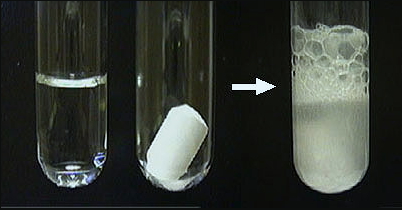
How could we make this reaction happen more quickly?

a)

Decrease the concentration of the acid

b)

crush the chalk to increase the surface area

c)

Put the test tube in an ice bath

74.
What is the penetrating rays and particles emitted by a radioactive source?
a)
Radiation
b)
Radioactivity
c)
Radioisotopes
75.
When small nuclei combine to produce a nucleus of greater mass
a)
Fusion
b)
Fission
c)
Chain Reaction
76.
The splitting of a nucleus into smaller fragments accompanied by the release of neutrons and a large amount of energy
a)
Fusion
b)
Fission
c)
Chain Reaction
77.
It is the energy producing reaction that takes place in our sun and other stars.
a)
Fission
b)
Chain Reaction
c)
Fusion
78.
The energy produced can be controlled and harnessed to produced electricity.
a)
Chain Reaction
b)
Fission
c)
Fusion
79.
What do nuclear fission and fusion have in common?
a)
They both break up atoms into small pieces
b)
They most make bigger atoms
c)
They both release lots of energy
d)
They both happen in nuclear power plants?
80.
What is a PRO (an advantage/ good thing) about nuclear energy?
a)
Uranium is cheap
b)
It is very safe and stable
c)
Both of these are true
81.
The stability of an isotope nucleus depends on the ____.
a)
atomic mass
b)
atomic number
c)
number of neutrons
d)
neutron-to-proton ratio
82.
What is a half-life?
a)
The average time it takes for any element to disappear completely 
b)
The time it takes for a radioactive atom to lose half its neutrons
c)
The time it takes for half of any number of radioactive atoms to decay
d)
The time it takes for a radioactive atom to lose half its electrons 
83.
How do atoms with stable nuclei differ from atoms with unstable nuclei? Nuclei is the plural of nucleus.
a)
The number of particles in stable nuclei never changes; the number of particles in unstable nuclei does change 
b)
Stable nuclei contain equal numbers of protons and neutrons; unstable nuclei do not 
c)
Stable nuclei emit electrons; unstable nuclei emit protons and neutrons 
d)
Stable nuclei can be found everywhere; unstable nuclei do not occur in nature