wayground logo

Free Printable Worksheets

Font size

S
M
L
XL
Worksheets

The Skin

Total questions: 35

Worksheet time: 34mins
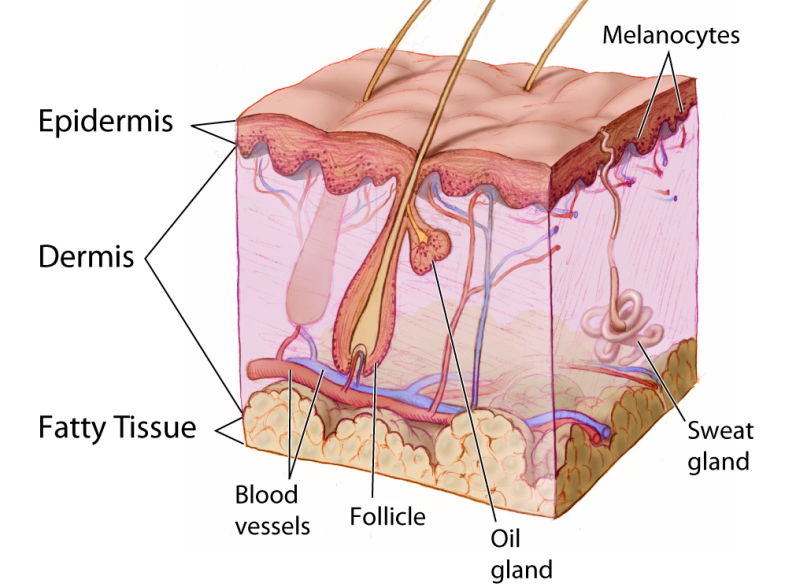
Name
Class
Date
1.
What is the outermost layer of the skin?
a)
Epidermis
b)
Dermis
c)
Subcutaneous
d)
fatty layer
2.
What are the three main layers of the skin?
a)
The epidermis, the dermis, and the subcutaneous
b)
The epidermis, the dermis, and the sebaceous
c)
The dermis, the sebaceous, and the sudoriferous
d)
The sudoriferous, the dermis, and the epidermis
3.
What gives your skin color
a)
Epidermis
b)
follicles
c)
dermis
d)
melanin
4.
What is the purpose of the sebaceous glands?
a)
Secretes oily and waxy matter
b)
Cleans your skin.
c)
Prevents Cancer
d)
Protects from the Sun
5.
Melanin:
a)
Helps protect skin from UV radiation
b)
Is found in almost every human being
c)
Is responsible for skin color
d)
All of the above
6.
What produces sweat?
a)
Sebaceous Gland 
b)
Hair Follicle 
c)
Erector Pili
d)
Sweat Gland
7.
Which is NOT a function of the skin?
a)
Insulation
b)
Movement
c)
Excretion
d)
Thermoregulation
8.
Which one is NOT a layer of skin?
a)
Dermis
b)
Flipidermis
c)
Epidermis
d)
Fatty Layer
9.

What is the oily substance that protects the skin against water called?

a)

seaweed

b)

callus

c)

sebum

d)

skin

10.

Exposure to UV light can cause you skin to produce

a)

Vitamin A

b)

Vitamin D

c)

melanin

d)

keratin

11.

A subcutaneous injection releases medicine in the

a)

epidermis

b)

dermis

c)

hypodermis

d)

muscle

12.

Which of the following is NOT a function of skin

a)

temperature regulation

b)

physical barrier to bacteria and viruses

c)

excretion of waste

d)

calcium production

13.

Why do some people have darker skin?

a)

more melanocytes

b)

more keratinocytes

c)

their melanocytes produce more melanin

d)

their keratinocytes produce more keratin

14.

layer of skin with nerve endings

a)

hypodermis

b)

dermis

c)

condradermis

d)

epidermis

15.

layer of skin that is thickened in a callus

a)

pentadermis

b)

epidermis

c)

dermis

d)

subcutaneous layer

16.

Which layer is ink injected in a permanent tattoo?

a)

epidermis

b)

dermis

c)

hypodermis

d)

subcutaneous layer

17.
The largest organ of the human body is the:
a)
liver
b)
skin
c)
lungs
d)
heart
18.
Why do you turn red when you are hot?
a)
The blood vessels in your skin constrict, reducing blood flow to cool the body
b)
The blood vessels constrict to increase blood flow to cool the body
c)
The blood vessels dilate to increase blood flow to the skin
d)
The blood vessels dilate to decrease blood flow to the skin
19.
how long does a skin cell live?
a)
2 to 3 weeks
b)
1 year
c)
4 days 
d)
11 days
20.
The structure that produces hair.
a)
Hair Shaft - 3
b)
Hair follicle/Hair bulb - 12
c)
Merkel disks - 4
d)
Sebaceous gland - 5
21.
Produce an oily and waxy material called sebum, which lubricates and waterproofs the skin.
a)
Merkel disks - 4
b)
Sebaceous gland - 5
c)
Eccrine sweat gland - 10
d)
Pacinian corpuscle - 16
22.
Cause the hair to stand up which is called piloerection.
a)
Hair follicle - 11
b)
Arrector pili muscle - 15
c)
Pacinian corpuscle - 16
d)
Sebaceous gland - 5
23.
Supply blood to all parts of the skin:
a)
Adipose tissue - 9
b)
Eccrine sweat gland - 8
c)
Hair shaft - 10
d)
Blood vessels - 11
24.
Stores energy, regulates temperature and provides protective cushioning 
a)
Eccrine sweat gland - 10
b)
Fat (adipose) tissue - 9
c)
Pacinian corpuscle - 16
d)
Free nerve endings - 17
25.

The functions of the skin include all of these except:

a)

taking in nutrients

b)

Reducing water loss

c)

preventing the entry of microorganisms

d)

regulating body temperature

26.

Which of the following is not a function of the skin?

a)

regulates body temperature

b)

stores water and fat

c)

prevents entry of bacteria

d)

supports body movement

27.

What causes goose bumps?

a)

hair follicles

b)

sebaceous glands

c)

arrector pili muscle

d)

hot weather

28.

How does sweat cool you?

a)

evaporation

b)

condensation

c)

invagination

d)

oder

29.

Which one is a function of the skin?

a)

Eliminates water.

b)

Produces vitamin D.

c)

Develop information.

d)

Mantaining a hot temperature.

30.

How do the dead cells of the epidermis help the body?

a)

Getting out of skin.

b)

Becoming part of the epidermal surface layer that protects skin.

c)

Stop producing vitamin D for the body.

d)

Eliminating all the wastes through perspiration.

31.
Skin helps the body maintain a steady _____________ through perspiration and enlarging of blood vessels.
a)
tan
b)
pace
c)
temperature
d)
heart beat
32.
When the temperature increases or decreases externally, what organ is the main sensor?
a)
stomach
b)
skin
c)
brain
d)
hair
33.

In a cold environment, what happens to your blood vessels

a)

they constrict

b)

they dilate

c)

they do nothing, they have nothing to do with temperature

d)

they bring more melanin to the surface of the skin

34.

If you want to lower your body temperature, which is your best option

a)

constrict your blood vessels

b)

create more melanin

c)

create more keratin

d)

sweat

35.

Sebaceous glands refer to

a)

Sweat glands

b)

Hair glands

c)

Oil glands

d)

Exocrine glands