
 Worksheets
Cell Membrane & Transport Review
Total questions: 66
Worksheet time: 52mins
How does the cell membrane help the cell maintain homeostasis?
It stores water and waste
It controls what enters and leaves the cell
It packages and ships proteins
It digests waste and old cell parts
What is homeostasis?
How cells break down food for energy
How plants form sugars using sunlight
How cells maintain a stable internal environment
How ribosomes make proteins
Which of these is not a function of a plasma membrane?
Controls the movement of substances in and out of a cell
Allows different conditions to be established inside and outside a cell
Acts as a partially permeable barrier
Is a barrier where only proteins can transport substances in and out of a cell
The ability to allow only certain molecules into or out of the cell.
Semipermeability
Permeability
Impermeability
Unpermeability
Describes the arrangement of the cell membrane as made of many parts that can flow and move.
The Fluid Mosaic Model
The Major Mobility Model
The Crazy Cell Model
The Maze Model
The plasma membrane has lipids, proteins, and carbohydrates throughout. This makes it look like a
mosaic because it all looks the same and there are a lot of the same things on the membrane.
fluid because they all move around
fluid because they stay still
mosaic because there are all types of things on the cell membrane
The head portion of the phospholipid is ________ and ___________.
hydrophobic and polar
nonpolar and hydrophilic
polar, hydrophilic
hydrophilic and nonpolar
The fatty acid tails are
nonpolar and hydrophobic
polar and hydrophobic
nonpolar and hydrophilic
polar and hydrophilic
Which of these statements is true
Phospholipids have a hydrophilic polar fatty acid tail
Phospholipids have a hydrophilic polar phosphate head
Phospholipids have a hydrophobic polar fatty acid tail
Phospholipids have a hydrophobic non polar phosphate head
Which molecule helps the membrane to be flexible?
protein
carbohydrate
cholesterol
A major function of glycoproteins and glycolipids in the membane is to
glue cells together to form tissues
allow cells to identify each other
attach membrane to cytoskeleton
help retain shape


Name substance 13
Glycoprotein
Glycolipid
Cholesterol
Channel protein

Name substance 7
Channel protein
Carrier protein
Gated channel protein
Surface protein

Name substance 1
Phospholipid
Glycolipid
Glycoprotein
Cholesterol

Name substance 5
Glycolipid
Glycoprotein
Phospholipid
Cholesterol

Which of the following molecules pass directly through the phospholipid bilayer, requiring no extra help or energy? Select all that apply.
sodium ion
glucose
oxygen
carbon dioxide
Which of the following molecules don't pass easily through the cell membrane, requiring extra help or input of energy?
sodium ion
glucose
oxygen
carbon dioxide
Which of the following are embedded in the phospholipid bilayer and help substances pass through?
lipids
proteins
cholesterol
carbohydrates
Which type of Passive transport uses the help of a transport protein?
Osmosis
Facilitated diffusion
Simple diffusion
What type of passive transport moves water molecules from high concentration to low concentration?
Simple diffusion
Osmosis
Active transport
Facilitated diffusion

What process is shown in the diagram below?
active transport
diffusion
osmosis
facilitated diffusion
Aquaporins are involved in which type of transport?
active transport
facilitated diffusion
phagocytosis
simple diffusion
Water channel proteins
Receptors
Aquaporins
Osmotic Pressure
Homeostasis
When a substance has equal concentrations on both sides of a membrane it will reach ____________ and the molecules will ____________ moving back and forth.
hypertonic, stop
hypertonic, keep
equilibrium, stop
dynamic equilibrium, keep
Osmosis
Diffusion
Dynamic Equilibrium

What is the ideal environment for a plant cell?
hypotonic
hypertonic
isotonic
tonic and lime
What type of solution should you put fresh flowers in to keep them fresh the longest?
Hypertonic- It causes plasmolysis, which causes the flowers to turgid.
Hypotonic- It causes the cell membrane to push on the cell wall, causing the flowers to stay turgid.
Isotonic- It causes the flowers to become flaccid.
Neutral solution- It will not cause any change in the flowers
What happens when a plant cell becomes flaccid?
The plant becomes stiff or turgid due to an increase in cell pressure.
There is more structure to the cells
The plant cells bursts
The plant becomes wilted because of a loss of cell pressure.

What is happening in the picture?
active transport
diffusion
osmosis
facilitated diffusion

The membrane does not allow the green molecules to pass through it. What will happen next?
Water will flow into side A.
Water will flow into side B.
Water will stay still.

Which way will the water molecules move during osmosis? (Mickey Mouse molecules in diagram)
Out of the cell, so the cell shrinks.
Out of the cell, so the cell swells.
Into the cell, so the cell shrinks.
Into the cell, so the cell swells.


If the % represent % of sugar, what direction will water flow?
Into the cell
Out of the cell
Both equally (equilibrium)

If the % represent % of sugar, what best describes the solution the cell is in?
Hypotonic Solution
Hypertonic Solution
Isotonic Solution

If the % represent % of sugar, what will happen to the cell in the given solution?
Swell up
Shrink
Stay the same

Where will water move in this situation?
Into the cell
Out of the cell
No movement
Into its parent's basement
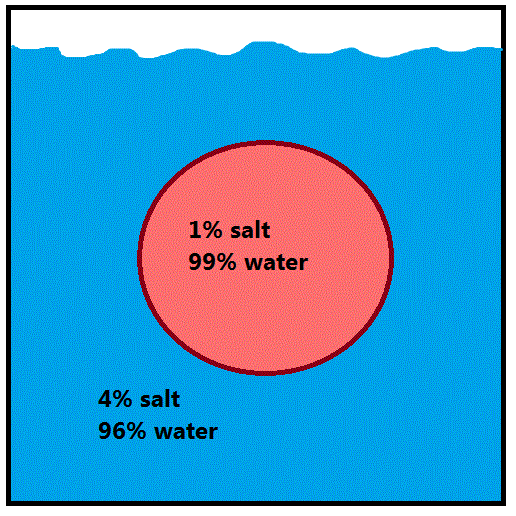
Where will the water go?
Into the cell
Out of the cell
Equally in & out - it's isotonic
There is no water
Why does active transport require energy?
The proteins are too small for the particles to pass and need energy to make a wider passage
The particles go against the concentration gradient from a lower to higher area.
The particles being transported are nonpolar
The particles go with the concentration gradient from a higher to lower area.
In active transport, molecules move from an area of __________ concentration to an area of __________ concentraiton
high, low
low, high
water, salt
active, passive
Which movement of substances through a cell membrane against a concentration gradient requires energy?
osmosis
diffusion
active transport
facilitated diffusion

The sodium potassium pump is an example of what type of transport?
Diffusion
Facilitated Diffusion
Active Transport
Passive Transport



