
 Worksheets
Physics Fall Semester Exam Review 22-23
Total questions: 125
Worksheet time: 2hrs 58mins
If five darts strike near the center of a target. The dart thrower is
accurate
precise
both accurate and precise
neither accurate nor precise
Please arrange these symbols of units of length in order from smallest to largest are
m, cm, mm ,km
mm, m, cm, km
km, mm, cm, m
mm, cm, m, km
Calculate the following and express the answer in scientific notation with the correct number of significant figures
10.5 x 8.8 x 3.14 =
2.9 x 10²
2.90 x 10²
290
290.1
How many significant figures in the number 2,000.000
1
4
7
6
How many significant figures are in the number 0.003350?
7
6
3
4
Round the number 3.92 to 1 significant figure
3.9
4
3
3.0
Place this number in scientific notation: 0.00035350
3.5 x 10⁴
3.5 x 10⁻⁴
3.5350 x 10⁻⁴
4 x 10⁴
In a graph x is on the ___________ axis and is the ___________ variable.
horizontal, independent
horizontal, dependent
vertical, independent
vertical, dependent
How do we know that motion has occurred?
The reference point has changed.
The position of the object has changed.
The object has changed.
This involves a magnitude and direction
scalar
vector
both of the above
none of the above
On my way to DQ I walked 3.2 meters East and then 7.2 meters west. What is my distance and displacement?
Distance 10.4 west, Displacement 10.4 meters east
Distance 10.4 meters, Displacement 4.0 meters east
Distance 10.4 meters, and Displacement 4.0 meters west
Distance 10.4 meters east, and Displacement 10.4 meter west

Speed that remains the same or does not change
Distance
Constant Speed
Mass
Acceleration
Slope is
run/rise
rise/run
run x rise
run + rise
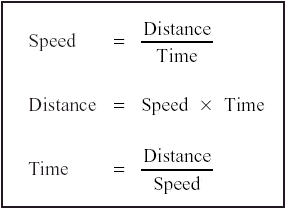
What is the speed of an object that travels 60 meters in 4 seconds?
240 m/s
0.67 m/s
15 m/s
15 mi/hr
The unit we use to measure acceleration is ___.
m
s
m/s
m/s2

Vector is a quantity with:
magnitude and direction
magnitude
direction
none of the above

What is the resultant of the two vectors shown above?
5 upward
5 downward
15 upward
15 downward
A measurement is considered to be more precise if it has...
more decimals
fewer decimals
The result of an experiment that is plotted along the y-axis is called the...
dependent variable
independent variable
derived units
fundamental units
scientific notation

Which of the motions is consistent with this graph?
The object is moving to the right and speeding up
The object is moving to the left and speeding up
The object is moving to the right and slowing down
The object is moving to the left and slowing down

Which of the motions is consistent with this graph?
The object is moving to the right and speeding up
The object is moving to the left and speeding up
The object is moving to the right and slowing down
The object is moving to the left and slowing down

Which of the motions is consistent with this graph?
The object is moving to the right and speeding up
The object is moving to the left and speeding up
The object is moving to the right and slowing down
The object is moving to the left and slowing down

Which of the motions is consistent with this graph?
The object is moving to the right and speeding up
The object is moving to the left and speeding up
The object is moving to the right and slowing down
The object is moving to the left and slowing down

Which description below is consistent with this graph?
The object moves at a constant speed and then slows down to rest
The object moves horizontally and then falls at a constant speed
The object is at rest and then moves in the negative direction at a constant speed

Which description below is consistent with this graph?
The object moves at a constant speed and then speeds up in the positive direction
The object moves horizontally and then moves up a hill at a constant speed
The object is at rest and then moves in the positive direction at a constant speed

Which description below is consistent with this graph?
The object moves slowly at a constant speed and then faster at a constant speed
The object accelerates in the positive direction and then accelerates more rapidly
The object moves forward, changes direction and then accelerates more rapidly

Which description below is consistent with this graph?
The object accelerates in the positive direction and then in the negative direction
The object moves upwards, reaches its peak and then falls with an acceleration
The object moves in the positive direction and then moves in the negative direction
Which one of the following graphs describes an object that is moving from slow to fast?


Which one of the following graphs describes an object that is moving from fast to slow?
Which one of these graphs describes an object that is moving at a constant speed to the right (+ direction)?


Which of these graphs describes an object that is at rest?


Which one of these graphs describes an object that is moving at a constant speed to the left (– direction)?

As represented by this velocity-time graph, this object is ____.
at rest for several seconds, then accelerates in the negative direction
moving in a positive direction at a constant speed, then slowing down
at rest for several seconds, then moves in the negative direction
moving in a positive direction at a constant speed, then moves in the negative direction

As represented by this velocity-time graph, this object is ____.
moving with a constant speed and then accelerates
at rest for several seconds and then moves forward at constant speed
at rest for several seconds, and then speeds up
at rest for several seconds and then moves up a hill

As represented by this velocity-time graph, this object is ____.
moving in the negative direction and speeding up, and then maintains a constant speed
slowing down to a rest position
accelerates in the negative direction and then stops
moving in the positive direction from fast to slow, and then maintains a constant speed

As represented by this velocity-time graph, this object is ____.
accelerating at a low rate and then a high rate, both in the positive direction
moving slowly and then rapidly, both at a constant speed
moving slowly in one direction, then rapidly in another direction
accelerating slowly from rest and then maintaining a constant speed

As represented by this velocity-time graph, this object is ____.
moving downwards at a constant rate of acceleration
moving with a constant speed in the negative direction
slowing down, changing directions and then speeding up
Nonsense! None of these appropriately describe the object's motion

As represented by this velocity-time graph, this object is ____.
speeding up, changing directions and then slowing down
speeding up and then slowing down while moving in the positive direction
moving with a constant positive velocity and then a constant negative velocity
accelerating while moving in the positive direction, then accelerating while moving in the negative direction
Slope of displacement vs time graph gives
velocity
speed
acceleration
displacement
When speed and direction of motion of an object do not change then the object will have:
uniform velocity
uniform acceleration
variable acceleration
variable velocity


A student throws a baseball straight up into the air. It travels up and then returns to the ground 1.00 m below where it was thrown. What is the ball's total displacement? (Up is positive)
1.00 m
-1.00 m
0.00 m
Depends on the height that it reached
A high-speed train in Japan travels a distance of 300 km in 3600 s. What is the average speed of this train?
0.0120 m/s
0.0833 m/s
12.0 m/s
83.3 m/s
Velocity is to speed as displacement is to
Acceleration
Time
Momentum
Distance

The graph represents the vertical displacement of an elevator over 16s interval.
Which of the following can be concluded from the graph?
Between 2s and 6s, the acceleration of the elevator is greatest
Between 4s and 12s, the velocity of the elevator is constant
Between 8s and 14s, the acceleration of the elevator is constant
Between 14s and 16s, the velocity of the elevator is greatest
Slope of velocity vs time graph gives
velocity
speed
acceleration
displacement
A biker rides west for 50 km from his starting position, then turns and bikes back east 80 km. What is his net displacement?
130 km
30 km east
30 km west
Cannot be determined from the information given

Using the graph, what is the runner's velocity from 4 s to 10 s?
-3 m/s
0 m/s
1.2 m/s
3 m/s

Describe the accuracy and precision of the image
Accurate, Precise
Accurate, Not Precise
Not Accurate, Precise
Not Accurate, Not Precise

Describe the accuracy and precision of the image
Accurate, Precise
Accurate, Not Precise
Not Accurate, Precise
Not Accurate, Not Precise

Describe the accuracy and precision of the image
Accurate, Precise
Accurate, Not Precise
Not Accurate, Precise
Not Accurate, Not Precise
Describe the accuracy and precision of the image
Accurate, Precise
Accurate, Not Precise
Not Accurate, Precise
Not Accurate, Not Precise
When converting units, if the same unit is on the top and also the bottom of the conversion grid we set up, ______________
the units cancel
the units multiply
the units are added together
the same unit can't be on the top and the bottom
A conversion factor ____________________
never changes the quantity that was measured or provided, just expresses it in different units
always changes the quantity that was measured or provided, because that is what happens when you change units
makes things more complicated than they need to be
is completely unnecessary in the days of Google
An object moving horizontally in the forward, positive direction and speeding up will have a _______________ acceleration.
positive
negative
constant
0
An object moving horizontally in the backward, negative direction and slowing down will have a _______________ acceleration.
positive
negative
constant
0
How do you write 1001 in scientific notation?
1.0001 x 10⁴
1.01 x 10⁵
1.001 x 10³
10.1 x 10³
A high-speed train in Japan travels a distance of 300 km in 3600 s. What is the average speed of this train?
0.0120 m/s
0.0833 m/s
12.0 m/s
83.3 m/s

The graph above represents a car driving down a straight highway. Which of the following is the speed of the car at t = 4 seconds?
0 m/s
5 m/s
10 m/s
20 m/s
Acceleration is defined as ____
Distance over time
Mass times velocity
Change is velocity over time
Mass times distance
Which graph represents a bicyclist pedaling away from the observer at a constant speed?


The graph above represents the motion of a cyclist. The graph shows that between t = 0 seconds and t = 2 seconds, the cyclist —
reversed direction
slowed down slightly
increased in speed
coasted at constant speed

from 3rd second to 5th second, the object is
moving at a constant speed
speeding up
not moving
slowing down

What is happening at E?
Stationary
Accelerating
Fast steady speed; moving away from the starting position
Steady speed; returning to start position
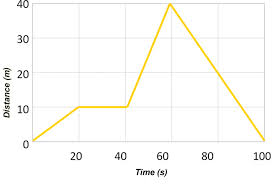
From t=1.0 second to t=3.0 seconds, the object is
moving at a constant speed
speeding up
not moving
slowing down

Which of the following is NOT true about slope?
the steeper the line the slower the object
the steeper the line the faster the object
a horizontal line means the object was not moving


Which section of the graph is the object traveling west and speeding up?
A
C
D
E

Slope of displacement vs time graph gives
velocity
speed
acceleration
displacement
John runs 2 miles south, then turns around and walks 3 miles north. What is John's displacement?
5 miles
0 miles
1 mile
6 miles
Karla walks 40 feet south, turns and walks 30 feet west, turns and walks 40 feet north. What is Karla's displacement?
40 feet south
30 feet west
0 Feet
110 feet north
Angela walks 5 m east, 3 m south, and 5 m west. Her total displacement is:
13 m
13 m south
3 m
3 m south
Angela walks 5 m east, 3 m south, and 5 m west in 20 s. Her average velocity is:
0.65 m/s
0.15 m/s
0.15 m/s south
0.65 m/s south
Vector Q is 27 km long in a direction 15° north of east. The expression for its y component is:
27 km · sin 15°
27 km · cos 15°
27 km · tan 15°
tan-1(15/27)

Find the slope of the graph
-0.5m/s
0.5m/s
-2m/s
2m/s

Do the objects start at the same point?
yes
No, A is ahead of B
No, B is ahead of A
There is not enough information

Match the graph to one of the answer choices


What velocity (speed) was the object traveling at "Point C"?
15 m/s
20 m/s
25 m/s
30 m/s
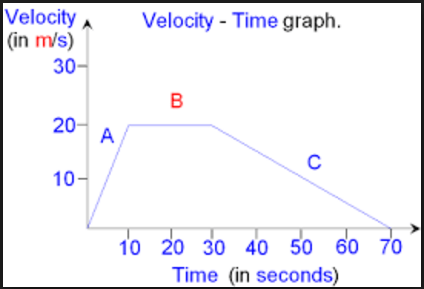
This is a velocity-time graph. What is the object doing in segment A?
Speeding up
Slowing down
Constant Velocity
Not moving

Vector F in the x-component is ....
F sin 30o
F cos 30o
F sin 60o
F tan 60o

Vector F in the y-component is ....
F sin 30o
F cos 30o
F cos 60o
F tan 30o


Find the distance: Sara walks from A to B, B to C then C to D?
11m
3m
5m
16 m
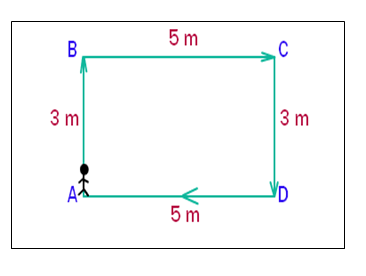
Fred walks in the following order: from Point A-B-C-D. The DISTANCE Fred walked is ____ meters and his Net DISPLACEMENT is ____ meters.
11 m; 16 m
16 m; 0 m
0 m; 16 m
16 m; 8 m


A cat chases a laser around in a circle and runs 50 meters while staying in the same position/location. What is the cat's Net Displacement?
50 m
0 m
Some quantity that we cannot
I have no idea
From the acronym SOH, Sinθ =
OppositeHypotenuse
AdjacentOpposite
AdjacentHypotenuse
HypotenuseOpposite
From the acronym TOA, Tangent θ =
AdjacentOpposite
OppositeAdjacent
HypotenuseOpposite
HypotenuseAdjacent
From the acronym CAH, Cosθ =
HypotenuseOpposite
HypotenuseAdjacent
AdjacentOpposite
Adjacent Hypotenuse
The opposite side is
across from the reference angle.
next to the reference angle.
across from the right angle.

Which side is highlighted?
Adjacent
Opposite
Hypotenuse

Which side is highlighted?
Adjacent
Opposite
Hypotenuse


The side of length 2.5 is which side of this triangle?
opposite
hypotenuse
adjacent
impossible to determine
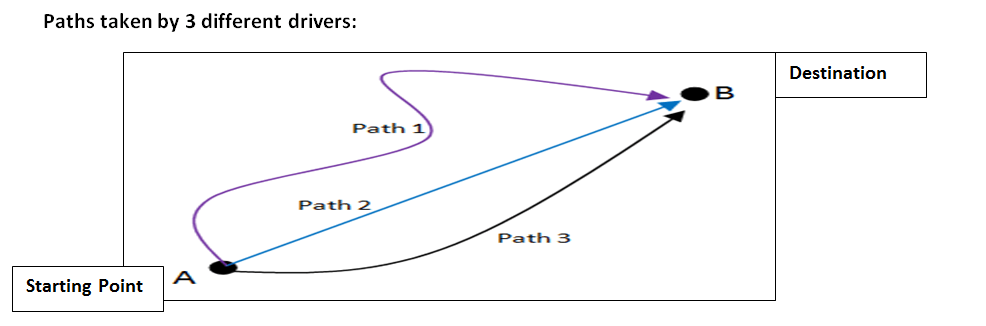
Which driver (path) has an equal distance and displacement at B?
1
2
3

