wayground logo

Free Printable Worksheets

NEW

Font size

S
M
L
XL
Worksheets

Atomic structure and periodic table

Total questions: 49

Worksheet time: 26mins

Name
Class
Date
1.

Subatomic particles with a negative charge

a)

Electrons

b)

Neutrons

c)

Protons

d)

Quarks

2.
Subatomic particles with a positive charge
a)
neutrons
b)
atomic mass
c)
protons
d)
isotopes
3.
Subatomic particles that are neutral in charge
a)
Neutrons
b)
Protons
c)
Nucleus 
d)
Electrons
4.

Look at this picture of Argon off the periodic table. Which of the following is true for this element?

a)

18 protons

b)

40 protons

c)

22 protons

d)

21.9 protons

5.

Which part of an atom is used to identify it?

a)

number of protons

b)

number of neutrons

c)

number of electrons

6.

The atomic mass of an atom is equal to

a)

number of protons plus number of neutrons

b)

number of protons plus number of electrons

c)

number of electrons plus the number of neutrons
7.
The nucleus of an atom is made of
a)
electrons and protons
b)
electrons and neutrons
c)
protons and neutrons
d)
empty space
8.
Outside the nucleus of an atom are these
a)
protons
b)
neutrons
c)
quarks
d)
electrons
9.
The charge of the nucleus of all atoms or ions
a)
positive
b)
negative
c)
neutral
d)
sometimes positive and sometimes negative
10.
The number of these determines which element an atom is.
a)
neutrons
b)
electrons
c)
protons
11.
Which of these phrases best describes an atom?
a)
a positive nucleus surrounded by a hard negative shell
b)
a positive nucleus surrounded by a cloud of negative charges
c)
a hard sphere with postive and negative charges on the outside
d)
a negative nucleus surrounded by protons and neutrons
12.
The term "neutral" means
a)
having only a little bit of charge
b)
having a positive charge
c)
having a negative charge
d)
having no charge at all
13.
a)
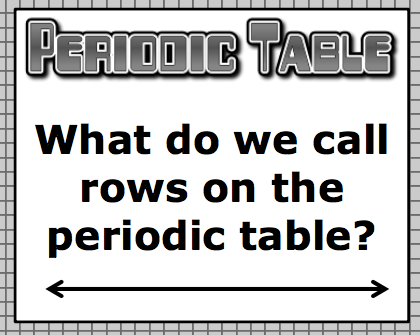
Periods
b)
Groups
14.
a)
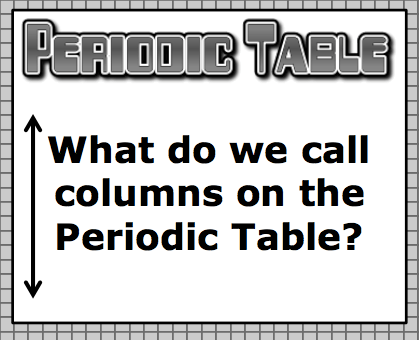
Periods
b)
Groups
15.
a)
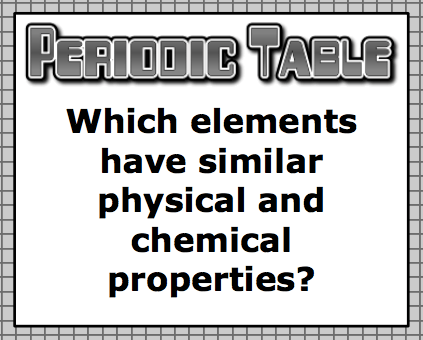
Same group
b)
Same period
16.

Which color on the image of the periodic table corresponds with the halogens.

a)

red

b)

black

c)

blue

d)

orange

17.

Which color on the image of the periodic table corresponds with the noble gases.

a)

red

b)

black

c)

blue

d)

orange

18.

Which color on the image of the periodic table corresponds with the transition metals.

a)

red

b)

black

c)

blue

d)

orange

19.

Which color on the image of the periodic table corresponds with the metalloids.

a)

bright yellow

b)

gold

c)

teal

d)

light blue

20.

Which color on the image of the periodic table corresponds with the alkaline earth metals.

a)

yellow

b)

dark yellow

c)

blue/green

d)

teal

21.

Horizontal rows on the periodic table are called ___?

a)

groups

b)

periods

c)

rows

d)

families

22.

Most metals share four common physical characteristics. Which of the options is not one of the four?

a)

Luster

b)

Conductivity

c)

Ductility

d)

Malleability

e)

Reactivity

23.

The periodic table is mostly comprised of what type of element?

a)

Metals

b)

Nonmetals

c)

Metalloids

24.

Which family of elements does not combine with other elements unless under special conditions in a laboratory?

a)

Noble gases

b)

Halogens

c)

Metalloids

d)

Alkaline earth metals

e)

Actinides

25.
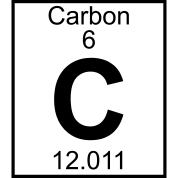
What does the 6 represent?
a)
atomic mass
b)
atomic number
c)
element name
d)
chemical symbol 
26.
What does 12.011 represent?
a)
atomic mass
b)
atomic number
c)
element name
d)
chemical symbol 
27.
What does the C represent?
a)
atomic mass
b)
atomic number
c)
element name
d)
chemical symbol 
28.
These are found on the Periodic Table.
a)
Compounds
b)
Elements
c)
Mixtures
29.

the basic structural unit of matter

a)

atom

b)

matter

c)

element

d)

nucleus

30.

a collection of atoms of one type that cannot be broken down into simpler substances by ordinary chemical or physical means

a)

element

b)

subatomic particle

c)

electron

d)

matter

31.
If an atom has 3 electrons, how many protons does it have?
a)
1
b)
2
c)
4
d)
3
32.
If the number of protons equal the number of _____, the atom will have no charge
a)
protons
b)
neutrons
c)
electrons
d)
nucleus
33.
How many neutrons does the isotope of lithium have?
a)
8
b)
3
c)
4
d)
5
34.

How many protons does Nitrogen have?

a)

7

b)

8

c)

14

d)

14.01

35.

If an element has an atomic number of 11 and a mass number of 23, how many neutrons does it have?

a)

11

b)

12

c)

23

d)

34

36.

Which of the following particles is NOT found in an atom's nucleus?

a)

proton

b)

neutron

c)

electron

37.

What is the chemical symbol of this element?

a)

79

b)

Au

c)

AU

d)

gold

38.

How many electrons can go in the first energy level?

a)

2

b)

8

c)

18

d)

32

39.

How many electrons can go in the Second energy level?

a)

2

b)

8

c)

18

d)

32

40.

What is the the outermost shell with electrons?

a)

Shells

b)

Isotope

c)

Orbit

d)

Valence

41.

True or False: The number of protons and neutrons are always the same

a)

False

b)

True

42.

What is 'E' pointing to?

a)

electron cloud

b)

electron

c)

nucleus

d)

proton

e)

neutron

43.
What is the name of this element?
a)
Helium
b)
Hydrogen
c)
Argon
d)
Silver
44.
What is the name of this element?
a)
Lithium
b)
Boron
c)
Carbon
d)
Neon
45.

What is the atomic number of this atom?

a)
2
b)
4
c)
6
d)
none of the above
46.

What is the atomic mass of this atom?

a)
1
b)
3
c)
4
d)
7
47.
What does the nucleus of an atom contain?
a)
Electrons and neutrons
b)
Protons and neutrons
c)
Neutrinos and positrons
d)
Electrons and megatrons
48.

Which element does this Bohr model represent?

a)

Aluminum

b)

Silicon

c)

Magnesium

d)

Cobalt

49.

How many valence electrons does an oxygen atom have?

a)

2

b)

6

c)

8

d)

16