wayground logo

Free Printable Worksheets

NEW

Font size

S
M
L
XL
Worksheets

Practice Mid-Term (Belyeu)

Total questions: 71

Worksheet time: 48mins

Name
Class
Date
1.

The number of protons an element has is its?

a)

Atomic mass

b)

Atomic number

c)

a.m.u

d)

Group

2.

How many electrons can go in the first energy level?

a)

2

b)

8

c)

18

d)

32

3.

How many valence (outer) electrons does an Oxygen atom have?

a)

2

b)

6

c)

8

d)

16

4.

What element is this?

a)

Na

b)

P

c)

N

d)

S

5.

What element is this?

a)

Nitrogen

b)

Chlorine

c)

Argon

d)

Phosphorous

6.

Which Bohr model represents Be?

a)
b)
c)
d)
7.

___________ simplify the Bohr Model by showing only the outer valence electrons used for bonding.

a)

Lewis Dot Diagrams

b)

Bohr Models

c)

Electron Clouds

d)

Periodic Tables

8.
How many electrons should Chlorine have around its Lewis dot model?
a)
5
b)
6
c)
7
d)
8
9.

What is the chemical symbol for sodium?

a)

S

b)

So

c)

Na

d)

K

10.

In an atom, which subatomic particles are always equal?

a)

protons and electrons

b)

protons and neutrons

c)

neutrons and electrons

d)

protons, neutrons, and electrons

11.

When a solid changes to a liquid as temperature increases, this is known as which phase change?

a)

Vaporization

b)

Condensation

c)

Freezing

d)

Melting

12.

When water vapor changes to liquid water as energy is removed, this is known as which phase change?

a)

melting

b)

freezing

c)

vaporization

d)

condensation

13.

Letter "C" represents which state of matter on the phase change diagram shown.

a)

Solid

b)

Liquid

c)

Gas

14.

Deposition is the phase change in which a gas turns straight into a ____________ without first turning into a liquid.

a)

solid

b)

liquid

c)

gas

d)

plasma

15.

What phase change is occurring when substances like dry ice turn straight from a solid to a gas?

a)

evaporation

b)

deposition

c)

sublimation

d)

freezing

16.

What phase change takes place when a liquid turns into a gas?

a)

melting

b)

condensation

c)

sblimation

d)

evaporation

17.

When the temperature of matter increases, the particles...

a)

speed up and move closer

b)

slow down and move closer together

c)

speed up and move farther apart

d)

slow down and move farther apart

18.

Which state of matter has NO definite shape and NO definite volume?

a)

gas

b)

solid

c)

liquid

19.

Mass is ________________________________.

a)

Anything that has Mass and volume.

b)

The amount of space an object occupies.

c)

The amount of matter in an object.

20.

Matter is _______________________________.

a)

The amount of matter in an object.

b)

Anything that has mass and volume.

c)

The amount of space an object occupies.

21.

An object with a density of 1.5 g/cm3 will sink in water.

a)

true

b)

false

22.

A block has a mass of 20.0 g and a volume of 40.0 cm3. What is its density?

a)

2.0 g/cm3

b)

1.2 g/cm3

c)

0.5 g/cm3

d)

4.0 g/cm3

23.

Which of the three blocks has the greatest density?

a)

A

b)

B

c)

C

24.
which point has the most potential energy
a)
G
b)
f
c)
b
d)
a
25.
When you stretch a rubber band, you are storing __________ energy. 
a)
kinetic 
b)
potential
c)
none of the above
d)
all of the above 
26.
How much pontential energy is at the top of a hill on a rollar coaster ride
a)
100%
b)
50%
c)
0%
d)
20%
27.
When a pendulum swings, at which point is kinetic energy highest?
a)
1
b)
2
c)
3
d)
4
28.
When a pendulum swings, at which point is potential energy at its greatest?
a)
1
b)
2
c)
3
d)
4
29.
Energy can be _____________ or changed from one type to another.
a)
destroyed
b)
transferred
c)
created
d)
ignored
30.
Energy due to motion is ____________ energy. 
a)
Potential 
b)
Energy
c)
Kinetic
d)
Friction
31.
__________ is stored energy. 
a)
Potential
b)
Kinetic
c)
None of the above 
d)
All of the above 
32.

Vertical columns on the periodic table are called ___?

a)

groups

b)

periods

c)

rows

d)

families

33.

Which color on the image of the periodic table corresponds with the halogens.

a)

red

b)

black

c)

blue

d)

orange

34.

Which color on the image of the periodic table corresponds with the noble gases.

a)

red

b)

black

c)

blue

d)

orange

35.

Which color on the image of the periodic table corresponds with the alkaline earth metals.

a)

yellow

b)

dark yellow

c)

blue/green

d)

teal

36.

Horizontal rows on the periodic table are called ___?

a)

groups

b)

periods

c)

rows

d)

families

37.

The periodic table is mostly comprised of what type of element?

a)

Metals

b)

Nonmetals

c)

Metalloids

38.
Each column in the periodic table is called a _________ .
a)
period
b)
group
c)
cluster
d)
unit
39.
Two elements chemically bonded form
a)
element
b)
compound
c)
mixture
d)
solutions
40.

the positively charged subatomic particle contained in the nucleus of an atom

a)

proton

b)

neutron

c)

electron

d)

matter

41.

a negatively charged subatomic particle that orbits the nucleus of an atom

a)

proton

b)

neutron

c)

electron

d)

matter

42.

What does the atomic mass tell you?

a)

Basically,the number of electrons and protons

b)

The number of neutrons

c)

Basically, the number of protons and neutrons

d)

The number of protons.

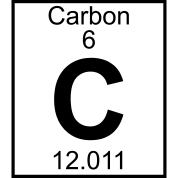
43.
What does the 6 represent?
a)
atomic mass
b)
atomic number
c)
element name
d)
chemical symbol 
44.
An ionic bond forms when atoms ___________ electrons.
a)
gain
b)
share
c)
increase
d)
transfer
45.
Chemical bonds form when atoms
a)
combined nuclei
b)
give up neutrons
c)
gain protons
d)
share or transfer electrons
46.
Covalent compounds
a)
Share electrons
b)
transfer electrons
c)
contain a sea of electrons
d)
conduct electricity
47.
How many valence electrons in this structure?
a)
6
b)
5
c)
4
d)
7
48.
The number to the lower side of an element is a 
a)
Subscript
b)
Superscript
c)
Coefficient
d)
Charge
49.
Matter can not be created nor destroyed: it can only be
a)
Destroyed a little bit
b)
Invisible
c)
Transformed, changed
d)
None of the above
50.
The number in front of a compound or element is a 
a)
Subscript
b)
Coefficient
c)
Superscript
d)
Charge
51.
A chemical reaction is balanced when
a)
both sides have the same elements
b)
Both sides have the same  number of atoms
c)
Same subscripts
d)
Same coefficients
52.
The coefficient in  3H2O is
a)
6
b)
2
c)
3
d)
5
53.
Which of these is not a chemical reaction?
a)
Burning of wood
b)
Milk going bad
c)
Mixing vinegar and baking soda
d)
Melting of ice
54.
If reaction starts with 20g of reactants it should produce 
a)
a total of 40g of products
b)
a total of 10g of products
c)
a total of 80 g of products
d)
a total of 20g of products
55.
What is the Law of Conservation of mass?
a)
Mass is created in a chemical reaction
b)
Mass is created in a physical change
c)
New chemicals formed from a chemical reaction have a larger overall mass than the original reactants
d)
Mass is never created or destroyed
56.
Which are the reactants in the following reaction?
2Mg + O2 ---> 2MgO 
a)
Mg and O
b)
MgO
c)
Mg and MgO
d)
O and MgO
57.

Which Chemical Equation is Balanced?

a)

CH₄+O₂------CO₂+2H₂O

b)

H₂+O₂-----2H₂O₄

c)

4Al+3O₂-----2Al₂O₃

58.

What happens to the total mass of the substances after a chemical reaction?

a)

It decreases.

b)

It increases.

c)

 It remains the same.

d)

It increases then decreases.

59.
The ability of a substance to dissolve is called...
a)
malleability
b)
ductility
c)
solubility
60.
The 3 State of Matter are?
a)
Idaho, Texas, and Florida
b)
Matter, Mass, and Weight
c)
Solids, Liquids, and Gas
d)
Steel, Copper, and Brass
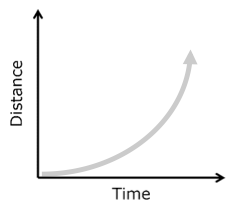
61.
This graph demonstrates an object that is -
a)
Increasing speed
b)
Decreasing speed
c)
Stationary
62.
This graph demonstrates an object that is -
a)
Increasing speed
b)
At a constant speed
c)
Decreasing speed
d)
Stationary
63.
This graph demonstrates an object that is -
a)
Increasing speed
b)
At a constant speed
c)
Decreasing speed
d)
Stationary
64.
This graph demonstrates an object that is -
a)
Increasing speed away from the start
b)
Moving away from the start at a constant speed
c)
Decreasing speed toward the start
d)
Moving toward the start at a constant speed
65.
This graph demonstrates an object that is -
a)
Increasing speed toward the start
b)
Moving away from the start at a constant speed
c)
Decreasing speed away from the start
d)
Moving toward the start at a constant speed
66.

The dependent variable is

a)

The variable that you change in an investigation

b)

The variable that you measure in an investigation

c)

A variable that you keep the same in an investigation

67.

The independent variable is

a)

The variable that you change in an investigation

b)

The variable that you measure in an investigation

c)

A variable that you keep the same in an investigation

68.

What is the purpose of controlled variables

a)

To control what happens in the investigation

b)

To make the investigation valid

c)

To make the investigation reliable

69.
The formula for density is
a)
volume/mass
b)
mass/weight
c)
mass/volume
d)
volume X mass
70.
Observations that deal with a number or amount are called
a)
manipulated observations
b)
operational observations
c)
qualitative observations
d)
quantitative observations
71.
Observations that deal with descriptions that cannot be expressed in numbers are called
a)
quantitative observations
b)
qualitative observations
c)
manipulated observations
d)
operational observations