
 Worksheets
Physical Science Final Review
Total questions: 103
Worksheet time: 2hrs 41mins
10 g is a measure of
Mass
Volume
Density
10 cm3 is a measure of
Mass
Volume
Density
10 g/cm3 is a measure of
Mass
Volume
Density
Which number is less than 1?
10.0
0.1
1.0
Which number is greater than 1?
10.0
0.1
1.0
An object with a density greater than 1 will _____.
Sink
Float
An object with a density less than 1 will _____.
Sink
Float
An object with a density equal to 1 will _____.
Sink
Float

This object's density is ______.
Greater than 1
Less than 1
Select the correct definition for MASS
A measure of the amount of matter in an object
A measure of the amount of space an object takes up
A property that describes the compactness of molecules in a substance

Which phase in the image is the LEAST DENSE?
Solid
Liquid
Gas

Which type of heat transfer is shown?
convection
conduction
radiation
stir frying

What type of heat transfer is shown here?
convection
conduction
radiation
sun shining

What type of heat transfer is shown?
convection
conduction
radiation
bonfire

What type of heat transfer is shown here?
convection
conduction
radiation
boiling water

If a door was left open between the bedroom (74 degrees) and the living room (68 degrees), what would likely happen to the temperatures after several hours?
nothing, they would not change
both rooms would become hotter
both room would become colder
the bedroom temp. would lower and the living room temp. would rise

If this drink is sitting outside on a hot, sunny day, name two reason why the drink won't stay cold.
radiation - from the sun is heating the glass
conduction - the table beneath the glass is heating
convection - the air is moving in a circle pattern around
conduction - the straw is heating up
What does the subscript in a chemical formula tell you?
How many molecules are present
How many atoms are present
How many elements are present
How many neutrons are present
How many elements are in this chemical formula?
H2SO4
1
2
3
4
How many atoms of Carbon are in this formula? C6 H12O6
6
1
12
What elements are represented in this chemical formula? Fe2O3
Iron, Oxygen
Francium, Europium, Oxygen
Ferrium, Oxygen
Berylium, Oxygen
What is the total number of atoms in this formula? H2O2
2
4
3
Which of the following elements is least likely to form a compound?
Hydrogen
Sodium
Argon
Potassium
Is this an element or a compound? CaSO4
Element
Compound
Which chemical formula correctly displays 1 atom of nickel and 2 atoms of Fluorine?
niF2
NIF2
Ni1F2
NiF2
What is the total number of atoms in this chemical formula? C8H3NaBr12
18
12
25
24
Mg + __HCl ---> MgCl2 + H2
Al + O2 → 2Al2O3
Balance this equation: _Zn + _O2 --> _ZnO
1, 1, 2
2, 1, 2
1, 1, 1
2 ,2, 2


What image show light being reflected?


What image show light being absorbed?
What image show light being transmitted?
What statement is true about materials that reflect ALL light?
the material appear white
the material appear black
the material appear clear
What statement is true about materials that transmits ALL light?
the material appear white
the material appear black
the material appear clear
Sunlight hits dark, black clouds. What is happening to the light waves in the clouds?
light is being reflected
light is being absorbed
light is being transmitted

Why does the leaf appear green?
Most light wavelengths are transmitted while the green light wavelengths are absorbed
Most light wavelengths are absorbed while the green light wavelengths are reflected
Most light wavelengths are reflected while the green light wavelengths are transmitted
Most light wavelengths are reflected while the green light wavelengths are absorbed



Where is the element's atomic NUMBER located?
the top
the bottom
the top + the bottom
the number of protons + the number of neutrons

Where is the element's atomic MASS located?
at the top
at the bottom
the top number + the bottom number
the number of protons + the number of neutrons
What are the 3 subatomic particles of an atom?
carbon atom, proton, electron
quarks, neutrons, protons
nucleus, protons, electrons
protons, neutrons, electrons
Generally, the number of neutrons ____ the number of protons in an atom.
=
<
>
Which subatomic particle has a negative charge?
proton
neutron
electron
Which subatomic particle has a positive charge?
proton
neutron
electron
Which subatomic particle has a neutral or no charge?
proton
neutron
electron
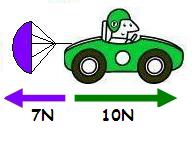
What is the net force?
3 N
3 N, right
17 N, right
3 N, left

What is the unit to MEASURE force?
Kilogram
Meter
Pounds
Newton

A ____________ is a push or a pull on an object.
friction
force
magnet
gravity
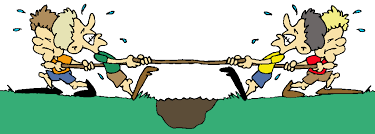

Forces that have a net force of zero Newtons
Balanced force
Unbalanced force

Name the missing force.
Gravitational Force
Normal Force
Friction Force
Applied Force

Name the missing force.
Normal Force
Push/Pull Force
Friction Force
Tension Force
“Pressure applied to an incompressible fluid is transmitted equally throughout the fluid” is an expression of
Archimedes’ principle
Pascal’s principle
Bernoulli’s principle
Newton’s principle
What does Archimedes’ principle state?
The buoyant force acting on an object is equal to the weight of the fluid displaced by the object.
The buoyant force acting on an object is equal to the volume of the fluid displaced by the object
The buoyant force acting on an object decreases if the volume of the object increases.
The buoyant force acting on an object decreases if the object is placed in a denser liquid.
The measure of the upward force a fluid exerts on an object that is submerged is:
elasticity.
buoyancy
gravity.
ductility.
Applied force creates pressure in all directions in:
solids and gases.
liquids only.
liquids and gases
gases only.
High viscosity can be described as...
a liquid that flows quickly
a liquid that flows slowly
Viscosity can be described as...
a physical property of liquids
a physical property of solids
a chemical property of liquids
Peanut butter is an example of a...
High viscosity liquid
Low viscosity liquid
Isnt a liquid at all! Don't be silly.

Holding a marble at the top of a ramp
Potential
Kinetic


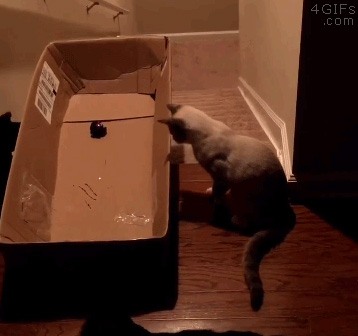
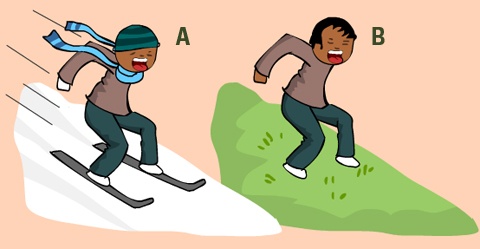
1st
Law of Motion
2nd
Law of Motion
3rd
Law of Motion

This equation goes with which law?
Newton's first law of motion
Newton's second law of motion
Newton's third law of motion

The acceleration of objects falling on Earth due to gravity is
9.8 m/s
9.8 m/s2
9.8 g/mL
9.8 g/m/m

