
 Worksheets
Test 1 - Physics
Total questions: 100
Worksheet time: 6hrs 57mins
12.5-mL + 20.05-mL + 2.69-mL
98.7°C - 97.25°C
33 g - 2.1 g = ?
31.9 g
31 g
30.9 g
30 g
220 ft - 100 ft = ?
120 ft
100 ft
150 ft
200 ft
220 ft - 101 ft = ?
100 ft
120 ft
119 ft
200 ft
0.495 g - 0.1 g = ?
0.395 g
0.39 g
0.4 g
1 g
0.495 g - 0.001 g = ?
0.394 g
0.3984 g
0.494 g
0.5 g
67 seconds + 10.1 seconds = ?
77.1
77
70
80
1001
in scientific notation?
8.317 x 10⁶
in standard form?
.000457
8.025 x 10⁻⁸
What property is measured in meters?
volume
mass
length
grams
The tool used to measure length is the
beaker
flask
graduated cylinder
meter stick
The prefix kilo means
10
100
1000
The prefix milli means
0.1
0.01
0.001
Which of the following is a temperature scale?
volume
mass
celsius
mercury
What property is measured in liters?
volume
mass
weight
grams
What unit is used to measure length?
meters
liters
centigrams
kilograms
Convert! 382 mL = __________________ L
382,000
3.82
.382
.0382


low precision, low accuracy
high precision, low accuracy
low precision, high accuracy
high precision, high accuracy

low precision, low accuracy
high precision, low accuracy
low precision, high accuracy
high precision, low precision
How CONSISTENT or close the numbers are regardless of to the actual value is the definition of .......
accuracy
target value
uncertainty
precision

Which Student is the most Precise?
Alex
Shandra
Luis
How close a measurement is to the true value is called..
Accuracy
Precision
Significant
Estimate
The students measured length during a science experiment, they got 12 cm. But the actual measurement was 14.25 cm. What was the percent error?
15.79%
18.75%
2.25%
18%
The students measured length during a science experiment, they got 12 cm. But the actual measurement was 14.25 cm. What was the percent error?
15.79%
18.75%
2.25%
18%
The deer population is estimated to be 17,600 in northern Illinois, but an actual count was 21,300. What is the percent error?
21%
17.37%
17.4%
21.02%
A student measures the length of their desk with a meterstick multiple times. They get 1.21 m, 1.215 m, 1.22 m, 1.205 m. Which best describes this range of results?
systematic error
random error
low accuracy measurements
low precision measurements
A student is calculating the acceleration of a falling object. She records a distance of 20.56m and a time of 2.05s. She calculates the acceleration to be 9.784651 s2m . What value should she record using the proper significant figures?
9.8 s2m
9.78 s2m
9.785 s2m
9.784651 s2m
A student measures the acceleration due to gravity to be 10.0 s2m . The accepted value is 9.81 s2m . What is the percent error?
1.90%
1.94%
0.019%
2.02%
Random errors lead to a lack of:
accuracy in the measurement.
significant digits in the measurement.
precision in the measurement.
gradation of the measuring instrument
Which of these is NOT true for systematic errors?
They arise due to errors in the measuring instruments used.
Repeating the observations or increasing the sample size can eliminate them
They are reproducible inaccuracies that are consistently in the same direction.
They arise from the design of the study.
A student uses a different balance for the third trial of their experiment. This would be an example of:
random error
systematic error
What kind of error is Parallax error or the viewing consistently from the wrong angle for all readings?
Systematic errors
Random errors
Both systematic and random errors
Neither systematic nor random errors
What errors occur in time measurements by a clock that runs too fast or slow?
Systematic errors
Random errors
Both systematic and random errors
Neither systematic nor random errors
Repeated measurements of a quantity can reduce the effects of
both random errors and systematic errors
neither random errors nor random errors
random errors
systematic errors
How can you avoid environment error?
Selecting the correct instrument
Calibrating the instrument carefully
Reducing the effect of dust and humidity
Using the arrangements to keep surrounding conditions constant
What is the best way to avoid human error?
Reading the instrument's manual thoroughly
Taking multiple readings and applying statistical techniques
Calibrating the instrument carefully
Selecting the correct instrument
What is the purpose of taking multiple readings to estimate true measurement values?
To avoid environmental error
To introduce human error
To reduce random error
To increase systematic error
What type of error is caused by human mistakes like misreading instruments?
Random error
Environmental error
Systematic error
Human error
What is the best way to avoid instrumental error?
Using the arrangements to keep surrounding conditions constant
Reducing the effect of dust and humidity
Calibrating the instrument carefully
Selecting the correct instrument
Which type of error is caused by instruments imperfection such as friction or faulty components?
Systematic error
Environmental error
Random error
Human error
Convert 700 milliNewtons into Newtons.
70,000 N
7 N
0.7 N
0.007 N
Convert 1 second into hectoseconds.
0.1 hs
100 hs
10 hs
0.01 hs
What is its speed in m/s?
(1 km = 1000 m)

A rectangular garden measures 5000 cm². What is the area in m²?
0.5 m²
5 m²
50 m²
500 m²
A car is traveling at 60 miles per hour (mph). What is this speed in feet per second (ft/s)?
60 ft/s
66 ft/s
88 ft/s
100 ft/s
A car gets 30 miles per gallon (mpg). What is this in kilometers per liter (km/L)?
7.9 km/L
10.2 km/L
12.8 km/L
14.5 km/L
A medicine is prescribed at 250 mg every 6 hours. What is the average mg per day dosage?
1000 mg/day
1500 mg/day
2000 mg/day
2500 mg/day


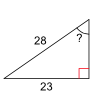


A 14 ft. ladder leans against the side of a house. The bottom of the ladder is 8 ft. away from the side of the house. Find x, the angle of elevation of the ladder. Round your answer to the nearest tenth.
55.2°
34.8°
29.7°
60.3°

A kite is flying 78 ft above the ground, and the string is pulled taut. The angle of elevation of the kite is 65°. Find the length of the string. Round your answer to the nearest tenth.
70.7 ft.
36.4 ft.
184.6 ft.
86.1 ft.


D= Mass/Volume
What is the density of a liquid that has a mass of 3g and a volume of 3ml?
3 g/ml
1g/cm3
1g
1 g/ml
D= Mass/Volume
What is the volume of an object with a mass of 10g and a density of 9 g/cm3?
90 g/cm3
1.1 mL
0.9 cm3
1.1 cm3
Density = Mass/Volume
What is the mass of a liquid with a volume of 5mL and density of 10 g/mL
0.5 g
50 g
2 g
5 mL
The density of a diamond is 3.51 g/cm3. What is the volume of a 6.0 carat diamond if 1 carat = 0.200 g?
.341888 cm3
1.7 cm3
105 cm3
0.34 cm3

