wayground logo

Free Printable Worksheets

Font size

S
M
L
XL
Worksheets

AP Chemistry Unit 5 Kinetics Reivew

Total questions: 119

Worksheet time: 5hrs 39mins

Name
Class
Date
1.
Which one of the following is a first order, overall reaction
a)
k1= 1.000 M s-1
b)
k1= 5403.2 M½ s½
c)
k1= 1.23 x 10⁻⁶ M-1 s-1
d)
k1= 10.7 s-1
2.
a)
A. is most exothermic
b)
B. is most exothermic
c)
C. is most exothermic
d)
D. is most exothermic
3.
Consider the following rate law: Rate = k[A]n[B]m
How are the exponents n and m determined?
a)
by using balanced chemical equation
b)
By using the subscripts for the formulas
c)
By educated guess
d)
By experiment 
4.
a)
A. has largest Ea
b)
B. has largest Ea
c)
C. has largest Ea
d)
E. has largest Ea
5.
a)
A. is the slowest reaction
b)
B. is the slowest reaction
c)
C. is the slowest reaction
d)
E. is the slowest reaction
6.
step 1: O3 → O2 + O
step 2: O3 + O → 2 O2

The oxygen atom (O) is considered to be a(n)...
a)
reactant
b)
catalyst
c)
reaction intermediate
d)
activated complex
7.
The reaction of (CH3)3CBr with hydroxide ion proceeds:
(CH3)3CBr(aq) + OH-(aq) → (CH3)3COH(aq) + Br-(aq)
What will the initial rate (in mol/L*s) be in Experiment 4?
a)
0.003
b)
0.006
c)
0.009
d)
0.018
8.
In any first order reaction, as the reaction proceeds at constant temperature, which describes the corresponding effects on k (the rate constant) and rate?
a)
k remains the same; rate decreases
b)
k and rate both remain the same
c)
k remains the same; rate increases
d)
k decreases; rate remains the same
9.
A compound has a half-life of 14 min. How much time will it take a 12 mol sample to decay to 1.5 mol?
a)
14 min
b)
28 min
c)
42 min
d)
56 min
10.
a)
IO-, because it was used as a reactant in an earlier step and reproduced in a subsequent step
b)
I-, because it was used as a reactant in an earlier step and reproduced in a subsequent step
c)
IO-, because it was produced in an earlier step and used up in a subsequent step
d)
I-, because it was produced in an earlier step and used up in a subsequent step
11.
a)

rate = k[CO]2[O2]2

b)

rate = k[CO]2[O2]

c)

rate = k[CO][O2]2

d)

rate = k[CO][O2]1/2

12.
A catalyst:
a)
should be eliminated when we solve elementary reaction steps of a proposed reaction mechanism simultaneously
b)
should always be introduced and eliminated in the first elementary step of a proposed reaction mechanism
c)
lowers the amount of energy released by an exothermic reaction
d)
lowers the amount of energy added to a reaction 
13.
Increasing temperature of a chemical reaction:
a)
increases the number of collisions per second of chemical reactants
b)
increases the speed of reaction
c)
can increase the pressure of reactants
d)
all of the above
14.
Multi-step (Consecutive) Reactions:
Mechanisms in which one elementary step is followed by another are very common.
step 1:              A + B → Q
step 2:              B + Q → C
net reaction:    A + 2B → C
Which of the following is false?
a)
The net reaction is just the sum of its elementary steps.
b)
The species Q is an intermediate, usually an unstable or highly reactive species. 
c)
Intermediates such as Q can appear in the rate law of a net reaction.
d)
If both steps proceed at similar rates, rate law experiments on the net reaction would not reveal that two separate steps are involved here.The rate law for the reaction would berate=k[A][B]2
15.
The rate law for a reaction is rate = k [A][B]2 Which one of the following statements is false? 
a)
A) If [B] is doubled, the reaction rate will increase by a factor of 4. 
b)
B) The reaction is second order in B.
c)
C) The reaction is first order in A.
d)
D) The reaction is second order overall.
16.

The graph shown depicts the relationship between concentration and time. What is the slope of this line?

a)

-k

b)

-1/k

c)

k

d)

ln[A]o

17.

What is the rate law for this reaction?

a)

rate = k[X]0

b)

rate = k[X]

c)

rate = k[X]2

d)

rate = -k[X]2

18.
a)
A. is most exothermic
b)
B. is most exothermic
c)
C. is most exothermic
d)
D. is most exothermic
19.
Which one of the following is a first order, overall reaction
a)
k1= 1.000 M s-1
b)
k1= 5403.2 M½ s½
c)
k1= 1.23 x 10⁻⁶ M-1 s-1
d)
k1= 10.7 s-1
20.
Consider the following rate law: Rate = k[A]n[B]m
How are the exponents n and m determined?
a)
by using balanced chemical equation
b)
By using the subscripts for the formulas
c)
By educated guess
d)
By experiment 
21.
a)
A. has largest Ea
b)
B. has largest Ea
c)
C. has largest Ea
d)
E. has largest Ea
22.
step 1: O3 → O2 + O
step 2: O3 + O → 2 O2

The oxygen atom (O) is considered to be a(n)...
a)
reactant
b)
catalyst
c)
reaction intermediate
d)
activated complex
23.
The reaction of (CH3)3CBr with hydroxide ion proceeds:
(CH3)3CBr(aq) + OH-(aq) → (CH3)3COH(aq) + Br-(aq)
What will the initial rate (in mol/L*s) be in Experiment 4?
a)
0.003
b)
0.006
c)
0.009
d)
0.018
24.
In any first order reaction, as the reaction proceeds at constant temperature, which describes the corresponding effects on k (the rate constant) and rate?
a)
k remains the same; rate decreases
b)
k and rate both remain the same
c)
k remains the same; rate increases
d)
k decreases; rate remains the same
25.
A compound has a half-life of 14 min. How much time will it take a 12 mol sample to decay to 1.5 mol?
a)
14 min
b)
28 min
c)
42 min
d)
56 min
26.
a)
IO-, because it was used as a reactant in an earlier step and reproduced in a subsequent step
b)
I-, because it was used as a reactant in an earlier step and reproduced in a subsequent step
c)
IO-, because it was produced in an earlier step and used up in a subsequent step
d)
I-, because it was produced in an earlier step and used up in a subsequent step
27.
a)

rate = k[CO]2[O2]2

b)

rate = k[CO]2[O2]

c)

rate = k[CO][O2]2

d)

rate = k[CO][O2]1/2

28.
Multi-step (Consecutive) Reactions:
Mechanisms in which one elementary step is followed by another are very common.
step 1:              A + B → Q
step 2:              B + Q → C
net reaction:    A + 2B → C
Which of the following is false?
a)
The net reaction is just the sum of its elementary steps.
b)
The species Q is an intermediate, usually an unstable or highly reactive species. 
c)
Intermediates such as Q can appear in the rate law of a net reaction.
d)
If both steps proceed at similar rates, rate law experiments on the net reaction would not reveal that two separate steps are involved here.The rate law for the reaction would berate=k[A][B]2
29.
The rate law for a reaction is rate = k [A][B]2 Which one of the following statements is false? 
a)
A) If [B] is doubled, the reaction rate will increase by a factor of 4. 
b)
B) The reaction is second order in B.
c)
C) The reaction is first order in A.
d)
D) The reaction is second order overall.
30.

The graph shown depicts the relationship between concentration and time. What is the slope of this line?

a)

-k

b)

-1/k

c)

k

d)

ln[A]o

31.
A catalyst:
a)
appears in the reactants of an early elementary step of a proposed reaction mechanism
b)
appears in the products of the last proposed reaction mechanism
c)
can affect reaction rate, but is not used up in a chemical reaction
d)
all of the above 
32.
Many kinetics equations fit a slope intercept form.  The Arrhenius equation is k = A e−(Ea/RT). The slope of a plot of ln k vs. 1/T is equal to: 
a)
-k
b)
k
c)
activation energy
d)
-Ea/ R
33.
A chemical reaction can occur:
a)
if the particles collide with enough energy
b)
if the particles collide with sufficient activation energy
c)
if the particles collide with correct orientation
d)
all of the above
34.
A "zeroth" order reaction for A-->B, will show:
a)
a straight line for a graph: time vs. ln [A]
b)
a straight line for a graph:  time vs. [A].
c)
a straight line for a graph:  time vs. 1/[A]
d)
none of the above
35.
A first order rate law for reaction A--> B will match a graph:
a)
which looks linear and positive in slope for time vs. ln [A].
b)
which looks non-linear and positive in slope for time vs. ln [A].
c)
which looks non-linear and negative in slope for time vs. ln [A].
d)
which looks linear and negative in slope for time vs. ln [A].
36.
A 2nd  order rate law for reaction A--> B will match a graph:
a)
which looks linear and positive in slope for time vs. 1/ [A].
b)
which looks linear and negative in slope for time vs. 1/ [A].
c)
which looks non-linear and positive in slope for time vs. 1/ [A].
d)
which looks non-linear and negative in slope for time vs. 1/[A].
37.
For a 1st order reaction, the half-life ("t1/2") is equal to:
a)
t1/2 = 0.693/k
b)
t1/2 = k/0.693
c)
t1/2 = 1/k[A]o 
d)
t1/2 = k 
38.
The rate law for a reaction is rate = k [A][B]2 Which one of the following statements is false? 
a)
A) If [B] is doubled, the reaction rate will increase by a factor of 4. 
b)
B) The reaction is second order in B.
c)
C) The reaction is first order in A.
d)
D) The reaction is second order overall.
39.
If the concentration of a reactant has zeroth order, it means:
a)
the multiple of the concentration change affects the reaction rate by the same multiple
b)
the multiple of the concentration change affects the reaction rate by a multiple of 2
c)
the multiple of the concentration change affects the reaction rate by a multiple of 4
d)
there is no effect of the concentration change on the reaction rate
40.
The mechanism for formation of the product X is:
           A + B -> C + D (slow)
           B + D -> X        (fast)
The intermediate reactant in the reaction is ___. 
a)
A
b)
B
c)
C
d)
D
41.
 For the elementary reaction NO3 + CO -> NO2 + CO2 the molecularity of the reaction is _______, and the rate law is rate = _______.
a)
A) 4, k[NO3][CO][NO2][CO2]
b)
 B) 2, k[NO3][CO]
c)
C) 4, k[NO2][CO2]/[NO3][CO] 
d)
 D) 2, k[NO2][CO2
42.
Suppose the reaction: A + 2B AB2 occurs by the following mechanism:
Step 1:  A + B--> AB     slow
Step 2:  AB + B -->ABfast
Overall: A + 2B AB2
The rate law expression must be Rate =______.
a)
(a) k[A]
b)
(b) k[B]
c)
(c) k[A][B]
d)
(d) k[B]2
43.
Consider the following mechanism.
Step 1:     O3        → O2 + O (fast)
Step 2:     O3 + O → 2 O2 (slow)
What is the overall balanced equation?
a)
4 O3 → 3 O2
b)
  O3 → 3 O2
c)
3 O3 → 2 O2
d)
2 O3 → 3 O2
44.

For the following reaction, the rate of consumption of C6H14 is -6.2 x 10⁻³ atm/s. Determine the rate of production of H2 at the same time.


C6H14 (g) -> C6H6 (g) + 4H2 (g)

a)

6.2 x 10⁻³ atm/s

b)

1.6 x 10⁻³ atm/s

c)

2.5 x 10⁻² atm/s

d)

-2.5 x 10⁻² atm/s

45.
Which one of the following is a first order, overall reaction
a)
k1= 1.000 M s-1
b)
k1= 5403.2 M½ s½
c)
k1= 1.23 x 10⁻⁶ M-1 s-1
d)
k1= 10.7 s-1
46.
Consider the following rate law: Rate = k[A]n[B]m
How are the exponents n and m determined?
a)
by using balanced chemical equation
b)
By using the subscripts for the formulas
c)
By educated guess
d)
By experiment 
47.
The rate law for a reaction is rate = k [A][B]2 Which one of the following statements is false? 
a)
A) If [B] is doubled, the reaction rate will increase by a factor of 4. 
b)
B) The reaction is second order in B.
c)
C) The reaction is first order in A.
d)
D) The reaction is second order overall.
48.

The graph shown depicts the relationship between concentration and time. What is the slope of this line?

a)

-k

b)

-1/k

c)

k

d)

ln[A]o

49.

What is the rate law for this reaction?

a)

rate = k[X]0

b)

rate = k[X]

c)

rate = k[X]2

d)

rate = -k[X]2

50.

Which of the following plots will show a linear relationship for a second order reaction?

a)

[A] vs time

b)

1/[A] vs time

c)

ln[A] vs time

d)

[A]2 vs time

51.

Which of the two graphs show a state of equilibrium being reached?

a)

A

b)

B

c)

A and B

d)

Neither.

52.
Reaction rate means...
a)
amount of product formed
b)
speed of reaction
c)
concentration of reacting particles
d)
combining reactants with products
53.
a)
A. is most exothermic
b)
B. is most exothermic
c)
C. is most exothermic
d)
D. is most exothermic
54.
For a 1st order reaction, the half-life ("t1/2") is equal to:
a)
t1/2 = 0.693/k
b)
t1/2 = k/0.693
c)
t1/2 = 1/k[A]o 
d)
t1/2 = k 
55.
step 1: O3 → O2 + O
step 2: O3 + O → 2 O2

The oxygen atom (O) is considered to be a(n)...
a)
reactant
b)
catalyst
c)
reaction intermediate
d)
activated complex
56.
A catalyst:
a)
should be eliminated when we solve elementary reaction steps of a proposed reaction mechanism simultaneously
b)
should always be introduced and eliminated in the first elementary step of a proposed reaction mechanism
c)
lowers the amount of energy released by an exothermic reaction
d)
lowers the amount of energy added to a reaction 
57.
Increasing temperature of a chemical reaction:
a)
increases the number of collisions per second of chemical reactants
b)
increases the speed of reaction
c)
can increase the pressure of reactants
d)
all of the above
58.
Multi-step (Consecutive) Reactions:
Mechanisms in which one elementary step is followed by another are very common.
step 1:              A + B → Q
step 2:              B + Q → C
net reaction:    A + 2B → C
Which of the following is false?
a)
The net reaction is just the sum of its elementary steps.
b)
The species Q is an intermediate, usually an unstable or highly reactive species. 
c)
Intermediates such as Q can appear in the rate law of a net reaction.
d)
If both steps proceed at similar rates, rate law experiments on the net reaction would not reveal that two separate steps are involved here.The rate law for the reaction would berate=k[A][B]2
59.
Which one of the following is a first order, overall reaction
a)
k1= 1.000 M s-1
b)
k1= 5403.2 M½ s½
c)
k1= 1.23 x 10⁻⁶ M-1 s-1
d)
k1= 10.7 s-1
60.
a)
A. is most exothermic
b)
B. is most exothermic
c)
C. is most exothermic
d)
D. is most exothermic
61.
Consider the following rate law: Rate = k[A]n[B]m
How are the exponents n and m determined?
a)
by using balanced chemical equation
b)
By using the subscripts for the formulas
c)
By educated guess
d)
By experiment 
62.
step 1: O3 → O2 + O
step 2: O3 + O → 2 O2

The oxygen atom (O) is considered to be a(n)...
a)
reactant
b)
catalyst
c)
reaction intermediate
d)
activated complex
63.
a)

rate = k[CO]2[O2]2

b)

rate = k[CO]2[O2]

c)

rate = k[CO][O2]2

d)

rate = k[CO][O2]1/2

64.
Multi-step (Consecutive) Reactions:
Mechanisms in which one elementary step is followed by another are very common.
step 1:              A + B → Q
step 2:              B + Q → C
net reaction:    A + 2B → C
Which of the following is false?
a)
The net reaction is just the sum of its elementary steps.
b)
The species Q is an intermediate, usually an unstable or highly reactive species. 
c)
Intermediates such as Q can appear in the rate law of a net reaction.
d)
If both steps proceed at similar rates, rate law experiments on the net reaction would not reveal that two separate steps are involved here.The rate law for the reaction would berate=k[A][B]2
65.
The rate law for a reaction is rate = k [A][B]2 Which one of the following statements is false? 
a)
A) If [B] is doubled, the reaction rate will increase by a factor of 4. 
b)
B) The reaction is second order in B.
c)
C) The reaction is first order in A.
d)
D) The reaction is second order overall.
66.

The graph shown depicts the relationship between concentration and time. What is the slope of this line?

a)

-k

b)

-1/k

c)

k

d)

ln[A]o

67.

What is the rate law for this reaction?

a)

rate = k[X]0

b)

rate = k[X]

c)

rate = k[X]2

d)

rate = -k[X]2

68.
The reaction of (CH3)3CBr with hydroxide ion proceeds:
(CH3)3CBr(aq) + OH-(aq) → (CH3)3COH(aq) + Br-(aq)
What will the initial rate (in mol/L*s) be in Experiment 4?
a)
0.003
b)
0.006
c)
0.009
d)
0.018
69.
a)

A

b)

B

c)

C

d)

D

e)

E

70.
a)
IO-, because it was used as a reactant in an earlier step and reproduced in a subsequent step
b)
I-, because it was used as a reactant in an earlier step and reproduced in a subsequent step
c)
IO-, because it was produced in an earlier step and used up in a subsequent step
d)
I-, because it was produced in an earlier step and used up in a subsequent step
71.
Under the collision theory, the particles must collide with  ____ and ____ for a reaction to occur.
a)
sufficient rate and sufficient energy
b)
sufficient surface area and correct orientation
c)
sufficient catalyst and sufficient energy
d)
sufficent energy and correct orientation
72.

Which of the two graphs show a state of equilibrium being reached?

a)

A

b)

B

c)

A and B

d)

Neither.

73.

Given the following rate law,

rate = k[A]2[B]

if [A] were doubled, what must happen to [B] to keep the rate constant?

a)

[B] must quadruple

b)

[B] must double

c)

[B] must be havled

d)

[B] must be quartered

74.
A possible rate law for a third overall order of a reaction is __________________
a)
Rate = k [A]2[B]2
b)
Rate = k [A][B]3
c)
Rate = k [A]3 [B]
d)
Rate = k [A]2[B]
75.

The following data were measured for the reaction

BF3(g) + NH3(g) ⟶ F3BNH3(g)

What is the rate law for the reaction?

a)

rate = k[NH3]

b)

rate = k[BF3]2[NH3]

c)

rate = k[BF3][NH3]

d)

rate = k[BF3][NH3]2

76.

A reaction is found to be second order with respect to carbon monoxide. If the concentration of carbon monoxide is doubled, the rate of reaction __________.

a)

doubles

b)

remains unchanged

c)

increases by a factor of 4

d)

is reduced by a factor of 2

77.

The catalyst alters the rate of a chemical reaction by,

a)

providing an alternative pathway with a lower Ea

b)

changing the products formed in the direction of the reaction

c)

providing a surface on which the molecules react

d)

increasing the frequencies of collisions between molecules

78.

What is the rate law for this mechanism?

a)

rate = k[A][B]2

b)

rate = [B][X]

c)

rate = [A]0.5[B]1.5

d)

rate = [W][Y][Z]

79.

What would the rate constant of the reaction be given the following set of experiments?

a)
b)
c)
d)
80.
Which one of the following is a first order, overall reaction
a)
k1= 1.000 M s-1
b)
k1= 5403.2 M½ s½
c)
k1= 1.23 x 10⁻⁶ M-1 s-1
d)
k1= 10.7 s-1
81.
a)
A. is most exothermic
b)
B. is most exothermic
c)
C. is most exothermic
d)
D. is most exothermic
82.
Consider the following rate law: Rate = k[A]n[B]m
How are the exponents n and m determined?
a)
by using balanced chemical equation
b)
By using the subscripts for the formulas
c)
By educated guess
d)
By experiment 
83.
a)
A. has largest Ea
b)
B. has largest Ea
c)
C. has largest Ea
d)
E. has largest Ea
84.
a)
A. is the slowest reaction
b)
B. is the slowest reaction
c)
C. is the slowest reaction
d)
E. is the slowest reaction
85.
step 1: O3 → O2 + O
step 2: O3 + O → 2 O2

The oxygen atom (O) is considered to be a(n)...
a)
reactant
b)
catalyst
c)
reaction intermediate
d)
activated complex
86.
The reaction of (CH3)3CBr with hydroxide ion proceeds:
(CH3)3CBr(aq) + OH-(aq) → (CH3)3COH(aq) + Br-(aq)
What will the initial rate (in mol/L*s) be in Experiment 4?
a)
0.003
b)
0.006
c)
0.009
d)
0.018
87.
In any first order reaction, as the reaction proceeds at constant temperature, which describes the corresponding effects on k (the rate constant) and rate?
a)
k remains the same; rate decreases
b)
k and rate both remain the same
c)
k remains the same; rate increases
d)
k decreases; rate remains the same
88.
A compound has a half-life of 14 min. How much time will it take a 12 mol sample to decay to 1.5 mol?
a)
14 min
b)
28 min
c)
42 min
d)
56 min
89.
a)
IO-, because it was used as a reactant in an earlier step and reproduced in a subsequent step
b)
I-, because it was used as a reactant in an earlier step and reproduced in a subsequent step
c)
IO-, because it was produced in an earlier step and used up in a subsequent step
d)
I-, because it was produced in an earlier step and used up in a subsequent step
90.
a)

rate = k[CO]2[O2]2

b)

rate = k[CO]2[O2]

c)

rate = k[CO][O2]2

d)

rate = k[CO][O2]1/2

91.
A catalyst:
a)
should be eliminated when we solve elementary reaction steps of a proposed reaction mechanism simultaneously
b)
should always be introduced and eliminated in the first elementary step of a proposed reaction mechanism
c)
lowers the amount of energy released by an exothermic reaction
d)
lowers the amount of energy added to a reaction 
92.
Increasing temperature of a chemical reaction:
a)
increases the number of collisions per second of chemical reactants
b)
increases the speed of reaction
c)
can increase the pressure of reactants
d)
all of the above
93.
Multi-step (Consecutive) Reactions:
Mechanisms in which one elementary step is followed by another are very common.
step 1:              A + B → Q
step 2:              B + Q → C
net reaction:    A + 2B → C
Which of the following is false?
a)
The net reaction is just the sum of its elementary steps.
b)
The species Q is an intermediate, usually an unstable or highly reactive species. 
c)
Intermediates such as Q can appear in the rate law of a net reaction.
d)
If both steps proceed at similar rates, rate law experiments on the net reaction would not reveal that two separate steps are involved here.The rate law for the reaction would berate=k[A][B]2
94.
The rate law for a reaction is rate = k [A][B]2 Which one of the following statements is false? 
a)
A) If [B] is doubled, the reaction rate will increase by a factor of 4. 
b)
B) The reaction is second order in B.
c)
C) The reaction is first order in A.
d)
D) The reaction is second order overall.
95.

The graph shown depicts the relationship between concentration and time. What is the slope of this line?

a)

-k

b)

-1/k

c)

k

d)

ln[A]o

96.

What is the rate law for this reaction?

a)

rate = k[X]0

b)

rate = k[X]

c)

rate = k[X]2

d)

rate = -k[X]2

97.

Which of the following plots will show a linear relationship for a second order reaction?

a)

[A] vs time

b)

1/[A] vs time

c)

ln[A] vs time

d)

[A]2 vs time

98.

The iodide ion reacts with hypochlorite ion in the following way:

OCl- + I- ⟶ OI- + Cl-.

This rapid reaction gives the rate data shown. What is the rate law?

a)

rate = [OCl-]2[I-]

b)

rate = [OCl-][I-]2

c)

rate = [OCl-][I-]

d)

rate = [OCl-]

99.

The following data were measured for the reaction

BF3(g) + NH3(g) ⟶ F3BNH3(g)

What is the rate law for the reaction?

a)

rate = k[NH3]

b)

rate = k[BF3]2[NH3]

c)

rate = k[BF3][NH3]

d)

rate = k[BF3][NH3]2

100.

The following data were measured for the reaction

BF3(g) + NH3(g) ⟶ F3BNH3(g)

What is the rate when [BF3] = 0.100 M and [NH3] = 0.500 M ?

a)

.01704 M/s

b)

.0852 M/s

c)

.1704 M/s

d)

.852 M/s

101.

A reaction is found to be second order with respect to carbon monoxide. If the concentration of carbon monoxide is doubled, the rate of reaction __________.

a)

doubles

b)

remains unchanged

c)

increases by a factor of 4

d)

is reduced by a factor of 2

102.

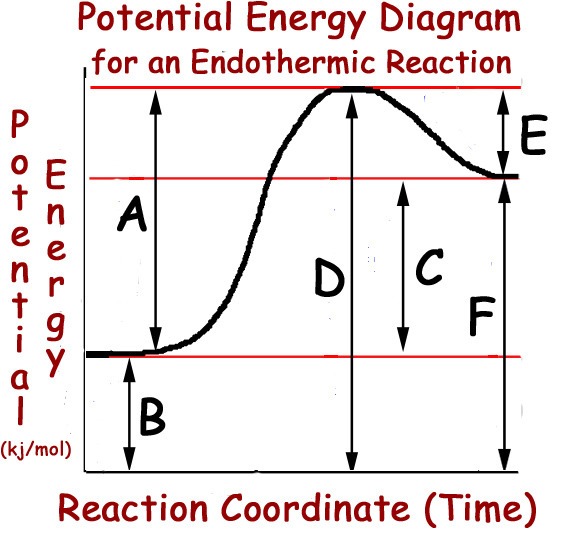
What letter represents the activation energy?

a)

A

b)

B

c)

C

d)

D

103.

Which of the two graphs show a state of equilibrium being reached?

a)

A

b)

B

c)

A and B

d)

Neither.

104.

Given the following rate law,

rate = k[A]2[B]

if [A] were doubled, what must happen to [B] to keep the rate constant?

a)

[B] must quadruple

b)

[B] must double

c)

[B] must be havled

d)

[B] must be quartered

105.

Which of the following best describes why increasing temperature increase reaction rate?

a)

Activation energy is reduced.

b)

Collisions become more frequent.

c)

Collisions become more energetic.

d)

Collisions become more frequent and more energetic.

106.

rate = k[A]

The rate constant in the rate law above is 0.5 L/mol·s. If the initial concentration of A is 0.1 M, how long will it take for [A] to drop to 0.025 M?

a)

0.7 s

b)

1.4 s

c)

2.8 s

d)

There is not enough information given.

107.

Which species is the catalyst in this reaction mechanism?

a)

R

b)

W

c)

X

d)

There is no catalyst.

108.

What is the rate law for this mechanism?

a)

rate = k[A][B]2

b)

rate = [B][X]

c)

rate = [A]0.5[B]1.5

d)

rate = [W][Y][Z]

109.

The addition of a catalyst to this reaction would cause a change in which of the indicated energy differences?

a)

I

b)

II

c)

III

d)

I and II

110.

Which factors increase the rate of a reaction?

a)

increasing temperature

b)

increasing concentration

c)

increasing surface area

d)

all of the above

111.
a)

A

b)

B

c)

C

d)

D

112.
a)

A

b)

B

c)

C

d)

D

e)

E

113.
a)

A

b)

B

c)

C

d)

D

e)

E

114.
a)

A

b)

B

c)

C

d)

D

e)

E

115.
a)

A

b)

B

c)

C

d)

D

116.
a)

A

b)

B

c)

C

d)

D

117.
a)

A

b)

B

c)

C

d)

D

e)

E

118.
a)

A

b)

B

c)

C

d)

D

e)

E

119.
a)

A

b)

B

c)

C

d)

D

e)

E