
 Worksheets
Geosphere
Total questions: 45
Worksheet time: 45mins
Which of the following describes the process by which sedimentary rock becomes metamorphic rock?
weathering
erosion
intense heat and pressure
cooling and solidifying
Evan examines a diagram of the rock cycle in his science textbook. He wonders how he can connect what he has learned about matter and energy to the rock cycle. Which statement explains what happens to material as it moves through the stages of the rock cycle?
New matter is being created all of the time.
The same matter is recycled over and over.
Eventually the broken-down matter disappears.
Old matter is destroyed and new matter takes its place.
Sedimentary rocks are changed to sediments by _________.
compaction
weathering and erosion
cementation
heat and pressure
The ____ shows how one rock changes into another
rock cycle
melting process
formation of crystals
none of the above
The rock cycle indicates that each type of rock can ______.
provide materials to make other rocks
form other rocks
be changed by forces at Earth's surface
all of the above
Scientists believe the deeper into the geosphere ________.
temperature and pressure both increase
temperature increases as pressure decreases
temperature and pressure both decrease
temperature decreases as pressure increases
The different layers formed on Earth are due to the differences in ________ of the material.
the mass
the volume
the climate
the density
Which layer of Earth is the most dense?
crust
mantle
outer core
inner core
Anderson is writing a description of Earth's layers. Which statement correctly describes the crust and mantle?
The crust is the liquid layer of Earth. The mantle is the solid layer.
The crust is the thickest layer of Earth. The mantle is the thinnest layer.
The crust is the innermost layer of Earth. The mantle surrounds the crust.
The crust is the outermost layer of Earth. The mantle is the thick middle layer.
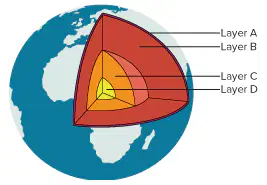
The diagram shows Earth's layers.
Which layers are made of rock?
Layers A and B
Layers B and C
Layers C and D
Layers A and D
The processes involved in the rock cycle include all of the following EXCEPT ________.
condensation
erosion
weathering
compaction
Igneous rocks form from ________ when it cools.
magma
lava
neither a nor b
both a and b
What type(s) of rock can form from pieces of rocks and minerals?
igneous
metamorphic
sedimentary
igneous and metamorphic
The crystals that form in slowly cooled magma produce ______ mineral grains.
tiny
invisible
fine-grained
large
Igneous rocks that cool slowly beneath Earth's crust are _______.
extrusive
intrusive
metamorphic
always magnetic
Igneous rocks that cool quickly on Earth's surface are _________.
extrusive
intrusive
metamorphic
always magnetic
A student finds a rock with seashells in it. What kind of rock is it?
an igneous rock
a sedimentary rock
a metamorphic rock
an extrusive rock
Which statement is correct regarding metamorphic rock formation?
The temperature inside Earth is cooler which allows metamorphic rocks to form more quickly.
Small pieces of rocks are buried, squeezed, and cemented together.
Weathering and erosion cause rocks to break down to form metamorphic rocks.
The deeper into Earth's crust, the higher the pressure that forms metamorphic rock.
An igneous rock body is exposed to the process of weathering and erosion. What must happen next in order for the rock to become a sedimentary rock?
It must cool and crystalize.
It must grow new mineral crystals and become harder.
The broken rock pieces must become compacted and cemented together.
The rock body must develop bands of alternating light and dark minerals.

Which layer best represents the mantle?
1
2
3
4

Which layer best represents the outer core?
1
2
3
4

Which layer best represents the crust?
1
2
3
4
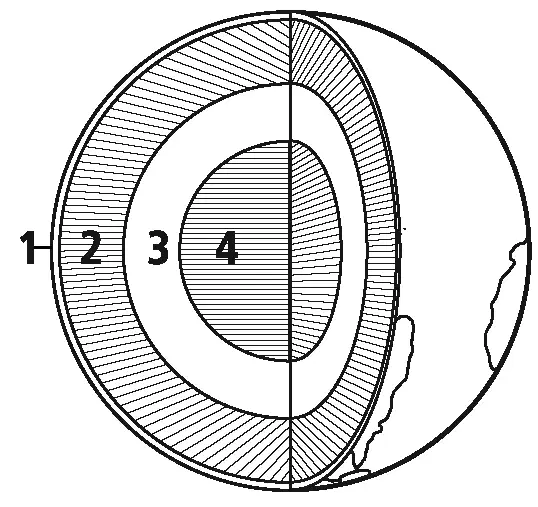
Which layer best represents the inner core?
1
2
3
4
Read the descriptions and match each rock type with is description.
Formed from other rocks and fossilized organisms
Sedimentary
Formed from heat and pressure
Metamorphic
Formed from molten rock
Igneous

The table shows Earth's layers and their approximate maximum temperatures. Which hypothesis could you develop from the data in the table?
The temperature of the crust is 1,480 degrees Celcius.
If you go deeper into Earth, the temperature increases.
The temperature of the crust is much hotter than the temperature of the core or the mantle.
As the pressure increases, temperature decreases.
Most of the information about Earth's interior was obtained by studying __________.
earthquake waves
rocks of the ocean crust
meteorites
rocks in deep wells
Sarah is watching a video in order to understand how convection in the mantle of the Earth occurs. The video shows rock rising and sinking to make convection currents in the mantle. Which process is responsible for causing rock to rise?
Rock rapidly cools off.
Rock is heated.
Rock increases in density.
Rock undergoes intense pressure.

There are different processes occurring in the rock cycle that result in the formation of the three main rock types.
At which numbered step does melting occur?
2
3
4
5
Earth's thin, rocky outer layer is its __________.
core
mantle
outer core
crust
Put Earth's layers in order from the innermost layer to the outermost layer
inner core
outer core
mantle
crust
As you travel further into the Earth, the pressure __________.
decreases
increases
stays the same
disappears
Which layer is a solid metal ball made mostly of nickel and iron?
inner core
outer core
mantle
crust
Which layer is mostly composed of liquid nickel and iron?
inner core
outer core
mantle
crust
The movement of Earth's plates is caused by convection currents found within which layer?
inner core
outer core
mantle
crust
Which layer is made of the three different types of rock: igneous, metamorphic, and sedimentary?
inner core
mantle
crust
outer core
The earth is composed mainly of
water
metal
iron
rock
Earth's inner core is suspended in
liquid iron and nickel
solid iron and nickel
heated gases
none of the above
Oceanic plates are thicker than Continental plates.
True
False
During an earthquake, energy is released into Earth.
True
False
Marcie is hiking in the mountains and she discovers an interesting shiny rock. As she picks it up she wonders whether it could be a mineral or whether it is just a rock. She notes that it is solid and naturally occurring with a definite chemical composition, but that it has no definite crystal structure. Suppose the object Ava found is a rock formed by volcanic processes. What type of rock would it be?
igneous
metamorphic
mineral
sedimentary
Payge is hiking in the mountains and she discovers an interesting shiny rock. As she picks it up she wonders whether it could be a mineral or whether it is just a rock. She notes that it is solid and naturally occurring with a definite chemical composition, but that it has no definite crystal structure. Payge believes that she has found a piece of obsidian. What causes obsidian to form?
extremely hot rock that cools fast
remains of plants and animals compacted
pressure deep beneath the surface of Earth
particles of rocks pressed and cemented together
Sam is creating a computer model to present to his classmates so they can compare the properties of each layer of Earth.
Choose the words to finish the sentences. The (a) should be the thickest layer of Sam’s model, and the (b) should be the thinnest layer.
Which word or phrase describes the INNER CORE.
solid
liquid
hottest layer
under the most pressure
causes the magnetic field
Which word or phrase describes the OUTER CORE.
solid
liquid
hottest layer
under the most pressure
causes the magnetic field
The cementing of small pieces of rock or shell causes (a) rock to form. When rocks are buried below the surface, pressure combined with heat causes (b) rock to form.

