wayground logo

Free Printable Worksheets

Font size

S
M
L
XL
Worksheets

Genes and Reproduction Review

Total questions: 44

Worksheet time: 53mins

Name
Class
Date
1.

Different forms of a single gene.

a)

Genotype

b)

Chromosome

c)

Trait

d)

Allele

2.

Carry hereditary information, located in the nucleus.

a)

Alleles

b)

Gene

c)

Chromosome

d)

Offspring

3.

Segments of DNA that carry hereditary information and are passed from parent to offspring.

a)

Chromosomes

b)

Probability

c)

Ressesive

d)

Genes

4.

The gene combination that is present in a cell or organism for a particular trait.

a)

Phenptype

b)

Hybrid

c)

Pure

d)

Genotype

5.

The passing of traits from parents to offspriing.

a)

Chromosomes

b)

Genes

c)

Heredity

d)

Alleles

6.

The result of sexual or asexual reproduction.

a)

Phenptype

b)

Offspring

c)

Probability

d)

Trait

7.

What an organism physically looks like.

a)

Genotype

b)

Phenotype

c)

Chromosomes

d)

Traits

8.

A special grid used to predict the possible outcomes of different crosses.

a)

Genotype

b)

Offspring

c)

Probability

d)

Punnett Square

9.

A trait the recedes into the background or is present in the alleles but hidden in appearance.

a)

Dominant

b)

Pure

c)

Hybrid

d)

Recessive

10.

A characteristic passed from parents to offspring.

a)

Probability

b)

Incomplete Dominance

c)

Punnett Square

d)

Trait

11.

What base pairs with adenine?

a)

phosphate

b)

guanine

c)

cytosine

d)

thymine

12.

What base pairs with thymine?

a)

adenine

b)

guanine

c)

cytosine

d)

limousine

13.

What base pairs with guanine?

a)

cytosine

b)

guanine

c)

thymine

d)

sugar

14.

What base pairs with cytosine?

a)

guanine

b)

adenine

c)

thymine

d)

magazine

15.

What are the 3 parts of a nucleotide?

a)

a phosphate group

b)

a base

c)

a wave caused by a large bomb

d)

a 5 carbon sugar

16.

Why is DNA important?

a)

It teleports cookies to my locker.

b)

It carries the instructions for our cells.

c)

It allows me to be invisible.

d)

It gave us a snow day in August.

17.

If a DNA sequence it GAATGCCT, what are the matching base pairs?

a)

ACGTACCTG

b)

AEIOU and sometimes Y

c)

CTTACGGA

d)

GCCTATGC

18.

If a DNA sequence is CATCAT, what are the matching base pairs?

a)

ACGTAC

b)

MEOW

c)

GTAGTA

d)

GCCTAT

19.
Which of the following is an inherited trait?
a)
Eye color
b)
Name
c)
Hairstyle
d)
Birthday
20.
How many alleles (letters) does a child get from each parent for each trait?
a)
1
b)
2
c)
3
d)
4
21.
How many alleles (letters) do each person carry for a trait?
a)
1
b)
2
c)
3
d)
4
22.
Dominant alleles are represented by a:
a)
Male gene
b)
lowercase letter
c)
recessive trait
d)
capital letter
23.
Aa, DD, bB, yy are all examples of
a)
genotypes
b)
phenotypes
24.
What you see, or the physical appearance.
a)
Genotype
b)
Phenotype
c)
Homozygous
d)
Heterozygous
25.
In a heterozygous genotype, the ___________ allele takes over in the phenotype.
a)
recessive
b)
dominant
c)
lower case letter
d)
both 
26.
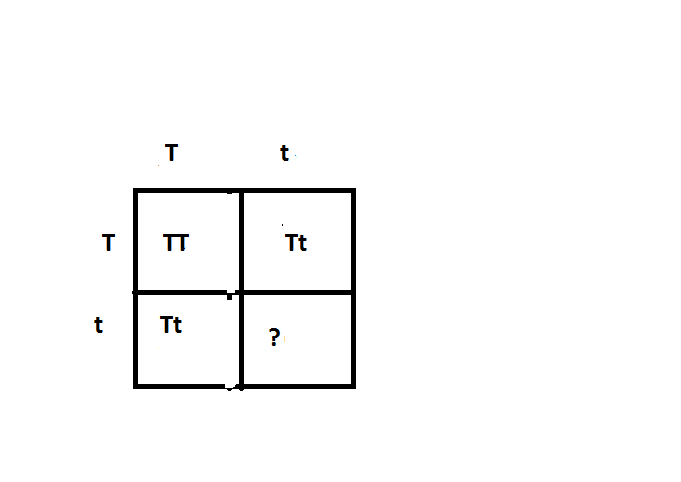
T - tall and t = short
In the punnett square below, what belongs in the missing square
a)
tt
b)
Tt
c)
Bb
d)
TT
27.
Aa is
a)
homozygous
b)
heterozygous
28.
Which of the following is a phenotype?
a)
Aa
b)
red hair
c)
heterozygous
d)
DNA
29.
Which of the following genotypes is homozygous dominant?
a)
A
b)
Aa
c)
AA
d)
aa
30.
Which of the following genotypes is heterozygous?
a)
Bb
b)
BB
c)
bb
d)
B
31.
Which of the following is homozygous recessive?
a)
Tt
b)
tt
c)
TT
d)
T
32.
In mitosis, the two resulting cells are
a)
different from the starting cell and identical to each other.
b)
different from the starting cell and different from each other.
c)
identical to the starting cell and different from each other.
d)
identical to the starting cell and identical to each other.
33.
Where does a cell contain it's genetic material?
a)
nucleus
b)
nucleolus
c)
cytoskeleton
d)
golgi
34.
Which of these lists presents the stages of the cell cycle in the correct order?
a)
interphase, mitosis, cytokinesis
b)
cytokinesis, mitosis, interphase
c)
mitosis, interphase, cytokinesis
d)
interphase, cytokinesis, mitosis
35.
Which part of the Cell Cycle takes the longest?
a)
Interphase
b)
Mitosis
c)
Prophase
d)
Cytokinesis
36.

In which stage of the cell cycle does the cell split into two?

a)

Mitosis

b)

G1

c)

Cytokinesis

d)

S

37.

The correct sequence of mitosis:

a)

metaphase, anaphase, telophase, prophase

b)

prophase, metaphase, anaphase, telophase

c)

prophase, anaphase, metaphase, telophase

d)

telophase, metaphase, prophase, anaphase

38.
Put the following stages of the cell cycle in order: G2, S, G1, M. 
a)
G1, S, G2, M
b)
S, G1, G2, M
c)
G1, M, G2, S
d)
M, G1, S, G2
39.
Identify the Cell Cycle Stage.
a)
Anaphase
b)
Cytokinesis
c)
Telophase
d)
Metaphase
40.
Identify the Cell Cycle Stage.
a)
Prophase
b)
Interphase
c)
Anaphase
d)
Telophase
41.
Identify the Cell Cycle Stage.
a)
Cytokinesis
b)
Interphase
c)
Anaphase
d)
Metaphase
42.
Identify the Cell Cycle Stage.
a)
Interphase
b)
Anaphase
c)
Telophase
d)
Prophase
43.
During which part of the cell cycle is DNA copied?
a)
Mitosis
b)
Cytokinesis
c)
S phase
44.
During which parts of the cell cycle does the cell grow?
a)
G1 and G2
b)
G1 and S
c)
M phase and cytokinesis