
 Worksheets
Semester 1 Grand Summary
Total questions: 100
Worksheet time: 50mins
The kinetic theory states
Particles won't move if you don't apply energy to it.
Particles only move in liquids and gases.
Particles are always in motion.
At the same temperature the object that has the most mass heats quicker.
The energy of movement is ___.
potential energy
kinetic energy
mechanical energy
The more energy that particles have, the ___ they move.
slower
faster
The force of attraction between molecules is ___.
intermolecular forces
bridge forces
chemical bonds

These properties describe a ___.
solid
liquid
gas

These properties describe a ___.
solid
liquid
gas

These properties describe a ___.
solid
liquid
gas
Collisions in which particles transfer all their kinetic energy to other particles are called ___.
elastic
inelastic
Which one of these is NOT an Ideal Gas Assumption?
Gas particles are hard, round spheres.
Gas particles are strongly attracted to one another.
Gas particles do not take up space.
Gas particles collide perfectly elastically.
The particles of ___ generally have the least amount of energy.
solids
liquids
gases
Liquid particles have more energy than ___ particles.
solid
gas
Diffusion occurs only in gases
True
False
The movement of particles is __________, resulting in the particles being spread throughout the container
Structured
In a straight line
Random
In curved, way motions
What does a 'region with high concentration' mean?
SMALL number of particles
LARGE number of particles
UNEVEN number of particles
no particles
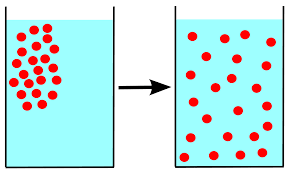
The picture below is an example of _________________.
osmosis
isotonic
diffusion
active transport
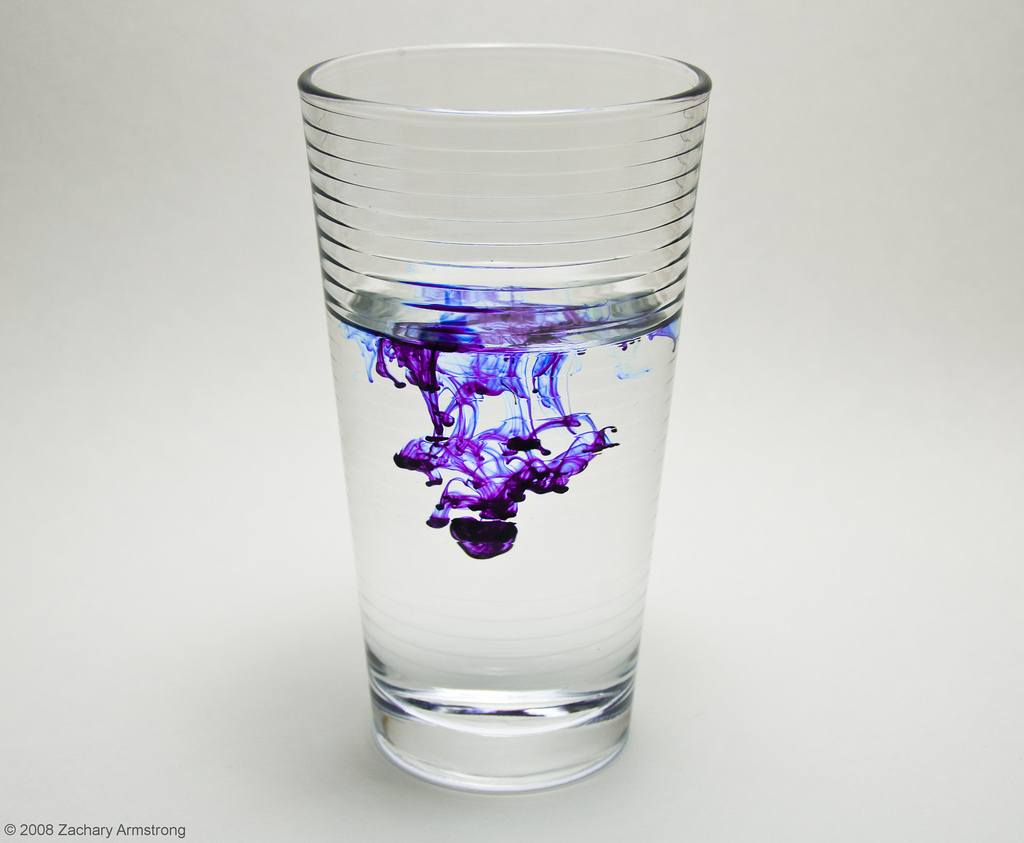
Where is there a low concentration of dye?
at the bottom of cup
in the color
at the top of cup
no concenteraion gradient

What is DIFFUSION?


Which BEST describes the meaning of mass of an object?
The amount of space an object or substance takes up
Mass divided by volume
The amount of matter in an object or substance
The weight of an object only in solid form and in zero gravity
Which of the following BEST describes volume?
How much space an object takes up
Where an object is in space
How much an object weighs
The mass of an object compared to its weight
What two properties do you need to find density?
Volume and weight
Mass and volume
Only volume
Only mass
If an object sinks in water than it is (a) than water and
If an object floats in water then it is (a) than water.
If I cut a block of gold in half, what happens to its density?
Density is cut in half.
Density stays the same.
Density doubles.
Density cannot be determined.


What is the most likely result of nitrogen and chlorine reacting based on their dot diagrams?
Three chlorine atoms will each steal one electron from nitrogen
Five chlorine atoms will each steal one electron from nitrogen
Three chlorine atoms will each share one electron with nitrogen
Five chlorine atoms will each share one electron from nitrogen
Which of the following isotopes has 18 neutrons?
40Ar
35Cl
18F
24Mg

As the number of protons increases across a period, while electrons are added to the same energy level, all of the following are true EXCEPT:
the effective nuclear charge increases
the electron shielding increases
the atomic radius decreases
the ionization energy increases
Electronegativity _______ across a period and ______ down a group.
increases, increases
increases, decreases
decreases, increases
decreases, decreases
Which of these atoms is the most electronegative?
Bromine
Fluorine
Hydrogen
Potassium
The electrons in a polar covalent molecule are shared...
Evenly
Unevenly
Electrons are not shared
None of the Above

The electrons in a nonpolar covalent molecule are shared...
Evenly
Unevenly
Electrons are not shared
None of the Above
In a polar covalent bond, the electrons gather around...
The atom with the Greatest Electronegativity
The atom with the Lowest Electronegativity
Each atom Equally
None of the Above
CH4 is
polar
non-polar
NH3 is
polar
non-polar
Which of these atoms is the most electronegative?
Bromine
Fluorine
Hydrogen
Potassium
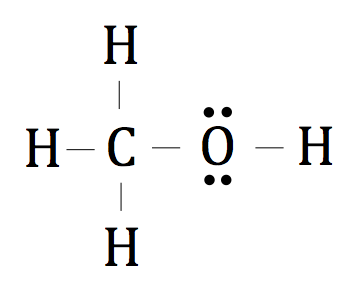
Is the following molecule polar or non-polar?
polar
non-polar
Electronegativity refers to an atom's ability to _____________ shared electrons in a covalent bond.
attract
donate
H2O is
polar
non-polar
More electronegative atoms in covalent compounds are likely to have:
Partial positive charge
Partial negative charge

Is this molecule polar or non-polar?
Polar
Non-polar


Why is the molecule polar?
There is a non bonding pair electrons on the central atom.
There are different types of elements bonded to the central atom.
There are no non bonding pairs on the central atom and all of the atoms bonded to the central atom are the same.

Is this molecule polar or non-polar?
Non-polar
Polar

Classify the above molecule.
Polar
Non polar

What is ionization energy?
Energy needed to destroy an atom
Energy required to remove an electron from an atom in its gaseous state
Energy needed to split an electron
Energy associated with how strongly an atom attracts electrons
Electronegativity is...
the measure of how strongly an atom attracts electrons
the ability of an atom to lose electrons
the energy required to remove an electron from a specific atom in its gaseous state
how easy it is to make friends.
What is the atomic radius?
The distance from the nucleus to the outer boundary of an atom
The distance from one side of an atom to the other side
The distance around the atom
The distance between atoms in the gas phase
The distance between atoms in the solid phase
As you move across the periodic table atoms tend to get smaller because, ______________.
the atoms have more mass.
the atoms have less mass
the atoms have a bigger effective nuclear charge
the atoms have less electrons.
Which atom has the largest atomic radius?
potassium
rubidium
francium
cesium
Which of these elements has the smallest atomic radius?
C
Ne
K
Al
P
Atomic radius generally increases as we move __________.
down a group and from right to left across a period
up a group and from left to right across a period
down a group and from left to right across a period
up a group and from right to left across a period

What is the number of proton of the molecule?
80
120
200
What is the number of proton of the molecule?
80
120
200
What is the number of electron of the molecule?
80
120
200
What is the number of neutron of the molecule?
80
120
200

What is the number of proton of the molecule?
29
34
63

How many atoms of hydrogen are in this compound?
1
2
3
4
How many elements are in the compound Fe2O3?
0
1
2
3
How many atoms of oxygen are in this compound?
2Ca(OH)2
1
2
3
4
Find the molar mass of CaCO3
100.09g
100g
100.2g
101g
What is the mass of one mole of aluminum?
27 g
13 g
54 g
14 g
What is the molar mass of NaOH?
40 g/mol
39 g/mol
24 g/mol
57 g/mol


What is MOLECULAR GEOMETRY of this molecule?
Bent
Trigonal Pyramidal
Tetrahedral
Linear

What is MOLECULAR GEOMETRY of this molecule?
Bent
Trigonal Pyramidal
Tetrahedral
Octahedral
Which type of elements form ionic compounds?
metal + metal
metal + nonmetal
nonmetal + nonmetal
metal + nonmetal + nonmetal
Which type of elements form covalent compounds?
metal + metal
metal + nonmetal
nonmetal + nonmetal
metal + nonmetal + nonmetal
Which type of compound is KBr, potassium bromide?
covalent
metallic
ionic
compound
Which type of compound is N2O3 , dinitrogen trioxide?
covalent
metallic
ionic
compound

What element is this?
Boron
Lithium
Oxygen
Sulfur

How many energy levels does this atom have?
1
2
3
4

How many energy levels does this element have?
Unknown - it represents any element with seven valence electrons.
1
2
3
Draw the Bohr Diagram for B. How many valence electrons does B have?
1
2
3
4

What is the correct Lewis Dot Structure for ammonia NH3



