
 Worksheets
Earth Science Review
Total questions: 88
Worksheet time: 1hrs 11mins
gravity in the atmosphere
collision of tectonic plates
the fiery hot magma in the Earth's mantle
weight of the mountains
Two plates come together or collide at what boundary?
Convergent
Divergent
Transform
Two plates spread or move apart at what boundary?
Convergent
Divergent
Transform
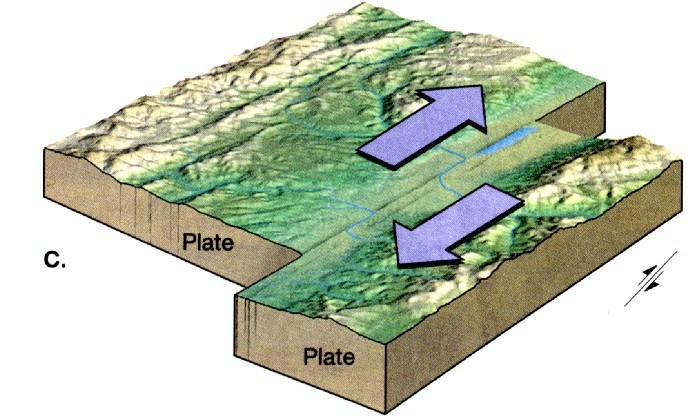
Two plates slide past each other at what boundary?
Covergent
Divergent
Transform

New oceanic crust (sea floor) is created at this boundary.
Divergent Oceanic
Divergent Continental
Convergent Oceanic
Transform

Oceanic crust (sea floor) is destroyed at this boundary.
Convergent Oceanic
Divergent Oceanic
Convergent Continental-Continental
Divergent Continental

The process where oceanic crust slides under another plate and is melted is called ___________.
seafloor spreading
subduction
continental drift
recycling

What two crustal features occur near every subduction zone?
Volcanoes and Trenches
Rift Valleys and Mid Ocean Ridges
Volcanoes and Rift Valleys
Mid Ocean Ridges and Trenches
A divergent boundary on land creates what feature?
Mid Ocean Ridge
Rift Valley
Subduction Zone
Deep Ocean Trench
A divergent boundary in the ocean creates what feature?
Mid Ocean Ridge
Rift Valley
Deep Ocean Trench
Subduction Zone
When two continental plates converge (collide) what type of crustal feature is formed?
Mid Ocean Ridge
Subduction Zone
Rift Valley
Folded Mountains
The process that occurs at a divergent oceanic boundary that creates new crust (sea floor) is called?
Subduction
Seafloor Spreading
Continental Drift
Volcanism
If an earthquake occurs at the bottom of the ocean floor what could form as result?
Volcano
Tsumani
Tidal Wave
Hurricane
Aside from Earthquakes, what is the only thing you will find at transform boundaries?
Volcanoes
Subduction Zones
Folded Mountains
Fault lines
What is the only event associated with ALL plate boundaries?
Volcanoes
Earthquakes
Subduction
Deep Trenches
The only type of crust that will subduct if two plates converge is...
Oceanic
Continental
Tsunamis are formed from what two types of convergent boundaries?
Continental-Continental
Oceanic-Continental
Oceanic-Oceanic
The long tube in the ground that connects the magma chamber to Earth's surface is called the _____________.
Crater
vent
magma chamber
Once magma reaches the Earth's surface it is called ____.
magma
lava
pyroclastic material
ash
Explosive eruptions occur if a volcano's magma is:
high in viscosity
Low in viscosity
Extremely hot
What provides the force that causes a volcano to become explosive?
Magma density
Extreme heat
Dissolved gases trapped in magma
Volcanoes with steep sides made of layers of ash is called ____.
Composite Volcano
Cinder Cone
Shield Volcano
Tall, cone-shaped mountains made of both cooled lava layers and layers of ash are called
Composite Volcano
Cinder Cone
Shield Volcano
What do we call molten hot liquid rock while it is still below the Earth's surface?
Igneous
Lava
Magma
What volcanoes are described as having a wide base?
Shield Volcanoes
Cinder Cones
Composite Volcanoes
A dead volcano is called _____
active
extinct
dormant
A sleeping volcano is called ______
active
extinct
dormant
Approximately 70% of the world's composite volcanoes are located around the Pacific Ocean in a region called the ____________.
Ring of Fire
Center of Fire
Volcano Ring
What energy can be tapped from a volcano?
hydrothermal energy
solar energy
nuclear energy
geothermal energy
The following are the three stages of volcano life cycle except_________________.
invasion of magma
eruption
crystallization
building pressure
Volcanoes are found:
on land
underwater
on islands
all of the above
Where do volcanoes form?
Places where plates are moving together
Hot Spots
Places where plates move apart
All of these options
Geothermal resources include all of the following except:
hotspot
volcanoes
wind
hot springs
It refers to the energy produced from the internal heat of the Earth
hydropower energy
geothermal energy
solar energy
The top of the main vent where lava flows through is the ___
crater
vent
conduit
The source of all lava is _____
vent
crater
magma chamber


How do you test a rock for calcite? What will happen if the rock does have calcite?
Put water in the bottle; if there is calcite, the rock will dissolve
Put salt water in the bottle; if there is calcite, the rock will turn a darker color
Put acid in the bottle; if there is calcite, the rock will fizz
Put liquid soap in the bottle; if there is calcite, the liquid will form a dome on the rock

After the acid test, Rock A fizzed and Rock B did not. What could that mean?
Rock A contains calcite and is probably shale
Rock B is harder than rock A
Rock A could be limestone, and rock B does not contain calcite
Rock B could be limestone, and rock A contains calcite

What rock will I find if I dig beneath Kimi sandstone at Paradise canyon?
Sunshine Shale
New York Limestone
Purple Sandstone
American Shale

Surprise Canyon is halfway between Vacation Canyon and Paradise Canyon. What kind of rock do you think will be at the top of Surprise Canyon?
Sunshine Shale
New York Limestone
Purple Sandstone
American Shale

Which two layers did the Colorado River erode away first when creating the Grand Canyon 6 million years ago?
Kaibab Formation and Toroweap Formation
Redwall Limestone and Supai Group
Bright Angel Shale and Tapeats Sandstone
All layers are eroded at the same time by the Colorado River

If the Colorado river continues to erode away the Grand Canyon. What layer of rock might you observe at river level in 2 million years?
Toroweap Formation
Supai Group
Redwall Limestone
Muav Limestone
What is the substance that makes the rock fizz with acid?
potassium
oxygen
calcite
carbon
Why are there stripes in the Grand Canyon?
It is from the way the sun has hit the rocks over time
It shows the different layers of rock built up from past environments
It is from the way the river has washed the rocks over time
There are no horizontal stripes in the Grand Canyon
Which of the rocks is a sedimentary rock?
Limestone
Basalt
Granite
All of the above
None of the above
You find a piece of shale on a hike. What substance is most likely to have formed that rock?
Sand
Silt
Calcite
Clay
You find a piece of limestone on a hike. What substance(s) are likely to have formed that rock?
Sand
Silt
Calcite
Clay
What are three examples of a descriptive group we used to organize our Mile 20 and Mile 52 rocks?
Size
Texture
Number
Color
Name

Why do Mile 20 and Mile 52 have different rock layers near the river?
Mile 52 is at a higher elevation than Mile 20
Mile 20 is at a higher elevation than Mile 52
Each site at the Grand Canyon has different rocks
Each site at the Grand Canyon has the same rocks

At Mile 20, if I drilled into the bottom of the Colorado River, what rock would I find?
Muav Limestone
Redwall Limestone
Supai Sandstone
Hermit Shale

How far apart are the sites at Mile 20 and Mile 52?
72 miles
36 miles
32 miles
76 miles
What is the chemical formula of...limestone?
limestone
CaCO3
MgCO3
NAHCO3
What type of rock is limestone?
lime
non-porous
sedimentary
physical
What evidence is there that limestone is this type of rock?
made of soil
made of fossils/sediments
made of salt
made of carbon dioxide
The three main types of sedimentary rocks are:
Sandstone
Basalt
Shale
Limestone
Granite
In a sequence of rock layers, how can you tell which layer is older than the other?
The older rock layers can be found below the younger layers.
The younger rock layers can be found below the older layers.
The older rock layers are closest to the surface.
The younger rock layers are deeper down.
What information does radiometric dating give scientists about a rock?
How much the rock costs
How long it has been since the rock formed
How much rock is layered on top of it
How many fossils are stored in the rock
How can finding marine (ocean) fossils at the top of mountains be used as evidence that evolution has occurred?
Shows that this environment has stayed the same over time
Shows that the mountain will become an ocean
Shows that fish were able to swim to the top of the mountain
Shows that an ocean once covered the mountain
How could scientists use the fossil record to show how plants have changed over time?
Scientists can compare fossils of plants from the same rock layer to see how they have changed.
Scientists cannot use the fossil record, because plants cannot become fossils.
Scientists can compare fossils of many plants from many different time periods to see how they have changed.
Scientists can examine plant fossils to determine what kind of animals ate them.
Law that states that rocks on the bottom are always the oldest and rocks on top are the youngest
Law of Inclusions
Law of Horizontality
Law of Cross Cutting
Law of Superposition


What is the fossils record?
Fossils found in layers of sedimentary rock
Collection of all fossils found on Earth
List of fossils at the Museum of Natural History
none of the above

Which of the following would be an example of a fossil?
Choose all of the correct answers!
Bones found in the woods outside your house
Petrified egg shells found in Sedimentary rock
Footprints preserved in a Shale outcropping
Oyster Shells found at a beach.
The fossil record documents _____________ of life forms throughout the history of Earth. Choose all of the answers that could correctly complete this statement.
Change
diversity
entire number
extinction
Environment

What types of organisms are more likely to form fossils?
Vertebrates
Invertebrates
Snails/Arthropods
Insects
Who studies fossils?
zoologist
meteorologist
paleontologist
biologist


