Font size
 Worksheets
Chemistry Semester Review Final
Total questions: 56
Worksheet time: 40mins


Electrons that have not been excited are said to be at:
high level
base line
set state
ground state
There may be a maximum of ____ p orbitals at a given energy level.
2
6
3
8
The principle quantum number, n, represents the:
spin value
suborbital value
energy level
magnetic value
Orbital sublevels, or L, represents:
orbital color
orbital shape
electron spin
energy level
if n = 2, then "l" can equal
1
2
3
0 and 1
If n = 5, then "m" can be equal to
4,3,2,1
-4,-3,-2,-1
-4,-3,-2,-1,0,1,2,3,4
infinity
Cl or Al?

How many VALENCE ELECTRONS does Chlorine have?
2
7
8
10
17

Ionic bonds are formed when electrons get
Shared between two atoms
Removed from both atoms
Transferred from one atom to another
Added to both atoms

Ionic bonds typically form between
A metal and a nonmetal
Two nonmetals
Two metals
A metalloid and a metal

What is the correct formula for Sodium Chloride?
SCl
NaCl
SC
NaCl2

Name this ionic compound: Al2O3
Dialuminum oxide
Aluminum oxygen
Oxygen Aluminide
Aluminum oxide
If you were to draw the lewis dot structure for Germanium (Ge), how many dots would you put around it?
2
4
6
8

Cations _______ electrons, becoming _______ charged.
Gain; positively (+)
Gain; negatively (-)
Lose; positively (+)
Lose; negatively (-)

Anions ____ electrons, becoming _____ charged.
Gain; positively (+)
Gain; negatively (-)
Lose; positively (+)
Lose; negatively (-)

Write the chemical formula for K and Br (potassium bromide).
KBr
K2Br
KBr3
KBr2

Write the chemical formula for Na and S (sodium sulfide).
NaS
S2S2
Na2S
NaS2

Using the model for the formation of Scandium Fluoride (an ionic compound), write the chemical formula.
Sc3F
Sc3F3
Sc+3F-1
ScF3
Lead Chloride is an ionic compound, made up from Pb2+ ions and Cl- ions. Which is the correct formula for this compound?
PbCl3
PbCl
PbCl4
PbCl2
Magnesium Hydroxide is an ionic compound made up from Mg2+ and OH- ions. Which is its correct formula?
MgOH
MgOH2
Mg(OH)2
MgO
The correct name for Cu(CN)2 is __.
copper (I) cyanide
carbon cyanide
carbon carbonate
copper (II) cyanide
copper (I) nitride
The name of the compound (NH4)3PO4 is:
tetrammonium phosphate
ammonium phosphate
nitrogen hydrogen phosphate
ammonia phosphide
triammonium phosphate
In the compound CoSO4, what is the charge on cobalt?
+4
+2
-2
-1
What is the correct name for Ni2(SO4)3
Nickel (I) sulfide
Nickel (II) sulfate
Nickel (III) sulfate
Nickel (III) sulfite
Sodium is found on the third row or Period 3 of the periodic table. How many energy levels do the electrons of a sodium atom occupy?
1
3
11
23
1s22s22p63s23p4
Which element is represented by this electron configuration?
sodium
sulfur
argon
selenium
1s22s22p63s23p4
What is the highest energy level in this electron configuration?
2
3
4
6
1s22s22p63s23p64s23d104p1
What element is represented by the electron configuration?
titanium
copper
gallium
germanium
The n = 3 energy level contains what subshells?
s
s and p
s, p, and d
s, p, d, and f
1s22s22p63s23p6
4s23d104p6

Which orbital shows a violation of the Pauli Exclusion Principle?
A
B
C
D
What are the quantum numbers for each electron in 2s?
(2, 1, 1, +1/2) (2, 1, 1, -1/2)
(2, 0, 0, +1/2) (2, 0, 0, -1/2)
(2,1, 0, +1/2) (2, 1, 0, -1/2)
(2, 0, -1, 1/2) (2, 0, +1, 1/2)
The last electron for a neutral atom is (3, 1, -1, -1/2). What element is this?
Phosphorous
Argon
Sulfur
Aluminum
What is the noble gas abbreviation for (4, 3, 3, +1/2)?
[Rn] 7s2 6f4
[Rn] 6s2 4f7
[Xe] 6s2 4f7
[Xe] 7s2 6f4
In the notation 289115 Mc, the number 289 is the
atomic mass
atomic number
number of neutrons
number of electrons
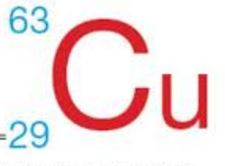

How many neutrons are in a Gold atom?
79
196
117
275
An atom with 10 protons, 8 neutrons, 8 electrons is a _______. (Choose all that apply)
cation
anion
neutral atom
ion
Write the hyphen notation for the isotope that has 39 protons and 50 neutrons.
Yttrium-11
Tin-39
Tin-89
Yttrium-89
How many neutrons are in an atom of carbon-14?
6
8
10
14

How many protons, neutrons, and electrons?
proton = 6, neutron = 4, electron = 1
proton = 4, neutron = 4, electron = 5
proton = 1, neutron = 6, electron = 10
proton = 4, neutron = 2, electron = 3

What is the atomic number of this atom?
2
4
6
8

Which group includes soft, highly reactive metals with one electron in their outer shell?
Alkai metals (group 1)
Alkaline metals (group 2)
Halogens (group 17)
Noble gasses (group 18)