wayground logo

Free Printable Worksheets

NEW

Font size

S
M
L
XL
Worksheets

Edexcel Chemistry Revision CC5 - CC7 Types of Bonding

Total questions: 61

Worksheet time: 38mins

Name
Class
Date
1.
What is a valence electron?
a)
an electron that is found in the outermost shell of an atom. 
b)
an electron found in the innermost shell of an atom.
c)
an electron found in the middle shell.
2.

How do positive and negative charges affect each other?

a)

No effect

b)

repel each other

c)

attract each other

d)

they physically join together

3.
What is an ion?
a)
atoms that have gained or lost protons and become positive or negative
b)

Atoms of the same element with different numbers of neutrons

c)
a charged atom that has lost or gained one or more electrons.
4.
Ionic Bonding involves...
a)
The transfer of protons
b)
The transfer of nuetrons 
c)
The transfer of electrons
d)
None Of the above
5.
What happens when an ionic bond is formed?
a)
One atom loses electrons to another atom to form oppositely charged ions that attract each other.
b)
One atom loses protons to another atom to form oppositely charged ions that attract each other.
c)
One atom loses neutrons to another atom to form oppositely charged ions that attract each other.
6.
Which kinds of elements are usually involved in the formation of ionic bonds?
a)

Metals and non-metals

b)

non-metals only

c)
Metals only
7.

How is a negative ion formed and what is it called?

a)

atom gains electrons; called a cation

b)

atom gains electrons; called an anion

c)

atom loses electrons; called an anion

d)

atoms loses electrons; called a cation

8.

What is the charge on the ions of elements in group 6 of the periodic table?

a)

-2

b)

+2

c)

-1

d)

-6

9.
What usually forms the positive ion?
a)
Metal
b)
Non Metals
c)
None
10.

What is the general name for a positive ion?

a)

anion

b)

ion

c)

cation

11.
What do atoms that form positive ions tend to do?
a)
Tend to lose electrons 
b)
Tend to lose protons
c)
Tend to gain electrons
d)
Tend to gain protons
12.
Explain why group 1 elements such as sodium and lithium form a 1+ ion.
a)

They have too many protons so lose them to become stable 

b)
They have one electron in outer shell and lose it to become stable.
c)

They have a full outer shell so gain electrons to become stable

13.
Which property would this giant ionic compound have?
a)
Conducts electricity
b)
Low boiling point
c)
High melting point
d)
Is a gas
14.
Why do atoms share electrons?
a)
To attain the electron configuration of a noble gas.
b)
To become ions and take a charge
c)
to increase the mass
d)
it's a nice thing to do.
15.
What two types of atoms make a covalent bond?
a)
2 Nonmetals
b)
1 Nonmetal and 1 Metal
c)
2 Metals
d)
2 Noble Gases
16.

How many electrons are shared in a single covalent bond?

a)

2 pairs

b)

4

c)

2

d)

1

17.
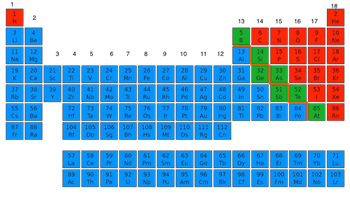
Where are the nonmetals located on the periodic table? 
a)
Blue
b)
Red
c)
Green
18.
How are covalent bonds explained?
a)
When one atom takes the other atom's electron
b)
When the atom shares an electron with an another atom
c)
When the two nucleus merge
d)
When the neutrons leave the nucleus
19.
What is a diatomic element?
a)
a metal bonded with a nonmetal
b)
2 or more nonmetals bonded together
c)
2 or more metals bonded together
d)
2 atoms of the same element bonded together
20.
Why do simple molecules have low melting points?
a)
A.  The intermolecular forces are very strong
b)
B.  The intramolecular forces are very weak.
c)
C.  The intramolecular forces are very strong.
d)
D.  The intermolecular forces are very weak.
21.
What element are diamond and graphite made up of?
a)
A.     Sodium
b)
B.     Carbon
c)
C.     Carbon dioxide
d)
D.     Silicon
22.
Define the term allotropes
a)
Atoms with same proton number but different number of neutrons
b)
Atoms with same proton number but different mass number
c)
Atoms in different arrangement in structure
d)
Atoms in different arrangement and different physical form
23.
Diamond and graphite are allotropes 
a)
True 
b)
False 
24.
What structure is shown in the diagram?
a)
Diamond
b)
Graphite
c)
Carbon fiber
d)
Carbon nanotubes
25.
Why is diamond strong?
a)
It's made of carbon
b)
It doesn't conduct electricity
c)
It forms 4 strong covalent bonds
d)
So it can cut glass
26.

Which is stronger...

a)

N − N

b)

N = N

c)

N ≡ N

27.

Which giant covalent structure is 'soft'?

a)

diamond

b)

graphite

28.
Why does graphite conduct electricity?
a)
Ions are free to move to carry the charge
b)
Aoms can move
c)
Free electrons that can carry the charge
29.
At room temperature, most metals are
a)
liquid
b)
solid
c)
gas
d)
an alloy
30.
What is the basis of a metallic bond?
a)
the attraction of neutral metal atoms.
b)
the attraction between protons and neutrons.
c)
the attraction between positive metal ions and interlocking electrons.
d)
the attraction between positive metal ions and free floating electrons.
31.
Metallic bonding is...
a)
a type of covalent bond.
b)
a type of ionic bond.
c)
an attraction between positive ions and electrons.
32.
Electrons that are free to move in metals
a)
delocalized electrons
b)
oxidation number
c)
chemical bond
d)
salts
33.
What is the ability of a substance to allow heat, sound, or electricity to flow through it?
a)
Malleability
b)
Ductility
c)
Solubility
d)
Conductivity
34.
How many valence electrons does nitrogen have?
a)
3
b)
2
c)
5
d)
1
35.
What is the number of valence electrons for Oxygen?
a)
8
b)
6
c)
2
d)
1
36.
What is the number of valence electrons for Beryillum?
a)
1
b)
4
c)
2
d)
7
37.
What is the number of valence electrons for Silicon?
a)
1
b)
2
c)
6
d)
4
38.
What is the number of valence electrons for Neon?
a)
6
b)
7
c)
8
d)
9
39.
How many valence electrons in this structure?
a)
6
b)
5
c)
4
d)
7
40.
What group would Ca like to join with
a)
5
b)
6
c)
7
d)
8
41.
Is Hydrogen considered a metal or a non-metal?
a)
Metal
b)
Non-metal
42.
Ionic or covalent?
H2O
a)
Ionic
b)
Covalent
43.

What type of bond will form

sodium and fluorine

a)

ionic

b)

covalent

c)

covalent-organic

d)

metallic

e)

no bond will form

44.

What type of bond will form

Lead and Phosphorus

a)

ionic

b)

covalent

c)

covalent-organic

d)

metallic

e)

no bond will form

45.

What type of bond will form

Copper and Silicon

a)

ionic

b)

covalent

c)

covalent-organic

d)

metallic

e)

no bond will form

46.

What type of bond will form

Aluminum and Iodine

a)

ionic

b)

covalent

c)

covalent-organic

d)

metallic

e)

no bond will form

47.

What type of bond will form

Chlorine and Strontium

a)

ionic

b)

covalent

c)

covalent-organic

d)

metallic

e)

no bond will form

48.

What type of bond will form

Carbon and Hydrogen

a)

ionic

b)

covalent

c)

covalent-organic

d)

metallic

e)

no bond will form

49.

What type of bond will form

Carbon and Oxygen

a)

ionic

b)

covalent

c)

covalent-organic

d)

metallic

e)

no bond will form

50.

What type of bond will form

Sulfur and Bromine

a)

ionic

b)

covalent

c)

covalent-organic

d)

metallic

e)

no bond will form

51.

What type of bond will form

Nitrogen and Tellurium

a)

ionic

b)

covalent

c)

covalent-organic

d)

metallic

e)

no bond will form

52.

What type of bond will form

Carbon and Selenium

a)

ionic

b)

covalent

c)

covalent-organic

d)

metallic

e)

no bond will form

53.

What type of bond will form

Polonium and Magnesium

a)

ionic

b)

covalent

c)

covalent-organic

d)

metallic

e)

no bond will form

54.

What type of bond will form

Iron(III) and Lithium

a)

ionic

b)

covalent

c)

covalent-organic

d)

metallic

e)

no bond will form

55.

What type of bond will form

Potassium and Tin

a)

ionic

b)

covalent

c)

covalent-organic

d)

metallic

e)

no bond will form

56.

What type of bond will form

Zinc(II) and Radium

a)

ionic

b)

covalent

c)

covalent-organic

d)

metallic

e)

no bond will form

57.

What type of bond will form

Gold(I) and Vanadium(IV)

a)

ionic

b)

covalent

c)

covalent-organic

d)

metallic

e)

no bond will form

58.

What type of bond will form

Silver(I) and Argon

a)

ionic

b)

covalent

c)

covalent-organic

d)

metallic

e)

no bond will form

59.

What type of bond will form

Arsenic and Neon

a)

ionic

b)

covalent

c)

covalent-organic

d)

metallic

e)

no bond will form

60.

What type of bond will form

Xenon and Zirconium(IV)

a)

ionic

b)

covalent

c)

covalent-organic

d)

metallic

e)

no bond will form

61.

What type of bond will form

Oxygen and Krypton

a)

ionic

b)

covalent

c)

covalent-organic

d)

metallic

e)

no bond will form