
 Worksheets
Semester 1 Final Review
Total questions: 100
Worksheet time: 2hrs 50mins


The polysaccharaide that makes up the cell walls of fungi
chitin
cellulose
lichtin
amylose

Virus invades cell -- produces new virus -- destroys host cell -- releases virus
Lytic Cycle
Lysogenic Cycle
Host Cell
Binary Fission


Which of the following is NOT a characteristic of arthropods?
Exoskeleton
Jointed appendages
Segmented body
Endoskeleton
The exoskeleton of an arthropod is made of which of the following?
chitin
dentin
protin
chlorotin
Which of the following is NOT a function of the exoskeleton
Protection
Prevents water loss
Attachment of muscles
Aids in digestion
Since the exoskeleton limits the growth of arthropods, they have to shed their exoskeletons and form a new one. This is called ____.
defecating
molting
morphing
excreting
Which of the following does not belong in subphylum Crustacea?
Crayfish
Crabs
Shrimp
Millipedes
Which of the following correctly describes a crayfish's body regions?
head, thorax, abdomen
head, abdomen
cephalothorax, abdomen
head, cephalothorax
Which of the following are considered to be "true jaws" that chew food?
Mandibles
Maxillae
Maxillipeds
Which of the following crayfish structures is used for gas exchange?
Malpighian tubules
Green glands
Gills
Book lungs
Which is the correct description of an arthropod's body?
A furry coat with large fangs
An interior skeleton with leathery skin
Two or more separate segments that have a hard outer cover with appendages
An eight legged animal with mandibals
Which three characteristics do arthropods have
Fur, Eyes, and Paws
Jointed segments, an exoskeleton, and body cavities
Claws, Leathery Skin, and Gills
Eat, Breath, and Sleep
Decapods have this many legs
4
6
8
10
(Taxonomy) The classification system we use today was created by....
Watson & Crick
Darwin
Mendel
Linnaeus
(Taxonomy) Classifying organisms based on their characteristics is called...
taxonomy
sorting
organizing
grouping
(Taxonomy) Which level of classification is the most broad?
Species
Class
Domain
Kingdom
(Taxonomy) Which level is the most specific?
Domain
Family
Species
Genus
(Taxonomy) What languages are scientific names written in?
Latin or Spanish
Spanish or German
German or Greek
Greek or Latin
(Taxonomy) How many scientific names does an organism have?
1
2
3
many
(Taxonomy) How many common names does an organism have?
1
2
3
many
(Taxonomy) Which is the correct way to write an organisms scientific name?
Ailuropoda Melanoleuca
ailuropoda melanoleuca
Ailuropoda melanoleuca
ailuropoda Melanoleuca
(Taxonomy) The scientific name for a lion is Panthera leo, what is the genus?
lion
Panthera
leo
(Taxonomy) An organism's scientific name includes its...
Family & Genus
Kingdom & Family
Genus & Species
Class & Genus
(Taxonomy) What tool do scientists use to classify organism based on their characteristics?
pedigree
cladogram
punnett square
dichotomous key
(Domain) Which domain(s) include only prokaryotic cells? (without nucleus)
Eukarya & Bacteria
Archaeabacteria
Bacteria & Archeabacteria
Bacteria
(Domain) Which domain(s) include organisms that have eukaryotic cells? (has nucleus)
Eukarya
Eukarya & Bacteria
Bacteria
Archaeabacteria
(Domain) Organisms in ______________ domain live in extreme environments like volcanic thermal vents.
Eukarya
Bacteria
Archaebacteria
(Kingdoms) Moss is multicellular, autotrophic (photosynthetic), and has cell walls. Which kingdom does moss belong to?
Protista
Fungi
Plantae
Animalia
(Kingdoms) Organisms in ____________ kingdom are unicellular, heterotrophs or autotrophs, most are aquatic and can be animal-like, plant-like, or fungus-like.
Fungi
Animalia
Protista
Plantae
(Kingdoms) This kingdom is the largest, organisms are multicellular, heterotrophs, most can move, aquatic or terrestrial, warm or cold blooded.
Protista
Animalia
Plantae
Fungi
(Kingdoms) Which kingdom contains organisms that are mostly multicellular, have cell walls, and can be decomposers or heterotrophs?
Fungi
Plantae
Animalia
Protista
(Taxonomy) What is hierarchy of classification from broad to most specific?
Species, Genus, Family, Order, Class, Phylum, Kingdom, Domain
Kingdom, Domain, Phylum, Family, Order, Class, Genus, Species
Domain, Kingdom, Phylum, Class, Order, Family, Genus, Species
Domain, Kingdom, Phylum, Order, Family, Class, Genus, Species
(Taxonomy) How many kingdoms are there?
2
4
6
8
(Taxonomy) The method of naming organisms by two names is known as...
dichotomous naming
binomial nomenclature
the scientific method
The value of fungi in the scheme of nature is described by which of the following statements?
Fungi “fix” nitrogen from the air for use by plants
Fungi trap sunlight energy in carbohydrates
Fungi release elements from organic matter.
Fungi suppress population explosions by parasitizing over productive animals.
The principal difference between a saprophytic and parasitic mode of nutrition is
the quality of the nutrients
not noticeable in fungi.
the same as intracellular versus extracellular digestion
determined by whether the food source is living or nonliving


An organism that absorbs its food from dead organic matter are refereed to as?
Parasites
Saprophytes
Fungi can exist as
I. saprotrophs
II. autotrophs
III. parasites
IV. mutualists
I only
I, II and III
I, III and IV
I, II and III
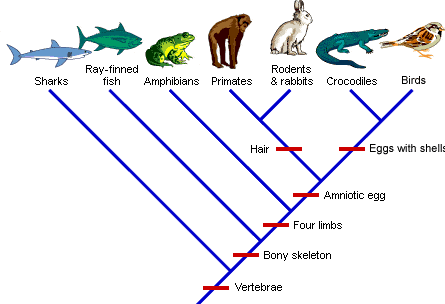
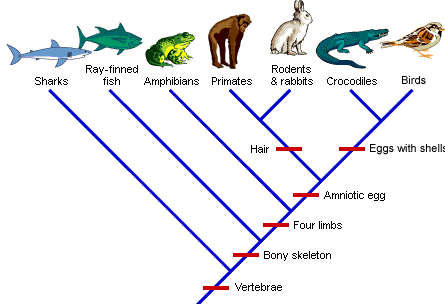
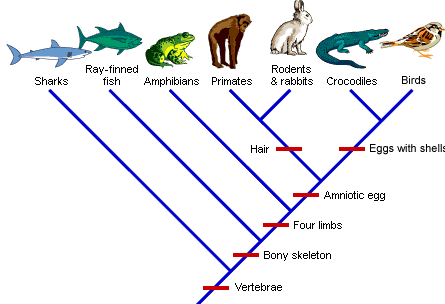
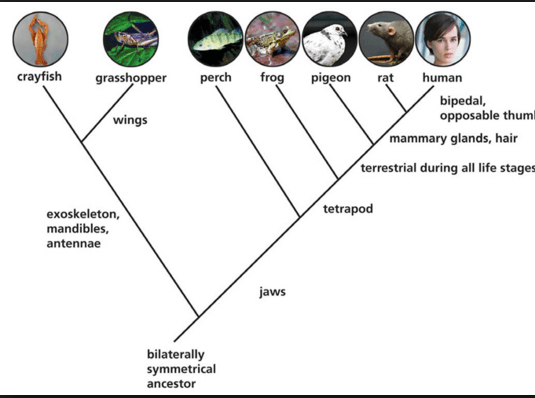
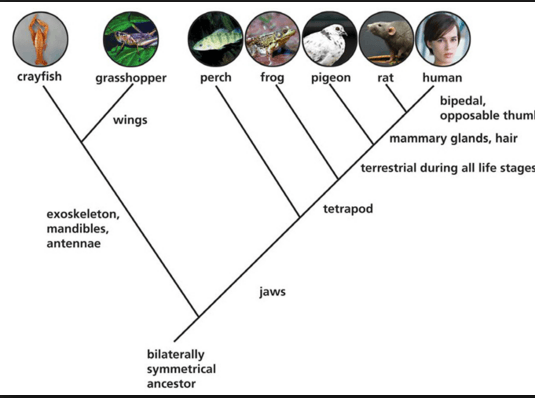
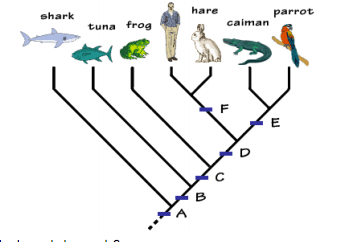

Which letter represents the most recent common ancestor of sponges and mushrooms?
A
B
C
D
E

