
NEW
Font size
 Worksheets
SEM 1 Body Systems Review
Total questions: 54
Worksheet time: 1hrs 6mins
What ensures the unidirectional flow of blood through the
heart?
Constant pressure generated by the heart contractions.
Valves within the heart that prevent backflow of blood.
Squeezing action of smooth muscle tissue in arterial walls.
Continuous osmotic outflow of plasma from capillaries.
The ____________ carries blood throughout the body;
the ____________ carries blood only to and from the
lungs.
systemic circuit; pulmonary circuit
pulmonary circuit; systemic circuit
venous circulation; arterial circulation
arterial circulation; venous circulation
Which neuron carries impulses from the brain/spinal cord to an effector?
motor
Sensory
Inter
Regular
The endocrine system and the nervous system have what in common?
They both produce hormones.
They both help regulate the body.
They both control internal temperature.
They both contain neurons.
Identify which system causes which response for the following scenario: You are stressed because of all the tests you have so your shoulder muscles get very tense and you start tearing up minutes later.
Nervous: Muscles tightening as they get tense
Endocrine: Tearing up
Nervous: Tearing up
Endocrine: Muscles tightening as they get tense
Respiratory: Muscles tightening as they get tense
Endocrine: Tearing up
Circulatory: Tearing up
Urinary: Muscles tightening as they get tense
Consists of your brain and spinal cord
medulla
cerebrum
central nervous system
peripheral nervous system
All parts of the nervous system except for the brain and spinal cord
nerves
neuron
central nervous system
peripheral nervous system

D
Synapse
Cell Body
Axon
Dendrite
A
Synapse
Cell Body
Axon
Dendrite
Electrical signals travel through a neuron in this direction.
(enter) A → E → D → B (leave)
(enter) B → D → E → A (leave)
What is the point of a feedback loop?
To provide the body with more energy
To provide the body with more food
To make sure the conditions in the body are always changing
To make sure the conditions in the body remain stable
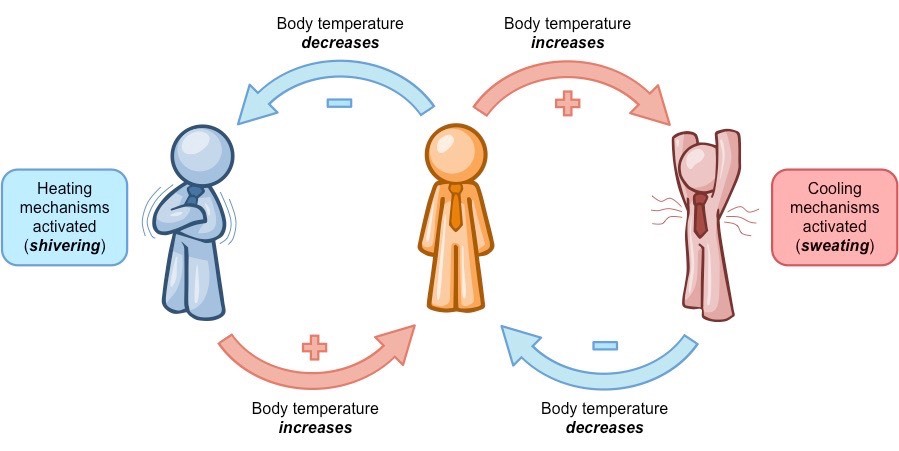
In this body temperature feedback loop, predict what would happen if cooling mechanisms were NOT activated?
The body would not warm up.
The body would not cool down.
Your body would get colder and colder.
Your body would release lots of heat.


What happens after the second time you are exposed to a pathogen?
The body will not be able to fight off the pathogen quickly, because it knows how to get into the body easier.
The body's immune system will react the same was as it did during the first exposure.
The body can only be exposed to a pathogen a second time if you do not have a vaccine.
The body will know how to fight off the pathogen quickly, because memory cells have been created after the first encounter.
A 3 month old baby contracts a virus called whooping cough (pertussis) after receiving the first of a sequence of 3 necessary DPT vaccines designed to prevent 3 diseases (diphtheria, pertussis, and tetanus). The vaccines are given at 2, 4, and 6 months of age to allow the body to develop specific immunity against these diseases. After the infant recovered from the disease, the doctor informed the parents that from now on the infant would only need the DT (diphtheria, tetanus) part of the vaccine. Why does the infant only need the DT vaccine?
The infant had the first of a series of vaccines which caused the disease
The infant had the pertussis disease and has already produced antibodies against the disease.
The infant had the first of a series of vaccines which protected him from getting the disease.
The infant had the pertussis disease and will get diphtheria in the future.

Nonspecific immunity is often the body's "first line of defense". Which of the following are part of the non-specific immune system?
White blood cells, tears, T-cells
Saliva, inflammation, Lymphocytes
Skin, tears, mucous membranes
Mucous membranes, fever, B-cells
Which of the following statements is TRUE about someone's immune system that has allergies?
Body cells are dividing at an uncontrolled rate.
The body is reacting to foreign antigens that are not dangerous to most people.
T cells and B cells in the body cannot be activated.
The body is mistaking its own cells for foreign antigens.
Which is the most important thing used in the first line of defense?
macrophage
fever
skin
antigens
Antibiotics
only destroy bacteria
only destroy viruses
can destroy both bacteria and viruses
An autoimmune disorder is a condition in which
a person's immune system is missing
a body attacks its own cells
the immune system doesn't work
a body attacks all foreign cells
Of the following, which patient should you treat first?
The patient who looks the worst
The patient with the most critical vital signs
The closest patient
The youngest patient

Muscles that oppose one another are
synergist
hateful
prime movers
antagonists


Number 5 is pointing to the...
Liver
mouth
Pancreas
Stomach


