wayground logo

Free Printable Worksheets

Font size

S
M
L
XL
Worksheets

Topic 3 and 4 Revision Set

Total questions: 50

Worksheet time: 25mins

Name
Class
Date
1.
What is the primary function of DNA polymerase in DNA replication?
a)
Unwinding the DNA helix
b)
Synthesizing new DNA strands
c)
Initiating transcription
d)
Translating mRNA sequences
2.
Where does transcription occur in eukaryotic cells?
a)
Nucleus
b)
Cytoplasm
c)
Mitochondria
d)
Ribosomes
3.
What is the purpose of electrophoresis in molecular biology?
a)
Amplifying DNA fragments
b)
Separating DNA fragments
c)
Transcribing mRNA
d)
Translating proteins
4.
What is the role of tRNA in translation?
a)
Carries amino acids to ribosomes
b)
Transcribes DNA to mRNA
c)
Unwinds DNA strands
d)
Synthesizes new DNA strands
5.
How does DNA methylation affect gene expression?
a)
Activates gene transcription
b)
Blocks gene transcription
c)
Enhances translation
d)
Repairs DNA damage
6.
What is the function of an exon in eukaryotic genes?
a)
Regulatory element
b)
Coding sequence
c)
Non-coding RNA molecule
d)
Initiation factor for translation
7.
Which process allows for the amplification of specific DNA segments?
a)
DNA methylation
b)
Transcription
c)
Translation
d)
Polymerase chain reaction (PCR)
8.
What determines the primary structure of a protein?
a)
Sequence of amino acids
b)
Folding into a three-dimensional structure
c)
Post-translational modifications
d)
Interaction with other proteins
9.
Why is the three-dimensional shape of a protein important for its function?
a)
Determines the genetic code
b)
Affects transcription
c)
Provides stability
d)
Enables protein synthesis
10.
What can be determined from an electropherogram?
a)
Protein structure
b)
DNA sequence information
c)
RNA expression levels
d)
Enzyme activity
11.

Which of these does NOT occur in the nucleus?

a)

Synthesizing new DNA strands

b)

Transcribing DNA into mRNA

c)

Translating mRNA into proteins

d)

Unwinding the DNA helix

12.
Where does translation occur in eukaryotic cells?
a)
Nucleus
b)
Cytoplasm
c)
Mitochondria
d)
Ribosomes
13.
What is the purpose of DNA methylation in gene regulation?
a)
Enhancing transcription
b)
Blocking transcription
c)
Promoting translation
d)
Repairing DNA damage
14.
What is the function of introns in eukaryotic genes?
a)
Coding sequences
b)
Regulatory elements
c)
Non-coding RNA molecules
d)
Initiating translation
15.
Which process amplifies specific DNA segments in the laboratory?
a)
DNA methylation
b)
Transcription
c)
Translation
d)
Polymerase chain reaction (PCR)
16.

Which of the following best describes the tertiary structure of a protein?

a)

The amino acid sequence

b)

Its three-dimensional shape

c)

The prescence of alpha-helices and beta-pleated sheets

d)

The complex formed by multiple polypeptides

17.
What can be determined from a DNA electropherogram?
a)
Protein expression levels
b)
DNA sequence information
c)
RNA structure and function
d)
Enzyme activity levels
18.
What is the role of transfer RNA (tRNA) in translation?
a)
Carrying amino acids to the ribosome
b)
Binding to DNA to initiate transcription
c)
Catalyzing peptide bond formation
d)
Synthesizing new DNA strands
19.

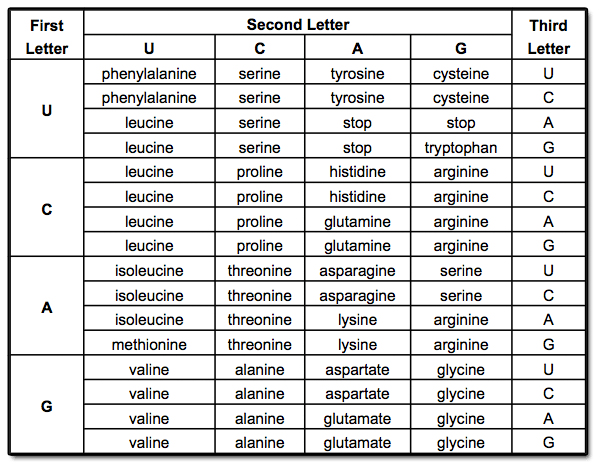
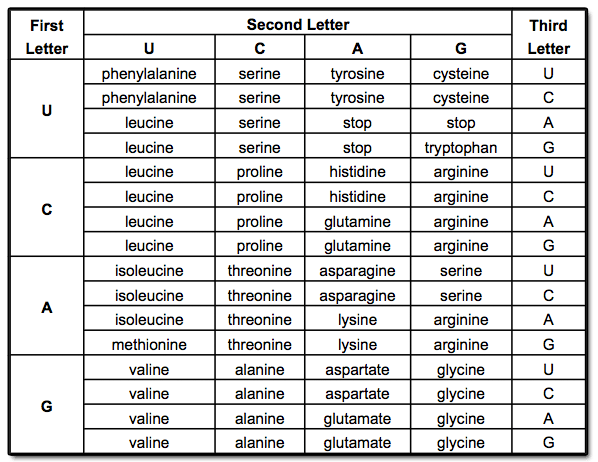
Which mRNA sequence/s code for glutamine?

a)

CGU

b)

CAG

c)

CUA

d)

CAA

20.

What is Transcription?

a)

The making DNA segment from mRNA.

b)

The making of an RNA strand into a protein.

c)

The making of an mRNA strand from the DNA template.

d)

The making of a DNA strand from a DNA template.

21.

How would the DNA template sequence GCTATA be transcribed to mRNA?

a)

GCUAUA

b)

CGATAT

c)

CGAUAU

d)

GCUTUT

22.
What is the term for a three-nucleotide sequence that codes for an amino acid?
a)
base
b)
codon
c)
amine
d)
serine
23.

How many amino acids are coded for by this sequence of nucleotides:

ATG GGA ACT CCA

a)

4

b)

2

c)

6

d)

12

24.

What type of cut is this photo?

a)

Blunt ends, created by a restriction enzyme

b)

Sticky ends, created by a restriction enzyme

c)

Blunt ends, created by a liagse enzyme

d)

Sticky ends, created by a ligase enzyme

25.

Which enzyme "glues" DNA fragments together during insertion?

a)

restriction enzymes

b)

DNA ligase

c)

DNA polymerase

d)

DNA helicase

26.

First stage involved in gene cloning.

a)

Amplification of the target gene

b)

Insertion of the target gene

c)

Polymerase Chain Reaction

d)

Isolation of the target gene

27.

What happens during telophase of mitosis?

a)

The nucleus disappears

b)

The chromatids are pulled away from each other by the fibres

c)

The chromosomes line up in the middle of the cell

d)

Two new nuclei form

28.
Which phase of mitosis is shown in the picture?
a)

Prophase

b)

Anaphase

c)

Telophase

d)

Metaphase

29.

What stage in the cell cycle is this?

a)

Telophase

b)

Prophase

c)

Anaphase

d)

Cytokinesis

30.
During which parts of the cell cycle does the cell grow?
a)

G1 and G2

b)

G1 and S

c)

M phase and cytokinesis

d)

S and G2

31.

What does DNA have that RNA doesn't

a)

Presence of thymine

b)

Presence of deoxyribose

c)

Presence of ribose

d)

BOTH thymine AND deoxyribose

32.

Removal of noncoding sequences from the pre-RNA is called

a)

Capping

b)

Splicing

c)

Tailing

d)

Spooling

33.
What is occurring in this picture?
a)
Translation
b)
Replication
c)
Translocation
d)
Transcription
34.

What is splicing?

a)

The process of synthesizing mRNA from DNA

b)

The process of removing introns and splicing exons together to form mature mRNA

c)

The process of translating mRNA into protein

d)

The process of copying DNA into RNA

35.
What structure of this molecule binds with the mRNA molecule?
a)
Amino Acid
b)
tRNA
c)
Anticodon
d)
Codon
36.
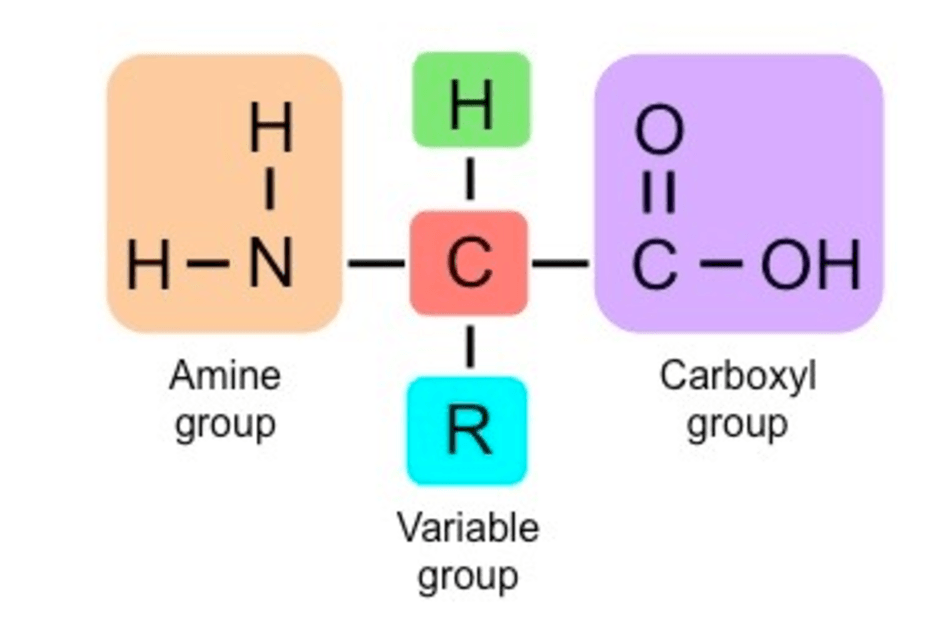
What is the monomer of a protein?
a)
amino acid
b)
monosaccharide
c)
fatty acid
d)
nucleic acid
37.
What amino acid is represented by the codon UUA?
a)

Phenylalanine

b)

Tyrosine

c)

Leucine

d)

Stop codon

38.
What is the correct amino acid sequence for the mRNA code AUGCCAGUAUGA
a)

Met-Pro-Ala-Val

b)

Met-Pro-Val

c)

Tyr-Gly-His

d)

Tyr-Gly-Arg-His

39.

What is the term for a three-nucleotide sequence that codes for an amino acid?

a)

base

b)

codon

c)

amine

d)

serine

40.

What is the correct amino acid sequence for the mRNA code AUGCCAGUAUGA

a)

Met-Pro-Ala-Val

b)

Met-Pro-Val

c)

Tyr-Gly-His

d)

Tyr-Gly-Arg-His

41.
How would the DNA sequence GCTATA be transcribed to mRNA?
a)
GCUAUA
b)
CGATAT
c)
CGAUAU
d)
GCUTUT
42.

DNA is recovered from a suspected dead soldier.  Which couple are the likely parents of the soldier?

a)

Parents C and D

b)

Parents E and F

c)

Parents A and B

d)

Parents G and H

43.

What happens during the denaturing step of a PCR reaction

a)

DNA nucleotides on each backbone are broken apart

b)

A heat tolerant polymerase initiates the copying of each strand of DNA

c)

DNA primers attache to the 3' ends of the target sequence

d)

The DNA double helix is separated into two single strands

44.

A student performed a gel electrophoresis experiment. The results are represented in the diagram. Compared to the fragments at the top of the gel, the fragments at the lower end are

a)

larger, and move slower

b)

larger, and move faster

c)

smaller, and move faster

d)

smaller, and move slower

45.

At an STR locus, one parent has the alleles (4,8) and the other parent's alleles are (7,12). Which of the following is a possible allele combination that their child could inherit?

a)

4,8

b)

4,7

c)

7,12

d)

8,8

46.

What information do the peaks on this electropherogram provide?

a)

Which genes are expression

b)

The number of repeats at each STR locus

c)

The DNA sequence

d)

Whether gene transfer was successful

47.

Transcription and translation of a gene composed of 30 nucleotides would form a protein containing no more than __________ amino acids.

a)

10

b)

15

c)

60

d)

90

48.
Which of the following statements regarding mRNA is correct?
a)
Exons are included in the protein sequence, while introns are left out
b)
Introns are included in the protein sequence, while exons are left out
c)
Exons and Introns can both be included or left out depending on the protein
d)
Exons and Introns are both part of the mRNA sequence, but only exons are part of the rRNA and tRNA
49.

Both Prokaryotic cells and Eukaryotic cells have

a)

DNA comprising A, T, C and G, but only eukrayotes have histones and linear DNA

b)

DNA comprising A, T, C and G, but only eukrayotes have histones and circular DNA

c)

DNA comprising A, T, C and G, histones and linear DNA

d)

Histones, but eukrayotes have linear DNA and prokaryotes have circular DNA

50.

Methylation of cytosine bases can

a)

cause genetic mutations.

b)

cause increased expression of regulatory genes, leading to cancer.

c)

cause decreased expression of regulatory genes, leading to cancer.

d)

denaturation of the DNA.