
 Worksheets
4th 6 Weeks Vocabulary quiz question bank
Total questions: 59
Worksheet time: 1hrs 3mins

What is the function and structure of the nucleus?
Structure: The jelly-like material that is within the cell and is enclosed by the cell membrane.
Function: Converts light energy into chemical energy.
Structure: A large, oval-shaped structure that is enclosed in a membrane.
Function: Contains the genetic material responsible for controlling the activities of the cell.

What is the function and structure of the vacuole?
Structure: Large, round sac filled with fluid.
Function: Stores water, food, or waste materials for the cell.
Structure: Bean- or peanut-shaped with internal membranes.
Function: Provides support to the organelles within the cell.

What is the function and structure of the mitochondria?
Structure: Bean- or peanut-shaped with internal membranes.
Function: Breaks down sugars to release energy in a form usable by the cell; the powerhouse of the cell.
Structure: Green, oval-shaped structure that contains chlorophyll.
Function: Regulates the passage of materials in and out of the cell, protects and gives some structure.

What is the Function and Structure of the Cell Membrane?
Structure: A porous, thin tissue that forms the outer surface of the cytoplasm.
Function: Converts light energy into chemical energy.
Structure: A porous, thin tissue that forms the outer surface of the cytoplasm.
Function: Regulates the passage of materials in and out of the cell, protects and provides structure.

What is the function and structure of the cytoplasm?
Structure: The jelly-like material within the cell, enclosed by the cell membrane.
Function: Provides support to the organelles within the cell.
Structure: A porous, thin tissue forming the outer surface of the cytoplasm.
Function: Contains the genetic material responsible for controlling the activities of the cell.

What is the function and structure of the chloroplast?
Structure: A green, oval-shaped structure that contains chlorophyll.
Function: Converts light energy into chemical energy.
Structure: Bean- or peanut-shaped with internal membranes.
Function: Contains the genetic material responsible for controlling the activities of the cell.
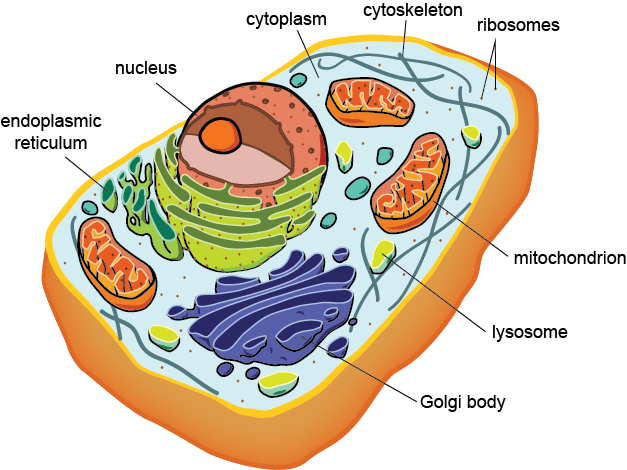
Which model is a Animal Cell?


Which model is a Plant Cell?


Check all that apply. How can you tell the difference between a Plant Cell and an Animal Cell? (Hint: there's more than one right answer)
Plant Cells have Mitochondria and Animal Cells do not
Plant cells have a Cell Wall and Animal cells do not
Animal cells have many small Vacuoles, while Plant cells have one large Vacuole
Animal cells do not have Chloroplasts, but Plant cells do
Plant cells have a square shape and Animal cells have a circular shape

Every living organism is made up of one or more cells.
True
False

What is a cell?
The basic unit of structure and function in living organisms
An organism
Found only in animals, not in plants

Which of the following are NOT found in animal cells?
Chloroplasts and cell wall
Cell wall and cell membrane
Mitochondria and nucleus


Which of the following converts food into energy for the cell?
mitochondria
cytoplasm
cell membrane

The fluid that surrounds the organelles is similar to Jell-o.
Cytoplasm
Vacuole

What do vacuoles do?
They actually do not have an important role
They protect the cell
They are the brain of the cell
They serve as storage areas for cells, particularly for water storage in plants

If you were a bad guy trying to sneak into an animal cell, who would be there to stop you? (Hint: it's the outer layer)
nucleus
mitochondria
cell membrane
cell wall

Which of the following is found ONLY in plant cells and provides structure for the cell?
Cell wall
Chloroplast
Mitochondria
Vacuole
There are two classifications of cells: Prokaryotic and Eukaryotic.
True
False
What is the major difference between a Eukaryotic and Prokaryotic cell?
Eukaryotes have a nucleus.
Prokaryotes have a nucleus.
Eukaryotes have a membrane.
Prokaryotes have sugars.

Cellular respiration, which produces energy, occurs within me. I am present in both plant and animal cells. I am a powerhouse.
Nucleus
Golgi Body
Cytoskeleton
Mitochondria

I am the "brain" of the cell or the "control center" for everything happening within the cell. What am I?
Golgi Body/Apparatus
Nucleus
Ribosome
Lysosome

Photosynthesis takes place within me. What am I?
Mitochondria
Cell Wall
Chlorine
Chloroplast

I provide plant cells with their rigid shape. I am the...
Cytoskeleton
Cell Membrane
Cell Wall
The function of providing protection and form to the plant cell is performed by _________.
Cell Wall
Cytoplasm
Nucleus
Mitochondria
Breaks down food to release energy. This is known as the power plant of the cell.
Endoplasmic Reticulum
Mitochondria
Ribosomes
Cell Wall
The function of storing water, food (glucose/sugar), or wastes is performed by _________.
Cell Wall
Vacuole
Chloroplast
Mitochondria
What is the clear, gel-like material in a cell that the cell’s organelles float in?
Cytoplasm
Cell Membrane
Nucleus
Mitochondria
Where can you find chloroplasts?
Only in plants
Only in animals
In both plants and animals
In both animals and bacteria
Why is the nucleus important?
It gives the cell its energy
It stores genetic information
It uses sunlight for food
It makes the proteins
How confident do you feel about this content?
Super confident! I get it all
Pretty confident, I get most things
Average, I'm unsure about a couple of things
I don't feel at all confident
Which organelle is needed for photosynthesis in a plant cell?
Ribosome
Mitochondria
Chlorophyll
Chloroplast
What was Robert Hooke observing when he discovered and coined the term "cell"?
Animal
Insect
Seed
Cork

The _______ is the control center of the cell.
Nucleolus
Cell Membrane
Nucleus
Mitochondria

What is #12 in this cell?
Nucleus
Cell wall
Chloroplast
Vacuole
Which organelle provides energy for the cell?
Mitochondria
Chloroplast
Lysosome
Cytoplasm
Who discovered that all animals are made of cells?
Hooke
Shleiden
Schwann
Virchow

What controls the entry and exit of substances in a cell?
Cell wall
Cell membrane
Nucleus
Lysosome
Every living organism is made up of one or more cells.
True
False
Which of the following lists these levels in the correct order of organization from the simplest to the most complex?
cells, tissues, organs, organ systems, organisms
organisms, organ systems, organs, tissues, cells
tissues, cells, organs, organisms, organ systems
organs, organ systems, organisms, cells, tissues

This organelle is where photosynthesis occurs. The pigment that makes it green is called what?
Mitochondria, Chloroplast
Lysosome, Chloroplast
Chloroplast, Chlorophyll
Vacuole, Chlorophyll

Which of the following is NOT a part of the cell theory?
All cells come from existing cells
All cells have a nucleus
All living things are made of cells
Cells are the basic unit of structure and function in living things
All cells come from ___________ cells.
pregnant
pre-existing
paternal
pin size
What is an organism made of one cell called?
Unicellular organism
Multicellular organism
Which is NOT a part of the Cell Theory?
New cells are produced from existing cells
All living things are composed of cells
Only eukaryotic cells have a nucleus
Cells are the basic unit of structure and function in living things
A group of organs working together creates an:
Organelle
Organ
Organ system
Organism
Choose the correct order from small to big.
atom, molecule, organelle, tissue, cell
organism, organ, cell, tissue
cell, tissue, organ, organ system, organism
atom, organelle, organ, organism
The thick, rigid boundary of a plant cell is a _____.
Chloroplast
Cell Membrane
Cell Wall
Cytoplasm
Which cell organelle controls all cell activity and contains DNA?
Nucleus
Cytoplasm
Ribosomes
Golgi Body
Which cell organelle breaks down sugar to be released as ATP energy?
Centrioles
Rough ER
Smooth ER
Mitochondria
Which cell organelle controls the movement of materials in and out of the cell?
Vacuole
Cell Wall
Cell Membrane
Cytoplasm
Which cell organelle stores food, water, and wastes?
Centrosome
Vacuole
Lysosome
Chloroplast
Which cell organelle uses energy from the sun to make glucose and oxygen during photosynthesis?
Centrosome
Vacuole
Lysosome
Chloroplast

what is #9 in the is animal cell?
nucleus
chloroplast
mitochondria
cell membrane
Which structure helps to maintain homeostasis by controlling what goes into and out of the cell
cell wall
cell membrane
chloroplast
cytoplasm
The process of maintaining a life-supporting internal environment is ...
(keeps things in balance for ideal conditions for cells to survive)
metabolism
homeostasis
photosynthesis
balanceism
Do you like to watch soccer on TV? The players have to run constantly during a soccer game. They also need to generate a lot of power in their legs to kick the ball up the field. Where do their bodies get so much energy?
Mitochondria convert glucose into ATP energy. the form of energy your body cells use to do their work
Chloroplasts convert glucose into ATP energy. the form of energy your body cells use to do their work
Vacuoles convert glucose into ATP energy. the form of energy your body cells use to do their work
The nucleus converts glucose into ATP energy. the form of energy your body cells use to do their work

