wayground logo

Free Printable Worksheets

NEW

Font size

S
M
L
XL
Worksheets

Forces, Momentum, and Newton's Laws

Total questions: 70

Worksheet time: 2hrs 51mins

Name
Class
Date
1.

When two equal forces act in opposite directions on an object, they are called ______________________.

a)

frictional force

b)

balanced force

c)

centripetal force

d)

gravitational force

2.

When an unbalanced force acts on an object, the force ______________________.

a)

changes the motion of the object

b)

is cancelled by another force

c)

does not change the motion of an object

d)

is equal to the weight of the object

3.

The resistance of an object to any change in its motion is called ______________________.

a)

inertia

b)

friction

c)

gravity

d)

weight

4.

According to Newton’s second law of motion, force is equal to mass times ______________________.

a)

inertia

b)

weight

c)

acceleration

d)

direction

5.
What law is best described by inertia?
a)
1st
b)
2nd
c)
3rd
6.

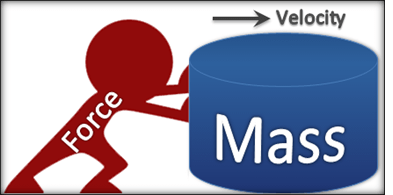
The picture is an example of Newton's...

a)

1st Law

b)

2nd Law

c)

3rd Law

7.

The picture is an example of Newton's...

a)

1st Law

b)

2nd Law

c)

3rd Law

8.

The picture is an example of Newton's...

a)

1st Law

b)

2nd Law

c)

3rd Law

9.

Acceleration is due to a force put on an objects mass.

a)

1st Law

b)

2nd Law

c)

3rd Law

10.
"For every action, there is an equal and opposite reaction."
a)
Newton's 1st Law
b)
Newton's 2nd Law
c)
Newton's 3rd Law
d)
Newton's 4th Law
11.
Force = Mass x Acceleration
a)
Newton's 1st Law
b)
Newton's 2nd Law
c)
Newton's 3rd Law
d)
Newton's 4th Law
12.
"An object in motion (or at rest) will to stay in motion (or at rest) until an outside force acts upon it."
a)
Newton's 1st Law
b)
Newton's 2nd Law
c)
Newton's 3rd Law
d)
Newton's 4th Law
13.
Any push or pull on an object.
a)
force
b)
velocity 
c)
inertia
d)
momentum
14.
The force that opposes motion between two surfaces in contact with each other.
a)
inertia
b)
friction
c)
momentum
d)
gravity
15.
The force of attraction between all matter.
a)
inertia
b)
friction
c)
net force
d)
gravity
16.
A Newton is a unit of...
a)
force
b)
inertia
c)
acceleration
d)
velocity
17.
When all the forces on an object are equal and opposite, & the net force is zero, that's...
a)
balanced forces
b)
unbalanced forces
c)
terminal velocity
d)
reaction forces
18.
The combination of all the forces acting on an object is the...
a)
net force
b)
action force
c)
reaction force
d)
balance force
19.
An archer pulls the bowstring back, then releases the string and the arrow flies forward. Pulling the string back is the...
a)
action force
b)
reaction force
c)
net force
d)
inertia
20.
An archer pulls the bowstring back, then releases the string and the arrow flies forward. The arrow flying forward is the...
a)
action force
b)
reaction force
c)
net force
d)
inertia
21.

Which law does this image represent?

a)

1st Law

b)

2nd Law

c)

3rd Law

22.

Which law does this image represent?

a)

1st Law

b)

2nd Law

c)

3rd Law

23.

Which law does this image represent?

a)

1st Law

b)

2nd Law

c)

3rd Law

24.

Which law does this image represent?

a)

1st Law

b)

2nd Law

c)

3rd Law

25.

Which law does this image represent?

a)

1st Law

b)

2nd Law

c)

3rd Law

26.

Which law does this image represent?

a)

1st Law

b)

2nd Law

c)

3rd Law

27.

Which law does this image represent?

a)

1st Law

b)

2nd Law

c)

3rd Law

28.

Which law does this image represent?

a)

1st Law

b)

2nd Law

c)

3rd Law

29.

Which law does this image represent?

a)

1st Law

b)

2nd Law

c)

3rd Law

30.

Which law does this image represent?

a)

1st Law

b)

2nd Law

c)

3rd Law

31.

Which law does this image represent?

a)

1st Law

b)

2nd Law

c)

3rd Law

32.

Which law does this image represent?

a)

1st Law

b)

2nd Law

c)

3rd Law

33.

Which law does this image represent?

a)

1st Law

b)

2nd Law

c)

3rd Law

34.

Which law does this image represent?

a)

1st Law

b)

2nd Law

c)

3rd Law

35.

Which law does this image represent?

a)

1st Law

b)

2nd Law

c)

3rd Law

36.

Which law does this image represent?

a)

1st Law

b)

2nd Law

c)

3rd Law

37.
If a 10 kilogram object accelerates suddenly at 15 m/s^2, how much force was applied to the object?
a)
150 Newtons
b)
15 Newtons
c)
150 kilograms
d)
100 kilograms
38.
If a force of 50 Newton's was applied to an object with a mass of 500 grams, what will the object's acceleration be?
a)
10 m/s^2
b)
.1 m/s^2
c)
100 m/s^2
d)
1 m/s^2
39.
If a force of 26 N is exerted on two balls, one with a mass of 0.52 kg and the other with a mass of 0.78 kg, which ball will have the greater acceleration?  (F=ma)
a)
The one with a mass of .78 kg will have the greatest acceleration.
b)
The one with a mass of .52 kg will have the greatest acceleration.
c)
They will both accelerate at the same rate.
40.
A 20 kg bike accelerates at 10 m/s2.  what was the force?
a)
25 Newtons
b)
20 Newtons
c)
200 Newtons
d)
10 Newtons
41.
The mass of a car is 1000 kg.  How much force would be required to accelerate the car at a rate of 3 m/s2? 
a)
1000 ÷ 3
b)
3 ÷ 1000
c)
1000 x 3
42.
A force of 250 N is applied to an object that accelerates at a rate of 5 m/s2.  What is the mass of the object? To solve this problem you must do - 
a)
250 ÷ 5
b)
5 ÷ 250
c)
250 x 5
43.
A 5 kg block is pulled across a table by a net force of 32 N. Calculate the acceleration of the object. To solve this problem you must do - 
a)
32 ÷ 5
b)
5 ÷ 32
c)
32 x 5
44.
A skier needs to apply a force of 132 N to accelerate at a rate of 2 m/s2. What is the mass of the skier? To solve this problem you must do - 
a)
132 ÷ 2
b)
2 ÷ 132
c)
132 x 2
45.
A skier needs to apply a force of 132 N to accelerate at a rate of 2 m/s2. What is the mass of the skier? The answer to this question is most likely (HINT: Look at the units!!!) - 
a)
66 N
b)
66 m/s2
c)
66 kg
46.
The masses of four objects are given in this table. If all objects are struck with the same amount of force, which one will have the greatest acceleration?
a)
Object 1
b)
Object 2
c)
Object 3
d)
Object 4
47.
Examine the table provided. Which of the objects is producing the greatest force?
a)
Soccer Ball
b)
Tennis Ball
c)
Marble
d)
Ping-Pong Ball
48.
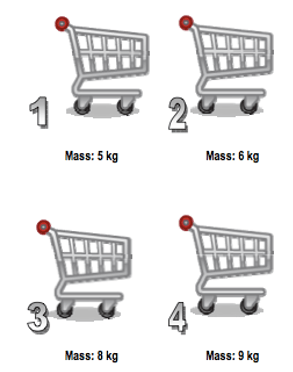
A force of 90N is applied to each cart below, which one will accelerate the fastest?
a)
Cart 1
b)
Cart 2
c)
Cart 3 
d)
Cart 4
49.
Unbalanced forces make an object:
a)
Come to rest
b)
move at constant velocity
c)
accelerate
d)
explode
50.
A basketball with a mass of 0.60 kg is accelerated with a force of 10.8 N. If resisting forces are ignored, what is the acceleration of the basketball to the nearest m/s2?
a)
16 m/s2
b)
17 m/s2
c)
18 m/s2
d)
19 m/s2
51.
The momentum of an object depends upon the object's ___________&_____________.  
a)
size and shape
b)
mass and speed
c)
mass and veloctiy
d)
mass and energy
52.
Determine the momentum of 1000-kg car moving northward at 20 m/s......... 
a)
20000 N
b)
20000 Joules
c)
20000 Kg * m/s
d)
20000 kg * m/s north
53.
The equation to calculate momentum is
a)
p=mv
b)
p=1/2mv2
c)
p=mgh
d)
p=mg
54.
In any collision (crash) the ______ is ALWAYS constant
a)
Total Momentum
b)
total speed
c)
total Velocity
d)
Energy
55.
A runner has a momentum of 720 kg m/s and is traveling at a velocity of 5 m/s. What is his mass?
a)
14.4 kg
b)
1400 kg
c)
144 kg
d)
360 kg
56.
When the speed of an object is doubled, its momentum
a)
remains unchanged in accord with the conservation of momentum.
b)
doubles
c)
quadruples
d)
decreases
57.
The total momentum before a collision is _________ the total momentum after a collision.
a)
equal to 
b)
less than 
c)
more than
d)
It depends on the type of collision
58.

Which of the following has the greatest momentum?

a)

a scurrying cockroach

b)

a parked semi-truck

c)

more information is needed

59.

Why does a semi truck have more momentum than a car if they are both traveling at 60kph?

a)

Truck is more massive

b)

Truck is less massive

c)

Car is moving faster

d)

Car is more massive

60.
An object with a mass of 2000 kg at rest has what momentum?
a)
2000 kg m/sec
b)
0 kg m/sec
c)
2000 kg
d)
2000 m/sec
61.
A 2 kg cart has a momentum of 10 kg m/s. What is its velocity?
a)
22 m/s
b)
.2 m/s
c)
5.0 m/s
d)
20 m/s
62.

If an object has a momentum of 40 kgm/s and a mass of 60 kg, what is it's velocity?

a)

2400 m/s

b)

1.5 m/s

c)

240 m/s

d)

.67 m/s

63.
A biker with a mass of 75 kg moves along the path with a constant velocity of 5 m/s. What is the biker's momentum?
a)
25 m/s
b)
375 m/s
c)
25 kg m/s
d)
375 kg m/s
64.
The momentum of a truck traveling in a straight line at 25 m/s is 37,500 kg m/s. What is the truck's mass? 
a)
937,500 kg
b)
937,500 N
c)
1,500 N
d)
1,500 kg
65.

Any push or pull is called...

a)

gravity.

b)

magnetism.

c)

a force.

d)

acceleration.

66.

Friction would be an example of ...

a)

gravity.

b)

magnetism.

c)

contact force.

d)

non contact force.

67.

A contact force is from

a)

objects physically touching

b)

far apart objects

c)

not touching object

d)

always a pull

68.

A non-contact force is between

a)

two objects that aren't touching

b)

two objects that are touching

c)

the ground and wheels

d)

you and me

69.

The three examples pictured are of

a)

Non-contact Forces

b)

Contact Forces

70.

Gravity is a

a)

Contact Force

b)

Myth

c)

Non-contact Force