

wayground logo

Free Printable Worksheets

Font size

S
M
L
XL
Worksheets

Body Systems Review for Partial Exam

Total questions: 67

Worksheet time: 52mins

Name
Class
Date
1.
Which body system sends electrical signals to all other body systems?
a)
circulatory system
b)
nervous system
c)
digestive system
d)
skeletal system
2.
Which system of the human body provides protection to most of the major organs?
a)
Nervous System
b)
Muscular System
c)
Skeletal System
d)
Circulatory System
3.
Bone cells need nutrients. Which two systems get nutrients to bone cells?
a)
the digestive system and the circulatory system
b)
the circulatory system and the respiratory system
c)
the respiratory system and the skeletal system
d)
the skeletal system and the digestive system
4.
Which two human body systems are most responsible for getting oxygen to cells?
a)
digestive and skeletal
b)
skeletal and circulatory
c)
circulatory and respiratory
d)
respiratory and digestive
5.
Which best explains how the muscular system relies on the respiratory system?
a)
The respiratory system cools the muscular system.
b)
The respiratory system acts as the support system for the muscular system.
c)
The respiratory system brings oxygen into the body for the muscular system to use.
d)
The respiratory system provides nutrients for the body to use as fuel.
6.
Which is responsible for providing oxygen to cells?
a)
skeletal
b)
nervous
c)
digestive
d)
cardiovascular
7.
Which best compares the respiratory system to the circulatory system?
a)
The respiratory system transports oxygen to cells, while the circulatory system provides oxygen for cells.
b)
The respiratory system provides oxygen for cells, while the circulatory system transports oxygen to cells.
c)
The respiratory system breaks down food for cell energy, while the circulatory system rids the body of waste.
d)
The respiratory system rids the body of waste, while the circulatory system breaks down food for cell energy.
8.
How do the muscular and skeletal systems work together to help the body?
a)
they provide blood to the body
b)
They provide nutrients to the body.
c)
They provide structure and movement for the body.
d)
They provide oxygen and carbon dioxide to the body.
9.
How does the circulatory system work with the digestive system?
a)
Blood is used to build muscle strength.
b)
Food is broken down in the bloodstream
c)
Blood carries nutrients throughout the body.
d)
Food waste is filtered by the heart and blood vessels.
10.
How does the muscular system depend on the nervous system?
a)
The nervous system transports blood to the muscles.
b)
The nervous system provides support for the muscles.
c)
The nervous system supplies food and oxygen to the muscles.
d)
The nervous system sends signals to the muscles to cause movement.
11.
Which system is responsible for creating red blood cells?
a)
Skeletal
b)
nervous
c)
digestive
d)
circulatory
12.
Which example best shows structures that make up the digestive system in the human body?
a)
heart, blood, vessels
b)
nose, trachea, lungs
c)
brain, spinal cord, nerves
d)
esophagus, stomach, intestines
13.
All of the following are examples of tissue except...
a)
organ
b)
muscle
c)
connective
d)
epithelial
14.
Where does mechanical digestion begin?
a)
stomach
b)
esophagus
c)
pancreas
d)
mouth
15.
The smallest unit that is a building block for all life.
a)
tissue
b)
organelle
c)
cell
d)
molecule
16.
The main purpose of the ____________ system is to break food particles into pieces that can be used.
a)
circulatory
b)
respiratory
c)
digestive
d)
skeletal
17.
What is responsible for delivering oxygen and removing carbon dioxide from the body?
a)
cell nucleus
b)
excretory system
c)
nervous tissue
d)
respiratory system
18.
The __________ is the main organ of the nervous system.
a)
heart
b)
lungs
c)
brain
d)
skin
19.
In multicellular organisms, tissues are comprised of _______.
a)
organs
b)
systems
c)
cells
d)
blood
20.
When tissues come together, they form ___________.
a)
cells
b)
atoms
c)
organs
d)
systems
21.
A(n) _________ is made of small parts connected together to make a whole.
a)
system
b)
problem
c)
evidence
d)
illustration
22.
Which of the following shows the levels of organization of an organism from LEAST to MOST complex.
a)
cells-tissues-systems-organs
b)
organs-cells-systems-tissues
c)
systems-organs-tissues-cells
d)
cells-tissues-organs-systems
23.
My heart is a _________, that pumps blood through the body. 
a)
Cell
b)
Tissue
c)
Muscle
d)
Bone
24.

The function of the human excretory system is to -

a)

break food into small molecules that the body can absorb

b)

dispose of wastes and control body fluid composition

c)

move materials from the environment into the body

d)

produce enzymes the body needs to break down food

25.

The table summarizes some of the structures and functions of the human body. What terms should replace Y?

a)

protects the body from germs

b)

allows the body to match the temperature of the environment

c)

provides a way for carbon dioxide to leave the body

d)

allows the body to move

26.

To show students that gravity is not the only force that helps move food through the body, the teacher does a headstand and eats a cookie. Which is responsible for moving the food to the stomach?

a)

chewing by the teeth

b)

movement of the tongue

c)

squeezing by the esophagus

d)

contraction of the stomach

27.
What is the largest organ in the human body?
a)
Skin
b)
Hair
c)
Nails
d)
All of the Above 
28.
This function of the skin that allows  the body to retain or lose heat.
a)
body temperature regulation
b)
storage
c)
excretion
d)
absorption
29.
The main function(s) of the skin is to:___________
a)
hold in water
b)
protect from infection
c)
provide the sense of touch
d)
All of the above
30.

The brain controls the body's functions.

a)

True

b)

False

31.

The CENTRAL nervous system is made up of which two organs?

a)

Brain and Spinal Cord

b)

Spinal Cord and Peripheral Nerves

c)

Peripheral Nerves and Heart

d)

Heart and Lungs

32.

Select the VOLUNTARY action.

a)
b)
c)
d)
33.

Select the INVOLUNTARY action.

a)
b)
c)
d)
34.

Nerve cells are called ____.

a)

synapses

b)

cerebrums

c)

neurons

d)

dendrites

35.

Nerves that cause muscles to move are ____.

a)

axon nerves

b)

motor nerves

c)

sensory nerves

d)

feeling nerves

36.

The thick cord of nerve tissue in the center of the backbone is the ____.

a)

dendrite

b)

neuron

c)

spinal cord

d)

brain stem

37.

Thread-like part of a neuron that receives impulses and sends them towards the cell body.

a)

axon terminals

b)

axon

c)

dendrites

d)

cell body

38.

The ____ is made of all the nerves that spread out from the brain and spinal cord.

a)

peripheral nervous system

b)

average nervous system

c)

central nervous system

d)

linear nervous system

39.

Part of the nervous system consisting of the brain and spinal cord.

a)

peripheral nervous system

b)

outside nervous system

c)

medial nervous system

d)

central nervous system

40.
The nervous system is composed of the ___, ___, and ___.
a)
heart, brain, kidneys
b)
lungs, liver, stomach
c)
brain, spinal cord, nerves
d)
eyes, pancreas, veins
41.
Which systems work together when nutrients are dropped off for the cells in the brain?
a)
Circulatory, Excretory, Respiratory
b)
Circulatory, Digestive, Nervous
c)
Circulatory, Respiratory, Nervous
d)
Circulatory, Skeletal, Nervous
42.

How do your nerves work?

a)

They carry messages back and forth from the brain to the rest of the body

b)

The send messages only to the spinal cord

c)

They only receive messages from the spinal cord

d)

They really don't work. They are lazy and want everything done for them.
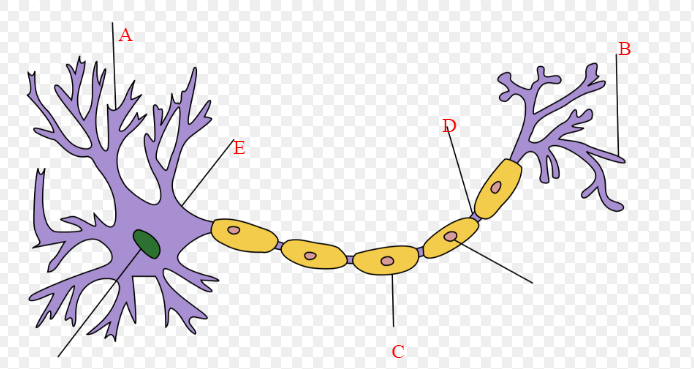
43.
B
a)
Dendrite
b)
Axon
c)
Axon Terminal
d)
Cell Body
44.
A
a)
Dendrite
b)
Axon
c)
Axon Terminal
d)
Cell Body
45.
The correct direction of the neural impulse within one neuron.
a)
Axon Terminal to Dendrite
b)
Dendrite to Axon Terminal
c)
Cell Body to Axon
d)
Axon Terminal to Cell Body
46.
C
a)
Synapse
b)
Soma
c)
Axon Terminal
d)
Myelin Sheath
47.
E
a)
Synapse
b)
Cell Body
c)
Axon 
d)
Dendrite
48.
The purpose of the immune system is to:
a)
Help germs invade your body
b)
Fight off sickness
c)
Make your nose run
d)
Give you diarrhea
49.

The immune system is made up of ....

a)

a. tissues

b)

c. cells

c)

b. organs

d)

d. all of the above

50.

As part of the immune system, white blood cells fight germs. Another name for white blood cells is ....

a)

a. Rhinovirus

b)

c. Glands

c)

b. Leukocytes

d)

d. Nodes

51.

What does it mean to have immunity?

a)

That you are infected

b)

That you are bald

c)

That you are more likely to get sick

d)

That you are protected

52.

The four main types of pathogens are:

a)

Viruses, bacteria, parasites, and fungi

b)

Viruses, parasites, fungi, and phagocytes

c)

Parasites, bacteria, lymphocytes, and fungi

d)

Small, medium, large, and extra large

53.

What is the scientific name of the causes of infectious diseases?

a)

Germ

b)

Pathogen

c)

Intruder

d)

Disease

54.

What is the first line of defense of the immune system?

a)

Mucos

b)

White Blood Cells

c)

Skin

d)

Red Blood Cells

55.

What is a vaccine?

a)

A weakened pathogen injected in the body to produce immunity

b)

Temporary immunity that develops as natural exposure

c)

An overreaction of the immune system

d)

Medicine that helps after you're infected

56.

A disease that is caused by a pathogen and can be passed to people is

a)

Noninfectious

b)

Not contagious

c)

Infectious

d)

Inherited

57.

Which of the following is not a type of pathogen?

a)

Vaccine

b)

Virus

c)

Parasite

d)

Fungi

58.

Your external defenses include

a)

Skin and Mucus

b)

White Blood Cells

c)

Fever

d)

Inflammation

59.

Internal defenses include all of the following except

a)

Inflammation

b)

Skin

c)

Fever

d)

White Blood Cells

60.

What is an increase in body temperature that slows the growth of germs?

a)

Allergy

b)

Vaccine

c)

Fever

d)

Pathogen

61.

Which cells identify and destroy germs?

a)

Bacteria

b)

Neurons

c)

Red Blood Cells

d)

White Blood Cells

62.

What is an immune response to a harmless substance?

a)

Fever

b)

Vaccine

c)

Allergy

d)

Immune deficiency

63.

Which system protects you from disease?

a)

Endocrine

b)

Immune

c)

Nervous

d)

Skeletal

64.

Which of the following protects you from pathogens?

a)

Skin

b)

White Blood Cells

c)

All of these

d)

Mucus

65.

What doubts do you still have before the exam?

4 lines
66.

How prepared do you feel for this exam?

a)

Super confident and ready!

b)

Confident enough

c)

ok

d)

Sort of

e)

I'm lost! Please help!

67.

Would you like an extra session with Ms Sandra to study before the exam?

a)

Yes, please!

b)

mmm..... Maybe

c)

No, thanks
