wayground logo

Free Printable Worksheets

Font size

S
M
L
XL
Worksheets

Final Review Mixed Review

Total questions: 189

Worksheet time: 4hrs 15mins

Name
Class
Date
1.

You know something is moving if its position changes against a background, which is called . . .

a)

position

b)

motion

c)

frame of reference

d)

reference point

2.

A change in position is called . . .

a)

position

b)

frame of reference

c)

reference point

d)

motion

3.

Tells you how the position of an object changes during a certain amount of time

a)

speed

b)

velocity

c)

acceleration

d)

force

4.

The speed of an object in a particular direction is called . . .

a)

speed

b)

velocity

c)

acceleration

d)

force

5.

Any change in velocity (speed and/or direction) of motion . . .

a)

speed

b)

velocity

c)

acceleration

d)

force

6.

The sum of all movements from start to the end of motion is best described as____.

a)

distance

b)

displacement

c)

motion

d)

donkey

7.

The change in an objects position from the final position to initial position.

a)

displacement

b)

distance

c)

motion

d)

reference point

8.
Vector quantities need both a magnitude and a _____.
a)
distance
b)
displacement
c)
direction
d)
velocity
9.

A man walks 5 miles forwards, 6 miles backwards and then 2 miles forwards. What is his displacement?

a)

1 mile forward

b)

13 miles

c)

3 miles forward

d)

1 mile

10.

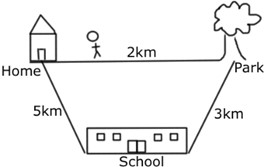
Jerry walked from home to school, then from the school to the park. What is his total distance?

a)

2 km

b)

5 km

c)

8 km

d)

10 km

11.
What is magnitude?
a)
The direction that describes a quantity.
b)
A numerical value
c)
A unit of force
12.
 Jermaine runs exactly 2 laps around a 400 meter track. What is the displacement?
a)
800
b)
400
c)
0
d)
200
13.
Bill runs 400 meters to Andy's house, turns around, and runs 400 meters back home.  What is Bill's distance?
a)
0 meters
b)
400 meters
c)
800 meters
d)
1600 meters
14.

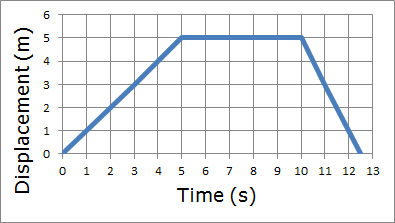
How was the graph created?

a)

Keeping the car steady, moving it away from the sensor at a constant speed, holding it still for a little while, then moving it back toward the sensor

b)

Keeping the car steady, moving it away from the sensor slowly after first and then faster, holding it still for a little while, then moving it back toward the sensor

c)

Keeping the car steady, moving it away from the sensor quickly at first then slowly, holding it still for a little while, then moving it back toward the sensor

d)

Computers hooked up to a science machine

15.

What is the total displacement of the car?

a)

60 m

b)

20 m

c)

0 m

d)

80 m

16.

What is the total distance traveled by the car?

a)

60 m

b)

20 m

c)

0 m

d)

80 m

17.
What is speed?
a)
how far you go
b)
how much distance is covered over a period of time
c)
how fast you accelerate
d)
the change in the location of a object
18.
A runner races in the 100 meter dash.  It takes her 10 seconds to finish.  What is her average speed?
a)
10 m/s
b)
1000 m/s
c)
100 seconds
d)
10 seconds
19.
Total distance divided by total time is
a)
average speed
b)
constant speed
c)
instantaneous speed
d)
acceleration
20.
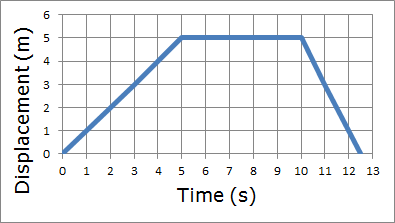
What does this graph represent?
a)
Constant Speed
b)
Acceleration
c)
Not moving
21.
According to the graph how far does the person travel in the first 5 seconds?
a)
2 m
b)
10 m
c)
0 m
d)
5 m
22.
What is the person doing from 5 seconds to 10 seconds?
a)
Walking 
b)
Running
c)
Standing Still 
d)
Walking Fast
23.
Velocity is both ____ and _____. 
a)
speed , direction 
b)
direction, mass
c)
volume, density 
d)
direction, magnitude 
24.
When you look at the speedometer of your car, it tells you your....
a)
Average speed
b)
Instantaneous speed
25.
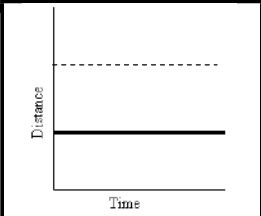
What does this graph represent?
a)
Constant speed
b)
Acceleration
c)
Not moving
26.
What is the speed of the red line?  
a)
4 m/s 
b)
16 m/s 
c)
32 m/s 
d)
2 m/s 
27.
A box sliding down an inclined plane attains a velocity of 27 m/s in 3 seconds from rest.  Find the acceleration.
a)
30 m/s
b)
24 m/s2
c)
9 m/s2
d)
81 km/hr
28.
A roller coasters accelerates from an initial velocity of of 6.0 m/s to a final velocity of 70 m/s over 4 seconds.  What's the acceleration?
a)
24 m/s2
b)
18 m/s2
c)
16 m/s2
d)
16 m/s
29.
The picture of the position vs. time graph shows an object that is...
a)
accelerating/speeding up
b)
moving at a constant speed 
c)
not moving 
d)
accelerating/slowing down. 
30.
Acceleration is defined as the CHANGE in 
a)
time it takes for one place to move to another place. 
b)
velocity of an object.
c)
distance divided by the time interval 
d)
velocity divided by the time interval 
31.
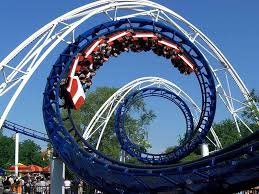
Why does a car accelerate as it round a corner at a constant speed?
a)
Its direction changes
b)
It doesn't
c)
It slows down
d)
Its speeds up  
32.
In each of the following cases, determine where the car has no acceleration ?
a)
A car shortly after a stoplight turns green.
b)
A car approaching a red light
c)
A car with the cruise control set at 80 km/h
d)
A car turning a curve at a constant speed
33.
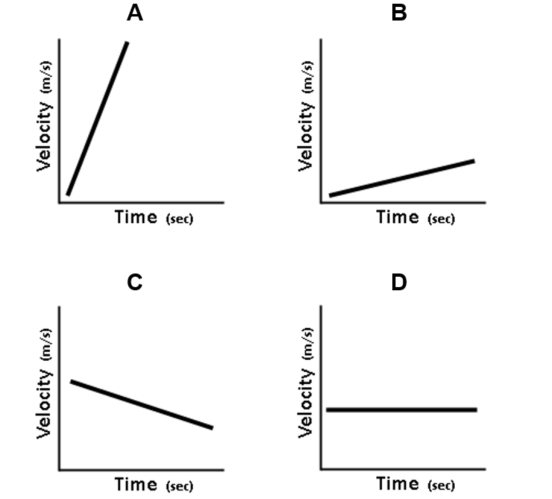
Which graph represents zero acceleration (constant velocity)?
a)
A
b)
B
c)
C
d)
D
34.
Which graph represents the greatest acceleration?
a)
A
b)
B
c)
C
d)
D
35.
Which of the following is a unit for acceleration?
a)
km/s
b)
m/s2
c)
mi/hr
d)
ft
36.
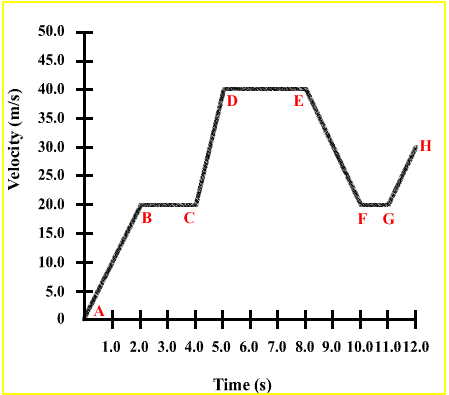
Which section of the graph shows acceleration?
a)
AB
b)
BC
c)
EF
d)
FG
37.
What happened during C to D point?
a)
not moving
b)
increasing speed at a constant rate
c)
moving at a constant speed
d)
moving at 0 m/sacceleration
38.
How long did it take this object to travel 10 m?
a)
0 s
b)
10 s
c)
15 s
d)
20 s
39.
Which runner won the race?
a)
A
b)
B
c)
C
40.
Which runner had a head start?
a)
A
b)
B
c)
C
41.

A negative acceleration means that your object is _____.

a)

doing nothing

b)

moving in circles

c)

speeding up

d)

slowing down

42.

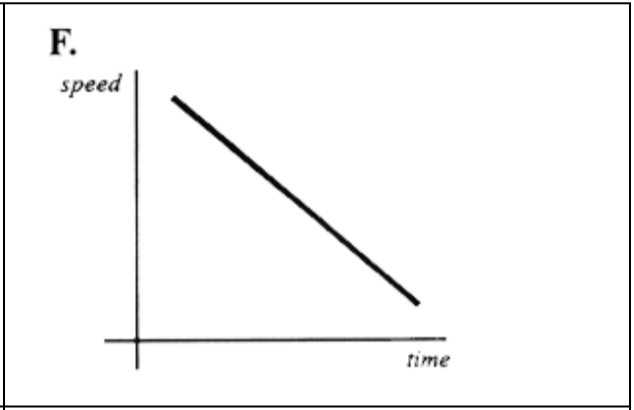
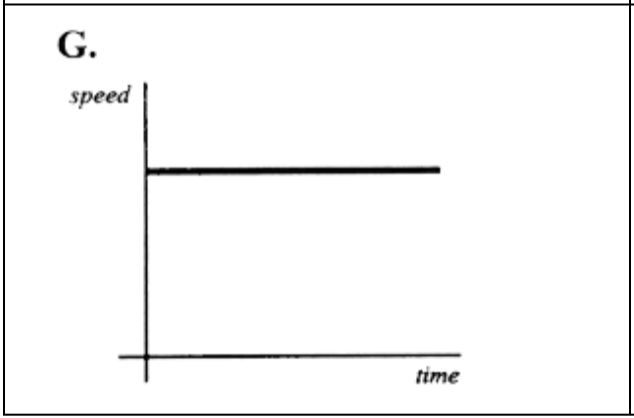
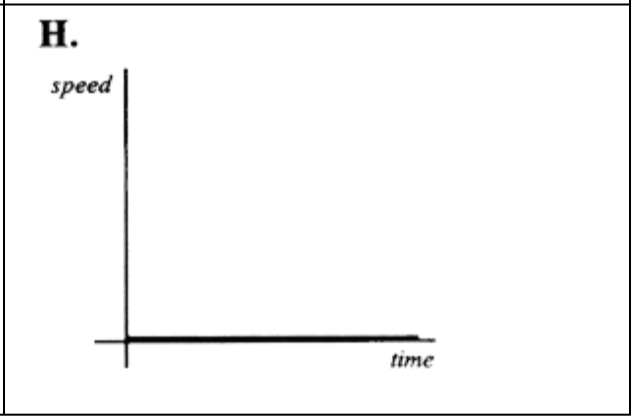
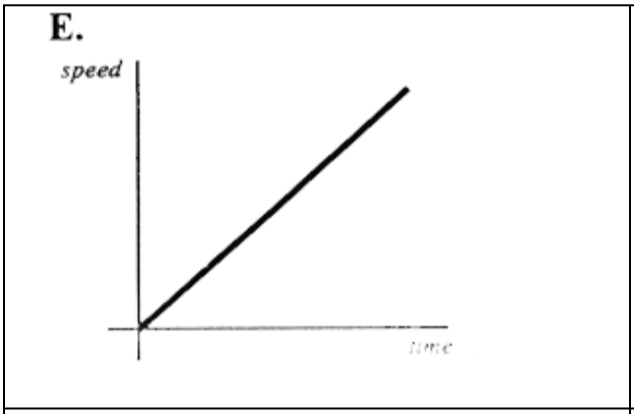
Match the graph to the description:

"The car is traveling at a constant speed."
a)
b)
c)
d)
43.

Match the graph to the description:

"The car is accelerating."

a)
b)
c)
d)
44.

Match the graph to the description:

"The car is slowing down."

a)
b)
c)
d)
45.

Match the graph to the description:

"The car is stationary."

a)
b)
c)
d)
46.
What is the formula for force?
a)
F=M/A
b)
F=A/M
c)
F=M*A
d)
F=M*F
47.
45 m/s2 is the... 
a)
Mass
b)
Force 
c)
Acceleration
d)
weight
48.
If a force of 26 N is exerted on two balls, one with a mass of 0.52 kg and the other with a mass of 0.78 kg, which ball will have the greater acceleration?  (F=ma)
a)
The one with a mass of .78 kg will have the greatest acceleration.
b)
The one with a mass of .52 kg will have the greatest acceleration.
c)
They will both accelerate at the same rate.
49.
A 20 kg bike accelerates at 10 m/s2.  what was the force?
a)
25 Newtons
b)
20 Newtons
c)
200 Newtons
d)
10 Newtons
50.
Unit of mass
a)
m/s 2
b)
m/s
c)
newtons
d)
kg
51.

A student pushes a box to right with a force of 10N while a young boy pushes the box to the left with a force of 8N. What is the net force on the box? 

a)
18N left
b)
18N right
c)
2N right
d)
2N left
52.
If net force acting on object is 0, then the force is considered to be..
a)
Balanced
b)
Unbalanced
c)
Equal in Direction
d)
Distance/Time
53.
A cat sitting on couch, a pencil on desk and a car at rest are all example of..
a)
Balanced Force
b)
Unbalanced Force
54.
A car speeding up, a dog slowing down and person turning around the block are examples of..
a)
Balanced Forces
b)
Unbalanced Forces
55.
What is Newton's First Law known as? The Law of
a)
Friction
b)
Mass
c)
Inertia
d)
Gravity
56.
Which type of force(s) will cause a change in an object's motion?
a)
gravity
b)
zero net force
c)
balanced forces
d)
unbalanced forces
57.
What is Newton's First Law
a)
F=ma
b)
Every action has an equal and opposite reaction
c)
An object at rest stays at rest, an object in motion stays in motion. 
d)
Friction 
58.
Newton's third law states that any action will have a(n) _______ and ______ reaction
a)
Equal and similar
b)
Equal and opposite
c)
Equal and different
d)
Greater and opposite
59.
This equation goes with which law?
a)
Newton's first law of motion
b)
Newton's second law of motion
c)
Newton's third law of motion
d)
None of these
60.
Which of Newton's laws is illustrated when a magician pulls a tablecloth out from under the dishes without disturbing them?
a)
first
b)
second
c)
third 
d)
fourth
61.
A person is pushed forward into their seat belt when a car stops.  Which law is this?
a)
1st
b)
 2nd
c)
2 and 3
d)
3rd 
62.
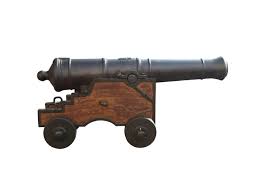
When a cannon fires a cannonball we observe Newton's third law. Which force is the reaction force?
a)
The cannon moving forward
b)
The cannonball moving forward
c)
The cannon moving backward
d)
The cannonball moving backward
63.
A bike accelerates at 10 m/s2 when a force of 50N is applied.  What is the mass of the bike and its rider?
a)
25 kg
b)
200 kg
c)
20 kg
d)
5 kg
64.
Which of Newton's laws are illustrated with a rocket launch?
a)
1st Law, the Law of Inertia. 
b)
2nd Law, the Law of Acceleration.
c)
3rd Law, the Law of Action Reaction
d)
The Law of Conservation of Mass
65.
Which of Newton's Laws is illustrated with a large mass and a small mass accelerating?
a)
1st Law, the Law of Inertia.
b)
2nd Law, the Law of Acceleration
c)
3rd Law, the Law of Action Reaction
d)
The Law of Conservation of Mass
66.
When a heavy football player and a light one run into each other, who exerts more force?
a)
The heavy one
b)
The light one
c)
They are equal
d)
There is no such thing as force 
67.
What is Newton's First Law of Motion?
a)
F = m x a
b)
Every action has an equal an opposite reaction
c)
An object at rests stays, an object in motion stays in motion
d)
Friction
68.
What pulls a ball back to earth?
a)
Gas
b)
Friction
c)
Gravity
d)
Molecules
69.
A _______ is a push or pull.
a)
Newton
b)
Acceleration
c)
Momentum
d)
Force
70.
What is Newton's Second Law of Motion?
a)
F = m x a
b)
Action/Reaction
c)
Object in motion will stay in motion, object at rest will stay at rest
d)
Velocity
71.
Which force produces a change in motion?
a)
Unbalanced force
b)
Balanced force
c)
Gravitational force
d)
Frictional force
72.
What is the standard unit force is measured in?
a)
Newton
b)
Gram
c)
Pound
d)
Meter
73.
What is Newton's Third Law of Motion?
a)
Object in motion stays in motion and an object at rest stays at rest unless acted on by an unbalanced force
b)
Force = m x a
c)
For every action there is an equal and opposite reaction
74.
According to Newton's Second Law, if you increase the force applied to an object:
a)
It accelerates more
b)
It doesn't move
c)
You get more inertia
d)
It decelerates
75.
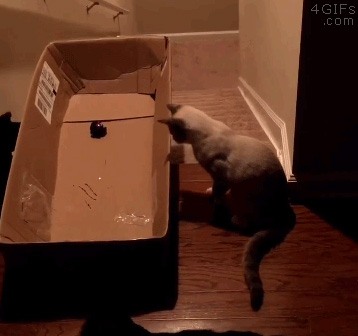
The law in the picture represents---
a)
Newton's 1st law
b)
Newton's 2nd law
c)
Newton's 3rd law
d)
Newton's 4th law
76.
What Newton's law does this picture represent?
a)
Newton's 2nd law
b)
Newton's 1st law
c)
Newton's 3rd law
d)
Newton's 5th law
77.
1000 kg is the -----
a)
Force
b)
Mass
c)
Acceleration
d)
Weight
78.
20 N is the ----
a)
Mass
b)
Force
c)
Acceleration
d)
Weight
79.
45 meters per second squared is the--
a)
Acceleration
b)
Mass
c)
Weight
d)
Force
80.
If an object is stationary (not moving) the forces acting upon it are---
a)
Balanced
b)
Unbalanced
c)
Weak
d)
Hulk Smash?
81.
Newton's Law of Inertia describes the motion of-
a)
Objects at rest only
b)
Objects in motion only
c)
Objects at rest and objects that are in motion
d)
Objects without a mass and resist being set into motion
82.
When the air is released from a balloon, the air moves in one direction, and the balloon moves in the opposite direction. Which law best explains the motion of the balloon?
a)
Newton's Law of Inertia
b)
Newton's Law of F=ma
c)

Newton's Law of Action and Reaction

d)
Newton's Law of Biology
83.
Which law best explains how objects accelerate when a force is applied?
a)
Newton's Law of Inertia
b)
Newton's Law of F=ma
c)

Newton's Law of Action and Reaction

d)
Newton's Law of Chemistry
84.
Which law best explains why the coin sitting on top of the ring falls directly into the jar below because it wants to remain at rest?
a)
Newton's Law of Inertia
b)
Newton's Law of F=ma
c)

Newton's Law of Action and Reaction

d)
Newton's Law of Science
85.
Which one of Newton’s Laws of Motion best explains why the dishes do not move when the table cloth is removed?
a)
Newton's Law of Inertia
b)
Newton's Law of F=ma
c)

Newton's Law of Action and Reaction

d)
Newton's Law of Biology
86.
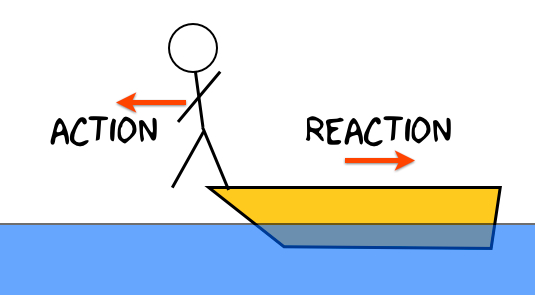
Which law best explains why the boat moves in the opposite direction that Sally moves as she jumps to shore?
a)
Newton's Law of Inertia
b)
Newton's Law of F=ma
c)

Newton's Law of Action and Reaction

d)
Newton's Law of Chemistry
87.
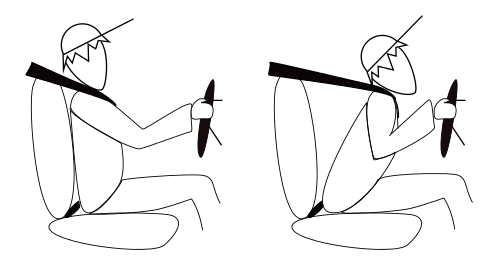
Which law best explains why people remain in motion when a car crashes, if they are not wearing a seat belt?
a)
Newton's Law of Inertia
b)
Newton's Law of F=ma
c)

Newton's Law of Action and Reaction

d)
Newton's Law of Biology
88.
Which law best explains why more force must be applied to the bowling ball to make it accelerate at the same rate as the tennis ball. 
a)
Newton's Law of Inertia
b)
Newton's Law of F=ma
c)

Newton's Law of Action and Reaction

d)
Newton's Law of Biology
89.
Based on Newton's Law of Force Pairs, what would be the reaction force, if the action force is 60 N to the right?
a)
60 N to the right
b)
60 N to the left
c)
30 N to the left
d)
9.8 N to the right
90.
Calculate the acceleration of the tire in the diagram.
a)
5.3 m/s2
b)
0.2 m/s2
c)
12.0 m/s2
d)
9.8 m/s2
91.
A man hits a 0.2 kg golf ball causing it to accelerate at rate of 20 m/s2. Calculate the force used on the golf ball.
a)
4 N
b)
100 N
c)
0.01 N
d)
20.2 N
92.
A force of 560 N is needed to produce an acceleration of 20 m/s2. What is the mass of the accelerated body?
a)
28 kg
b)
11200 kg
c)
0.04 kg
d)
580 kg
93.
If you double the mass of an object with the same force apply on it, the acceleration will
a)
double
b)
cut in half
c)
the same
d)
zero
94.
What kind(s) of objects have inertia?
a)
all objects with mass
b)
only objects at rest
c)
only objects in motion
d)
only objects whose motion is being changed
95.
Which one needs a greater net force to move, a kilogram of feathers or a kilogram of iron? 
a)
feathers 
b)
iron
c)
same
d)
depends on their friction
96.
After a cannonball is fired into frictionless space, the amount of force needed to keep it going equals
a)
twice the force with which it was fired
b)
the same amount of force with which it was fired
c)
1/2 the force with which it was fired
d)
zero, since no force is required to keep it moving. 
97.
The acceleration produced by a net force on an object is
a)
inversely proportional to the mass of the object.
b)
directly proportional to the magnitude of the net force.
c)
in the same direction as the net force.
d)
 all of the above
98.

A 10-kg brick and a 1-kg book are dropped in a vacuum. The Fg (weight) on the 10-kg brick is

a)

10 times as much as the force on the 1-kg book

b)

zero.

c)

the same as the force on the 1-kg book.

d)

none of the above

99.
A book weighs 4 N. When held at rest in your hands, the net force on the book is
 
a)
0 N.
b)
 0.4 N.
c)
 4 N.
d)
 39 N.
100.
A 20 kg bike accelerates at 10 m/s2.  what was the net force
a)
25 Newtons
b)
20 Newtons
c)
200 Newtons
d)
10 Newtons
101.
When a cannon fires a cannonball we observe Newton's third law. Which force is the reaction force?
a)
The cannon moving forward
b)
The cannonball moving forward
c)
The cannon moving backward
d)
The cannonball moving backward
102.
Which one of Newton’s Laws of Motion best explains why the dishes do not move when the table cloth is removed?
a)
Newton's 1st Law
b)
Newton's 2nd Law 
c)
Newton's 3rd Law 
d)
Newton's Law of Biology
103.
The tendency of an object to stay in motion or at rest is called 
a)
velocity
b)
acceleration
c)
speed
d)
inertia
104.
What is the difference between mass and weight?
a)
mass is how much matter is in an object, and weight is the gravitational pull on that object
b)
mass and weight are the same
c)
weight affects how much mass is in an object
d)
weight is determined by how many atoms make up an object
105.
What is the net force?
a)
5000 N right
b)
4000 N right
c)
40 N left
d)
4000 N left
106.
Which of the following shows the direction of the friction force?
a)
A
b)
B
c)
C
d)
D
107.
Which force produces a change in motion?
a)
unbalanced force
b)
balanced force
c)
gravitational force
d)
frictional force
108.
What is the standard unit force is measured in?
a)
Newtons
b)
pounds
c)
grams
d)
meters
109.
What is Newton's First Law known as? The Law of
a)
Friction
b)
Mass
c)
Inertia
d)
Gravity
110.
What is the formula for force?
a)
F=M/A
b)
F=MA
c)
F=AX
d)
what is force?
111.
What is Newton's Third Law?
a)
Object in motion stays in motion and an object at rest stays at rest unless acted on by a outside force
b)
Force = mass x acceleration
c)
For every action there is an equal and opposite reaction
112.
According to Newton's second law, if you increase the force applied to an object :
a)
it accelerates more
b)
it doesn't move
c)
you get more inertia
d)
it decelerates
113.
What law of motion does this picture represent?
a)
Newtons 1st law
b)
Newtons 4th law 
c)
Newtons 3rd law 
d)
Newtons 2nd law
114.
What is Newtons 2nd law of motion?
a)
Pancakes 
b)
Force= Mass multiplied by acceleration
c)
For every action there is a equal and opposite  re-action.
d)
Law of gravity 
115.
What Newtons law does this picture represent
a)
Newtons 2nd law 
b)
Law of gravity 
c)
Newtons 1st law
d)
Newtons 5th law
116.
Forces always act in equal and opposite pairs.
a)
Newton's 1st Law
b)
Newton's 3rd Law
c)
Newton's second law
117.
Newton's first law of motion states that __________.
a)
when a force is applied on an object, there is an equal force applied by the object in the opposite direction
b)
hen a force acts on an object, its acceleration is in the same direction as the force
c)
an object will remain at rest or keep moving with a constant velocity unless a force acts on it
d)
cceleration is calculated by dividing the force exerted on an object by the mass of the object
118.
 Work done = Force x _________
a)
a. distance
b)
b. acceleration
c)
c. velocity
d)
d. speed
119.
The unit used to measure work is the 
a)
Watt
b)
Newton
c)
Joule
d)
meter
120.
Which situation is work not done?
a)
lifting a 20 pound box off the floor
b)
holding a 20 pound box above the floor
c)
sliding a 20 pound box across the floor
d)
sliding a 20 pound box up an inclined plane
121.
What is work?
a)
A push or pull.
b)
When the object moves in the same direction in which the force is exerted.
c)
A change in energy.
d)
The rate at which energy is transferred.
122.
A force exerted over a distance to move an object is ______________________.
a)
power
b)
work
c)
momentum
d)
Watt
123.
Which is doing work?
a)
pushing a wall
b)
holding a box
c)
picking up a pencil
d)
sitting in a chair
124.
Which of the following is the best example of work being done? 
a)
doing homework
b)
lifting a box
c)
pushing a stationary box
d)
holding a box
125.
An example of work is holding a heavy bag.
a)
True
b)
false
126.
Work is a measurement of how much force is applied over a certain
a)
distance
b)
velocity
c)
shape
d)
size
127.
You do work only when you exert a force on an object and move it.
a)
True
b)
False
128.
Two factors that determine work are
a)
size of the force, and distance
b)
size of the force, and type of force
c)
mass, and distance
129.
If you push a cart with a force of 60 N for 2 m, how much work have you done?
a)
120 J
b)
30 J
c)
120 N 
d)
30 N
130.
Both work and energy are measured in 
a)
joules
b)
newtons
c)
meters
d)
seconds
131.
Which of the following is the best example of work being done?
a)
doing homework
b)
lifting a box
c)
pushing a stationary box
d)
holding a box
132.
A girl pushes a box across the floor. Did she do work?
a)
No.
b)
Yes.
133.
Fred kicks a ball with a force of 20N to George, who is 5M away. How much work was done to the ball?
a)
25J
b)
100J
c)
4J
d)
75J
134.
What is work?
a)
Force x Distance
b)
Force / Distance
c)
Distance / Force
d)
Force + Distance
135.
In order for Work to happen, what 2 things must occur?
a)
Mass and Displacement
b)
Force and Mass
c)
Force and Work
d)
Force and displacement
136.

Units of force are...

a)

Newtons

b)

Grams

c)

Joules

d)

Meters

137.

Units of work are...

a)

Newtons

b)

Grams

c)

Joules

d)

Meters

138.

If 40N of force is applied to Rollo Koster's 10 kg cart over a distance of 50 meters, how much work is done?

a)

8000 J

b)

8000 N

c)

4000 J

d)

2000 J

139.

If Jay Loppy pushes his van 20 meters how much work is done?

a)

2,000 J

b)

40,000 J

c)

10,000 J

d)

800,000 J

140.

Which of the following is defined as an energy transfer?

a)

kinetic energy

b)

work

c)

potential energy

d)

chemical energy

141.

The unit of work is

a)

watt

b)

hertz

c)

joule

d)

pascal

142.

45 J of work were done on the object that moved 5 meters. How much force was applied to the object?

a)

8 N

b)

225 N

c)

9 N

d)

0 N

143.
The net work done by a net force acting on an object is equal to the change in the kinetic energy of the object.
a)
Force-Work Theorem
b)
Work-Kinetic Energy Theorem
c)
Force-Kinetic Energy Theorem
d)
Work-Force Theorem
144.

What is the ΔKE of a baseball hit with a force of 6000 N that travels 120 m across the field?

a)

6000J

b)

43560000J

c)

720000J

d)

50J

145.

A 10.0 kg box is accelerated from 2.0 m/s to 4.0 m/s. What is the amount of work needed to accelerate the box?

a)

50 J

b)

60 J

c)

20 J

d)

45 J

146.
When my velocity triples, my kinetic energy increases by ______ times.
a)
9
b)
 3 
c)
1.5
d)
4.5
147.
True or false: the net work done on a body is equal to its change in kinetic energy.
a)
True
b)
False
148.

The equation for work is

a)

work = power x mass

b)

work = power / time

c)

work = force x distance

d)

work = distance x time

149.

The equation for POWER is

a)

power = mass x time

b)

power = work / time

c)

power = time / work

d)

power = work x time

150.

The equation for KINETIC ENERGY is

a)

KE = mass x gravity

b)

KE = 1/2 height x speed

c)

KE = mass2

d)

KE = 1/2 mass x speed2

151.

Kinetic energy is the energy of ___________.

a)

Distance

b)

Motion

c)

Work

d)

Roman

152.

Energy cannot be ________ or ___________.

a)

big/small

b)

left/right

c)

created/destroyed

d)

made/transferred

153.

Energy can be transformed from one form into another, but the total amount of energy never changes.

a)

Work-energy theorem

b)

Law of conservation of energy

c)

Newton's second law of motion

d)

King's theorem of energy

154.
Calculate the PE of a 2 kg cat perched 10 meters above the ground. 
a)
20 J
b)
200 J
c)
2.04 J
d)
200 W
155.
Calculate the work needed to raise a 3 kg cat up to a height of
4 m.
a)
12 J
b)
0 J
c)
120 J
d)
1.22 J
156.
Calculate the Kinetic Energy (KE) of a girl whose mass is 50 kg who is moving at 4 m/s.
a)
200 J
b)
800 J
c)
400 J
d)
100 J
157.
True or false: when the distance an object moves is zero the work done on the object is also zero.  
a)
True
b)
False
158.
As a pendulum swings from its highest to lowest position, what happens to its kinetic and potential energy? 
a)
Both the potential energy and kinetic energy decrease
b)
The potential energy decreases while the kinetic energy increases 
c)
The kinetic energy decreases while the potential energy increases 
d)
Bothe the potential energy and kinetic energy increase 
159.
While a boulder is on the top of a hill it has what type of energy? 
a)
Mechanical
b)
Kinetic
c)
Potential 
d)
Reactive 
160.

Gravitational potential energy depends on the ________ and ________ of the object.

a)

Position (height) and mass

b)

Friction and movement

c)

Mass and Movement

d)

Height and Friction

161.

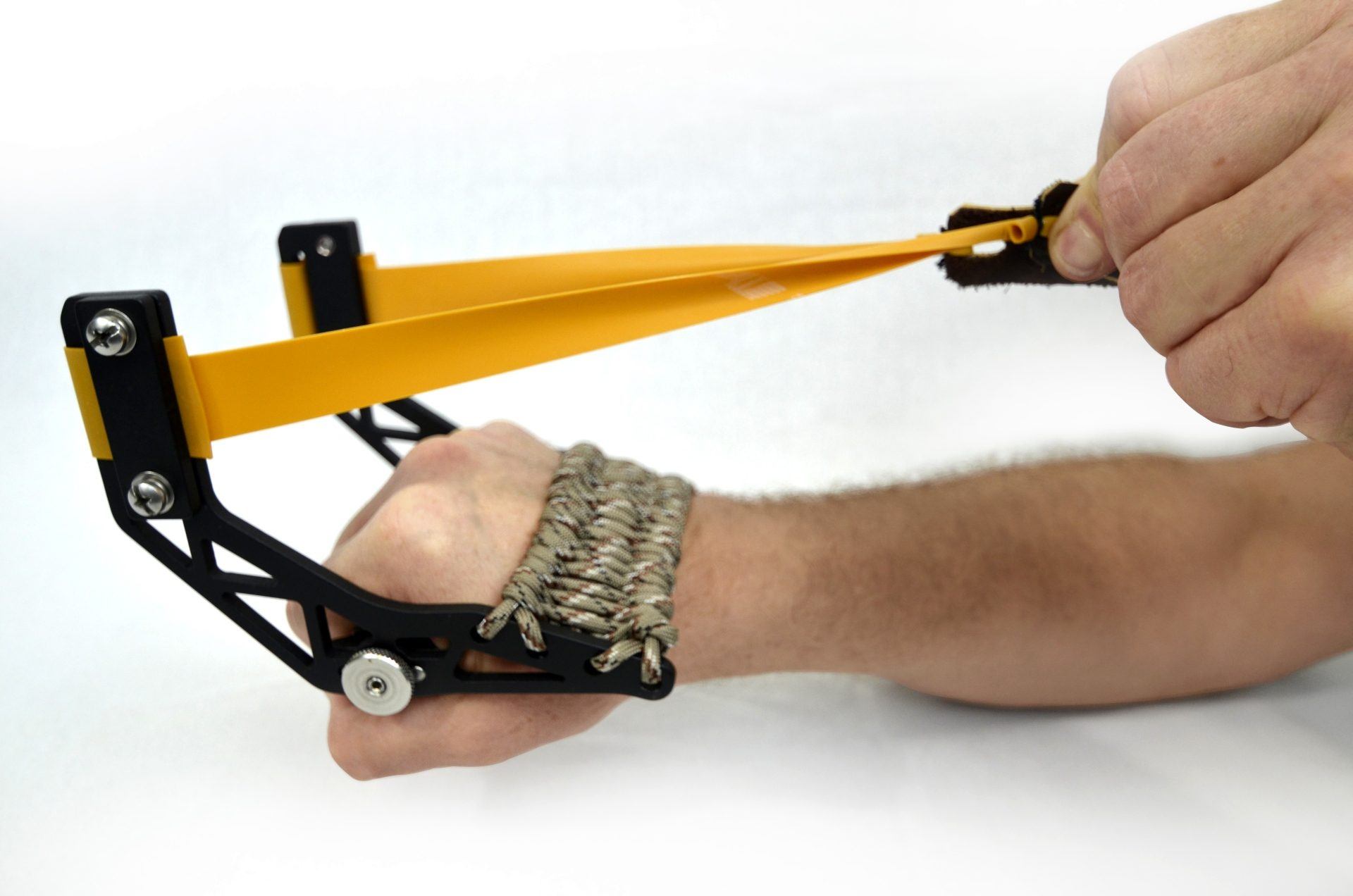
When you stretch a rubber band, you are storing __________ energy.

a)

kinetic

b)

potential

162.

What kind of energy is in a moving skateboard?

a)

Potential

b)

Kinetic

163.

What energy does a rock at the edge of a cliff have?

a)

Potential

b)

Kinetic

164.

Which is the best example of an object having kinetic energy?

a)

a car parked on a steep hill

b)

a tennis ball rolling across the court

c)

a picture hanging on the wall

d)

a piece of coal before it's burned

165.

The Lay of Conservation of Energy states that energy cannot be ________ or ________, but it can change from one form to another.

a)

created, destroyed

b)

gravity, force

c)

heat, created

166.

What are the two factors that affect kinetic energy?

a)

time and energy

b)

power and mass

c)

mass and speed

d)

time and work

167.

Which of the following is an example of kinetic energy decreasing as the gravitational potential energy increases?

a)

a person parachuting out of a plane

b)

a car racing around an oval track

c)

a person skiing down a hill

d)

a person walking up a hill

168.

In order to INCREASE the potential energy of an object, you need to:

a)

put the object lower to the ground

b)

raise the object higher

169.

What kind of energy is represented in this picture?

a)

Heat

b)

Potential

c)

Nuclear

d)

Electrical

170.
What type of energy is in this picture?
a)
Kinetic
b)
Elastic Potential
c)
Chemical
d)
Gravitational Potential 
171.

When plants convert the sun's energy into food, which type of energy is it?

a)

kinetic

b)

chemical

c)

heat

d)

electrical

172.

What kind of energy is represented in the picture?

a)

Heat

b)

Chemical

c)

Sound

d)

Nuclear

173.

A battery converts what type of energy to another?

a)

sound to kinetic

b)

light to heat

c)

kinetic to electrical

d)

chemical to electrical

174.
This type of potential energy depends on an object's height and mass
a)
gravitational potential energy
b)
kinetic potential energy
c)
elastic potential energy
d)
nuclear potential energy
175.
A device that converts electrical energy to light energy.
a)
A blender
b)
A light bulb
c)
A bicycle
d)
A balloon
176.
The ability to do work.
a)
Energy
b)
Matter
c)
Weight
d)
Volume
177.

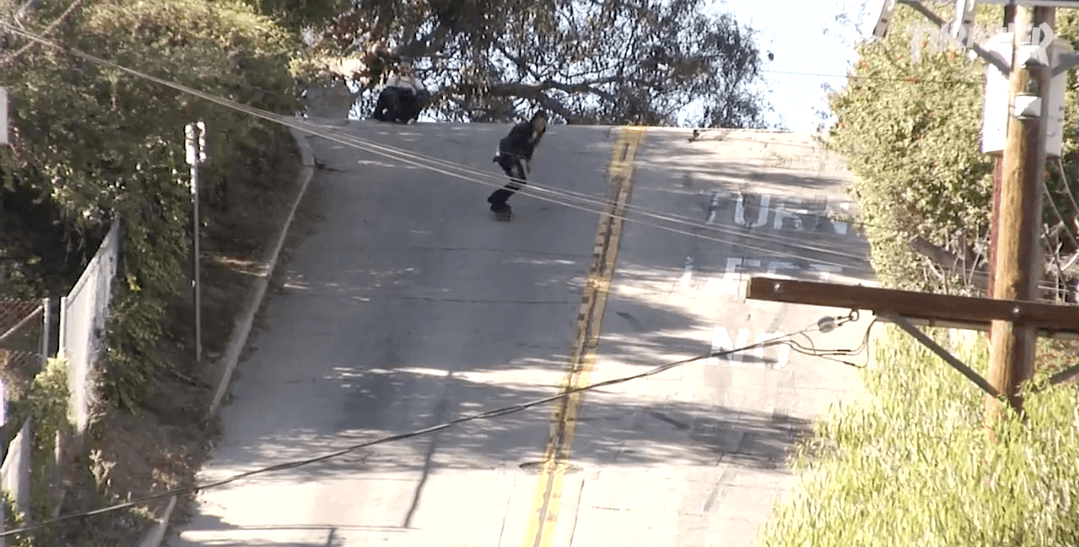
What is the energy conversion when you have a skateboard at the top of the hill then move down?

a)

kinetic to potential

b)

potential to kinetic

c)

potential to thermal

d)

electrical to kinetic

178.

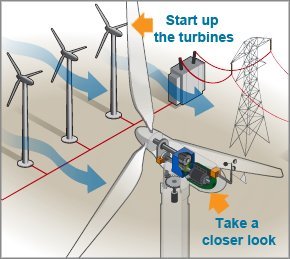
What is the energy conversion when a wind turbine turns to provide energy to a power supply?

a)

electrical to potential

b)

potential to kinetic

c)

kinetic to electrical

d)

nuclear to heat

179.
What are the two factors that affect (Gravitational) Potential Energy?
a)
Gravity and Time
b)
Distance and Force
c)
Mass and Height
d)
Power and Gravity
180.

Name the Energy Conversion of a dryer.

a)

Chemical→ Thermal and Light

b)

Electrical → Elastic, Heat and Sound

c)

Gravitational → Nuclear, Sound and Heat

d)

Electrical → Heat, Kinetic and Sound

181.

Potential energy that is stored in stretched or compressed material.

a)

energy

b)

kinetic energy

c)

gravitational potential energy

d)

elastic potential energy

182.

The process in which one kind of energy changes into another kind.

a)

law of conservation of energy

b)

energy

c)

energy conversion

d)

kinetic energy

183.

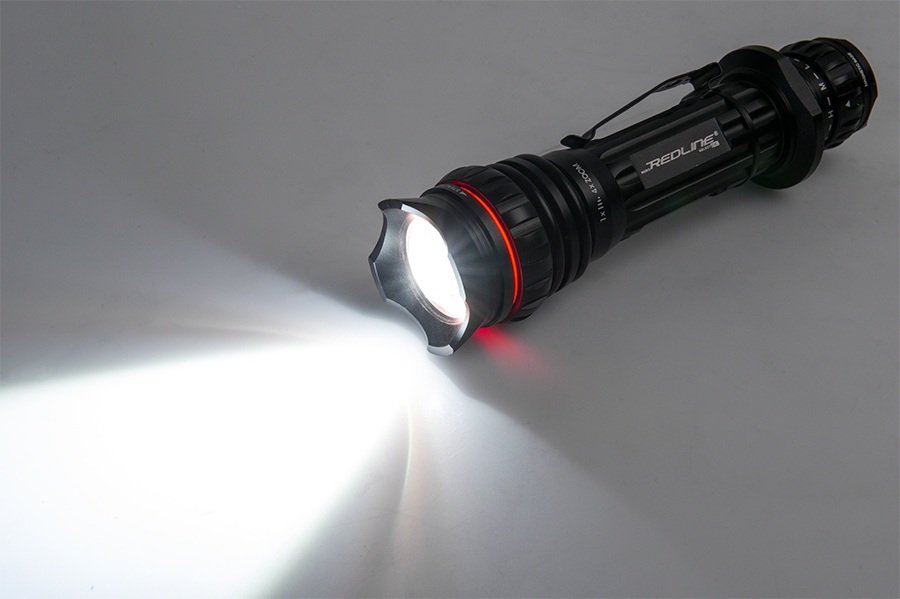
What is the energy conversion when you put batteries in a flashlight to make it turn on?

a)

chemical to light

b)

light to kinetic

c)

chemical to thermal

d)

nuclear to light

184.

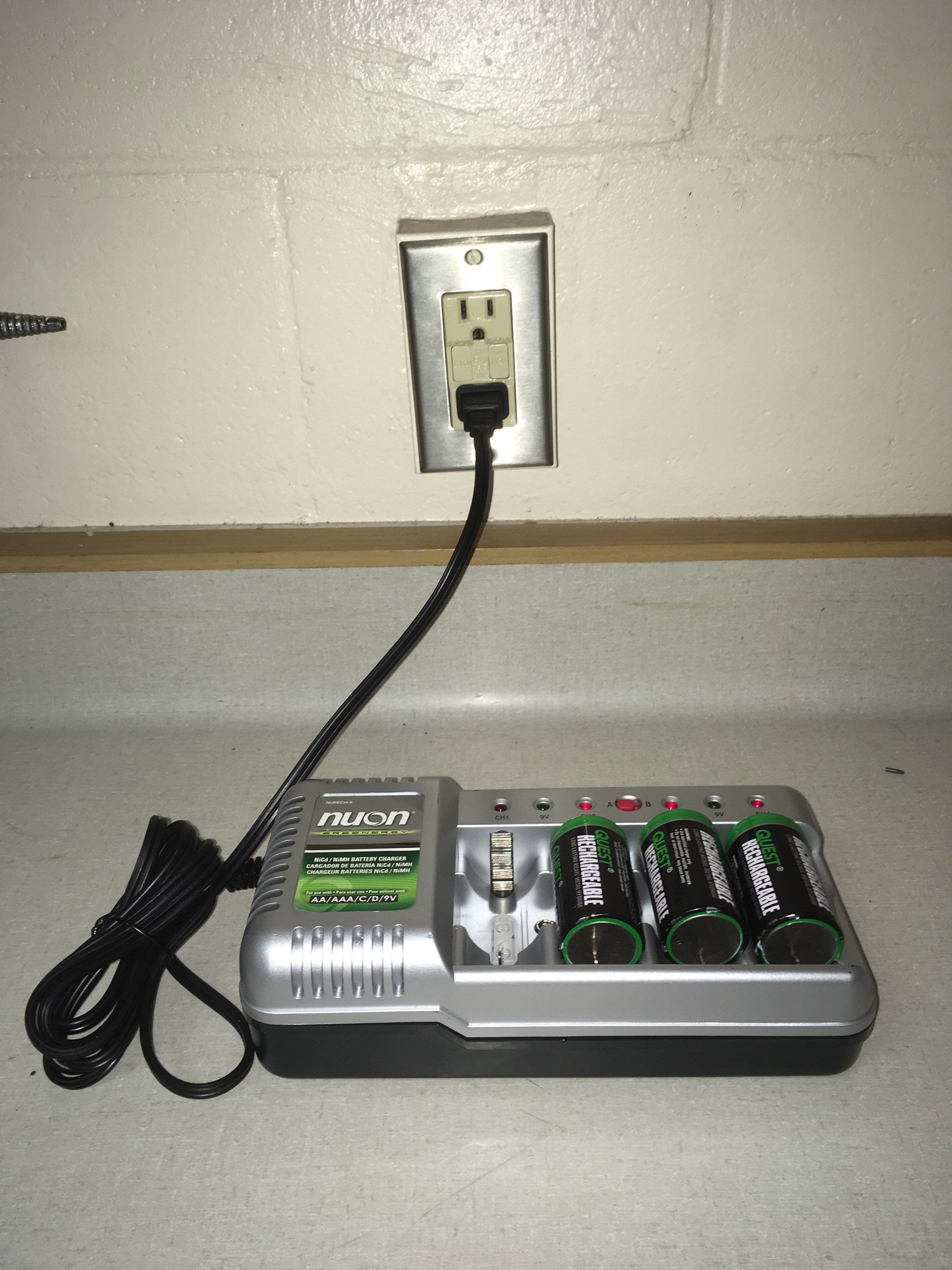
What is the energy conversion when you plug in a charger to charge a battery?

a)

electrical to light

b)

kinetic to potential

c)

thermal to chemical

d)

electrical to chemical

185.

What is the energy conversion when a wind turbine turns to provide energy to a power grid?

a)

electrical to potential

b)

potential to kinetic

c)

kinetic to electrical

d)

nuclear to heat

186.

How high must a 20kg box be lifted to give it 784J of potential energy?

a)

3.98 km

b)

392 m

c)

3.92 m

d)

3

187.
9. A 1000kg car is traveling at 5m/s.  How much kinetic energy does it have?
a)
25 J
b)
2500 J
c)
25000 m/s
d)
12,500 J
188.

The energy transformation that occurs when someone jumps on a trampoline is best described as:

a)

Elastic PE → Motion KE → Gravitational PE

b)

Sound KE → Chemical PE → Motion KE

c)

Motion KE → Chemcial PE → Gravitational PE

d)

Gravitational PE → Elastic PE → Motion KE

189.

A 6 kg cat is running at a speed of 5 m/s. What is its KE?

a)

30 J

b)

294 J

c)

75 J

d)

11 J