
 Worksheets
2nd Semester Physical Science Benchmark Review 1
Total questions: 191
Worksheet time: 5hrs 53mins


Which of the following is an opaque material?
frosted glass
stain glass
window
aluminum foil
A pencil looks like it is broken when it is placed in a glass half-filled with water. What
causes the pencil to look broken?
Reflection
Refraction
Absorption
Compression
What does white light create?
bioluminescence
lasers
The blended colors of the rainbow
sunset
How does light allow you to see a tree?
Light goes from your eyes to the tree.
Light shines on your eyes and on the tree.
Light falls on the tree and travels back to the sun.
Light reflects off the tree and travels to your eyes.
What is an example of when you can SEE sound energy . Click all that apply
A speaker vibrating as music plays
Listening to a saxophone
The seats vibrating at a baseball game.
Hearing your friend sing.
What is true about a white shirt?
All the colors of light are reflected
All the colors of light are absorbed
The only color absorbed is clear.
Which color is not a color of the rainbow?
red
orange
yellow
pink
What is the best type of curtains for a person who likes to sleep in?
transparent material
translucent material
opaque material
What object reflects light in order to be visible?
the moon
the door
a paper bag
What type of glass in a window would allow the most light into a room?
transparent window
translucent window
opaque window
What are different materials vibrations can travel through?
solids liquids and glasses
solids only
liquids only
If 3 nails are hit with a pencil, which will produce the lowest pitch?
the shortest nail
the middle nail
the longest nail


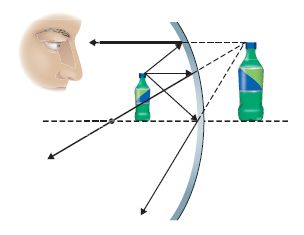
Light rays that hit a convex mirror ____ as they are reflected.
magnify
diverge
unite
disappear
____ are thick in the middle and thin at the edges.
Plane mirrors
Convex lenses
Concave lenses
Concave mirrors
The image formed by a plane mirror is ____.
real and reversed
real and upright
upright and reversed
virtual and inverted
A farsighted eye focuses an image ____.
behind the retina
in front of the lens
in front of the retina
on the retina
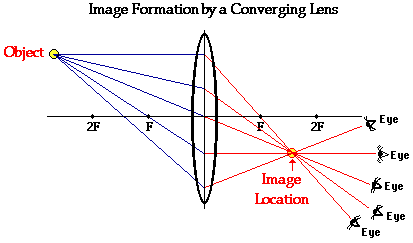


The above lens is a type of ___.
diverging lens
converging lens
divergent lens
convergent lens
Which figure represents the path light takes through a convex lens?
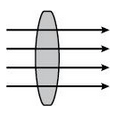
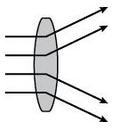
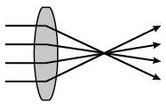
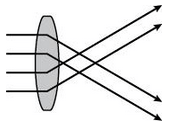
____ are thick in the middle and thin at the edges.
Plane mirrors
Convex lenses
Concave lenses
Concave mirrors


White light is made up of _________________ colors.
10
3
6
70


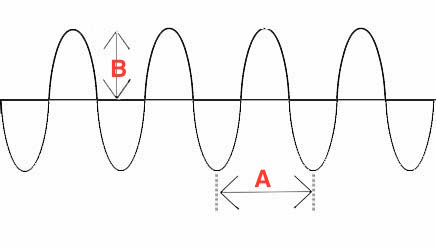
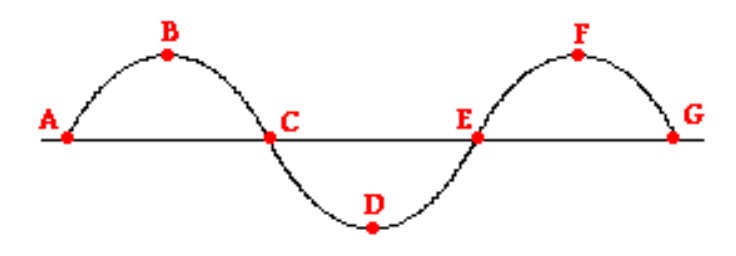
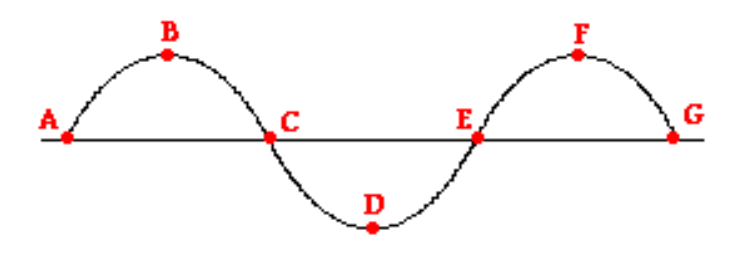
What property of this wave is represented by the letter "A"
amplitude
crest
trough
wavelength
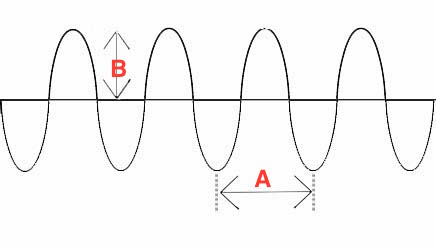


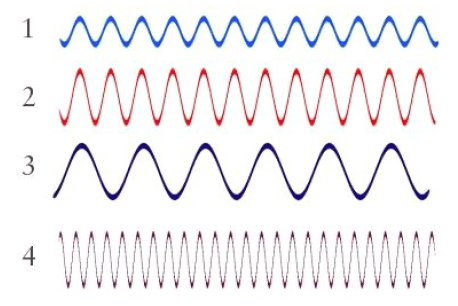


What do we call the part of a compressional wave that is when the waves are squeezed together?
compression
rarefaction
crest
trough
What do we call the part of a compressional wave that is spread a part?
compression
rarefaction
crest
trough


What is another name for wave height?
Frequency
Amplitude
Wavelength
Origin

Regulates the amount of light entering the eye and gives the eye its color.
Iris
Lens
Pupil
Retina


We see a tree because of light being:
emitted by the tree.
reflected from the tree.
refracted from the tree.
absorbed by the tree.
Which statement does NOT accurately describe the human eye?
There are three kinds of cone cells.
The eye has about 130 million rod cells and 7 million cone cells.
The eye has many more cone cells than rod cells.
Photo-receptors are located on the surface of the retina.


Log
Conductor
Insulator
Styrofoam Cup
conductor
insulator


You have 20 g of water with specific heat of 4.18 J/g°C. The temperature changes from 25° C to 20° C. How much heat energy (Q) moves from the water to the surroundings? Answer 418 Joules
418 Joules
209 J
83 J
4.18 J
Calculate the heat absorbed by 105.0 grams of water when it is heated to cook spaghetti. The initial temperature of the water is 20.0°C, and the final temperature of the water is 99.0°C. The specific heat of water is 4.18 J/g•°C.. Answer 34673 J/g°C
8778 J/g°C
0.0005 J/g°C
34673 J/g°C
43451.1 J/g°C
The temperature of an unknown piece of metal with a mass of 30.00 g changes from 25.0 °C to 35.0 °C when the metal absorbs 350.0 J of energy. What is the specific heat of the metal? 1.17 J/g°C
1.17 J/g°C
-1.17 J/g°C
0.857 J/g°C
-0.857 J/g°C

