wayground logo

Free Printable Worksheets

Font size

S
M
L
XL
Worksheets

Physical Science Study Guide

Total questions: 187

Worksheet time: 3hrs 14mins

Name
Class
Date
1.
What are the two types of Mechanical Energy? (ME)
a)
Kinetic and Potential Energy
b)
Kinetic and Nuclear Energy
c)
Potential and Chemical Energy
d)
Thermal and Kinetic Energy
2.

Where is potential energy at its maximum?

a)

a

b)

b

c)

c

d)

d

3.

Where is kinetic energy at its maximum?

a)

a

b)

b

c)

c

d)

d

4.

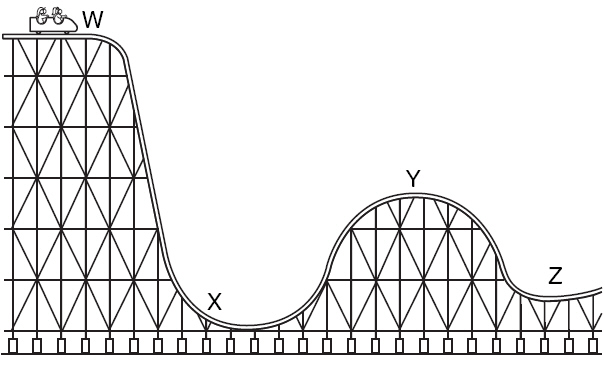
What is the kinetic energy at W, where the car is stopped?

a)

0J

b)

10,000J

c)

20,000J

d)

can not be determined

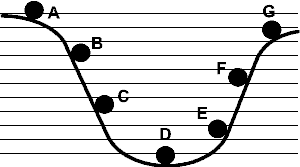
5.

Q. What does the Law of Conservation of Energy state?

a)

Energy can be created but not destroyed.

b)

Energy can be created and destroyed.

c)

Energy cannot be created but can be destroyed

d)

Energy cannot be created or destroyed.

6.

Q. What has to be true about an object for it to have kinetic energy?

a)

it must be moving

b)

it must be experiencing a net force

c)

it must be elevated

d)

it must be accelerating

7.

When does an object have no kinetic energy?

a)

when it is moving very slowly

b)

when it has no electrical charge

c)

when the only force that is acting on it is gravity

d)

when it is at rest

8.

You calculated PE at 1960 J and your KE at 225 J. What is your Total Mechanical Energy? Select the Equation you should use.

a)

PE = mgh

b)

KE = 1/2 (m) (v^2)

c)

W=fd

d)

TME = KE + PE

9.

You calculated PE at 1960 J and your KE at 225 J. What is your Total Mechanical Energy?

a)

225 J

b)

3150 J

c)

2185 J

d)

1960 J

10.

Which of the is the equation for calculating work?

a)

W = Fd

b)

W = ma

c)

W = mv

d)

W = mc2

11.

Work is defined as applying a force on an object that displaces the object in the direction of the applied force. Which of the following IS NOT an an example of work being done on an object?

a)

A waiter walking with a tray of food that he is holding with his hand under the tray.

b)

A horse pulling a plow through a field.

c)

A shopper pushing a cart down the aisle of a grocery sture.

d)

A weightlifter lifting a barbell above his head.

12.

Which of the following is an instance where a force is in the opposite direction of the displacement.

a)

A car skidding to a stop on a roadway surface.

b)

A student rolling a bowling ball down a bowling lane alley.

c)

A pitcher throwing a baseball.

d)

a man pushing a crate across a loading dock.

13.

An instance where a force is appiled in the opposite direction of a displacement is called __________________ work.

a)

negative

b)

false

c)

faux

d)

opposite

14.

If a ball tossed into the air has a maximum gravitational potential energy of 5.75 joules, what is its maximum kinetic energy in the same toss?

a)

5.75 joules

b)

11.14 joules

c)

2.88 joules

d)

7.93 joules

15.

What is the mechanical energy of the roller coaster car?

a)

100 joules

b)

50 joules

c)

2500 joules

d)

1 joule

16.

This drawing illustrates which of the following?

a)

Conservation of Mechanical Energy

b)

Conservation of Mass

c)

Conservation of Momentum

d)

Universal Gravitation

17.

How much work is being done with 200 N of force to the right on object that moves 426 meters to the right? (assume the force and displacement are in the same direction)

a)

85,200 J

b)

45,620 J

c)

90,480 J

d)

62,329 J

18.
How do you calculate power?
a)
P = W/t
b)
P = E/t
c)
P = w * t
d)
P = bbq/chicken
19.
How do we calculate work?
a)
W = F * d
b)
w = f * D
c)
W = F * D
d)
w = f * d
20.
How much work is being done with 200 N of force over 426 meters?
a)
85,200 J
b)
45,620 J
c)
90,480 J
d)
62,329 J
21.
If 150 Joules of work is needed to move a box 10 meters, what force was used? 
a)
1500 N
b)
15 N
c)
1.5 N
d)
150 N
22.
If 68 Joules were necessary to move a 4 Newton crate, how far was the crate moved?
a)
272 m
b)
17 m
c)
4.05 m
d)
272 cm 
23.
Work is done when a weightlifter holds a barbell still above his head.
a)
True
b)
False
24.

You push against the back of your friends car that is stuck. You push and be become very tired, but the car does not move. Did you do work?

a)

Yes, work was done

b)

No, work wasn't done

25.

Person A and Person B are both using the same amount of work to lift something. Person A takes half as much time to do it. Who has greater power.

a)

Person A

b)

Person B

26.
How much work is done in holding a 15 N sack of potatoes while waiting in line at the grocery store for 3 minutes?
a)
15 J
b)
45 J
c)
0 J
d)
5 J
27.
If 68 W of power is produced in 18 seconds, how much work is done?
a)
1,224 J
b)
0.264 J
c)
3.77 J
d)
12.24 J
28.
How much time is needed to produce 720 Joules of work if 90 watts of power is used? 
a)
0.125 s
b)
8 s
c)
64800 s
d)
80 s
29.
If 68 Joules were necessary to move a 4 Newton crate, how far was the crate moved?
a)
272 m
b)
17 m
c)
4.05 m
d)
272 cm 
30.

Which of the following is the best example of work being done.

a)

doing homework

b)

lifting a box

c)

pushing a stationary box

d)

holding a box

31.
if you push a cart with a force of 60 N for 2 m... how much work have you done
a)
120 J
b)
30 J
c)
120 N 
d)
30 N
32.
A 5000N block is lifted 10 m. How much work was done?
a)
50000 J
b)
5000 J
c)
500 J
d)
50 J
33.
How much work is produced when 350 N is used to move a car 5 m?
a)
70 J
b)
1750 J
c)
355 J
d)
175 J
34.
P=25 watts 
W=5000 Joules 
t=???
a)
200 sec
b)
0.0005 s
c)
125000 s
d)
125 s
35.

A 8.6 kg box is pushed across a floor 3.2 m with a force of 5.5 N. How much work is done on the box?

a)

17.6 J

b)

8.7 J

c)

1.72 J

d)

No work is done.

36.

A student carries a 10.5 kg book bag 15.3 m. How much work is done on the book bag by the student?

a)

No work is done.

b)

160.65 J

c)

1.46 J

d)

25.8 J

37.

An object of mass 6.8 kg is lifted to a height of 1.3 m. How much work is done on the object?

a)

8.84 J

b)

8.1 J

c)

5.23 J

d)

No work is done.

38.

If the direction an object is displaced is the same as the direction of a force applied to it:

a)

Positive work is done.

b)

Negative work is done.

c)

No work is done.

39.

If the direction of an applied force is anti-parallel (opposite) to the direction an object is moving:

a)

Negative work is done.

b)

Positive work is done.

c)

No work is done.

40.

If the direction an object is displaced is perpendicular to the direction of a force applied to it:

a)

No work is done.

b)

Positive work is done.

c)

Negative work is done.

41.

How much power is required to do 40.2 J of work in 3.3 s?

a)

12.18 W

b)

132.66 W

c)

43.5 W

d)

0.08 W

42.

In order to do 20.5 J of work in 0.46 s, how much power is required?

a)

44.57 W

b)

9.43 W

c)

32.35 W

d)

11.56 W

43.

A force of 4.6 N moves a 2.7 kg box a distance of 3.3 m in 6.8 s. How much power is exerted?

a)

2.23 W

b)

6.03 W

c)

17.4 W

d)

278.7 W

44.

How much work is done when 114 W of power is used over 0.62 s?

a)

70.68 J

b)

183.87 J

c)

57.62 J

d)

No work is done.

45.

How much work is done when 114 W of power is used over 0.62 s?

a)

70.68 J

b)

183.87 J

c)

57.62 J

d)

No work is done.

46.

The roller coaster car has a mass of 500 kg. It is pulled from position 1 to 2 (30 m) by a motor. At the top of the ride the vertical distance top to bottom is 20 m. The motor pulls the car with a 4000 N force. Calculate the work done getting the car to the top of the ride.

a)

100 000J

b)

120 000J

c)

800 000J

d)

90 000J

47.
Is this an example of work? 
A waiter carries a tray full of meals above his head by one arm straight across the room at constant speed. 
a)
True
b)
False
48.

An 80 N rope tension force is used to slowly pull a wagon 50 m up a hill. Calculate the work done by the rope if it pulls parallel to the hill

a)

-4000 J

b)

4000 J

49.

How high up is a 3200-kg plane if it has 960000 J of potential energy?

a)

10 m

b)

30 m

c)

307200000 m

d)

300 m

50.
What kind of energy is in a rock at the edge of a cliff?
a)
Potential
b)
Kinetic
51.
What kind of energy is in a person climbing a ladder?
a)
Potential
b)
Kinetic
c)
Both
52.
What kind of energy is in a stretched rubber band?
a)
Potential
b)
Kinetic
53.
At which point is potential energy greatest?
a)
W
b)
X
c)
Y
d)
Z
54.
Which point has the most potential energy?
a)
G
b)
f
c)
b
d)
a
55.
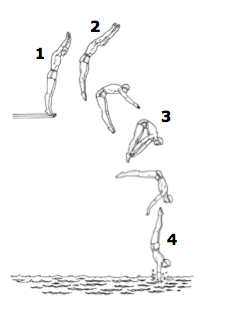
2. The diagram to the right represents a diver’s motion from the top of a high diving board into a pool of water. At what point does the diver have the greatest kinetic energy and the least potential energy?
a)
1
b)
2
c)
3
d)
4
56.
Explain what happens to the potential energy of a rock as it falls off the side of a cliff.
a)
The kinetic energy decreases as the potential energy increases.
b)
The kinetic energy decreases as the potential energy decreases.
c)
The potential energy decreases as the kinetic energy increases.
d)
The potential energy decreases as the kinetic energy decreases. 
57.
When riding a roller coaster, you go up and down many hills. As you get to the top of a roller coaster, what energy change is taking place.
a)
Potential energy is changed into kinetic energy.
b)
Kinetic energy is changed into potential energy.
c)
Chemical energy is changed into heat energy.
d)
Heat energy is changed into chemical energy. 
58.
What would have the greatest kinetic energy?
a)
A car driving down a hill.
b)
A person running down a hill. 
c)
A ball rolling down a hill. 
d)
leaves rolling down a hill 
59.
Which is an example of potential energy?
a)
a roller coaster speeding down a hill
b)
the pulled back string on an archers's bow
c)
releasing the strings on a guitar
d)
an electric current lighting a light bulb
60.

The law of ​ (a)   states that energy in a system can change forms but can never be created or destroyed.

Choose from the below words
conservation of energy
consecration of energy
conversion of energy
construction of energy
61.
As a pendulum swings from its highest to lowest position, what happens to its kinetic and potential energy? 
a)
The PE and KE increase and decrease together
b)
The PE decreases while the KE increases 
c)
Impossible to know without knowing the mass  
62.
Can energy be destroyed?
a)
no
b)
yes
63.
Is energy always conserved?
a)
Always
b)
Often
c)
Never
d)
Sometimes
64.
Which is the best example that something has kinetic energy?
a)
a. a car parked on a steep hill 
b)
b. a tennis ball rolling across the court
c)
c. a picture hanging on the wall 
d)
d. a piece of coal before it's burned 
65.

What is the kinetic energy of a ball with a mass of 5kg rolling at 10m/s

a)

50 J

b)

500 J

c)

250 J

d)

25 J

66.

If a football player wants to become better at tackling by increasing his or her kinetic energy, how can the player do this?

a)

Increase his/her height

b)

Increase his/her speed

c)

Increase his/her mass

d)

Decrease his/her speed

67.
What is kinetic energy?
a)
When an object is in motion
b)
When an object is not in motion
c)
all of the above
d)
none of the above
68.

On a roller coaster, where is maximum kinetic energy?

a)

At the bottom of a big hill

b)

When going around a corner

c)

At the top of a big hill

69.

When force is used to move an object across a distance, this is called...

a)

effort

b)

power

c)

energy

d)

work

70.

If the object does not move then what is happening

a)

nothing

b)

work

c)

power

d)

no work is being done on the object

71.

What is the equation for work?

a)

W = mass x acceleration

b)

W = force x distance

c)

W = force/distance

d)

W = speed/time

72.
The unit used to measure work is the 
a)
Watt
b)
Newton
c)
Joule
d)
meter
73.

In which scenario is work = 0 J ?

a)

Pushing a stationary wall

b)

Pulling a trolley car

c)

Pushing a book across the table

d)

Dropping a set of keys from a height, h.

74.

Energy in the form of motion.

a)

mechanical energy

b)

potential energy

c)

kinetic energy

d)

momentum

75.

How fast does gravity accelerate?

a)

9.8 m/s

b)

6.67 x 10⁻¹¹kg

c)

6.67 m2/s2

d)

9.8 m/s2

76.
AgF
a)
silver fluoride
b)
silver fluorine
c)
monosilver monofluoride
d)
silver monofluorine
77.
Nonmetals tend to 
a)
gain electrons
b)
lose electrons
78.
Metals tend to 
a)
gain electrons
b)
lose electrons
79.
How do the following two elements bond together?
Na1+  F1-         
a)
NaF
b)
NaF3
c)
Na3F
d)
Na1F2
80.
How do the following two elements bond together?
K1+  S2- 
a)
KS
b)
K8S
c)
K6S3
d)
K2S
81.
How do the following two elements bond together?
Al3+  O2-         
a)
AlO
b)
Al2O3
c)
Al3O6
d)
Al3O2
82.
The proper formula for magnesium hydroxide:
a)
MgOH
b)
Mg2OH
c)
Mg(OH)2
d)
Mg2OH2
83.
What is the charge on the hydroxide ion?
a)
0
b)
-1
c)
-2
d)
-3
84.
Name the following ionic compound: LiNO3
a)
lithium nitrate
b)
lithium III nitrate
c)
lithium nitride
d)
lithium oxide
85.
Name the following ionic compound: MgSO4
a)
magnesium sulfoxide
b)
magnesium sulfide
c)
magnesium sulfate
d)
magnesium oxide
86.
Name the following ionic compound: BeCl2
a)
beryllium chlorine
b)
beryllium II chloride
c)
beryllium chloride
d)
beryllium dichloride
87.
What would be the proper chemical formula for combining Al3+ and Cl- :
a)
AlCl3
b)
Al3Cl
c)
AlCl
d)
Al3Cl3
88.
The chemical formula of lead (IV) nitrate is
a)
PbN₄
b)
PbNO₃₄
c)
Pb(NO₃)₄
d)
Pb₃NO₄
89.
The chemical formula of iron (III)bromide is
a)
FeBr
b)
Fe(III)Br
c)
FeBr₃
d)
Fe₂Br₃
90.
The chemical formula of iron (III)bromide is
a)
FeBr
b)
Fe(III)Br
c)
FeBr₃
d)
Fe₂Br₃
91.
When naming ionic compounds you always write the name of the positive element  _______ .
a)
first
b)
second
c)
with "ide"
d)
with a prefix
92.
In most cases, when naming you change the ending of the second element to ________.
a)
-ate.
b)
-ite.
c)
-ide.
d)
-ine.
93.
What is the formula for calcium phosphide?
a)
CaP
b)
Ca2P3
c)
Ca3P2
d)
Ca2P
94.
What is the formula for copper(I) sulfate?
a)
CuSO3
b)
CuSO4
c)
Cu2SO3
d)
Cu2SO4
95.
The chemical formula for an ionic compound of potassium and oxygen is
a)
KO.
b)
K2O.
c)
K2O2.
d)
KO2.
96.

What is the name of the following compound: NaCl

a)

sodium chloride

b)

sodium (I) chloride

c)

sodium chlorine

d)

sodium (I) chlorine

97.

What is the name of the following compound: CuBr2

a)

copper bromine

b)

copper bromide

c)

copper (I) bromide

d)

copper (II) bromide

98.

What is the name of the following compound: K2SO4

a)

potassium sulfur

b)

potassium sulfate

c)

potassium (I) sulfate

d)

potassium (II) sulfide

99.

What is the name of the following compound: Mn2O3

a)

manganese oxide

b)

manganese (II) oxide

c)

manganese (III) oxide

d)

magnesium oxide

100.

What is the what charge of manganese in the compound: Mn2O3

a)

+1

b)

+2

c)

+3

d)

-3

101.

What is the charge of copper in the compound: CuBr2

a)

+1

b)

+2

c)

-1

d)

-2

102.

What is the what charge of lead in the compound: lead (IV) iodide

a)

+1

b)

+4

c)

+6

d)

-1

103.

Which is the correct formula for the compound: Calcium Oxide

a)

CaO

b)

CaO2

c)

Ca2O

104.

Which is the correct formula for the compound: Barium Hydroxide

a)

BaOH

b)

Ba(OH)2

c)

BaOH2

d)

Ba2OH

105.

Which is the correct formula for the compound: lead (II) fluoride

a)

Pb2F

b)

PbF2

c)

PbF

d)

PbF7

106.

Why do atoms form chemical bonds?

a)

Atoms bond to become less chemically stable.

b)

Atoms bond to change from liquid to a solid.

c)

Atoms bond to become more chemically stable.

d)

Atoms bond to make new substances.

107.

An ionic bond forms when electrons are __________ between atoms.

a)

shared

b)

transferred

108.

Ionic bonds most likely form between _________.

a)

2 nonmetals

b)

2 metalloids

c)

a nonmetal and a metal

d)

2 metals

109.

When forming ionic bonds, metal atoms tend to ________.

a)

lose electrons

b)

gain electrons

c)

share electrons

d)

lose protons

110.

When forming ionic bonds, nonmetal atoms tend to ________.

a)

lose electrons

b)

gain electrons

c)

share electrons

d)

lose protons

111.

When forming ionic bonds, nonmetal atoms tend to become ________.

a)

cations

b)

anions

c)

neutral

d)

ionic

112.

When forming ionic bonds, metal atoms tend to become ________.

a)

cations

b)

anions

c)

neutral

d)

ionic

113.

When a binary ionic compound is named, the positive charged ion will always be written _______.

a)

first

b)

second

c)

with a Roman Numeral

d)

with -ide

114.

When a binary ionic compound is named, the name of the ________ will end in with the suffix _______.

a)

metal // -ate

b)

metal // -ide

c)

nonmetal // -ate

d)

nonmetal // -ide

115.

How many elements are present in a binary compound?

a)

1

b)

2

c)

3

d)

4

116.

Which is a binary compound?

a)

potassium hydroxide

b)

sodium chlorate

c)

silver nitrate

d)

barium sulfide

117.

Which of the following compounds is NOT an ionic compound?

a)

CaCl₂

b)

NaCl

c)

BF₃

d)

Fe₂(CO₃)₃

118.

What is the charge of a sodium ion?

a)

S⁺¹

b)

S⁻¹

c)

Na⁺¹

d)

Na⁻¹

119.

What is the charge of a magnesium ion?

a)

Mg⁺²

b)

Mg⁻²

c)

Mn⁺²

d)

Mn⁻²

120.

What is the charge of a iron in the compound iron (III) sulfide?

a)

Fe⁺²

b)

Fe⁻²

c)

Fe⁺³

d)

Fe⁻³

121.

What is the charge of a copper in the compound copper (II) chloride?

a)

Cu⁺²

b)

Cu⁻²

c)

Cu⁺¹

d)

Cu⁻¹

122.

Which compound formula is written correctly for copper (II) chloride?

a)

Cu⁺²Cl⁺¹

b)

Cu₁Cl₂

c)

Cu₂Cl

d)

CuCl₂

123.

Which compound formula is written correctly for lead (IV) sulfide?

a)

PbS₂

b)

Pb(IV)S

c)

Pb⁺⁴S⁻²

d)

Pb₂S₄

124.

What is the correct formula for

ammonium chloride?

a)

NH₄Cl₂

b)

(NH₄)₂Cl

c)

NH₄Cl

d)

ClNH₄

125.

What is the correct formula for

iron (III) nitrite?

a)

Fe₃NO₂

b)

Fe(NO)₂

c)

Fe(NO₂)₃

d)

Fe₂NO₃

126.

What is the correct formula for

copper (I) phosphide?

a)

Cu₃P₂

b)

Cu₃P

c)

Cu₂P₃

d)

CuP

127.

What is the correct formula for

tin (IV) selenide?

a)

Sn₂Se₂

b)

Sn₂Se₄

c)

Sn₂Se

d)

SnSe₂

128.

What is the correct formula for

potassium + sulfur?

a)

K₂S

b)

P₂S

c)

KS

d)

KS₂

129.

What is the correct formula for

aluminum + bromine?

a)

AlBr

b)

Al₃Br

c)

Al₂Br₃

d)

AlBr₃

130.

How many different elements are in the compound

lithium carbonate (Li₂CO₃)?

a)

2

b)

3

c)

6

d)

7

131.

How do the following two ions bond together?

K+1  S-2

a)

KS

b)

K8S

c)

K6S3

d)

K2S

132.

How do the following two elements bond together?

Al+3  O-2

a)

AlO

b)

Al2O3

c)

Al3O6

d)

Al3O2

133.

What is the correct formula for

magnesium hydroxide?

a)

MgOH

b)

Mg2OH

c)

Mg(OH)2

d)

Mg2OH2

134.

What is the charge on the hydroxide ion?

a)

0

b)

+1

c)

-1

d)

-2

135.

Name the following ionic compound:

LiNO3

a)

lithium nitrate

b)

lithium (II) nitrate

c)

lithium nitride

d)

lithium nitrous oxide

136.

Name the following ionic compound:

MgSO4

a)

magnesium sulfoxide

b)

magnesium sulfide

c)

magnesium sulfate

d)

magnesium oxide

137.

Name the following ionic compound:

BeCl2

a)

beryllium chlorine

b)

beryllium (II) chloride

c)

beryllium chloride

d)

beryllium dichloride

138.

Match the following

a)

three

1.

tri-

b)

four

2.

tetra-

c)

six

3.

hexa-

d)

seven

4.

hepta-

e)

eight

5.

octa-

139.

Match the following

a)

one

1.

mono-

b)

two

2.

di-

c)

five

3.

penta-

d)

nine

4.

nona-

e)

ten

5.

deca-

140.
Name the following compound: 
N2O4
a)
dinitrogren tetraoxide
b)
tetranitrogen dioxide
c)
nitrogen oxide
d)
dinitrogen tetraoxygen
141.
Name the following compound: 
CO2
a)
monocarbon dioxide
b)
carbon oxide
c)
carbon dioxide
d)
oxygen carbonide
142.
Name the following compound: 
CCl4
a)
monocarbon quadchloride
b)
carbon tetrachloride
c)
carbon chloride
d)
monocarbon quadchloide
143.
Name the following compound:
NF3
a)
nitrogen triflouride
b)
mononitrogen triflouride
c)
nitrogen flouride
d)
tetranitroflouide
144.
Name the following compound:
H2O
a)
hydrogen oxide
b)
dihydrogen oxide
c)
trihydroxide
d)
dihydrogen monoxide
145.
Write the formula for:
dinitrogen tetroxide
a)
N2O4
b)
NO2
c)
NO
d)
N4O8
146.
Write the formula for:
dinitrogen pentoxide
a)
NO
b)
N2O5
c)
2NO5
d)
O5N
147.
Write the formula for:
disulfur decafluoride
a)
2SF10
b)
SF5
c)
S2F10
d)
F10S2
148.
Write the formula for:
chlorine trifluoride
a)
ClF3
b)
ClF
c)
Cl3F
d)
3ClF
149.
Write the formula for:
trilithium mononitride
a)
Li2N1
b)
Li3N3
c)
LiN3
d)
Li3N
150.
Write the formula for:
trilithium mononitride
a)
Li2N1
b)
Li3N3
c)
LiN3
d)
Li3N
151.
In an electron dot diagram, two pairs of shared electrons represents a ...
a)
single bond
b)
double bond
c)
triple bond
d)
quadruple bond
152.
A Nitrogen molecule (N2) has one triple bond. How many electrons do the nitrogen atoms share?
a)
1
1
b)
3
c)
4
d)
6
153.
Compared to ionic compounds, molecular compounds generally have...
a)
good conductivity
b)
greater densities
c)
more chemical bonds
d)
a low boiling point
154.
Compared to ionic compounds, molecular compounds generally have...
a)
stronger chemical bonds
b)
poor conductivity
c)
a high melting point
d)
lower densities
155.
The chemical bond formed when two atoms share electrons  is called a(an) IONIC bond. 
a)
True
b)
False
156.
Covalent bonds usually form when a nonmetal combines with a(an) METAL.
a)
True
b)
False
157.
A(n) ION is a neutral group of atoms joined by covalent bonds.
a)
True
b)
False
158.
If a molecule contains polar bonds, the molecule MAY OR MAY NOT be polar overall. 
a)
True 
b)
False
159.
In a(an) POLAR bond, one atom pulls on the shared electrons more than the other atom. 
a)
True
b)
False
160.
The forces between molecules are much STRONGER than the forces between ions. 
a)
True
b)
False
161.
How many valence electrons does nitrogen have?
a)
3
b)
2
c)
5
d)
1
162.
What can be generalized about covalent bonds?
a)
Electrons will be exchanged.
b)
Electrons will be transferred.
c)
Electrons will be given and taken.
d)
Electrons will be shared.
163.

What is it called if there are three-pairs of electrons being shared?

a)

Triple Bond

b)

Three Single Bonds

c)

Tribond

d)

Double and Single Bond Combo

164.

Which of the following is the best representation of a molecule of fluorine (F2)?

a)

A

b)

B

c)

C

d)

D

165.

Carbon is in 4A, so how many bonds can it form based on electrons needed to fill its outer shell?

a)

1

b)

3

c)

4

d)

5

166.
What two types of atoms make a covalent bond?
a)
2 Nonmetals
b)
1 Nonmetal & 1 Metal
c)
2 Metals
d)
2 Noble Gases
167.
What is a diatomic element?
a)
a metal bonded with a nonmetal
b)
2 or more nonmetals bonded together
c)
2 or more metals bonded together
d)
2 atoms of the same element bonded together
168.
How many electrons are shared in a double bond?
a)
2
b)
4
c)
6
d)
8
169.

What bond is formed between a metal and a nonmetal?

a)

Covalent bond

b)

Ionic bond

c)

Hydrogen bond

d)

Metallic bond

170.

When two nonmetals do not share electrons evenly, the resulting covalent bond will be

a)

nonpolar

b)

polar

c)

ionic

d)

metallic

171.

Since covalent compounds do not have free charges, they are

a)

good conductors

b)

poor conductors

c)

ionic

d)

metallic

172.
Most covalent compounds are do not exist in which state?
a)
solid
b)
liquid
c)
gas
173.
The number of bonds an element will form in a covalent compound will be equal to
a)
the number of valence electrons
b)
eight electrons
c)
the number of electrons needed to reach an octet
d)
the group number
174.

Which would be the only situation where valence electrons would be shared evenly?

a)

metals and nonmetals

b)

different nonmetals

c)

nonmetals of the same element

d)

metalloids of the same element

175.

Which formula is for phosphorus trichloride?

a)

KCl3

b)

PCl3

c)

K3Cl

d)

P3Cl

176.

Silicon dioxide is the compound in sand. What is its formula?

a)

SO2

b)

NaO2

c)

SiO2

d)

SiO

177.
The chemical formula of sulfur hexabromide is
a)
SBr₆
b)
S₆Br
c)
S(VI)Br
d)
S6Br
178.

What is the formula for diphosphorus pentoxide?

a)

P2O5

b)

PO5

c)

P5O2

d)

P2O6

179.
What is the correct name for NO?
a)
Mononitrogen Monoxide
b)
Nitrogen Monoxide
c)
Mononitrogen Dioxide
d)
Nitrogen Oxide
180.
Which of the following is NOT an ionic compound:
a)
CaO
b)
NaOH
c)
BaCl2
d)
Br2
181.

The octet rule means that all valence shells want to have the number......

a)

1

b)

9

c)

8

d)

16

182.
Which of the following is the correct Lewis dot structure for the molecule fluorine (F2)?
a)
A
b)
B
c)
C
d)
D
183.
Which of the following is the correct LD Diagram for Hydrogen Cyanide? HCN?
a)
A
b)
B
c)
C
d)
D
184.

How many valence electrons does Helium Have?

a)

1 Valence electron

b)

2 Valence electron

c)

3 Valence electron

d)

4 Valence electron

e)

5 Valence electron

185.

How many valence electrons does Nitrogen Have?

a)

1 Valence electron

b)

2 Valence electron

c)

3 Valence electron

d)

4 Valence electron

e)

5 Valence electron

186.

How many valence electrons does Magnesium Have?

a)

1 Valence electron

b)

2 Valence electron

c)

3 Valence electron

d)

4 Valence electron

e)

5 Valence electron

187.

How many valence electrons does Aluminum Have?

a)

1 Valence electron

b)

2 Valence electron

c)

3 Valence electron

d)

4 Valence electron

e)

5 Valence electron