
NEW
Font size
 Worksheets
light and quantized energy
Total questions: 36
Worksheet time: 1hrs 18mins
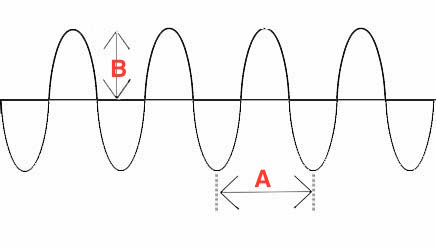
Which of the following do not necessarily describe a wave?
c
frequency ν
wavelength λ
amplitude
λ and ν are:
inversely proportional
directly proportional
they are proportional in 10 different ways
they are proportional in 20 differentways
A ______________ is the minimum amount of energy that can be gained or lost by an atom.
wavelength
frequency
quantum
electron
what is the speed of light ?
3 x10⁸ m/s
3 x10⁸ km/s
30 x108 m/s
1000
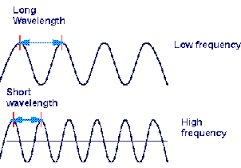
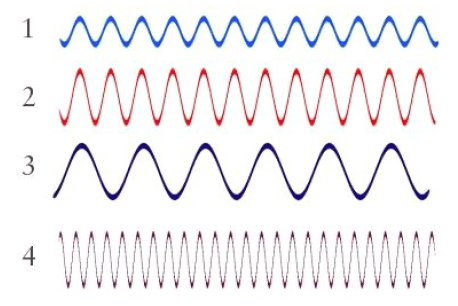
Wavelength and Frequency are related in that...
they are always the same
when one increases, the other decreases (inversely proportional)
there is no correlation
they both vary in an irregular pattern
which of the following is correct equation
E photon = h + v2
E photon = b x v
E photon = h x v
E photon = h ÷ v
The frequency of violet light is 7.5x10¹⁴ Hz. What is its wavelength?
4.0x10⁻⁷ m
4.0x10⁷ m
2.25x10²³m
2.25x10²³ Hz
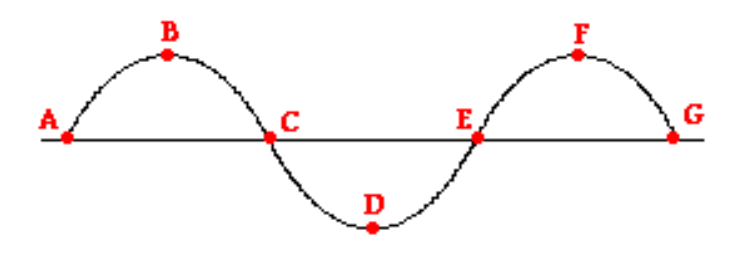
Which letter(s) represent the wavelength?
A & B
B & D
B & F
C & E
4.10 x 10⁻¹² m. What is the frequency?
Red light has a wavelength of 675 x 10-9 m. What is its frequency?
2.03x10¹¹ m
4.44x10¹⁴ Hz
4.44x10¹⁴ nm
2.03x10¹¹ Hz
What is Planck's Constant?
6.63x10⁻³⁴ Js
6.63x10⁻³⁴ J/s
3.0x10⁸ ms
3.0x10⁸ m/s

Which type of wave or ray on the electromagnetic spectrum has the highest energy?
radio
microwaves
ultraviolet
gamma rasys

Which type of wave or ray on the electromagnetic spectrum has the longest wavelength?
radio
microwaves
ultraviolet
gamma rays

Which type of wave or ray has a frequency of 5.00 x 10¹² Hz?
microwave
infrared
visible light
ultraviolet
Which was NOT a failing of Rutherford's model of the atom?
He was the first to include a nucleus
He didn't explain how electrons were arranged around the nucleus
He didn't say why electrons weren't pulled into the nucleus
He didn't show that chemical behavior and electrons were related
Which color has the longest waves?
green
blue
red
yellow
Which color has the highest energy ?
green
violet
red
orange
The particle model treats light as being comprised of:
photons
electrons
neutrons
electricity
The contribution of Planck is...
Light is both a wave and a particle (explanation of the photoelectric effect)
Matter is both a particle and a wave
Credited with inventing the periodic table
Energy comes in packets called quanta
The contribution of Einstein is...
Light is both a wave and a particle (explanation of the photoelectric effect)
Uncertainty Principle: You can’t know both
the location and velocity of a particle exactly.
The contribution of Bohr is...
Wave functions, orbitals, quantum mechanical model of the atom
His model of the atom, electrons move in fixed orbits around the nucleus like planets around the sun, energy levels are quantized.
Credited with inventing the periodic table
The contribution of DeBroglie is...
Matter is both a particle and a wave
Light is both a wave and a particle (explanation of the photoelectric effect)
Wave functions, orbitals, quantum mechanical model of the atom
The contribution of Heisenberg is...
His model of the atom, electrons move in fixed orbits around the nucleus like planets around the sun, energy levels are quantized.
Uncertainty Principle: You can’t know both
the location and velocity of a particle exactly.
The contribution of Schrodinger is...
Energy comes in packets called quanta
Uncertainty Principle: You can’t know both
the location and velocity of a particle exactly.
The contribution of Mendeleev is....
Uncertainty Principle: You can’t know both
the location and velocity of a particle exactly.
Light is both a wave and a particle (explanation of the photoelectric effect)
Credited with inventing the periodic table
Bohr model of the atom, electrons move in fixed orbits around the nucleus like planets around the sun, energy levels are quantized.
What must happen in order for an electron to change from the ground state to an excited state?
energy released
energy absorbed
radiation emitted
electron moves from higher to lower energy level
What is required for an electron to move from an excited state to a ground state?
absorption of energy
release of visible light
an increase in energy
emission of electromagnetic radiation
C (the speed of light) =
frequency/wavelength
frequency x wavelength
frequency + wavelength
frequency - wavelength
Frequency of electromagnetic radiation is measured in waves/second. What is the unit for frequency?
quanta
nanometers
Hertz
Joules
What was the problem with Bohr's model?
It was too small.
It did not apply to atoms with more than one electron.
It didn't match the line-emission spectrum for hydrogen.
It was too large.
A three-dimensional region around the nucleus where there is a high probability of finding electrons is called
an orbital
a photon
an orbit
a line-emission spectrum

