
 Worksheets
Graphing Logs Quiz Review
Total questions: 42
Worksheet time: 2hrs 47mins
Without technology, determine which of the following is an increasing function. Check all that apply.
y = log2 (x - 4)
y = log3 (x+3)
y = -2log5 (x-1)
y = 1/2 log x + 4
Which of the following has a domain of (2, ∞) ?
y = log2 x
y = log3 (x+2)
y = log4 (x - 2)
y = log7 x - 2
Which of the following is the sketch of the graph of y = -log3 (x+5) ?


Which of the following are not allowed bases, b, in a logarithm? logb A = P Check all that you believe aren't allowed.
1
0
fractions
decimals
whole numbers

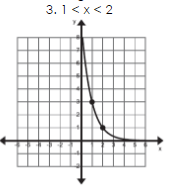
Classify the following graph.
(If you move your mouse over the graph, the image will pop up larger.)
Exponential Growth
Exponential Decay
Logarithmic Growth
Logarithmic Decay
f(x)=log4x Identify ALL of the true characteristics about the function. (There are multiple correct statements!)
As the x-values increase, the values of the function decrease.
As the x-values increase, the values of the function increase.
The x-intercept is (1,0).
The x-intercept is (4,0).
There is no y-intercept.
What is the equation of the asymptote on the graph of y=log5(x+3)+5 ?
x = -3
x=5
y= -3
y=5
Compared to the graph of y=log2x , the asymptote of y=log2x+1 will translate...
right one to x = 1
left one to x = -1
no observable translation, and will remain x = 0
Which of the following has a vertical asymptote at x=4
y=2x−4
y=log2(x−4)
y=2x+4
y=log2(x+4)
Select the function with a domain of (− ∞,−1) .
y=log2(x+1)
y=log2(x−1)
y=log2(−x+1)
y=log2(−x−1)
What are the coordinates of the x-intercept of y=log7(x-2)?
(3, 0)
(-2, 0)
(2, 0)
(1, 0)


Exponential Growth
Exponential Decay
Logarithmic Growth
Logarithmic Decay

Exponential Growth
Exponential Decay
Logarithmic Decay
Logarithmic Growth

Exponential Growth
Exponential Decay
Logarithmic Decay
Logarithmic Growth

What equation matches the graph?
f(x) = 3x
f(x) = (⅓)x
f(x) = log₃(x)
log31(x)

Which of the following transformations would take f(x)= lnx to g(x)= −ln(x+5)
reflection over the x-axis
reflection over the y-axis
translate right 5
translate up 5
translate left 5


What is the correct transformed equation for the graph?
y = log(x - 4)
y = log(x) - 4
y = log(x + 4)
y = log(x) + 4
Which graph best represents the following logarithmic function?
y=log4x


f(x) = ln(x)
R: y > 0
Range: all real numbers
Range: all real numbers
Range: y < 0
What is the rate of change (-2,6) and (1,1)?
35
−35
53
−53

Find the rate of change of Pete's height from 3 to 5 years.
8
2
4
82
What is the formula for rate of change?


Find the average rate of change of f(x)= 2log2x+5 from 1 to 2.
1
1/2
2
-2
What is the base and x-intercept in the equation of the graph: y = log3x
Base is 3; x-intercept: (1, 0)
Base is 3; x-intercept is (0, 1)
Base is 1; x intercept: (0, 3)
Base is 1; x-intercept is (3, 0)

f(x)=log5(x+4) - 2
Describe the asymptote
Horizontal Asymptote x = -4
Vertical Asymptote x = -4
Horizontal Asymptote x = 4
Vertical Asymptote x = 4

f(x)=2ln(x+2)
Describe the transformation
Vertical Stretch by 2, translation 2 units to the left
Vertical Compression by 2, translation 2 units to the left
Vertical Stretch by 2, translation 2 units to the right
Vertical Compression by 2, translation 2 units to the right

