wayground logo

Free Printable Worksheets

Font size

S
M
L
XL
Worksheets

How much do you know about Civics?

Total questions: 60

Worksheet time: 41mins

Name
Class
Date
1.
The Supreme Court is the highest court that is found under this Branch of the US Government
a)
Legislative
b)
Judicial
c)
Executive
d)
Congressional
2.
You are automatically a citizen if you are born in the USA.
a)
False
b)
True
3.

What age can you start to vote?

a)

20

b)

12

c)

18

d)

30

4.
How many Amendments does the U.S have today?
a)
27
b)
24
c)
22
d)
32
5.
2nd amendment entitles you the freedom of...
a)
Right to refuse to hold soldiers
b)
Freedom of Speach
c)
Right to bear arms
d)
Right to a speedy trial 
6.
What makes up the Bill of Rights?
a)
1-5 amendments
b)
10-20 amendments
c)
1-15 amdendments
d)
1-10 amendments
7.
the study of the rights and duties of citizens
a)
civics
b)
geography
c)
law
d)
geology
8.
The president's main job is to 
a)
carry out laws
b)
declare war
c)
make laws
d)
pardon criminals
9.
Which of the following protects the right of Americans to publish newspapers, magazines, and books?
a)
states' rights
b)
freedom of religion
c)
freedom of the press
d)
separation of powers
10.
Every American citizen gets to enjoy the rights guaranteed by the ______________________.
a)
Declaration of Independence
b)
U.S. Constitution
c)
Emancipation Proclamation
d)
Articles of Confederation
11.
Which is not an example of a civic responsibility?
a)
paying taxes
b)
going to church
c)
obeying the law
d)
serving on juries
12.
In a democracy where does its power come from?
a)
the president
b)
the people
c)
the legislators
d)
the courts
13.
What is one requirement in order to become a citizen  of the United States?
a)
Be related to a US citizen.
b)
Be able to pass a citizenship test
c)
Be able to pass a health exam
d)
Be prepare to join the military
14.
The 15th, 19th, and 26th Amendments to the U.S. Constitution are all related to ________.
a)
terrorism
b)
suffrage
c)
federalism
d)
integration
15.
The Governor has authority at the state level and is found in which branch of the government?
a)
Judicial
b)
Monarchy
c)
Legislative
d)
Executive
16.
The List of Grievances were the part of the Declaration that
a)
detailed the colonists' complaints with King George.
b)
listed a man's natural rights.
c)
introduced the Declaration.
d)
concluded the Declaration, declaring America a free country.
17.

What did the Colonists do after the Stamp Act?

a)

Boycott British goods

b)

Made their own goods

c)

Decided they didn't need goods

d)

Stopped paying all of their taxes

18.

What are unalienable rights?

a)

Rights that government cannot take away

b)

Rights that government takes away

c)

rights for aliens

d)

Government is needed to promote equality

19.

Forced colonists to give shelter (house) to British soldiers

a)

Sugar Act

b)

Townshend Act

c)

Quartering Act

d)

Housing Act

20.
What are the three inalienable rights that all people have?
a)
Food, Shelter, and Clothing
b)
Life, Liberty and Death
c)
Life, Liberty and the Pursuit of Happiness
21.
What two acts did the British Parliament make that put very high taxes on paper and sugar?
a)
Stamp Act and Sugar Act 
b)
Tea Act and Trade Act
c)
Cookie Act and Cake Act
d)
Letter Act and Molasses Act
22.
According to the Declaration of Independence, the main purpose of a government is to-
a)
ensure the stability of the economy
b)
protect the rights of the individual
c)
provide strong military leadership
d)
protect a nation from foreign invasions
23.
According to the Declaration of Independence, from where does government get the power to achieve its purpose?
a)
it is endowed by nature
b)
from the permission of the king
c)
from the authority of parliament
d)
from the consent of the governed
24.
Which of the following was the main purpose for writing the Declaration of Independence?
a)
convince Great Britain to stop mercantilism in North America
b)
force Spain to support a Revolutionary War against England
c)
proclaim war on Great Britain due to lack of economic rights
d)
state the colonists' reasons for separating from Great Britain
25.
The principles of government that Thomas Jefferson included in the Declaration of Independence were most influenced by which of the following people?
a)
John Locke
b)
Ben Franklin
c)
King George III
d)
Charles de Montesquieu
26.
According to the Declaration of Independence, when government becomes oppressive of the people's rights, the people have the right to...
a)
ignore laws that people don't like or agree with
b)
meet in secret congresses to discuss solutions
c)
call for elections to choose new rulers
d)
alter or abolish it and institute a new government
27.
What event completes the timeline?1. First Continental Congress2. Petition to King is sent3. ________________________4. Second Continental Congress
a)
the Boston Massacre defendants are tried
b)
the Battles of Lexington and Concord
c)
the Proclamation of 1763 bands westward settlement
d)
the Stamp Act repealed
28.
Who is the primary author of the Declaration of Independence?
a)
John Adams
b)
John Locke
c)
Thomas Jefferson
d)
Ben Franklin
29.
Tyranny is best described by which of the following?
a)
A government where all the power is in the hands of one person.
b)
A government headed by a king or a queen.
c)
A government that abuses its power.
d)
A government where some citizens are not allowed to vote.
30.
Which monarch ruled when the colonies declared their independence?
a)
George III
b)
Elizabeth I
c)
Henry VIII
d)
James VI
31.
A queen rules a nation.  When she dies, the throne will pass to her daughter.  What kind of government does this nation have?
a)
a monarchy
b)
a theocracy
c)
a dictatorship
d)
a representative democracy
32.
A military leader seizes control of a government during a revolution.  He has complete control and kills anyone who opposes him.  What kind of government does this nation have?
a)
a monarchy
b)
a theocracy
c)
a dictatorship
d)
an oligarchy
33.
Three military leaders take over a nation.  They make all the rules and do not allow any discussion.  What kind of government does this nation have?
a)
an oligarchy
b)
anarchy
c)
a theocracy
d)
a dictatorship
34.
Some nations in the Middle East have Islam as the state religion.  Their citizens must practice this religion.  What kind of government do these nations have?
a)
a monarchy
b)
a theocracy
c)
a dictatorship
d)
an oligarchy
35.
People overthrow their government, but no ruler takes charge.  Without leadership, the nation is in chaos.  What is this situation called?
a)
autocracy
b)
oppression
c)
anarchy
d)
revolution
36.
Anna lives in a direct democracy.  What does that mean?
a)
She will be brought up on charges if she does not vote.
b)
As a citizen, she is a member of the government and sits in Congress.
c)
She votes for representatives who decide on the issues and laws.
d)
She personally votes on every issue and law.
37.
Brady lives in a representative democracy.  What does that mean?
a)
He will be brought up on charges if he does not vote.
b)
As a citizen, he is a member of the government and sits in Congress.
c)
He votes for representatives who decide on the issues and laws.
d)
He personally votes on every issue and law.
38.
The king or queen has complete or total power among his or her people.
a)
Absolute Monarchy
b)
Constitutional Monarchy
39.
The king or queen has power that is limited by a constitution and parliament.
a)
Absolute Monarchy
b)
Constitutional Monarchy
40.
What form of government is the United States?
a)
Direct Democracy
b)
Representative Democracy
41.

How many Articles are there in the Constitution?

a)

4

b)

7

c)

14

d)

27

42.

Ratification means...

a)

To Approve

b)

To Deny

c)

To Block

d)

To Allow

43.

What was the 1st government in America called?

a)

The Declaration of Independence

b)

The Constitution

c)

The Articles of Confederation

44.

Which branch is in charge of making the laws?

a)

Legislative

b)

Executive

c)

Judicial

45.

Which branch is in charge of enforcing the laws?

a)

Legislative

b)

Executive

c)

Judicial

46.
What are the first three words of the Constitution?
a)
In order to
b)
We the people
c)
Once upon a
d)
The United States
47.
What term refers to the system that gives each government branch some power over the others?
a)
Articles of Confederation
b)
Ratification
c)
Federalism
d)
Checks and Balances
48.
What is the name for a change or addition to the Constitution?
a)
Federalism
b)
Amendment
c)
Ratification
d)
Veto
49.
The first 10 Amendments are called...
a)
The Amendments. 
b)
The Bill of Rights
c)
Laws
d)
Important Information
50.
What was the date that the Declaration of Independence was signed?
a)
July 4, 1776
b)
July 2, 1776
c)
July 4, 1787
d)
July 2, 1775
51.
What is the best definition of Civics?
a)
the study of the rights and duties of citizenship.
b)
the study of the rights and duties of the clergy.
c)
the study of the rights and duties of media.
d)
the study of the rights and duties of warfare.
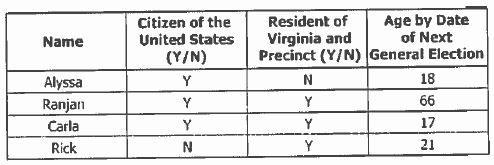
52.
Which person is eligible to register to vote in the state of Virginia?
a)
Alyssa
b)
Ranjan
c)
Carla
d)
Rick
53.
Which of the following protects the right of Americans to publish newspapers, magazines, and books?
a)
states' rights
b)
freedom of religion
c)
freedom of the press
d)
separation of powers
54.
Every American citizen gets to enjoy the rights guaranteed by the ______________________.
a)
Declaration of Independence
b)
U.S. Constitution
c)
Emancipation Proclamation
d)
Articles of Confederation
55.
The first 10 Amendments in the US Constitution are known as the ______________________.
a)
Halifax Resolves
b)
Bill of Rights
c)
Jim Crow laws
d)
Suffrage Amendments
56.
Citizens in communist societies are expected to actively participate in government.
a)
TRUE
b)
FALSE
57.
In a democracy where does its power come from?
a)
the president
b)
the people
c)
the legislators
d)
the courts
58.
Being an informed citizen does not have an impact on how government works.
a)
TRUE
b)
FALSE
59.
What is the process of becoming a U.S. citizen called?
a)
Immigration
b)
Assimilation
c)
Urbanization
d)
Naturalization
60.
The 15th, 19th, and 26th Amendments to the U.S. Constitution are all related to ________.
a)
terrorism
b)
suffrage
c)
federalism
d)
integration