
 Worksheets
Review: LUG and UCM
Total questions: 81
Worksheet time: 2hrs 33mins
Newton's Universal Law of Gravitation explained about...
Gravitational force
Magnetic force
Centripetal force
What is the value of gravitation constant...
3×10⁸ ms−1
6.67 ×10⁻¹¹ Nm2kg−2
6.63×10⁻⁹ Nm2
what is the factors that affect gravitational force
mass, distance
speed, distance
momentum, mass
what is the relationship between mass of object and distance between objects..
mass increase, gravitational force increase
mass increase, gravitational force decrease
mass decrease, gravitational force increase

Newton's Law of Universal Gravitation affects
All objects with mass in the known universe
All objects and empty space in the known universe
Thoughts and Ideas
Only things that are the color red
If one of two objects increases its mass, it _________ the gravitational pull between the two objects
increases
decreases
has no effect on
eliminates
If one of two objects decreases its mass, it _________ the gravitational pull between the two objects
increases
decreases
has no effect on
eliminates
If two objects increase their distance, it _________ the gravitational pull between the two objects
increases
decreases
has no effect on
eliminates
If two objects decreases their distance, it _________ the gravitational pull between the two objects
increases
decreases
has no effect on
eliminates
The gravitational pull is __________ proportional to the mass of object 2
conversely
directly
phonetically
inversely
The gravitational pull is __________ proportional to the distance between two objects
conversely
directly
pyrotechnically
inversely
A direct relationship between two parts of an equation means:
One part doesn't beat around the bush when it wants to address something sensitive between the two
One part tells the other where to stand, how to use their body language, and deliver lines for a scene to elicit the proper reaction from audiences
If one increases in value, the other decreases in value
If one increases in value, the other increases in value
A inversely proportional relationship between two parts of an equation means:
One part grabs the top part of a halfpipe and stands upside down on a skateboard or snowboard
One part is quiet, kinda keeps to themselves, isn't really outgoing to socialize with others, but is okay with it all and is more comfortable in smaller group settings.
If one increases in value, the other decreases in value
If one increases in value, the other increases in value
Every object with mass is gravitationally attracted to each other object with mass in the entire universe.
True
False
Which is the formula for Newton's Law of Universal Gravitation?
F = G * m1m2 / r
F = G * m1m2 / r2
F = G * m1m2 / 2r
F = m1m2 / 2r


The Net Force between the two spheres is 40N.
Scenario: The distance between the two masses is then halved. How much will the numerator be divided by?
2d2=4d
.5d2= .25d
2d
.5d
If I double the distance between two objects, what happens to their gravitational Force?
4x bigger
4x smaller
2x bigger
2x smaller
If you double the mass of an object, how will the gravity force it exerts on other objects be affected?
Gravity force will double.
Gravity force will be 1/4 as much.
Gravity force will be 1/2 as much.
Gravity force will not be affected.
Distance and Gravitational Force are ___ proportional.
Directly
Inversely
Not
Mass and Gravitational Force are ___ proportional.
Directly
Inversely
Not
Which of the following would be a proper setup for this problem: A 60 kg person is standing on earth's surface (radius = 6.4x10⁶ m). The mass of earth is 6x1024 kg.
(6.4x10⁶)2(6.67x10⁻¹¹)(60)(6x1024)
(6x1024)2(6.67x10⁻¹¹)(60)(6.4x10⁶)
(6.4x10⁶)(6.67x10⁻¹¹)(60)(6x1024)
(6.4x10⁶)2(60)(6x1024)
If two objects are brought closer to 1/2 the original distance, by what factor would the gravity force between them change?
1/2 as much
2 x as much
4 x as much
1/4 as much
If two objects are moved to a distance 3 x further than they were before. How would the gravity force between them change?
It would be 3x larger.
It would be 1/3 as large
It would be 1/9 as large
It would be 9x larger
A planet and a moon have a gravity force between them of Fg. If the planet was 3x more massive and they were moved 3x further apart. How much gravity force would there be between them?
3 Fg
1/3 Fg
9 Fg
1/9 Fg
1/27 Fg

A curved groove is place on the top of a level table as shown in the diagram. A ball is pushed in the groove at P so that it leaves at Q. Which picture shows how the ball will move when it leaves the groove at Q?


At the instant shown in the diagram, the car's centripetal acceleration is directed-
toward E
toward N
toward W
clockwise

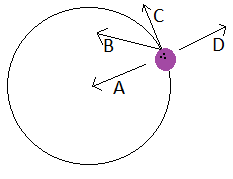
At the position shown in the diagram, which arrow indicates the direction the instantaneous (tangential) velocity of the cart?
A
B
C
D


The drum of a washing machine rotates 600 times in 1 minute. What is the frequency of the drum?
600 Hz
10 Hz
0.1 Hz
0.002 Hz
An object is moving with uniform speed in a counterclockwise, horizontal circle. Which of the following images correctly depicts the force vector and velocity vector at a point in time.


Which has greater angular velocity, a horse near the outside rail of a merry-go-round or a horse near the inside rail?
The inside horse
The outside horse
Neither - they both have the same angular velocity

Stars originate as large bodies of slowly rotating gas. Because of gravity, these clumps of gas slowly decrease in size. What happens to the angular speed of the star as it shrinks?
It rotates faster.
It rotates slower.
It starts to accelerate in the forward direction.
The rotation rate stays the same.
Jack and Rose are holding hands and spinning in a circle as fast as they can. If Rose lets go by accident, what can you say about Jack's motion?
it will be in a straight line opposite of Rose
it will be in a straight line in the direction of the instantaneous velocity
it will be in a curved path in the direction that he was originally going
Rose said she would never let go... she lied
The time required for one complete revolution is:
torque
frequency
period
rotational kinetic energy
Categorize something that is measured in radians per second
Linear Distance
Angular Distance
Linear Speed
Angular Speed
2 cars are moving at the speed of 22 m/s.
the radius of the 1st vehicle's tire is 22 cm
and of the 2nd vehicle's tires is 30 cm. which tire has a greater angular speed?
the 1st car
the 2nd car
A bug on a turning phonograph record will make more turns per minute if it is located toward the center of the record.
True
False

There are 360 ___________ in one revolution of a circle.
Gradiens
Radians
Degrees
None of the Above
The angular velocity is represented by the Greek letter ____.
ω
θ
α
σ
The movement of a body or body part in a circular path about an axis of rotation can be described as:
Angular Motion
Angular Velocity
Moment of Inertia
Torque
The unit of angular velocity is
m/s
m/s²
rad/s
rad/s²

An object is moving with uniform speed in a horizontal, counterclockwise circle. At location B, which way does the acceleration vector point?
Left
Right
Up
Down
An object is moving with uniform speed in a horizontal, counterclockwise circle. At location A, which way does the velocity vector point?
Left
Right
Up
Down
An object is moving with uniform speed in a horizontal, counterclockwise circle. At location D, which way does the centripetal force vector point?
Left
Right
Up
Down
An object is moving with uniform speed in a counterclockwise, horizontal circle. Which of the following images correctly depicts the force vector and velocity vector at a point in time.

An object moving is moving with uniform speed in a horizontal counterclockwise circle. At the location depicted, the centripetal force stops. Which path will the object follow?


Two students (A and B) are on a merry-go round (depicted). Which student has the greater period of revolution?
A
B
Both are equal
Cannot be determined
Two students (A and B) are on a merry-go round (depicted). Which student has a greater tangential speed?
A
B
Both are equal
Cannot be determined
Two students (A and B) are on a merry-go round (depicted). Which student has a greater centripetal acceleration?
A
B
Both are equal
Cannot be determined

A racecar is driving with a constant speed around a track (depicted). At what location will the car have the greater centripetal force acting on it?
A
C
D
F
A racecar is driving with a constant speed around a track (depicted). At what location will the car have the least centripetal force acting on it?
b
C
D
F
A test car moves at a constant speed around a circular track. If the car is 75.0 m from the track’s center and has a centripetal acceleration of 19.6 m/s2, what is the tangential speed?
1470 m/s
3.83
38.3
19.6
A student sits on a merry-go-round that has a period of revolution of 45.0 seconds. If the student is on a carousel horse that is 4.50 meters from the center, what is the student’s centripetal acceleration?
9.80 m/s2
1.23 m/s2
0.0532 m/s2
0.0876 m/s2
A truck (m = 3500 kg) drives around a curve in the road (r = 20.0 m) with a constant speed of 12.0 m/s. Determine the centripetal force acting on the truck.
34300 N
70000 N
25200 N
5830 N
A fighter pilot (m = 90.0 kg) flies through a vertical loop (r = 9500 m) at a speed of 285 m/s. Determine the centripetal force acting on the pilot.
770 N
882 N
25700 N
8.55 N
A second fighter pilot (m = 90.0 kg) flies through a vertical loop (r = 5500 m) at a speed of 285 m/s. Determine the range of G-force acting on the pilot.
0-1 G's
1-3 G's
3-6 G's
>6 G's
A roller coaster ( m = 1000 kg) travels through the bottom of a vertical loop (r = 10.0 m) with a speed of 16.0 m/s. Determine the magnitude of the normal force acting on the roller coaster.
9800 N
15500 N
25600 N
35400 N
A roller coaster ( m = 1000 kg) travels through the top of a vertical loop (r = 15.0 m) with a speed of 13.0 m/s. Determine the magnitude of the normal force acting on the roller coaster.
9800 N
1470 N
5340 N
35400 N

