
 Worksheets
Chapter 14 Section 1 states of matter and phase changes
Total questions: 46
Worksheet time: 23mins
In a solid the molecules are
far apart
compact
have some space between them
are ionized
In a liquid the molecules are
far apart
compact
have some space between them
are ionized
In a gas the molecules are
far apart
compact
have some space between them
are ionized
The attraction between molecules in a gas is
high
low
medium
The attraction between molecules in a liquid is
high
medium
low
The attraction between molecules in a solid is
high
medium
low
The energy in a solid is
high
medium
low
The energy in a liquid is
high
medium
low
The energy in a gas is
high
medium
low
When a substance goes from a solid to a gas
melting
vaporization
sublimation
freezing
When a substance goes from a gas to a solid
freezing
sublimation
condensing
deposition
When energy is lost the process is
Exothermic
Endothermic
When energy is added the process is
exothermic
endothermic
Melting is
exothermic
endothermic
Vaporization is
exothermic
endothermic
Sublimation is
exothermic
endothermic
Deposition is
exothermic
endothermic
Condensation is
exothermic
endothermic
Freezing is
exothermic
endothermic
During a phase change
temperature increases
temperature is constant
temperature decreases
Temperature is
the measure of kinetic energy
the measure of heat energy
the measure of potential energy
Temperature changes during a
Single Phase or State
Phase Change
Both a Single Phase or Phase Change
In an endothermic process during a phase change
temperature remains constant
temperature increases
temperature decreases
In an exothermic process during a phase change
temperature decreases
temperature increases
temperature remains constant
kinetic energy decreases
During a single phase when looking at an exothermic process
potential energy decreases
kinetic energy increases
potential energy is consant
kinetic energy decreases
During a single phase when looking at an endothermic process
temperature increases
kinetic energy is constant
temperature decreases
kinetic energy decreases

What is the condensation point (temperature)?
37 oC
120 oC
60 oC
140 oC

What is the freezing point (temperature)?
37 oC
120 oC
60 oC
140 oC

What letters show a change in kinetic energy?
B, D
A, C, E
A, B
D, E

What letters show a change in potential energy?
B, D
A, C, E
C
A, B
When moving from a solid to liquid to gas the process is
exothermic
endothermic
During an exothermic reaction when a substance is in the solid state kinetic energy is ______.
the potential energy is increasing
the kinetic energy is decreasing
kinetic energy

If the image shows an endothermic process, at point C
temperature decreases
kinetic energy is constant
kinetic energy decreases
kinetic energy increases
During a phase change when energy is added temperature
changes
is constant
During a single phase when energy is added temperature is
constant
changing

What is the vaporization point of the substance?
280 K
340 K
175 K
310 K

What phase is the substance pictured in?
solid
liquid
gas

What state of matter is the picture shown?
Solid
Liquid
Gas
the temperature scale on which water freezes at 0 and boils at 100
Kelvin scale
conduction
Fahrenheit scale
Celsius scale
Select the state changes that latent heat of fusion applies to.
melting
evaporating
freezing
condensing
sublimation
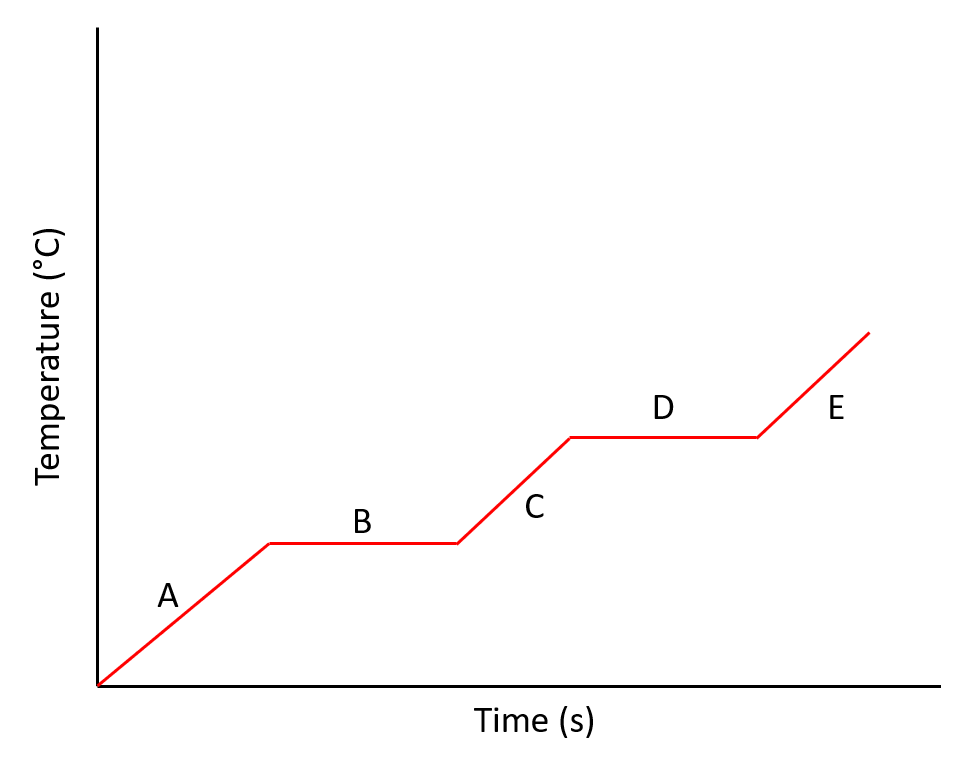
Why are lines B and D flat?
The ice is melting
The ice is freezing
All of the thermal energy is used to break the bonds
They stopped the stopwatch
They stopped heating the ice.
Select the state changes that latent heat of vaporisation applies to.
melting
evaporating
freezing
condensing
sublimation
specific latent heat of vaporisation is
the amount of heat required to change 1 kg of the substance from the solid to liquid phase without change in temperature
the amount of heat required to change 1 kg of the substance from the liquid to gaseous phase without change in temperature
the amount of heat required to change the temperature 1 kg of the substance by 1 degree Celcius
Plasma can be found in which of the following
Auroras
Lightening
LED light bulbs
Stars
Moons
A plasma can be made in a laboratory by
cooling a gas to very low temperatures
cooling a gas and reducing the pressure
heating a gas to extremely hot temperatures
heating a liquid to the point it turns into a gas

