
 Worksheets
Earth and Space Patterns
Total questions: 107
Worksheet time: 1hrs 25mins

Dee measured the the temperature and humidity every afternoon for four days. She recorded the results in the table below.
Which day could Dee conclude was the most hot and humid?
Monday
Wednesday
Tuesday
Thursday


What is weather?
Can change within a few minutes or hours!
Takes a very long time to change!

Chicago received more snow this decade(ten years) than in past decades(ten years).
Weather
Climate

The picture shows how a puddle changes during the day.
What process is taking place?
condensation
precipitation
evaporation
runoff


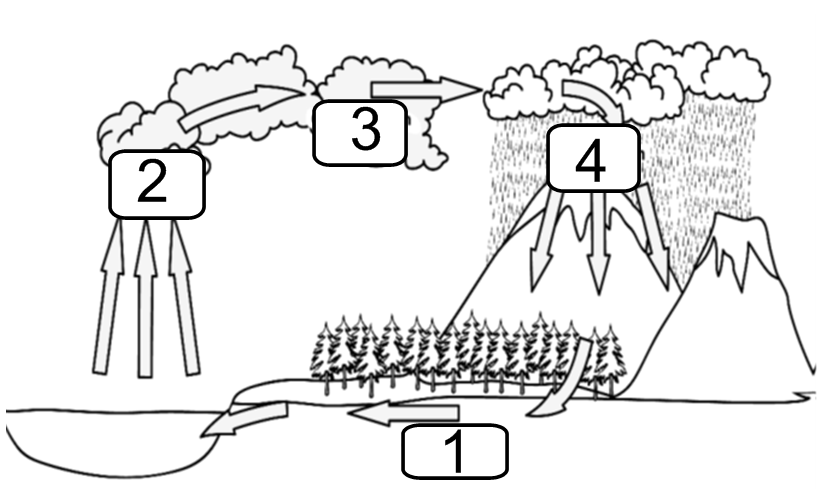
The diagram below shows the water cycle.
At which point does precipitation happen?
1
2
3
4
What is climate?
Can change within a few minutes or hours!
Takes a very long time to change!

The table below describes some weather conditions at two different weather stations.
Which statement is correct?
Station 1 is experiencing more rain than station 2.
Both stations are experiencing stronger winds than station 2.
Both stations are experiencing freezing conditions.
Both stations have wind traveling in the same direction.


We got 3 inches of rain yesterday.
Weather
Climate

Over the past 30 years, May has been the rainiest month.
Weather
Climate


Today is much colder than yesterday!
Weather
Climate
The daily forecast for Charlotte, North Carolina, is partly cloudy with a 30% chance of rain.
Weather
Climate
Arizona is dry most of the time.
Weather
Climate
It was cloudy and rainy all weekend.
Weather
Climate
What is the state of the atmosphere at a given time and place called?
climate
weather
circulation
altitude
In 2005, Hurricane Katrina hit the Gulf Coast.
Weather
Climate
When looking at the precipitation in the desert over time, we noticed that the desert is very dry.
Weather
Climate
Precipitation includes
rains, snow, and air
frost, clouds, and blizzards
snow, sleet, and hail
rain, wind, and snow
Every year when timmy goes to Colorado for Christmas, there is plenty of snow for skiing.
Weather
Climate
Tara is studying the water cycle. She knows that in order for evaporation to happen, there needs to be a source of energy that generates heat. What is the main source of energy that powers the water cycle?
sun
oceans
clouds
water vapor
Mrs. Patton's class wants to measure how quickly water evaporates. They measure the level of some water in a glass for 4 days and record the levels. Which graph shows that the water evaporated over time?


sunset - west
sunset west
sunset - south
sunset - east


How many planets do we have in our solar system?
9
8
7
6
The ______ is the center of our solar system.
Sky
Earth
Sun
Moon
_______ are balls of gases made up of mainly hydrogen and helium.
Moons
Stars
Planets
Asteroids
Areas of the photosphere that appear to be darker because they have a lower temperature.
Sunspots
Solar flare
Corona
An explosive eruption of waves and particles from the sun's surface into space.
Sun
Asteroids
Solar flare
A natural object that orbits a body bigger than itself.
Planet
Star
Comet
Moon
What planet is closest to the sun?
Mars
Earth
Venus
Mercury
What are the four inner planets?
Earth, Uranus, Mercury, Venus
Mercury Venus Earth Saturn
Mars, Earth , Mercury, Venus
Mars, Earth, Neptune, Mercury
What are the outer planets?
Jupiter, Saturn, Earth, Neptune
Saturn, Neptune, Mars, Uranus
Uranus, Saturn, Neptune, Jupiter
Mercury, Venus, Earth, Mars
What is at the center of our solar system?
asteroid belt
Earth
sun
moon
Which planets are mostly made of gases?
terrestrial
gas giants
inner planets


The asteroid belt is located between which 2 planets?
Mercury and Venus
Jupiter and Saturn
Uranus and Neptune
Mars and Jupiter
When an object moves closer to a light source, its shadow...
Gets smaller
Gets bigger
Changes shape
Stays the same size
When the Sun is behind you, your shadow is ...
behind you
in front of you
at the side of you
not there
When the sun gets higher in the sky, shadows get ______.
longer
gone
shorter
darker
1. What is our main source of light?
sun
moon
trees
Shadows are shortest at this time of day:
morning
noon
afternoon
evening
In what ways does a shadow change throughout the day?
Check all of the correct answers.
length
color
orientation (direction)
size

If the sun is setting in the western part of the sky, in which direction will we find the shadow of an object?
north
south
east
west

Which picture shows the shadow of a pole at noon?




What is the role of the sun in the water cycle?
provide heat energy for evaporation
provide heat energy for condensation
dry out the soil for runoff to occur
provide thermal energy for accumulation
What is it called when water changes from a liquid to a water vapor?
EVAPORATION
PRECIPITATION
TRANSPIRATION


The Earth, Sun, and Moon have gravity.
True
False
Out of the Earth, Sun, and Moon, the Earth has the most gravity of the three.
True
False
Out of the Earth, Sun, and Moon, the Sun has the most gravity of the three.
True
False
The Earth and Moon are both made of rock.
True
False
The Sun is made of gas.
True
False
The sun is composed mainly of-
Rocky Soil
Hot Gases
Liquid Water
Mineral Crystals
The Earth's surface is constantly changed by weathering, erosion, and deposition. The Moon's surface has changed very little over thousands of years. What account for this difference between the Earth and the Moon?
The Moon rotates more slowly that the Earth
There is no wind or moving water on the Moon.
Earth has more gravitation pull than the Moon.
Only one side of the Moon is visible from Earth.
Students are using balls to show size relationships between the Earth, Moon, and the Sun. They used a basketball to represent the Sun and a tennis ball to represent the Earth. What would best represent the Moon in their model?
Soccer Ball
Volleyball
Baseball
Ping-pong ball
The Moon's surface has many more craters than the Earth's. What best explains the difference in the number of craters on the surface of the Moon and the Earth?
The Moon rarely gets impacted by meteorites.
The Earth's atmosphere protects it from impacts.
The Moon's gravity attracts more meteorites that Earth's.
The Earth rotates on its axis more quickly than the Moon.
Which of the following lists the Earth, Sun, and Moon in order of size, from largest to smallest?
Earth, Sun, Moon
Earth, Moon, Sun
Sun, Earth, Moon
Sun, Moon, Earth
While they are different in some ways, the Earth and the Moon share many of the same characteristics. Both the Earth and the Moon-
rotate on an axis
have a thick atmosphere
support living organisms
experience wind and storms
Which of the following is a characteristic of both the Earth and the Moon?
Atmosphere containing oxygen
Rocky surface covered with landforms
Flowing water in oceans and rivers
Fossil and fossil fuels under the surface
The Sun and the Earth share some similarities, including their-
size
shape
temperature
composition
Among the Earth, Sun, and Moon, what makes the Earth unique? Only the Earth-
can generate energy
lacks an atmosphere
is made mostly of rock
contains water in liquid form

At what time of the day will a shadow of a lamppost be the shortest?
8 AM
12 PM
6 PM
2 AM

The moon does not produce any light. Yet we can we see the moon in the sky. Why?
Moon reflecting Earth's light
Earth reflecting the Moon's light
Moon reflecting the Sun's light

What is the 6th planet from the Sun?
Mercury
Saturn
Earth
Venus

Which of the following are characteristics of the Sun?
Made up of gas
Solar flares
Star
All of the above
Which event best describes an example of evaporation?
Water flows downhill after a storm
Dark clouds form in the sky
Rain water oaks into the ground
Solar energy heats water at the ocean's surface.

