
NEW
Font size
 Worksheets
Earth Environmental Final Exam
Total questions: 63
Worksheet time: 16hrs 45mins
Fusion is the source of energy for stars. Besides hydrogen, which other element is MOST likely also common in stars?
nitrogen
helium
oxygen
uranium
How does the energy produced by the sun travel to Earth?
by the magnetic fields between the sun and Earth
by the convection of heat through particles in space
by the radiation of electromagnetic waves through space
by the process of conduction of heat between the sun and Earth
Which statement BEST explains an aspect of the differential heating of Earth’s surface by the Sun?
Photosynthesis in the oceans uses more solar energy than photosynthesis on land.
The atmosphere over the ocean is different than the atmosphere over land.
Photons interact differently with solids and liquids.
Liquids and solids absorb and store heat differently.
A new planet is discovered orbiting a single star. The planet has one moon. According to Kepler’s first law, what do scientists know about the orbit of the planet around the star?
The orbit is circular with the star at the center of the circle.
The orbit is elliptical with the star at one focus of the ellipse.
The planet takes 12 times longer to orbit the star than the moon takes to orbit the planet.
The planet orbits the star in a direction opposite to the direction of the moon’s orbit of the planet.
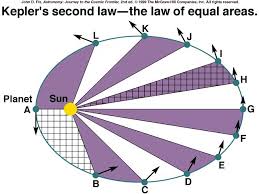

Why do planets orbit the Sun?
The Sun is the only celestial object that has a gravitational pull.
The Sun’s chemical composition makes it attract planets.
Only celestial bodies that emit light, like the Sun, can be at the center of an orbit.
The Sun is the most massive object in our solar system, so it exerts the greatest gravitational pull.
The temperate zones of the United States experience changing of seasons from winter to summer. Which is the reason for this annual change of seasons?
the distance of Earth from the Sun
the tilt of Earth’s axis, its rotation, and revolution
the rotation of Earth on its axis
the size and orbit of the Moon around Earth
A tide is the periodic rise and fall of the surface of the ocean. Several factors combine to cause the tides. Which has the greatest effect on the height of a tide?
the revolution of Earth around the Sun
the gravitational pull of the Sun
the tilt of Earth on its axis
the gravitational pull of the Moon
The Big Bang Theory suggests that our universe formed as the result of a huge explosion that sent all existing matter flying outward from a single point. The Big Bang Theory is supported by which of these observations?
All matter in the universe is composed of the same atoms.
All galaxies appear to be moving away from all other galaxies.
All stars in the universe are approximately the same age.
The universe is relatively the same temperature in all locations.

The diagram shows the tilt of Earth and the angle of arriving sunlight caused by this tilt. Which conclusion is supported by the diagram?
The equator has the greatest number of deserts.
The Northern Hemisphere is experiencing summer.
The tilt of the Earth is causing iceburgs to melt
The Southern Hemisphere is experiencing summer.
What is the importance of the Earth magnetic field?
protects us from the damage that the solar wind can cause
protects us from pollution
protects us from lasers
protects us from the damage that the moon can cause
Why is the ozone content of the stratosphere important to living organisms?
Ozone in the atmosphere prevents radiation of heat from Earth.
Ozone is necessary to create oxygen for living things.
Ozone absorbs ultraviolet radiation from the Sun.
Ozone absorbs infrared radiation from the Sun.
Which of these has been controlled in an attempt to reduce the depletion of ozone in Earth’s atmosphere?
use of chlorofluorocarbons (CFCs)
methods of radioactive waste storage
methods of filtering gasoline
use of mercury (Hg) compounds

The map shows a typical jet stream pattern in the United States during spring months. During one spring, the jet stream shifted southward, moving across Texas and northern Florida. How would weather in North Carolina that spring compare to that of a typical year?
warmer and wetter
warmer and drier
cooler and wetter
cooler and drier
In a High Pressure Systems colder air sinks towards the surface of the Earth. High Pressure systems bring clear, sunny weather.
What will MOST likely result if a high-pressure system remains in an area for a long period of time?
fog
drought
rain
tornado
Greenhouse gases in the atmosphere absorb heat from Earth’s surface and re-radiate some of it back to Earth. Which of these gases have the MOST significant impact on the temperature of Earth’s atmosphere?
nitrous oxide and neon
methane and argon
carbon dioxide and water vapor
hydrochloric acid and hydrogen

The arrows on the map represent the movement of air masses across North America.
Air mass 1 would MOST likely bring which weather conditions to a region?
warm and humid
warm and dry
cool and humid
cool and dry

A Low pressure system has moved into Texas. What type of weather is to be anticipated?
Dry
cold
Wet
Snow
What is the basis for the division of the layers of the atmosphere surrounding Earth?
changing temperature
changing weather patterns
changing amount of oxygen
changing composition of gases
What do greenhouse gases do?
Reflect the sun's energy
Block the sun's infrared radiation
Act as a thermal blanket for the Earth, absorbing heat and warming the surface
They help light up the moon at night
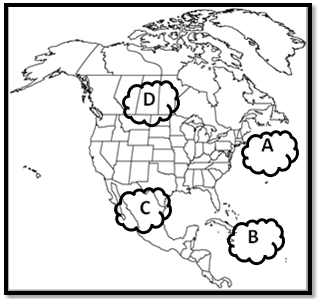
Which type of air would you find at air mass B?
Global warming affects sea levels. Which of these is a likely consequence if the trend of global warming continues in coming decades?
Melting glaciers will cause flooding of coastal towns and cities.
Melting glaciers will reduce lake sizes in mountainous regions.
Evaporation will increase land areas in U-shaped valleys, as fjords dry up.
Evaporation will enlarge land areas near coastlines, as sea levels drop.
Estuaries are marine environments located in areas where fresh water from rivers flow into the ocean. Estuaries are one of the most biologically productive ecosystems. Birds, fish, turtles and many other organisms inhabit these ecosystems. How will climate Change MOST likely cause changes to estuary habitats on a global scale?
decreases in powerful hurricanes
increases in earthquakes
increases in sea level
decreases in volcanic eruptions
It is hypothesized that in the next 200 years, the lowest land areas on Earth could be submerged beneath rising oceans. Which climate change would MOST likely cause this to occur?
decreased winds
the start of an ice age
increased desertification
global warming
Which is a possible consequence of global warming?
a decrease in temperature, causing longer growing seasons
an increase in the number of heat waves, causing droughts
an increase in the amount of coral reefs
As the amount of carbon dioxide in the atmosphere increases, which occurrence is MOST likely a long-term result?
The number of earthquakes will decrease.
The polar ice caps will melt.
Volcanoes will erupt more often.
Rainforests will be unable to support animal life.
Scientists use ice cores to help predict the impact of future atmospheric changes on climate. Which property of ice cores do these scientists use?
the stable products of completely decayed radioactive isotopes
the chemically inactive gases that are present at very cold temperatures
the composition of ancient materials trapped in air bubbles
the ratio by molecular mass of greenhouse compounds found in ancient waters
If we didn't have the 'greenhouse effect' at all, Earth would
have volcanoes erupting everywhere
Cool to a point where we could not live here
Catch on fire
blow up from being hit by meteors
Which of the following is contributing to an increase in carbon dioxide in the atmosphere?
deforestation
photosynthesis and respiration
oceans acidification
all of the above
Scientists classify climate according two factors:
Precipitation and humidity
Temperature and evaporation
Temperature and precipitation
Eruption of a large volcano on a tropical island releases ash and gases into the atmosphere. After the eruption, the air temperatures on the island cool temporarily before returning to normal. Which is the MOST likely reason for the temporary cooling of the island?
Large particles of ash blanket the ground surface
Fine particles of atmospheric dust block sunlight.
Carbon dioxide levels increase in the atmosphere.
Water vapor condenses and causes precipitation
What long-term impact could the destruction of large areas of forests have on Earth?
decreased rates of erosion
increased atmospheric carbon dioxide
decreased amounts of acid rain
increased atmospheric oxygen levels
Temperature affects the development of sea-turtle eggs. Eggs that are incubated at warmer temperatures are more likely to become females. Eggs incubated at cooler temperatures are more likely to become males.
How would higher atmospheric carbon dioxide concentrations MOST likely affect sea turtle populations?
Earth’s climate would be warmer, so the percentage of female turtles would increase.
Earth’s climate would be cooler, so the percentage of female turtles would increase.
Earth’s climate would be warmer, so the percentage of female turtles would decrease.
Earth’s climate would be cooler, so the percentage of female turtles would decrease
After a period of steady increase, the rate of coal consumption was 50% higher during 2009 than it was during the year 2000. If this trend continues, which impact will coal consumption most likely have on the environment after the year 2010?
decreased rates of deforestation
decreased atmospheric temperatures
increased amounts of radioactive waste
increased levels of greenhouse gas emissions
Raising livestock, such as sheep and cattle, results in the production of large amounts of methane gas (CH4). Methane has a similar effect in the atmosphere as carbon dioxide (CO2). As more livestock are raised to provide food for humans, what is the MOST likely effect of the increase in methane?
acid rain
global warming
ozone thinning
water pollution
Which human activity directly affects the quality of freshwater resources?
depleting the ozone layer
burning gasoline in car engines
throwing trash out of car windows
allowing runoff from agricultural fields
What would most likely result if more farms were developed along river basins in North Carolina?
an increase in average rainfall
an increase in water pollution
an increase in average rainfall
an increase in severe weather events
Which BEST explains why population growth can result in water shortages and rationing in certain areas?
Lake water is reserved for recreation.
Aquifers recharge slowly.
Increasing biomass decreases evaporation rates.
Tall buildings impede the development of rain clouds.
A scientist wants to track contaminant movement in the Gulf Stream. The Gulf Stream is a warm water current in the North Atlantic Ocean and is part of the North Atlantic gyre. The gyre is influenced by the Coriolis effect. To follow the contaminant after it exits the Gulf Stream, the scientist needs to know characteristics of the North Atlantic gyre. Which of these BEST describes a movement of the North Atlantic gyre the scientist needs to know?
linear movement due west
linear movement due south
clockwise movement
counterclockwise movement

One of the most effective ways to prevent soil erosion is to -
Cover bare soil with concrete or bricks
Spray fertilizer on the soil
Plant grasses, shrubs, and trees in the soil
Put fences around all areas of bare soil
High levels of sediment in the water can be harmful to aquatic plants and animals. Which of these human activities can lead to soil erosion?
Applying fertilizer on lawns and crops
Allowing pet waste to wash into the watershed during rains
Construction sites for new neighborhoods and businesses
All of these choices
Kelly wants to build a small koi fish pond in her backyard. What natural material should she line her pond with to make sure that no water leaks out of the pond through gravitational water flow?
sand
gravel
clay

Look at the diagram to answer the question that follows.
If a northern coastline such as the Norway coast is located near a warm ocean current
the climate will be colder than normal for that latitude.
the climate will be warmer than normal for that latitude.
spring is longer than normal for that latitude.
spring is shorter than normal for that latitude.
Warm ocean currents, like the Gulf Stream, affect world climate by
spreading plant and animal life over a wider area.
ensuring ocean density is not the same globally.
carrying sediment from rivers and inland basins
transferring heat to and from various regions.

The Red Sea marks a boundary between two tectonic plates that are moving apart.
What name is given to this type of plate tectonic boundary?
divergent boundary
convergent boundary
transform boundary
Mountains are a result of this type of boundary.
divergent boundary between two oceanic plates
convergent boundary between two continental plates
divergent boundary between an oceanic plate and a continental plate
Earthquakes can be severe along the San Andreas Fault in Southern California, but volcanoes are nonexistent. Which statement BEST explains this pattern?
The crust is thin and weak at the location of this fault.
The crustal plates slide along each other at a transform boundary
The material in the mantle solidified due to cooling under this fault.

The diagram shows a volcano.
This volcano was MOST likely caused by which activity?
faulting at a transform boundary
two continental plates moving away from each other at a divergent boundary
subduction at a convergent boundary
Over time, lava rock from an old volcano is worn down and broken into small pieces. These small pieces pile up and are cemented together to form new rock. What is the classification for this new rock?
igneous
metamorphic
sedimentary


What process is happening at "B".
Intense pressure and heat
Weathering and erosion
Compaction, cementation, and lithification
Melting
What must happen to a metamorphic rock before it becomes a sedimentary rock?
It must be broken down into sediment
It must be melted into magma
Its minerals must dissolve in water
It must be exposed to high temperature and pressure

The diagram shows the path a river takes as it runs from high ground, to lower ground, and eventually to the sea.
At which point in the diagram would the greatest deposition from the river occur?
1
2
3
4
Weathering and erosion help to shape the surface of Earth. Which BEST represents an example of weathering?
Flowing water transports rocks to the ocean.
Pieces of rock pile on top of each other in layers.
Wind and rain break large rocks into smaller pieces.
Wind blows small pieces of rock from one area to another.

As shown in the diagram below, when water freezes in the cracks of rocks, ice wedging can occur.
Ice wedging is an example of
a tectonic process.
a depositional process.
chemical weathering
physical weathering.
Landforms are created through destructive forces such as weathering. Which of these is an example of physical weathering?
acid rain
abrasion
hydrolysi
oxidation
Where are most volcanoes located?
at divergent boundaries, transform boundaries, and hot spots
at convergent boundaries, divergent boundaries, and hot spots
at convergent boundaries, hot spots, and transform boundaries
at divergent boundaries, convergent boundaries, and transform boundaries
When scientists map the location of most volcanoes and earthquakes, where do they find that they most occur?
middle of tectonic plates
in the core of the earth
only near mountains
at plate boundaries

