wayground logo

Free Printable Worksheets

Font size

S
M
L
XL
Worksheets

Chemical Reactions

Total questions: 63

Worksheet time: 1hrs 22mins

Name
Class
Date
1.
the starting materials in a chemical reaction
a)
Products
b)
Reactants
c)
Starters
d)
Enders
2.
The substances listed on the right side of a chemical equation are the
a)
Yields
b)
Reactants
c)
Products
d)
Precipitates
3.

The process by which one or more substances change to produce one or more different substances

a)

Chemical Process

b)

Reactant

c)

Chemical Reaction

4.
In the equation,          2Mg + O2 ---> 2MgO, which are the reactants?
a)
Mg and O
b)
MgO
c)
Mg and MgO
d)
O and MgO
5.
What are Chemical Reactions?
a)
It's when you mix substances.
b)
a process in which atoms rearrange to form new substances
c)
When something bubbles.
d)
letter and numbers showing the types and number of atoms
6.

6CO2+ 6H2O  C6H12O6 + 6O26CO_2+\ 6H_2O\ \rightarrow\ C_6H_{12}O_{6\ }+\ 6O_2  

The carbon atoms are balanced with ____ on each side of the reaction.

a)

1

b)

6

c)

2

7.

Determined whether the following equation is balanced or unbalanced. Ag + O2 ---> 2Ag2O

a)

Balanced

b)

Unbalanced

8.

Determine whether the following equations is balanced or unbalanced. H4 + O2 ---> 2H2O

a)

Balanced

b)

Unbalanced

9.

Determine whether the following equation is balanced or unbalanced. H2 + Br2 ---> 2HBr

a)

Balanced

b)

Unbalanced

10.

Determine whether the following equation is balanced or unbalanced. 2Fe + 3Cl2 ---> FeCl3

a)

Balanced

b)

Unbalanced

11.

In order for an equation to be balanced, there must be ...

a)

an equal amount of atoms on both sides

b)

a greater mass on the product side

c)

a greater mass on the reactant side

d)

elements with the same atomic # on both sides

12.
In this image, what are the information in red is called the_______.
a)
Product
b)
Reactant
c)
Chemical Subscript
d)
Coefficient
13.
In this image, what are the information to the right of the arrow (in black) is called the_______.
a)
Product
b)
Reactant
c)
Chemical Subscript
14.
The law of conservation of mass states that....
a)
Matter can be made
b)
Matter can be destroyed
c)
Matter can neither be made or destroyed
d)
Matter can evaporate
15.
Is the following equation balanced or unbalanced?
Fe + S --> FeS
a)
balanced
b)
unbalanced
16.
Is this balanced?...
Al + O2 --> 2Al2O3
a)
Yes!
b)
NO!
17.

Determine whether the following equation is balanced or unbalanced. 4P +5O2 ---> 2P2O5

a)

Balanced

b)

Unbalanced

18.
How many atoms of aluminum are on each side of the following equation: 4Al + 3O--> 2AlO3
a)
2
b)
6
c)
1
d)
4
19.
Grinding a seltzer tablet into powder increases the rate of reaction due to increased
a)
concentration
b)
surface area
c)
temperature
d)
reactants
20.
Which factors increase the rate of a reaction.
a)
increasing temperature
b)
increasing concentration
c)
increasing surface area
d)
all of these
21.
In a chemical equation, is it true that -
a)
the reactant side and product side can have different numbers of atoms for each element
b)
there can be different elements on the reactant side and the product side
c)
an element or compound must be accompanied by a phase change
d)
the coefficients indicate the number of molecules of each reactant used and the number of molecules of each product made
22.
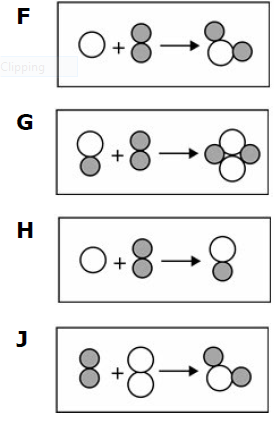
Which of the following models best demonstrates a balanced chemical equation?
a)
F
b)
G
c)
H
d)
J
23.
The reactants are on the left side of the chemical equation.
a)
True
b)
False
24.

How many atoms in all are in a molecule of serotonin?

C10H12N2O

a)
22
b)
24
c)
25
d)
4
25.
Coal contains carbon and other elements. Carbon dioxide forms when coal burns in the presence of oxygen. Which of these is the best evidence that a chemical reaction occurs when coal burns?
a)
The shape of the coal changes
b)
Oxygen is present
c)
A new substance is produced
d)
Coal is made up of more than one element
26.
Is burning wood a chemical or physical change?
a)
chemical
b)
physical
27.
Is glass breaking a chemical or phyiscal change?
a)
chemical
b)
physical
28.
Is hammering wood together to build a house a chemical or physical change?
a)
chemical
b)
physical
29.
Is a a rusting bicycle a chemical or physical change?
a)
chemcial
b)
physical
30.
Is melting butter for popcorn a chemical or physical change?
a)
chemical
b)
physical
31.
Is melting ice a chemical or physical change?
a)
chemical
b)
physical
32.
Is spoiling food a physical or chemical change?
a)
phyiscal
b)
chemical
33.
Is mixing lemonade powder with water a physical or chemical change?
a)
physical
b)
chemical
34.
Is mowing the lawn a phyiscal or chemical change?
a)
physical
b)
chemical
35.
Which of the following equations demonstrates an actual chemical reaction that forms a new substance? (HINT: it must follow the Law of Conservation of Mass)
a)
A
b)
B
c)
C
d)
D
36.
What is the left part of a chemical equation called?
H2 + O → H2O
a)
Reactants
b)
Products 
c)
Yields 
d)
Chemical Equation 
37.
Is this balanced?
2HgO → 2Hg + O2
a)
Yes
b)
No
38.
Is this balanced?
Al + O2 → 2Al2O3
a)
Yes
b)
No
39.
When materials combine to form new compounds it is a chemical change. Which example is a chemical change?
a)
baking powder fizzing
b)
water boiling
c)
ice melting
d)
sugar cube dissolving
40.
Which is an example of a chemical reaction?
a)
paper cut into small pieces
b)
chocolate melting in a pan
c)
flour and sugar mixed in a bowl
d)
cookies baking in an oven
41.

During a reaction, atoms are

a)

created

b)

destroyed

c)

neither created or destroyed - just rearranged

42.

How many total atoms are in this compound? Al2O3

a)

2

b)

5

c)

6

d)

3

43.

How many F atoms are in this compound?

MgF2

a)

2

b)

6

c)

8

d)

12

44.

Is a copper penny turning greenish after a few years a chemical or physical change?

a)

Chemical Change

b)

Physical Change

45.

the starting materials in a chemical reaction are called what?

a)

Products

b)

Reactants

c)

Starters

d)

Enders

46.

a substance that is formed as the result of a chemical reaction is called

a)

Product

b)

Reactant

c)

Starters

d)

Enders

47.

How would you describe this chemical formula?

3O

a)

3 Oxygen molecules

b)

3 Oxygen atoms

c)

3 Oxygen elements

d)

3 Oxygen compounds

48.

How would you describe this chemical formula?
3 H2O

a)

3 H2O molecules

b)

3 H2O atoms

c)

3 H2O elements

d)

3 H2O parts

49.

A chemical reaction is when...

a)

Atoms and molecules are destroyed

b)

Atoms and molecules are created

c)

Atoms and molecules break apart and regroup to form new products

d)

Atoms and molecules go on vacation and relax a little

50.

Which chemical equation matches the model shown?

a)

3C + 4O --> 3CO2

b)

3C + 2O2 --> 3CO2

c)

C3 + 4O --> 3CO6

d)

C3 + 2O2 --> 3CO6

51.
What are the basic building blocks for all matter?
a)
atoms
b)
elements
c)
compounds
d)
chemicals
52.
What is a molecule?
a)
Two or more atoms bonded together
b)
One element
c)
One atom
d)
Solid, Liquid, Gas
53.

The substances listed on the right side of a chemical equation are the

a)

Yields

b)

Reactants

c)

Products

d)

Precipitates

54.

The substances listed on the left side of a chemical equation are the

a)

Products

b)

Coefficients

c)

Precipitates

d)

Reactants

55.
Which of the following is not evidence of a chemical reaction?
a)
Formation of a precipitate
b)
Production of gas
c)
Change in temperature
d)
Change in state of matter
56.
A chemical reaction is...
a)
when a substance is mixed with another substance
b)
when a substance undergoes a change to form a new substance
c)
when a substance is dissolved into another substance
d)
when a substance is heated or exposed to another substance
57.
Mass cannot be ____ or _____.
a)
made, changed
b)
created, destroyed
c)
rearranged, unmade
d)
stagnant, unchanging
58.
Balance the following equation:
____MgO + ____H2O → ____Mg(OH)2
a)
1,1,1
b)
1,2,2
c)
2,3,4
d)
2,2,2
59.
What type of reaction is the following:
CH+ O→ CO2 + 2H2O
a)
double replacement
b)
single replacement 
c)
combustion
d)
synthesis
60.
A precipitate is...
a)
a solid that falls out of a liquid solution
b)
a reactant in a reaction
c)
a clear substance
d)
the mass of a product
61.

True or False: In a complete chemical equation, there must be the same number of atoms of each element on the reactants and products side.

a)

True

b)

False

62.

In a chemical reaction, atoms (a)   and form new bonds.

63.

Look at the chemical equation.


Is it written correctly to show the Law of Conservation of Mass?

a)

Yes

b)

No