
Font size
 Worksheets
Light and sound waves grade 8
Total questions: 60
Worksheet time: 1hrs 8mins

What type of lens do you have in your eye?
Concave
Prismatic
Objective
Convex

Which parts of the eye are used to focus the light on the retina?
eyelid
lens
cornea
retina
iris

When light passes through a convex lens, it_________.
Diverges, or spreads apart
Converges, or comes together
Reflects, or bounces off
Creates a rainbow
A myopic person might have trouble:
reading small print
seeing clearly in low light
making out faraway objects
seeing certain colors

If your vision problems can be corrected by a convex lens, you:
Having trouble seeing nearby objects
Having trouble seeing faraway objects
Having trouble telling whether objects are close up or far away
Having blind spots at the edges of your vision
Which of the following statements is true of nearsighted people?
their retinas that are slightly misshapen
they have trouble seeing nearby objects
their vision problems can be corrected with convex lenses
the lenses of their eyes focus light in front of their retinas

Which kind of eye defect is this?
short sighted
long sighted
normal sighted
How do you correct for this kind of eye defect?
use a convex lens
use a concave lens
no lens is needed

Which kind of eye defect is this?
short sighted
far sighted
normal sighted
How is this type of eye defect corrected?
using a convex lens
using a concave lens
normal sighted
Sound is a form of energy. How is it produced?
by waiting
by vibrating objects
It is the unit used for frequency.
Hertz (Hz)
decibel (dB)
A _____ frequency sound has a higher pitch. A lower frequency sound has a _____ pitch.
higher, higher
lower, higher
higher, lower
lower, lower
The human ear can only sense within the frequency range of _____.
20 Hz to 20,000 Hz
1,000 Hz to 100, 000 Hz
It determines the s loudness or volume of a sound wave.
frequency
amplitude
A high amplitude sound means _____ sound, and a low amplitude sound means _____ sound.
softer, louder
louder, softer
louder, louder
softer, softer
The unit of intensity level for sound _____.
Hertz (Hz)
decibel (dB)
A rarefaction is generated when particles move _______.
together
apart
closer
under
In which of these types of media will sound travel fastest?
solid
liquid
gas
vacuum
Frequency of waves is measured in __________.
hertz
decibels
watts
meters/second

When sound hits a hard, flat solid the sound tends to ____________ resulting to an echo.
Pass through
Bounce back
be absorbed

Sound cannot travel without a medium to pass through.
True
False
None of the above

Sound travels FASTEST through which of these materials?
A type of gas, like helium
Empty space
A metal such as iron
Water

What is the wavelength of this wave?
0.030 m
0.040 m
0.060 m
0.080 m
Pitch is related to (a)
Loudness (volume) is related to (a) (this part of the wave).
The pitch of a sound depends on its:
frequency
amplitude
intensity
loudness
The human ear can detect frequencies between:
20 and 20000 Hz
100 and 200 Hz
1 and 100 Hz
20 and 30 Hz
Frequency is measured in:
decibels
Hertz
meters
seconds

What does point C represent?
Amplitude
Trough
Crest
Wavelength

What does point A represent?
Amplitude
Wavelength
Crest
Trough

The _______ of a wave is how many waves pass a given point every second.
Frequency
Wavelength
Amplitude
Frequency is how many waves pass a point in 1 second. If 100 waves pass a given point in 4 seconds, what is the wave's frequency?
25 Hz
100 Hz
4 Hz
400 Hz

In a longitudinal wave, a ____ is an area where the particles are spread apart and a ____ is an area where the particles are close together.
crest, trough
compression, rarefaction
rarefaction, compression
trough, crest

In the diagram of a compressional wave, A is showing a ___ while B is showing a ___.
compression, rarefaction
trough, crest
rarefaction, compression
crest, trough
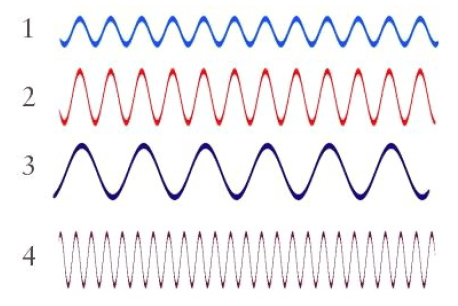
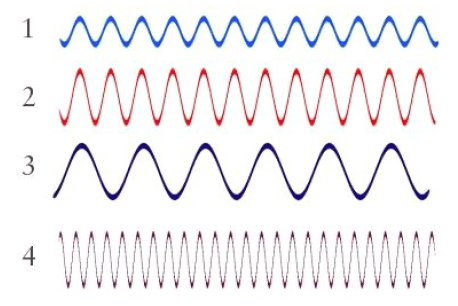
The number of wave cycles in a unit of time is the ...
Wave Speed
Frequency
Wavelength
Amplitude
Period
What is the purpose of a wave?
To confuse people.
To transfer energy from one point to another.
To transfer matter from one point to another.
To alter the medium it travels through.


Which color has the lowest frequency?
Red
Pink
Green
Blue
It determines the s loudness or volume of a sound wave.
frequency
amplitude

