wayground logo

Free Printable Worksheets

Font size

S
M
L
XL
Worksheets

untitled

Total questions: 178

Worksheet time: 2hrs 4mins

Name
Class
Date
1.

What phase is this?

a)

Prophase

b)

Metaphase

c)

Anaphase

d)

Telophase

e)

Cytokinesis

2.

What phase is this?

a)

Prophase

b)

Metaphase

c)

Anaphase

d)

Telophase

e)

Cytokinesis

3.

What phase is this?

a)

Prophase

b)

Metaphase

c)

Anaphase

d)

Telophase

e)

Interphase

4.

What phase is this?

a)

Prophase

b)

Metaphase

c)

Anaphase

d)

Telophase

e)

Interphase

5.

What phase is this?

a)

Prophase

b)

Metaphase

c)

Anaphase

d)

Telophase

e)

Cytokinesis

6.

What phase is this?

a)

Prophase

b)

Metaphase

c)

Anaphase

d)

Telophase

e)

Interphase

7.
Which organic macromolecules are composed of chains of amino acids that join to form the structural components of organisms?
a)
carbohydrates
b)
nucleic acids
c)
proteins
d)
lipids
8.
Which is the only structure you would expect to see when examining a prokaryotic cell with a compound microscope?
a)
nucleus
b)
chloroplast
c)
cell membrane
d)
mitochondria
9.
Which cell part is present in eukaryotic cells, but not in prokaryotic cells?
a)
cell membrane
b)
cell wall
c)
cytoplasm
d)
nucleus
10.

The ability to maintain a stable internal environment is called ________________.

a)

Metabolism

b)

Mitosis

c)

Heterozygous

d)

Homeostasis

11.
What is the capsid of a virus?
a)
the disease it causes
b)
the receptors to which it binds
c)
the genetic material
d)
its protein coat
12.
What is one way that a lysogenic infection differs from a lytic infection?
a)
A lysogenic virus does not act on bacteria as a lytic virus does.
b)
A lysogenic virus can remain in the host DNA for a longer period without becoming active.
c)
A lysogenic virus contains RNA instead of DNA.
d)
A lysogenic virus directs the production of new viruses right away.
13.
Which of the following is a possible result of a disruption in the cell cycle?
a)
cancer
b)
photosynthesis
c)
cellular respiration
d)
protein synthesis
14.

Cell have several mechanisms for regulating their internal environments. Which of these mechanisms involved in maintaining homeostasis requires energy?

a)

osmosis

b)

diffusion

c)

active transport

d)

passive transport

15.
Which of the following is the only characteristic shared by living cells and viruses?
a)
the presence of carbohydrates
b)
the ability to reproduce
c)
the presence of the nucleic acid
d)
a cell membrane
16.
This cell is undergoing mitosis.  What stage of mitosis is shown?
a)
prophase
b)
metaphase
c)
anaphase
d)
telophase
17.
This diagram shows the cell cycle.

Which of the following activities occur in the S phase?
a)
Replication of the DNA
b)
Growth of the cell
c)
Formation of the mitotic spindle
d)
Breakdown of the nuclear membrane
18.
Meiosis is the process by which gametes are produced. In which of the following human organs would meiosis occur?
a)
Liver
b)
Stomach
c)
Testis
d)
Lungs
19.
Which of the following macromolecules are a prominent part of animal tissues that function in insulation, helping animals conserve heat?
a)
Carbohydrates
b)
Lipids
c)
Proteins
d)
Nucleic acids
20.
a)

Prophase

b)

Anaphase

c)

Telophase

d)

Interphase

21.
The diffusion of water through a semi-permeable membrane is called?
a)
Osmosis
b)
Cell wall
c)
Diffusion
d)
Respiration
22.
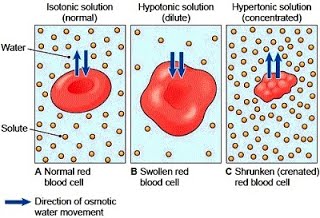
An animal cell placed in a hypertonic (salty) solution will
a)
Shrink
b)
Swell
c)
Stay the same
23.

Mitosis is the stage of the cell cycle during which ____.

a)

the cell's nucleus divides into two new nuclei.

b)

the cell divides into two new cells.

c)

the cell's DNA is replicated.

d)

the cell's cytoplasm divides.

24.

During what stage of the cell cycle does replication occur?

a)

interphase

b)

cytokinesis

c)

prophase

d)

mitosis

25.

What happens during cytokinesis of an animal cell?

a)

Each organelle divides into two parts.

b)

A new round of mitosis begins.

c)

Two new daughter cells are formed.

d)

A cell plate forms.

26.

Chromatids are...

a)

identical daughter cells.

b)

doubled rods of condensed chromatin.

c)

pigments that absorb the energy in sunlight.

d)

identical strands of chromosomes.

27.

Cycle of growth and division that cells undergo is...

a)

replication

b)

the cell cycle.

c)

interphase.

d)

mitosis.

28.

The longest phase of the cell cycle is...

a)

prophase

b)

interphase

c)

metaphase

d)

mitosis

29.

The structures that become tightly packed during cell division and contain DNA are

a)

centromeres

b)

centrioles

c)

chromosomes

d)

spindle fibers

30.

Which stage of mitosis is visible here?

a)

anaphase

b)

prophase

c)

telophase

d)

metaphase

31.

Which stage is visible?

a)

anaphase

b)

prophase

c)

telophase

d)

metaphase

32.

Identify the stage.

a)

prophase

b)

anaphase

c)

metaphase

d)

telophase

33.

What happens during cytokinesis?

a)

nuclear division

b)

DNA replicates

c)

cell grows

d)

cytoplasm divides

34.
During what phase of the cell cycle is DNA replicated?
a)
G1 phase
b)
S phase
c)
G2 phase
d)
M phase
35.
Put the following stages of mitosis in order: anaphase, prophase, metaphase, and telophase. 
a)
prophase, metaphase, telophase, anaphase
b)
prophase, anaphase, metaphase, telophase
c)
prophase, metaphase, anaphase, telophase
d)
prophase, telophase, metaphase, anaphase
36.
Put the following stages of the cell cycle in order: G2, S, G1, M. 
a)
G1, S, G2, M
b)
S, G1, G2, M
c)
G1, M, G2, S
d)
M, G1, S, G2
37.
a)

Cytokinesis

b)

Interphase

c)

Anaphase

d)

Metaphase

38.
In mitosis, the two resulting cells are
a)
different from the starting cell and identical to each other.
b)
different from the starting cell and different from each other.
c)
identical to the starting cell and different from each other.
d)
identical to the starting cell and identical to each other.
39.
Fruit fly body cells have 8 chromosomes. After mitosis, you would expect a resulting fruit fly daughter cell to have -
a)
16 chromosomes.
b)
46 chromosomes.
c)
8 chromosomes.
d)
4 chromosomes.
40.

How many chromosomes do humans have?

a)

46

b)

21

c)

10

d)

23

41.

_____ is the uncontrolled growth of cells, often resulting in a tumor or mass of abnormal cells

a)

Cancer

b)

Apoptosis

c)

Radiation

42.

1. Why does a cell go through cell division?

a)

to repair and replace worn out cells

b)

to grow and create more of an organism

c)

Both Reasons

d)

Neither Reason

43.

What is this phase of mitosis?

a)

Prophase

b)

Anaphase

c)

Telophase

d)

Metaphase

44.
The diagram shows a container divided into two compartments by a membrane permeable to water but not to starch. Two solutions containing different concentrations of dissolved starch were placed on each side of the membrane. Which of the following describes what will happen to the water level during the process of osmosis?  
a)
The water level of both sides of the membrane will decrease 
b)
The water level on the right side of the membrane will increase 
c)
The water level on the left side of the membrane will increase
d)
The water level on both sides of the membrane will stay the same 
45.
An animal cell placed in a sugar solution is shown in the diagram. Which statement best describes how osmosis will affect this animal cell?  
a)
Water will move out of the cell and the cell will shrink
b)
Water will move into the cell and the cell will expand 
c)
Sugar will move out of the cell and the cell will expand 
d)
Sugar will move into the cell and the cell will expand
46.
In order to make hydrochloric acid, which is required in human digestion, ATP is used to move hydrogen ions from the blood to the stomach lining. This is an example of ___.   
a)
Active Transport
b)
Passive Transport
c)
Osmotic Potential 
d)
Facilitated Diffusion
47.
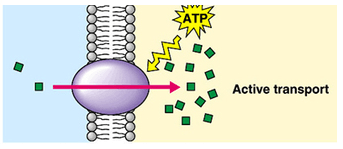
A cell requires energy to move materials from an area of low concentration, across the cell membrane, to an area of high concentration.  This process is called ___. 
a)
Osmosis
b)
Active transport 
c)
Passive transport 
d)
Facilitative diffusion
48.
In active transport, carrier proteins ___.  
a)
Move substances across the cell membrane without the use of ATP.
b)
Move from low concentration to high concentration by diffusion
c)
Move small molecules through the cell membrane by osmosis 
d)
Move substances from a low concentration to high concentration through the use of energy.
49.
What will most likely occur when a cell is placed into a saline solution that has a higher salt concentration than inside the cell?    
a)
Water molecules will move into the cell
b)
Salt molecules will move out of the cell 
c)
Salt molecules will move until the salt concentration is the same inside and outside the cell 
d)
Water molecules will move until the salt concentration is the same inside and outside of the cell.
50.
 An ion must cross the cell membrane through active transport instead of passive transport when the ion is ___. 
a)
Negatively charged
b)
Carried across by a protein 
c)
Going against the concentration gradient 
d)
Too small to move independently
51.
The diagram shows the semipermeable membrane of a cell and the concentration of solutions inside and outside the cell. Which of the following statements best describes how the molecules will move?   
a)
Water molecules will move out of the cell 
b)
Water molecules will move into the cell 
c)
Solute molecules and water molecules will move out of the cell 
d)
Solute molecules and water molecules will move into the cell 
52.
The stages of the cell cycle are shown in random order below.  Starting with prophase, sequence the diagrams to show the stages of mitosis.  
                       
a)
5-3-1-2-4
b)
3-1-4-2-5
c)
4-1-2-5-3
d)
2-3-1-5-4
53.
What is the diploid number of chromosomes in the above diagrams?   
a)
2
b)
4
c)
6
d)
8
54.
The diagrams show the stages of mitosis in random order.  What sequence correctly shows the stages of mitosis?             
a)
3-1-2-4
b)
1-3-4-2
c)
4-2-3-1
d)
2-1-4-3
55.
A daughter cell that resulted from a mitotic division has 24 chromosomes.  How many chromosomes did the parent cell have?   
a)
6
b)
12
c)
24
d)
48
56.
A bone cell of a goat contains 60 chromosomes.  How many chromosomes will be in each daughter cell after mitosis? 
a)
15
b)
30
c)
60
d)
120
57.
What must occur during the cell cycle to ensure proper division of the chromosomes?  
a)
The cell must grow in size
b)
The mitochondria must divide 
c)
The DNA of the cell must replicate
d)
The cell membrane must dissolve
58.
The main purpose of DNA replication is to ___.  
a)
Capture sunlight
b)
Store energy in the bonds of a glucose molecule
c)
Synthesize proteins 
d)
Copy genetic information 
59.
The diagram to the right shows the phase of mitosis when the centrioles are at opposite poles of the cell and the chromosomes are lined up midway between the centrioles. Which phase would be the next phase of mitosis?   
  
a)
anaphase
b)
prophase
c)
interphase
d)
telophase
60.
The figures below show four processes involving DNA and RNA.  Use these figures to answer the next question. 
Which figure shows the process of replication?
a)
figure 1
b)
figure 2
c)
figure 3
d)
figure 4
61.
.  Which statement best describes the primary function of DNA replication?   
a)
To ensure daughter cells have a complete copy of the DNA
b)
To prevent mutations from occurring in cells 
c)
To provide genetic variation within specific organisms
d)
to allow prokaryotic cells to undergo meiosis
62.
.  Which of these statements is true about plant and animal cells that are in the process of cell division?   A.    B.  C.  D.  
a)
Most animal and plant cells develop a cell plate
b)
Most animal and plant cells develop a cleavage furrow 
c)
Plant cells develop a cell plate and animal cells develop a cleavage furrow 
d)
Animal cells develop a cell plate and plant cells develop a cleavage furrow
63.
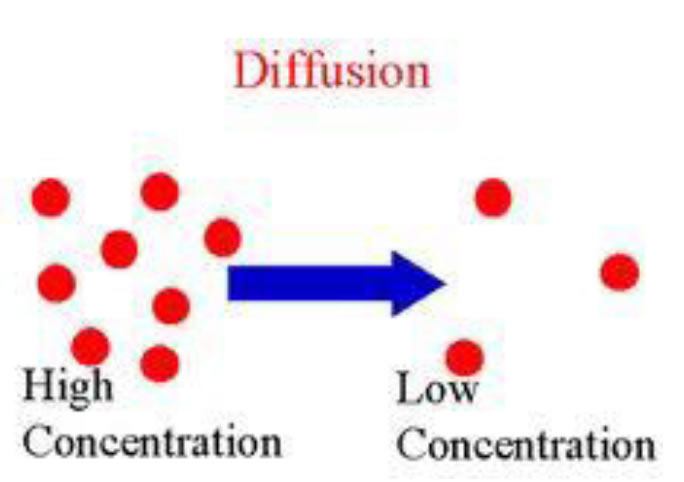
What is diffusion?
a)
when molecules move 
b)
when molecules move from a high concentration to a low.
c)
no movement 
d)
molecules move everywhere
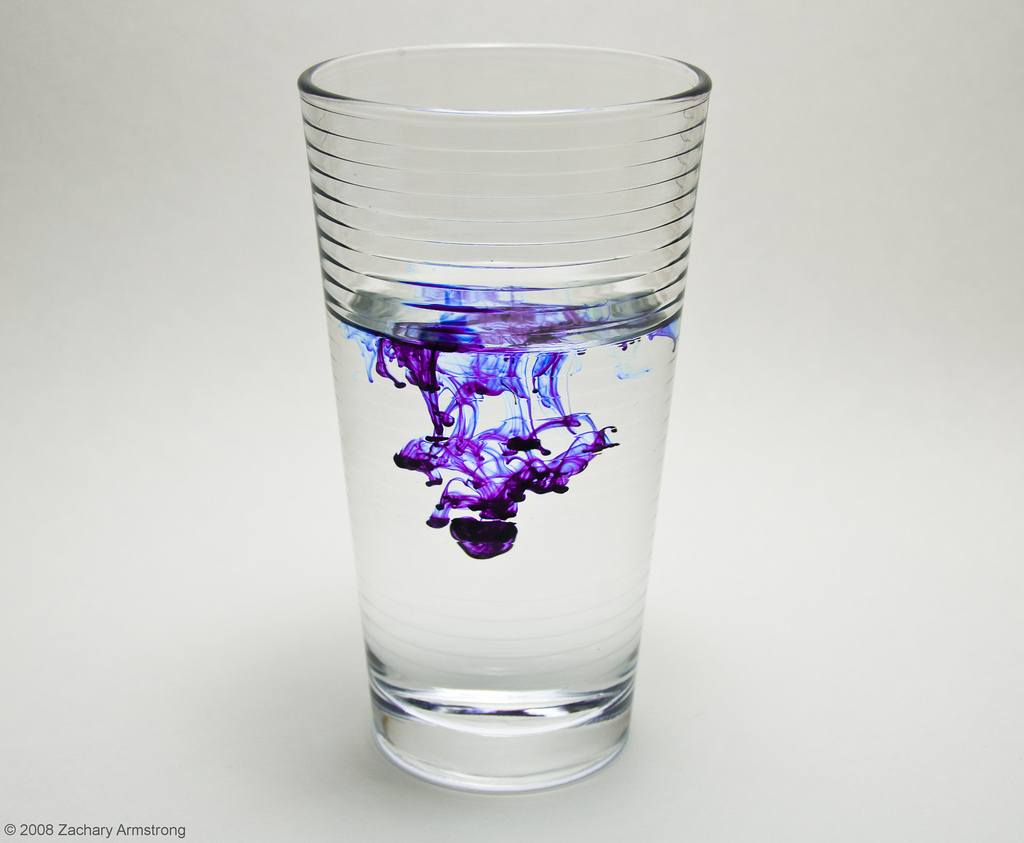
64.
Where is there a low concentration of dye?
a)
at the bottom of cup
b)
in the color
c)
at the top of cup 
d)
no concenteraion gradient
65.
Osmosis is the movement of _____ across a membrane.
a)
food
b)
energy
c)
oxygen
d)
water
66.
During osmosis
a)
water moves from high to low concentration
b)
large or oddly shaped molecules move across a cell membrane
c)
water moves when energy is used
d)
proteins are built
67.
The diffusion of water through a semi-permeable membrane is called?
a)
Osmosis
b)
Cell wall
c)
Diffusion
d)
Respiration
68.
Where is there a high concentration of water?
a)
in the flower
b)
cannot be determined by picture.
c)
in the vase
d)
in the leaves
69.
What is diffusion?
a)
when molecules move 
b)
when molecules move from a high concentration to a low.
c)
no movement 
d)
molecules move everywhere
70.
Where is there a low concentration of dye?
a)
at the bottom of cup
b)
in the color
c)
at the top of cup 
d)
no concenteraion gradient
71.
Osmosis is the movement of _____ across a membrane.
a)
food
b)
energy
c)
oxygen
d)
water
72.
During osmosis
a)
water moves from high to low concentration
b)
large or oddly shaped molecules move across a cell membrane
c)
water moves when energy is used
d)
proteins are built
73.
The diffusion of water through a semi-permeable membrane is called?
a)
Osmosis
b)
Cell wall
c)
Diffusion
d)
Respiration
74.
Where is there a high concentration of water?
a)
in the flower
b)
cannot be determined by picture.
c)
in the vase
d)
in the leaves
75.
What is the definition of  Selective Permeability?
a)
The movement of materials across the cell membrane that requires NO ENERGY from the cell.
b)
The movement of materials through (or across) the cell membrane
c)
The ability of the cell membrane to allow some things to pass through while preventing other things from passing through.
d)
The movement of molecules from an area of high concentration to a area of low concentration 
76.
What a cell needs to transport particles by active transport?
a)
Sun
b)
Wind
c)
Energy
d)
Channels
77.
When both inside and outside of a cell have the same amount of water it is said that the cell has reached a state of
a)
Osmosis
b)
Diffusion
c)
Equilibrium
78.
A person would never have pure water put into their veins in a hospital because their cells would...
a)
Shrink/Dehydrate
b)
Expand
79.
A person should never drink salty water because their cells would
a)
shrink
b)
expand
80.
If there is 5 percent water inside a cell and 5 percent water outside a cell
a)
more water will move inside the cell
b)
more water will move outside the cell
c)
There will be no movement of water cells
81.
Passive transport requires no
a)
concentration gradients
b)
osmosis
c)
motion
d)
energy
82.
The movement of molecules against a concentration gradient
a)
simple diffusion
b)
facilitated diffusion
c)
active transport
d)
osmosis
83.
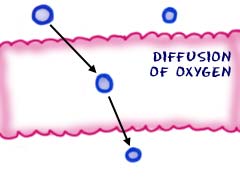
The picture is an example of...
a)
active tranport
b)
passive transport
c)
diffusion
d)
osmosis
84.
Sometimes, energy is required for ____ molecules to go in or out of the cell because they cannot fit into the membrane.
a)
big
b)
small
c)
crunchy
d)
water
85.
What is diffusion?
a)
when molecules move from a low concentration to a high concentration 
b)
when molecules move from a high concentration to a low concentration.
c)
no movement 
d)
molecules move everywhere
86.
_______ regulates what enters and leaves a cell.  
a)
Cell Membrane
b)
Nucleus
c)
Mitochondria
d)
Cytoplasm
87.
In the given scenario what will happen to the organism: salt is poured onto eggplant.
a)
Water will move out of the eggplant cells and the cells will shrink.
b)
Water will move out of the eggplant cells and the cells will swell.
c)
Water will move into the eggplant cells and the cells will swell.
88.
In the given scenario what will happen?  An egg is placed in pure water for 48 hours.
a)
The egg will gain water and swell.
b)
Water will move in and out of the cell equally, and the cell with neither shrink nor swell.
c)
The egg will lose water and shrink.
89.
Which example(s) of cell transport does not require chemical energy
a)
Drops of blue food coloring are placed in water and spread throughout the water, turning it blue.
b)
A potato slice is placed in water and water molecules from outside the potato move into the potato cells.
c)
Both Answers
d)
 Neither answers
90.
The diagram shows various molecules that move into and out of the cell. How does molecule C move out the cell?
a)
Active Transport
b)
Diffusion
c)
The use of a protein pump
d)
Manipulated osmosis
91.
An animal cell placed in a hypertonic (salty) solution will
a)
Shrink
b)
Swell
c)
Stay the same
92.
How many diamond molecules need to move to reach equilibrium?
a)
A net of 2 molecules move inside the cell.
b)
A net of 2 molecules move outside the cell.
c)
There is no net movement because the molecules are at equilibrium.
d)
The molecules do not move.
93.
Which way will the water molecules move during osmosis?
a)
Out of the cell, so the cell shrinks.
b)
Out of the cell, so the cell swells.
c)
Into the cell, so the cell shrinks.
d)
Into the cell, so the cell swells.
94.
Just like Coke is a type of soda, __________ is a type of ___________.
a)
diffusion, osmosis
b)
concentration, equilibrium
c)
equilibrium, concentration
d)
osmosis, diffusion
95.
In which case would a cell most likely shrink?
a)
when placed in a solution containing a high salt concentration
b)
when placed in a isotonic solution
c)
when placed in a solution containing a low pH
d)
when placed in a solution containing distilled water
96.
Active transport requires energy because...
a)
The cell is moving something against a concentration gradient
b)
The cell is moving something with a concentration gradient
97.
A student noticed that placing wilted lettuce in a bowl of cool water caused the lettuce to become more crisp and firm. What is the best explanation for his observation?
a)
Water moved into the lettuce cells by active transport.
b)
Water moved into the lettuce cells by osmosis.
c)
Salt moved into the lettuce cells by diffusion.
d)
Water moved out of the lettuce cells by osmosis.
98.
Diffusion and Osmosis are examples of...
a)
Active Transport
b)
Passive Transport
99.
Endocytosis and Exocytosis are examples of...
a)
Active Transport
b)
Passive Transport
100.
During diffusion
a)
substances (things) moves from high to low concentration
b)
water moves when energy is used
c)
large or oddly shaped molecules move across a cell membrane
d)
water moves from high to low concentration
101.
The cell below is in a _____________ solution.
a)
Hypertonic
b)
Hypotonic
c)
Isotonic
102.
The cell below is in a _________ solution.
a)
Hypotonic
b)
Hypertonic
c)
Isotonic
103.
Passive transport requires no
a)
concentration gradients
b)
osmosis
c)
motion
d)
energy
104.

What feature of a root hair cell makes it good at osmosis?

a)

It is green

b)

It has a large surface area

c)

It contains a lot of chloroplasts

d)

It contains a lot of mitochondria

105.
Ideally, your cells should be in a(n) _______ solution
a)
Hypertonic
b)
Hypotonic
c)
Isotonic
d)
Cola
106.
Water will move INTO a cell in a(n) _______ solution
a)
Hypertonic
b)
Hypotonic
c)
Isotonic
d)
Gravy
107.
An animal cell placed in a hypertonic (salty) solution will
a)
Shrink
b)
Swell
c)
Stay the same
108.

 If the volume of a cell 

increases when it is placed 

in a solution, that solution is

 said to be __________ to the 

cell

a)
 hypertonic
b)
subatomic
c)
 isotonic
d)
 hypotonic 
109.
What information could be added to make this diagram a more complete model of osmosis in red blood cells?
a)
Information about the temperatures of the cell and of the solution.
b)
The relative concentrations of solute inside and outside the cell.
c)
Show that energy is required for the osmosis to occur.
d)
Show the cell holding its shape as osmosis occurs.
110.
An animal cell that is surrounded by fresh water will burst because the osmotic pressure causes
a)
water to move into the cell.
b)
water to move out of the cell.
c)
solutes to move into the cell.
d)
solutes to move out of the cell.
111.
If you enjoy rubbery carrots, place them in .....
a)
Cold Water
b)
Hot Water
c)
Distilled Water
d)
Salt Water
112.

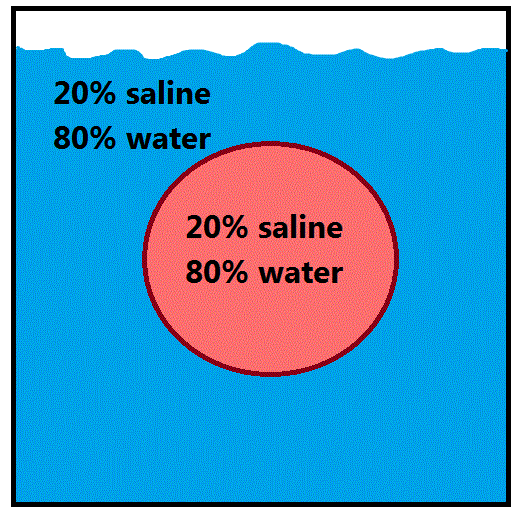
A blood cell is placed into the jar, as seen. Where will the water go?

a)

Into the cell

b)

Out of the cell

c)

Equally in & out - it's isotonic

d)

The water is a lie

113.

Where will the water go?

a)

Into the cell

b)

Out of the cell

c)

Equally in & out - it's isotonic

d)

There is no water

114.

Why can't you drink salt water?

a)

It's hypertonic to your cells

b)

It's hypotonic to your cells

c)

It's isotonic to your cells

d)

It's paratonic to your cells

115.
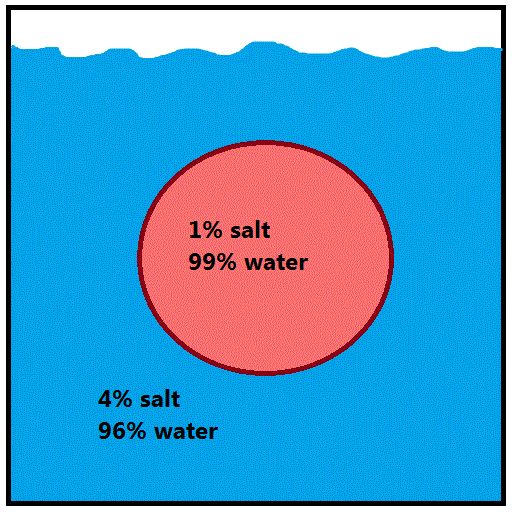
What type of solution is shown in the image?
a)
Hypertonic
b)
Hypotonic
c)
Isotonic
d)
Unknown
116.
What type of solution is shown in the image?
a)
Hypertonic
b)
Hypotonic
c)
Isotonic
d)
Unknown
117.
What type of solution is shown in the image?
a)
Hypertonic
b)
Hypotonic
c)
Isotonic
d)
Unknown
118.
What type of solution is shown in the image?
a)
Hypertonic
b)
Hypotonic
c)
Isotonic
d)
Unknown
119.
What type of solution is shown in the image?
a)
Hypertonic
b)
Hypotonic
c)
Isotonic
d)
Uknown
120.
What type of solution is shown in the image?
a)
Hypertonic
b)
Hypotonic
c)
Isotonic
d)
Unknown
121.
What will happen to the cell in the image?
a)
It will shrink
b)
It will expand
c)
It will stay the same
d)
Unknown
122.
What will happen to the cell in the image?
a)
It will shrink
b)
It will expand
c)
It will stay the same
d)
Unknown
123.
What will happen to the cell in the image?
a)
It will shrink
b)
It will expand
c)
It will stay the same
d)
Unkown
124.
A concentration gradient is...
a)
Concentrations of different substances
b)
A difference in concentrations
c)
An unknown concentration
d)
A different color of concentration
125.
Which is NOT a form of active transport?
a)
Endocytosis
b)
Osmosis
c)
Exocytosis
d)
Pinocytosis
126.
When cells take in a liquid through active transport, what is it called?
a)
Exocytosis
b)
Phagocytosis
c)
Pinocytosis
d)
Osmosis
127.
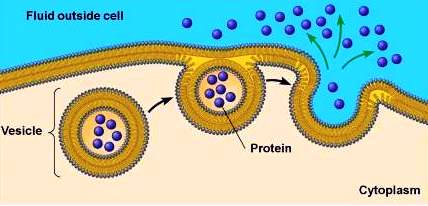
Which form of active transport is being shown?
a)
Pinocytosis
b)
Endocytosis
c)
Exocytosis
d)
Osmosis
128.
Which does NOT require energy to occur?
a)
Passive Transport
b)
Active Transport
c)
Endocytosis
d)
Exocytosis
129.
What is the difference between active and passive transport?
a)
Active does not need energy and passive uses ATP (energy)
b)
Active uses ATP (energy) and passive does not need energy
c)
Active stores transport proteins and passive releases 
d)
Active uses hormones and passive does not 
130.
This type of endocytosis is used by the cell to take in large molecules or tiny organisms. 
a)
Pinocytosis 
b)
Protein pumps
c)
Phagocytosis
d)
Exocytosis
131.

In this image, the cell is using which type of molecular transport?

a)

Osmosis

b)

Diffusion

c)

Phagocytosis

d)

Exocytosis

132.
Protein "pumps" move molecules from an area of _______ concentration to and area of _______ concentration.
a)
zero, 100%
b)
high, low
c)
some, little 
d)
low, high 
133.
Active transport...
a)
... includes diffusion
b)
... requires energy
c)
... is limited to only things leaving the cell
d)
... is limited to only things entering the cell
134.
What kind of biomolecule is the pump in the sodium potassium pump example?
a)
Protein
b)
Carbohydrate
c)
Lipid
d)
Nucleic acid
135.
Which is not a type of active transport?
a)
Receptor-mediated endocytosis
b)
Pinocytosis
c)
Sodium potassium pump
d)
Facilitated diffusion
136.
Which process describes how large particles are removed from the cell?
a)
Diffusion
b)
Osmosis
c)
Exocytosis
d)
Endocytosis
137.

Simple diffusion allows the movement of particles without the use of?

a)

Energy

b)

a Transport Protein

c)

Data

d)

Lipids

138.

Passive Transport stops when the concentration has reached equilibrium - true or false?

a)

true.

b)

false

139.
When both inside and outside of a cell have the same amount of water it is said that the cell has reached a state of ___________.
a)
osmosis
b)
equilibrium
c)
diffusion
d)
hypertonic
140.
_______ regulates what enters and leaves a cell.  
a)
Cell Membrane
b)
Nucleus
c)
Mitochondria
d)
Cytoplasm
141.
This process is known as (leaving the cell)
a)
phagocytosis
b)
endocytosis
c)
exocytosis
d)
osmosis
142.
This active transport process is known as (bacteria being engulfed)
a)
endocytosis
b)
phagocytosis
c)
exocytosis
d)
facilitated diffusion
143.
Which cell organelle is used in active transport, but not in passive transport?
a)
Nucleus
b)
Mitochondria
c)
Cell Membrane
d)
Ribosomes
144.

In order for active transport to happen.........

a)

a transport protein is needed

b)

a transport protein is needed, oxygen is needed and carbon dioxide is needed

c)

a transport protein is needed PLUS energy (ATP) is needed

d)

no energy is needed

145.

If you looked at red blood cells under a microscope and saw the blood cells exploded, what would you say happened?

a)

The cells were placed in a hypotonic solution.

b)

the solution was isotonic.

c)

The solution was hypertonic.

d)

The blood cell had more solute molecules on the outside than on the inside.

146.
What type of solution is this cell in?
a)
Isotonic
b)
Hypertonic
c)
Hypotonic
d)
diffused
147.
What type of solution is this cell in?
a)
Isotonic
b)
Hypertonic
c)
Hypotonic
d)
diffused
148.
What type of solution is this cell in?
a)
Isotonic
b)
Hypertonic
c)
Hypotonic
d)
diffused
149.
Special proteins help move particles, but NO energy is needed. This is..
a)
facilitated diffusion
b)
exocytosis
c)
active transport
d)
equilibrium
150.

The diagram of the cell shows that it has a 0.2 ml of glucose inside and 0.2 ml of glucose outside of the cell. With this information we can determine.

a)

The cell is in an isotonic solution.

b)

The move of water molecules will slow down, but not completely stop.

c)

Homeostasis can be maintained.

d)

Energy is being required for the movement of water and glucose.

151.

Analyze the diagram to determine what type of solution each of the cells are in.

a)

Beaker A- Isotonic Solution

Beaker B- Hypotonic Solution

Beaker C- Hypertonic Solution

b)

Beaker A- Hypotonic Solution

Beaker B- Isotonic Solution

Beaker C- Hypertonic Solution

c)

Beaker A- Hypertonic Solution

Beaker B- Hypotonic Solution

Beaker C- IsotonicSolution

d)

Beaker A- Diffusion

Beaker B- Facilitated Diffustion

Beaker C- Hypertonic Solution

152.

What does it mean when substances move "down a concentration gradient?" Choose the best answer.

a)

They move from areas where there are few particles to areas where there are lots of particles.

b)

They move from areas with lots of water to areas with little water.

c)

They move from one side of the cell membrane to the other.

d)

They move from areas where there are a lot of particles to areas where there are few particles.

153.

If you were looking for transport proteins, where would you find them?

a)

Inside a cell's nucleus

b)

Lodged in the cell's membrane

c)

Inside a cell's cytoplasm

d)

Inside the cell's golgi body

154.

What might happen if a cell did not have any ATP/energy?

a)

It would not have enough energy to do active transport

b)

It's cell membrane would break

c)

The transport proteins would not be needed.

155.

How do transport proteins move substances across membranes?

a)

They move inside the the membrane, carrying the substance

b)

They change shape

c)

They rip open a temporary hole in the membrane
156.
a)
Passive Transport
b)
Active Transport
157.
a)
Passive Transport
b)
Active Transport
158.
a)
Passive Transport
b)
Active Transport
159.
a)
Passive Transport
b)
Active Transport
160.
Osmosis
a)
Passive Transport
b)
Active Transport
161.
High to Low
a)
Passive Transport
b)
Active Transport
162.
Solutes move with the concentration gradient
a)
Passive Transport
b)
Active Transport
163.
Diffusion
a)
Passive Transport
b)
Active Transport
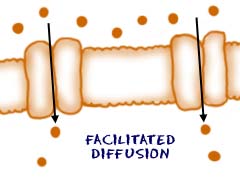
164.
Facilitated Diffusion
a)
Passive Transport
b)
Active Transport
165.
a)
Passive Transport
b)
Active Transport
166.
a)
Passive Transport
b)
Active Transport
167.
a)
Passive Transport
b)
Active Transport
168.
Uses ATP
a)
Passive Transport
b)
Active Transport
169.
Solutes move against the concentration gradient
a)
Passive Transport
b)
Active Transport
170.
Low to High
a)
Passive Transport
b)
Active Transport
171.
Endocytosis
a)
Passive Transport
b)
Active Transport
172.
Exocytosis
a)
Passive Transport
b)
Active Transport
173.
a)
Passive Transport
b)
Active Transport
174.
a)
Passive Transport
b)
Active Transport
175.
a)
Passive Transport
b)
Active Transport
176.
a)
Passive Transport
b)
Active Transport
177.
a)
Passive Transport
b)
Active Transport
178.
a)
Passive Transport
b)
Active Transport