
NEW
Font size
 Worksheets
LONG EXAM
Total questions: 50
Worksheet time: 1hrs 3mins
A baseball was pitched at a velocity of 4m/s. What will be the ball's horizontal velocity when it reach the maximum height?
0 m/s
2m/s
4m/s
6m/s
Without air resistance, What will be the time for a vertically tossed ball to return to where it was thrown?
-9.8 m/s for every second in the air.
the same as the time going upward.
less than the time going upward.
more than the time going upward.
Which among them is a factor in affecting the flight of a projectile?
Final Velocity
Initial velocity
Angle of release
Time
In a projectile motion, the magnitude and direction of the horizontal component is always constant. What is the relationship on the magnitude and direction in the vertical component?
Magnitude: Changing, Direction: Constant
Magnitude: Changing, Direction: Changing
Magnitude: Constant, Direction: Constant
Magnitude: Constant, Direction: Changing
A coin is thrown in a projected manner and another coin with the same mass is dropped with the same height as the first coin. Which coin will fall faster? (neglecting air resistance)
The coin projected.
The coin in freefall.
It cannot be determined.
Both will fall at the same time.
A physics book slides off a horizontal tabletop with a speed of 1.10 m/s. It strikes the floor in 0.35 s. Ignoring Air resistance; How far from the base of the table will the book land?
0.39 m
0.50 m
0.60 m
Insufficient data.


What is true about the vertical velocity of a projectile launched horizontally?
It is initially at its maximum value.
It increases due to gravity as it falls.
It remains constant throughout its trajectory.
It decreases as it falls due to gravity.
What is the velocity of an object launched straight up at its highest point?
zero
equal to its vx
½ its maximum value
equal to gravity
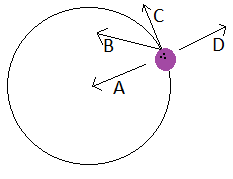
What would the force between them be if the distance between them were doubled?
What's the centripetal force of a .2 kg yoyo spun in a circle with a radius of .7 meters at a velocity of 3 m/s?
2.05 N
2.57 N
2.90 N
3.13 N
What's the centripetal acceleration of a .2 kg yoyo spun in a circle with a radius of .7 meters at a velocity of 3 m/s?
8.23 m/s2
10.54 m/s2
12.86 m/s2
17.39 m/s2
A car is making a turn at speed v. The radius of the turn is r and the centripetal force on the car is F. If the car rounds the same curve at speed 2v, the required centripetal force is...
21F
F
2F
4F
A body of mass m moves in a horizontal circle of radius r at constant speed v for one complete revolution. Which of the following statements is incorrect?
The angular velocity of body is directed perpendicular to the plane of circular motion
The work done by the centripetal force is 2πmv2
The change in linear momentum of the body is zero
The total energy of the body is constant.
Which of the following statements is not true for a stone attached to a string and swung in a uniform vertical circular motion?
The magnitude of resultant force acting on the stone changes depending on the position of the stone in the circle.
The tension in the string is lowest when the stone is at the highest point of the circular motion.
The kinetic energy of the stone is constant throughout the entire circular motion.
The resultant acceleration is always directed towards the centre of the circle.
The combined mass of a race car and its driver is 600 kg. Travelling at constant speed, the car completes one lap around a circular track of radius 160 m in a total time of 36 s. What is the magnitude of the centripetal acceleration of the car?
0.17 m s-2
4.9 m s-2
100 m s-2
2900 m s-2

In a tape cassette, the tape leaves one spool at a constant speed v and at a variable distance r from the centre. Which of the following statements is true?
The angular velocity decreases as radius r decreases.
The angular velocity increases as radius r decreases.
The angular velocity is directly proportional to the speed v.
The angular velocity is directly proportional to the speed v2

A pendulum bob is released from rest in a horizontal position with the string taut. Which of the following statements is correct when the pendulum reaches its vertical position at point P?
The tension attained its least value
The tension depends only on the length of the pendulum
The tension depends on the mass and length of the pendulum bob.
The magnitude of tension equals the weight of the pendulum bob

Centripetal force is an acceleration of an object moving in circular path whose direction is _________________________of the circular path and whose magnitude is equal to the square of the speed divided by the radius.
towards the tangent
towards the centre
towards the minimum point
towards the maximum point
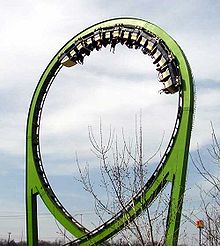
Where is the net force when the rollercoaster is at the top of the loop?
Towards the sky
Towards the Right
Towards the left
Towards the center of the circle
In uniform circular motion, the magnitude of the _______________________of an object is constant but the __________ is continually changing.
speed, acceleration
speed, direction
acceleration, speed
acceleration, velocity


The _______________________ supplies the centripetal force requirement for the car to move in a horizontal circle. Without it, the car would turn its wheels but would not move in a circle (as is the case on an icy surface).
friction force
centrifugal force
normal force
applied force

Two particles, X and Y, are attached to the surface of a horizontally mounted turntable.
The turntable rotates uniformly about a vertical axis. The magnitude of the linear velocity of X is v and the magnitude of its acceleration is a. Which of the following correctly compares the magnitude of the velocity of Y and the magnitude of the acceleration of Y with v and a respectively?
Y velocity = v
Y acceleration < a
Y velocity > v
Y acceleration < a
Y velocity = v
Y acceleration > a
Y velocity > v
Y acceleration > a
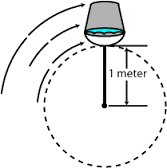

Why do objects experience centripetal acceleration even though they can have a constant speed?
Because they are speeding up as they move in a circle
Because they are constantly changing direction and hence, velocity changes, and that net change is directed inward.
Because they are constantly changing both speed and direction
Because when you have 100 people pedaling, you can speed up more easily.
The linear velocity is always _____ to the line of a circle.
outwards
towards the center
tangent
faster



Given that the angular velocity of a car is 25 rpm. What is its angular velocity in rad/s?
2.62
0.83
157.1
78.5

