
NEW
Font size
 Worksheets
General Wave Properties 1
Total questions: 60
Worksheet time: 3hrs 0mins
Waves transfer _______.
particles
matter
energy
_____ waves have vibrations that run parallel to the direction the wave travels, and _____ waves have vibrations that run perpendicular to the direction the wave travels.
transverse, longitudinal
longitudinal, transverse
Examples of this type of waves include water waves, waves on a string/jump rope, and light waves.
transverse
longitudinal
Examples of _____ waves include sound waves and earthquake P-waves.
transverse
longitudinal
_______ is the distance between waves, measured from one crest to the next crest.
Wavelength
Frequency
Amplitude
The _______ is the highest point on a transverse wave, and the ____ is the lowest point.
Trough, Crest
Crest, Trough
Compression, Rarefaction
Rarefaction, Compression
The _______ is the size or height of a wave, measured from the equilibrium to the crest or trough.
Amplitude
Wavelength
Frequency

The _______ of a wave is how many waves pass a given point every second.
Frequency
Wavelength
Amplitude
Frequency is measured in _______.
Hertz (Hz)
Meters per second
Meters
Newtons
Frequency is how many waves pass a point in 1 second. If 100 waves pass a given point in 4 seconds, what is the wave's frequency?
25 Hz
100 Hz
4 Hz
400 Hz

In a longitudinal wave, a ____ is an area where the particles are spread apart and a ____ is an area where the particles are close together.
crest, trough
compression, rarefaction
rarefaction, compression
trough, crest

Examples of ________ waves include visible light, xrays, ultraviolet, and radio waves.
transverse
longitudinal
Waves that can travel through empty space are called _____ waves. Waves that require a medium to travel, such as air or water, are called _____ waves.
mechanical, electromagnetic
electromagnetic, mechanical
crest, trough
compressional, rarefactional

In the diagram of a compressional wave, A is showing a ___ while B is showing a ___.
compression, rarefaction
trough, crest
rarefaction, compression
crest, trough

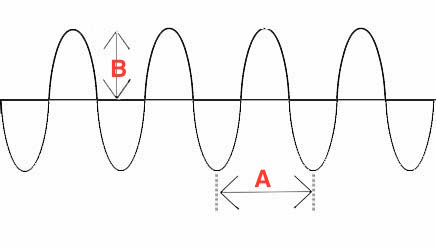
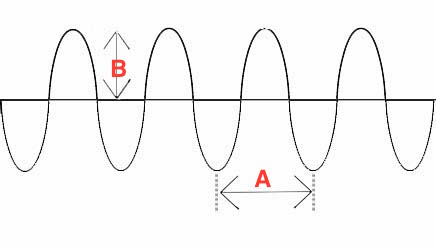
In this diagram of a transverse wave, A is showing the wave's _____ and B is showing the wave's _____.
amplitude, trough
amplitude, crest
wavelength, trough
wavelength, crest

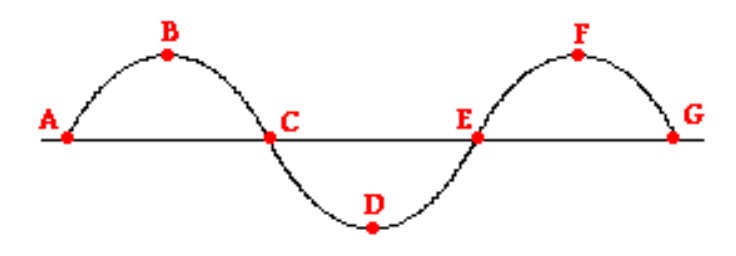
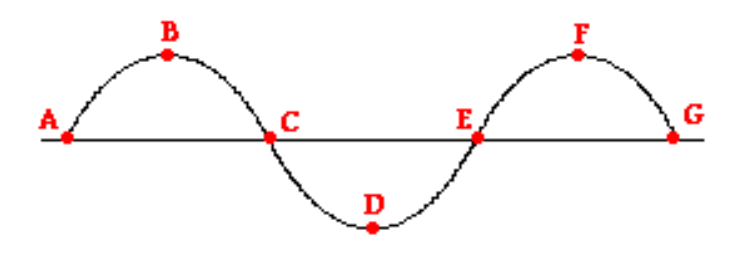
In this diagram of a transverse wave, C is showing the wave's _____ and D is showing the wave's _____.
crest, amplitude
trough, amplitude
crest, wavelength
trough, wavelength

A wave has a velocity of 10 m/s and a frequency of 20 hz. What is the wave length of the wave?
2 m
0.5 m
10 m
A wave has a frequency of 2.5 hz and a wavelength of 20 m. What is the velocity of the wave?
50 m/s
8 m/s
40 m/s
A wave has a velocity of 4 m/s and a wavelength of 2 m. What is the frequency of the wave?
2 hz
8 hz
18 hz
A wave has a velocity of 25 m/s and a wavelength of 5 m. What is the frequency of the wave?
2 hz
5 hz
125 hz
A wave has a velocity of 25 m/s and a frequency of 12.5 hz. What is the wave length of the wave?
12 m
5 m
2 m
A wave has a frequency of 15 hz and a wavelength of 5 m. What is the velocity of the wave?
27 m/s
3 m/s
75 m/s
A wave has a frequency of 1.2 hz and a wavelength of 4.4 m. What is the velocity of the wave?
5.28 m/s
4.3 m/s
4 m/s

What is the wavelength?
1
2
3
4

What is one wavelength?
3
6
9
12

What is the amplitude of the wave?
2 cm
4 cm
6 cm
18 cm

What is the amplitude of the wave?
1 cm
3 cm
6 cm
18 cm


The time it takes for one complete oscillation is the _____.
period
frequency
wavelength
oscillation
A pendulum makes 12 oscillations in 18 seconds. What is the period of the pendulum?
.67 Hz
1.5 Hz
.67 seconds
1.5 seconds
How are frequency and period related?
frequency is twice the period
period is 2π
period is frequency2π
frequency =period
What is the unit for frequency?
Hertz (Hz)
seconds (s)
meters (m)
Newtons (N)
What is the unit for period?
Hertz (Hz)
seconds (s)
meters (m)
Newtons (N)
A ball bounces 25 times in 40 seconds. What is the frequency?
0.625 Hz
15 Hz
65 Hz
0.375 Hz
Find the frequency of a wave whose period is 0.04s
15 Hz
20 Hz
25 Hz
30 Hz
A timer has a frequency of 500 Hz. Find the the period of the beeping timer.
0.001s
0.002s
0.003s
0.004s
A tennis ball is being swung on the end of a 1.5 m (r) string and takes 1.25 seconds (T) for a complete revolution. What is the period (T) of the tennis ball?
1.25 s
0.833 s
1.2 s
0.021 s
After closing a deal with a client, Kent leans back in his swivel chair and spins around with a frequency of 0.5 Hz. What is Kent’s period of spin?
120 s
0.0083 s
0.5 s
2 s
Missy’s favorite ride at the Topsfield Fair is the Rotor, which has a radius of 4.0 m. The ride takes 2.0 s to make one full revolution. Calculate the period of the Rotor.
0.5 s
2.0 s
0.033 s
30 s
_____________ waves vibrations are perpendicular to the direction of the wave.
Longitudinal
Transverse
Earth quake
Sound
The maximum displacement of a wave from equilibrium is the ______________
wavelength
frequency
amplitude
velocity
Which of the following is NOT a characteristic of mechanical waves?
They consist of disturbances or oscillations of a medium.
They transport energy.
They travel in a directions which is at right angles to the direction of the particles of the medium.
They are created by a vibrating source.
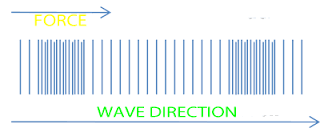
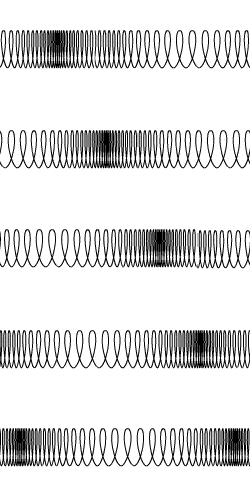

The waves are traveling at the same speed.
Which wave has the greater amplitude?
Wave on the Left
Wave on the Right
Both amplitudes are the same
Wavelength= __________
Frequency= 600 hertz
A wave has wavelength of 10 m and a speed of 340 m/s. What is the frequency of the wave?
34 m/s
34 hz
3400 m/s
3400 Hz

