
Font size
 Worksheets
Work,power, and energy test
Total questions: 70
Worksheet time: 2hrs 39mins
Which of the following is the best example of work being done on an object?
holding a 50 kg barbell
keeping a board in place
lifting a bag of groceries
pushing on a car that will not move
Mechanical energy does not include
kinetic
potential
thermal
Energy due to elevation is
mechanical
kinetic
elastic potential
gravitational potential
internal
Energy due to motion is
mechanical
kinetic
elastic potential
gravitational potential
internal
When mechanical energy increases
positive work is done
no work is done
negative work is done
A pendulum swings back and forth. What happens to most of its gravitational potential energy at the bottom of its swing?
It is transformed into inertia.
It is transformed into thermal energy.
It is transformed into kinetic energy.
It is transformed into chemical potential energy.
T or F? Carrying your backpack from one desk to another is an example of doing work.
true
false
Work is
a type of mechanical energy
a transfer of mechanical energy
a type of thermal energy
a transfer of thermal energy
Heat is
a type of mechanical energy
a transfer of mechanical energy
a type of thermal energy
a transfer of thermal energy
You hold a 50 N bag of nails. After 2 seconds, how much work have you done?
0 J
25 J
50 J
100 J
You move a 20 N box from a 2 m high shelf to the floor. The amount of work you have done is
40 J
10 J
- 10 J
- 40 J
A 25 N force moves an object a distance of 2 m at a speed of 3 m/s. The work done (in Joules) is
(a)
Which doesn't belong?
kinetic
potential
work
thermal
Average molecular kinetic energy is also called
(select all that apply)
heat energy
thermal energy
internal energy
Driving at 10 mph, a car can stop in 20 feet. When the same car is traveling at 20 mph, the stopping distance is
20 feet
40 feet
60 feet
80 feet
100 feet
Energy is measured in
Joules
Newtons
Watts
kg•m/s
The unit Joule is the same as
Newton-second
Newton-meter
Newton/second
Newton/meter
When positive work is done
energy increases.
energy is conserved.
energy decreases.
When positive work is done on an object it can
(select all that apply)
speed up
slow down
move up
move down
neither change speed nor change height
When zero work is done on an object it can
(select all that apply)
speed up
slow down
move up
move down
neither change speed nor change height
Select the forms of energy.
kinetic
potential
work
thermal
heat
The unit Watt is the same as
Joule-second
Joule-meter
Joule/second
Joule/meter
How much power (in Watts) is required to lift a 5 kg mass at a speed of 3 m/s?
(a)
How much energy (in Joules) does a 60W lightbulb use in 1 second?
(a)
How much energy (in Joules) does a 40W lightbulb use in 10 seconds?
(a)
You do 36 J of work in stretching a really big rubber band. If the rubber band has a mass of 2 kg, what is the speed of the rubber band (in m/s) when you launch it across the room?
(a)
if 105 J of energy is used in 103 seconds, what is the average power consumption in Watts?
102 W
108 W
1011 W
1015 W
unit of work is
joule
Newton
Watt
kg
The unit of energy is
joule
Newton
Watt
kg
You try to push a heavy trolley along the floor with a force of F=100 N. You push on the box at an angle of &= 45 degrees to the horizontal and it moves 2 m. How much horizontal force is exerted on the box
Fx= F x cos &
71 N
71 J
3195 N
2560 J
You have to push with 15 N of force to move it 10 meters. How much work do you do?
15 Joules
150 Joules
1.5 Joules
.67 Joules
500 J of work is done by a person who uses a force of 50N to move a box, how far does it go?
10 m
0.1 m
25,000 m
10 J
Newtons are the unit for _____________.
Work
Distance
Acceleration
Force
You exert 200 J of work by pulling on an object with 20 N of force. What distance is the object moved?
.01 m
10 m
10 J
4,000 m
_____________ is the rate of doing work.
Conservation of energy
Joules
Energy
Power
Power is measured in ___________.
meters
joules
newtons
watts
You do 40 Joules of work in 8 seconds. How much power did you exert?
0.2 watts
320 watts
5 watts
The law of Conservation of Energy says________
energy is constantly created
energy can not be created or destroyed instead it changes from one form to another
energy can not change forms
Two factors that determine work are
force
acceleration
mass
distance
velocity
if you push a cart with a force of 60 N for 2 m... how much work have you done
120 J
30 J
120 N
30 N
In which scenario is work = 0 J ?
Pushing a stationary wall
Pulling a trolley car
Pushing a book across the table
Dropping a set of keys from a height, h.

A cheetah can run briefly with a speed of 31.0 m/s. Suppose a cheetah with a mass of 47.0 kg runs at this speed. What is the cheetah’s kinetic energy?
1457 Joules
22,584 Joules
15 Joules
45,167Joules
A girl weighs 400 N. She runs up a flight of stairs of height 5 m in 4 seconds. Her power is:
320 W
400 W
500 W
2 000 W

Which energy-conversion chain occurs whenever coal is burned to create steam to spin the generator at a power station?
chemical to mechanical to potential
thermal to chemical to mechanical to electrical
chemical to thermal to mechanical to electrical
chemical to chemical to mechanical to radiant
A weightlifter holds a 100 kg barbell above her head. Is work done?
Yes because there is a force applied to the barbell and the force causes a displacement of the barbell.
Yes because there is an upward force applied to the barbell and the barbell moves vertically.
No because no displacement occurred.
No because there is no force applied.

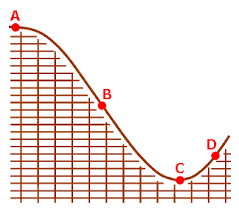
How will you describe the energy at Point A?
mostly potential energy
mostly kinetic energy
losing PE, gaining KE
losing KE, gaining PE
If you use 30 J of energy to move an object, you have done ____ J of work.
3
10
30
0
A 40-kg person is climbing 3 m up a flight of stairs in 6 seconds. How much power did they exert climbing the stairs?
400 W
1200 W
200 W
120 W

The photo shows a power plant which gets energy by drilling deep into the earth.
What is the name of this type of energy?
Geothermal
Hydroelectric
Biomass
Solar

The photo shows different fuels burning.
Which one of the following fuels is NOT regarded as a fossil fuel?
Wood
Coal
Oil
Natural gas


Producing electrical energy causes a certain amount of pollution.
Which one of the following energy sources has the HIGHEST level of pollution?
Nuclear energy
Solar energy
Hydroelectric energy
Tidal energy
Wind energy
The blades of a toy helicopter spin when its circuit is connected to a battery. Which sequence below correctly identifies the energy changes taking place in the helicopter?
chemical to electrical to potential
chemical to electrical to mechanical

What type of energy transformation occurs, when a hawk eats a mouse and then uses the energy from the mouse to fly?
mechanical energy to chemical energy
thermal energy to mechanical energy
chemical energy to mechanical energy
mechanical energy to thermal energy

